Listen to this Post
Introduction:
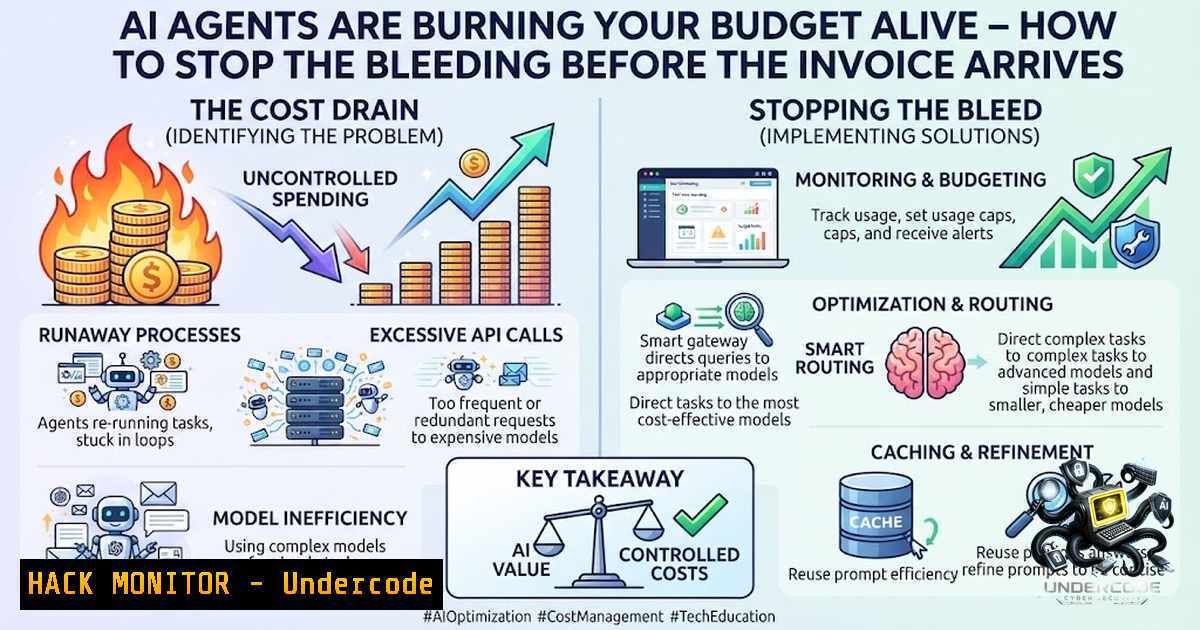
Most engineering teams treat AI agents like unlimited resources—deploying frontier models for every task, from complex data synthesis to simple string matching. The result? Token consumption spirals out of control, cloud bills skyrocket, and security surfaces expand exponentially. Adam Biddlecombe, a Zapier Partner and AI startup founder, recently articulated a fundamental truth that separates cost-efficient AI deployments from financial disasters: “The smartest AI agent should spend most of its life asleep.” This principle—using AI only where judgment is actually required and hardening predictable workflows into deterministic automation—represents the next evolution in enterprise AI architecture, with profound implications for security, cost governance, and operational resilience.
Learning Objectives:
- Understand the cost-per-task metric and why token consumption alone is a misleading performance indicator for AI agent deployments.
- Master the five-task framework for determining when AI adds value versus when a simple rule suffices.
- Implement security hardening techniques for AI agent workflows, including least-privilege access, prompt injection defenses, and authenticated workflow boundaries.
You Should Know:
- The Five Jobs That Actually Justify AI Spend
Biddlecombe’s framework cuts through the hype with surgical precision. In practice, AI earns its keep in exactly five scenarios: summarising, analysing, classifying, drafting, and extracting. Everything else—every mundane lookup, every field mapping, every conditional branch—is “a rule pretending to be clever.”
This distinction matters because frontier models incur significant per-token costs. When you deploy GPT-4 or Claude Opus to determine whether a webhook payload contains a non-1ull field, you’re paying inference rates for work that a three-line JavaScript function could handle at near-zero cost. The fix isn’t less ambition—it’s better placement.
To operationalize this:
- Audit every agent step against the five-task test. If the output doesn’t depend on reading and understanding something, replace it with deterministic logic.
- Build agentically, deploy deterministically. Use AI during development to figure out what “good” looks like, then harden the predictable parts into cheap, boring automation.
- Treat the frontier model as a surgical instrument, not a sledgehammer. Let the AI wake up only for edge cases that need genuine judgment.
2. Cost-per-Task: The Metric Most Teams Aren’t Tracking
The number that matters isn’t tokens consumed—it’s cost per task. Teams obsess over token counts while ignoring the fundamental economics: a task that requires 500 tokens of GPT-4 reasoning costs roughly $0.015. A task that requires 50 tokens of the same model costs $0.0015. Both appear on the same invoice, but only one delivered value commensurate with its cost.
Biddlecombe frames this as “valuemaxxing”—spending tokens only where they actually earn their keep. Zapier’s own analysis, included in their short guide on this approach, demonstrates that most teams are burning cash not because they’re using AI wrong, but because they’re using it everywhere.
Practical cost governance steps:
- Implement token budgeting at the workflow level. Set hard caps on per-agent monthly token consumption.
- Enable prompt caching where feasible. ProjectDiscovery reports that caching saved 59% on LLM costs, rising to 70% post-optimization.
- Route requests intelligently. Open-source tools like efficient-agent-router can route each request to the most suitable model, reducing token burn through cost-aware model ranking.
- Monitor token usage in real time. Portal26’s Agentic Token Control provides telemetry to enforce token usage across agents as they operate, preventing uncontrolled loops.
3. Security Hardening for AI Agent Workflows
The security implications of indiscriminate AI deployment are as severe as the cost implications. Every agent step represents an attack surface—a potential vector for prompt injection, data leakage, or unauthorized tool invocation.
Zapier’s response to this challenge includes AI Guardrails, a built-in app (included on all plans) that screens content for specific risks before it reaches your agent or after the agent generates a response. The risks worth screening for include:
- Personally Identifiable Information (PII) detection
- Prompt injection attempts (adversarial inputs designed to subvert agent behavior)
- Toxic content and negative sentiment
- Compliance violations before they reach production
Beyond guardrails, implement these security controls:
- Managed authentication: Zapier handles authentication, encryption, and rate limiting, reducing the operational burden on your team.
- Least-privilege permissions: When handing SDK credentials to Claude, Cursor, or another AI agent, permissions give you a per-action checkpoint before it does anything irreversible to your connections.
- Authenticated workflows: Security reduces to protecting four fundamental boundaries: prompts, tools, data, and context.
- Runtime monitoring: Frameworks like SAFE-AGENT provide runtime monitoring and policy enforcement to reduce tool misuse and confidential data leakage.
4. The Zapier Exploit Chain: A Cautionary Tale
In May 2026, security researchers at Token Security disclosed a five-stage exploit chain that turned a free Zapier account into write access on Zapier’s public developer SDK packages and internal packages that load in every authenticated zapier.com session. The chain could have let a single attacker act as any signed-in user across thousands of connected apps, potentially granting access to millions of user accounts and the systems those accounts connect to.
The vulnerability wasn’t any single flaw—it was the composition of five separate weaknesses. This is precisely what falls between teams: security teams audit individual components, but no one owns the composition.
Key lessons:
- Treat composition as a first-class security concern. Map every connection between agent steps, APIs, and third-party services.
- Revoke exposed tokens immediately. Zapier acknowledged the report within hours, revoked the exposed NPM token, tightened the ECR role within days, and confirmed full remediation within weeks.
- Monitor supply chain risks. The incident involved unauthorized modifications to npm packages resulting from a third-party supply chain compromise known as Shai-Hulud.
- Step-by-Step: Building a Cost-Effective, Secure AI Agent Workflow
Here’s a practical guide to implementing the principles above:
Step 1: Audit Existing Agents
Run a complete inventory of every agent step. For each step, ask: “Does this output depend on reading and understanding something?” If no, flag it for replacement with deterministic logic.
Step 2: Implement the Five-Task Filter
For each remaining AI-dependent step, classify it as one of the five: summarising, analysing, classifying, drafting, or extracting. If it doesn’t fit, reconsider whether AI is actually needed.
Step 3: Harden Predictable Steps
Replace flagged steps with:
- Linux/Unix: Shell scripts using `jq` for JSON parsing,
awk/sedfor text manipulation - Windows: PowerShell scripts using `ConvertFrom-Json` and regex operations
- No-code: Zapier filters, formatters, and built-in logic steps
Step 4: Apply Security Controls
- Enable AI Guardrails on all agent inputs and outputs
- Implement least-privilege permissions for SDK credentials
- Set up allow/deny lists for APIs the agent can call
Step 5: Implement Cost Governance
- Set per-agent token budgets
- Enable prompt caching where supported
- Implement model routing to match task complexity with model capability
Step 6: Monitor and Iterate
- Track cost-per-task, not just tokens consumed
- Review guardrail logs for prompt injection attempts and PII leaks
- Update model selections as better, cheaper models ship
6. Linux/Windows Commands for Deterministic Automation
Replace AI agents with these deterministic alternatives where possible:
Linux/Unix:
 Extract JSON field (replaces AI classification)
jq '.field_name' payload.json

Conditional logic (replaces AI decision-making)
if [ "$(jq -r '.status' payload.json)" = "active" ]; then
./process_active.sh
else
./process_inactive.sh
fi

Text summarization via deterministic extraction (not AI)
head -1 10 large_file.txt | grep "keyword"

Data transformation (replaces AI drafting)
sed 's/old_pattern/new_pattern/g' input.txt > output.txt
Windows PowerShell:
 Extract JSON field
$json = Get-Content payload.json | ConvertFrom-Json
$field = $json.field_name

Conditional logic
if ($field -eq "active") {
.\process_active.ps1
} else {
.\process_inactive.ps1
}

Text processing
Get-Content input.txt | Select-String "pattern" | Set-Content output.txt
Zapier-Specific:
- Use Filters to conditionally continue workflows
- Use Formatters (text, numbers, dates) for deterministic transformations
- Use Paths for branching logic without AI invocation
What Undercode Say:
- Key Takeaway 1: The distinction between AI-appropriate tasks and rule-appropriate tasks is the single most important architectural decision in enterprise AI deployments. The five-task framework (summarising, analysing, classifying, drafting, extracting) provides a practical, defensible boundary.
-
Key Takeaway 2: Cost-per-task is the metric that matters. Token consumption is a vanity metric that obscures the real economics of AI deployment. Teams that track cost-per-task consistently outperform those that track tokens consumed.
Analysis: Biddlecombe’s framing—“build agentically, deploy deterministically”—represents a maturation of the AI industry. Early adopters treated AI as a magic wand; now, sophisticated practitioners treat it as an expensive, powerful tool that must be deployed with surgical precision. The security implications are equally significant: every agent step that can be replaced with deterministic logic eliminates an attack surface. The Zapier exploit chain demonstrated that compositional vulnerabilities are the new frontier in AI security. Organizations that adopt the “sleeping agent” philosophy—waking AI only for tasks that genuinely require judgment—will not only control costs but also dramatically reduce their security exposure. The future of enterprise AI isn’t more AI everywhere; it’s AI exactly where it adds value, and nothing—absolutely nothing—where a rule will do.
Prediction:
- +1 Organizations that implement the five-task framework and cost-per-task metrics will achieve 40–60% reductions in AI operational costs within six months, while maintaining or improving output quality.
-
+1 The “sleeping agent” architecture will become the default pattern for enterprise AI deployments by 2027, with deterministic automation handling 70–80% of workflow steps and AI reserved exclusively for judgment-dependent tasks.
-
-1 Organizations that fail to implement compositional security reviews will face increasingly severe breaches as attackers shift focus from single-vector exploits to multi-step agentic attack chains.
-
-1 The gap between cost-optimized AI deployments and “AI everywhere” deployments will widen into a competitive moat, with the former achieving sustainable margins while the latter face budget reviews and project cancellations.
▶️ Related Video (72% Match):
https://www.youtube.com/watch?v=1mczGY_ed08
🎯Let’s Practice For Free:
🎓 Live Courses & Certifications:
Join Undercode Academy for Verified Certifications
🚀 Request a Custom Project:
Secure, high-velocity infrastructure and disruptive technological engineering. Contact our engineering team for high-tier development and proprietary systems:
[email protected]
💎 Smart Architecture | 🛡️ Secure by Design | ⭐ Trusted by Thousands
IT/Security Reporter URL:
Reported By: Adam Biddlecombe – Hackers Feeds
Extra Hub: Undercode MoN
Basic Verification: Pass ✅


