Listen to this Post
Introduction:
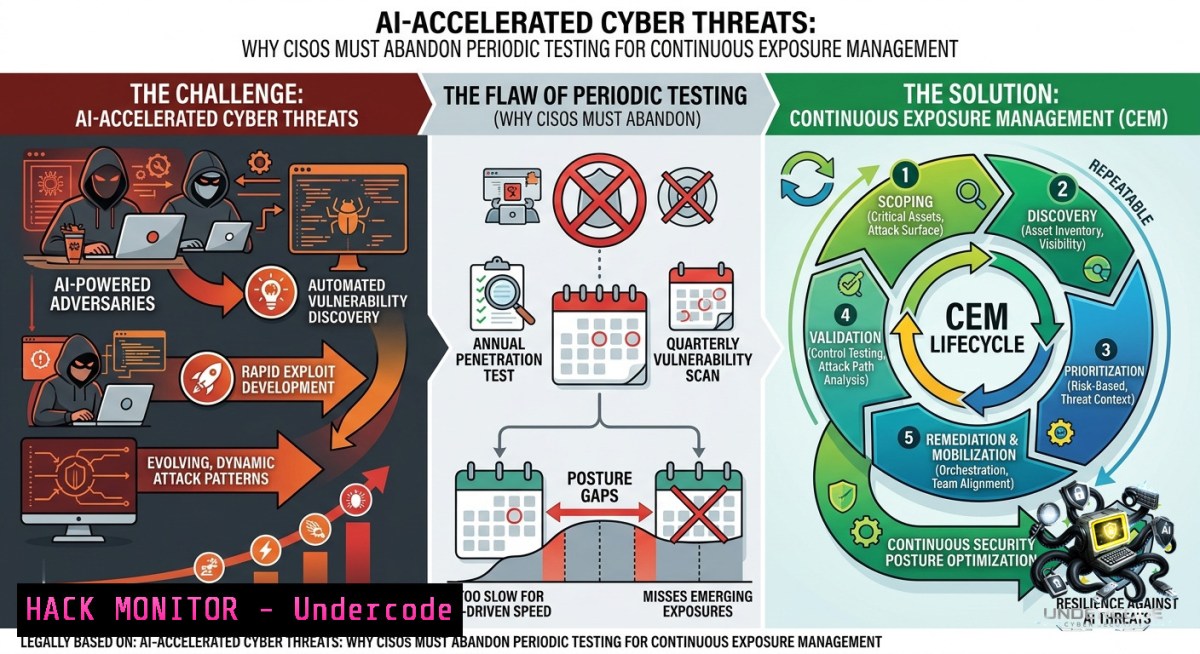
Frontier AI models are compressing exploit timelines from months to days while expanding attack surfaces through DevOps, Infrastructure as Code (IaC), and AI-assisted coding. Traditional periodic testing—annual or quarterly pentests—creates dangerous visibility gaps that AI-driven attackers exploit continuously, forcing a paradigm shift toward real-time, continuous exposure management.
Learning Objectives:
– Implement continuous asset discovery and real-time inventory maintenance across cloud, on-premise, and third-party environments
– Deploy automated, AI-assisted attack simulation combined with human-led validation to filter false positives and prioritize exploitable vulnerabilities
– Integrate verified findings into SIEM, ITSM, and CI/CD pipelines to reduce remediation windows from weeks to hours
You Should Know
1. Real-Time Asset Inventory and Exposure Mapping
AI-powered reconnaissance tools can discover shadow IT and forgotten subdomains within minutes. CISOs must maintain a living inventory of all internet-facing assets, including cloud instances, APIs, and supply chain components.
Step‑by‑step guide:
Linux – Discover live hosts and open ports:
 Install masscan for rapid port scanning
sudo apt install masscan -y

 Scan entire /24 subnet for common web ports (rate-limited)
sudo masscan 192.168.1.0/24 -p80,443,22,8080,8443 --rate=1000 -oJ live_hosts.json

 Use nuclei for template-based exposure detection
nuclei -l live_hosts.txt -t exposures/configs/ -o exposed_assets.txt
Windows – Enumerate domain-connected assets:
 Active Directory asset discovery
Get-ADComputer -Filter  -Properties IPv4Address | Select-Object Name, IPv4Address | Export-Csv -Path assets.csv

 Azure/M365 exposed resources
Get-AzResource | Where-Object {$_.ResourceType -like "publicIP"} | Format-Table Name, ResourceGroupName
Continuous automation (cron / Task Scheduler):
 Linux cron – hourly asset sweep
0     /usr/bin/masscan -p80,443,8443 0.0.0.0/0 --rate=10000 --exclude 255.255.255.255 > /var/log/asset_inventory.log
What this does: Automatically identifies new or forgotten assets, reduces attack surface blind spots, and feeds real-time data into vulnerability management platforms.
2. Continuous Attack Simulation with AI + Human Validation
AI-driven tools generate thousands of attack variants per second, but false positives overwhelm teams. Combine automated scanners with human triage to deliver verified, actionable findings.
Step‑by‑step guide:
Deploy automated vulnerability scanning (Nuclei + Custom AI prompts):
 Run nuclei with AI-assisted template generation (using OpenAI CLI)
nuclei -u https://target.com -t cves/ -json -o raw_findings.json

 Filter by EPSS score > 0.7 (high probability of exploitation)
cat raw_findings.json | jq 'select(.info.epss_score > 0.7)' > high_probability.json
Linux – Integrate with AI-based prioritization (example using Python):
 ai_priority.py – simulate AI risk scoring
import requests, json
findings = json.load(open('raw_findings.json'))
for f in findings:
risk = f['info']['epss_score']  (1 + f['info']['cvss_score']/10)
if risk > 1.2:
print(f"CRITICAL: {f['info']['name']} – EPSS:{f['info']['epss_score']}")
Windows – Send prioritized findings to SIEM:
 Forward to Splunk via HTTP Event Collector
$body = @{event="Critical finding: Log4Shell on 10.0.0.5"} | ConvertTo-Json
Invoke-RestMethod -Uri "https://splunk:8088/services/collector" -Method Post -Body $body -ContentType "application/json"
How to use: Schedule automated scans nightly, then run the AI filter to remove noise. Only findings that exceed risk thresholds trigger tickets in your ITSM (Jira, ServiceNow).
3. Prioritization Using Exploit Prediction (KEV + EPSS)
With AI increasing vulnerability volume by an order of magnitude, teams cannot patch everything. Focus on actively exploited and epss-prioritized findings.
Step‑by‑step guide:
Fetch known exploited vulnerabilities (KEV) catalog:
 Download CISA KEV JSON
curl -s https://www.cisa.gov/sites/default/files/feeds/known_exploited_vulnerabilities.json | jq '.vulnerabilities[] | {cveID, dateAdded, dueDate}' > kev_list.json

 Compare against your asset inventory
grep -f cve_ids_from_assets.txt kev_list.json >> critical_patches.txt
Linux – EPSS score integration (using epss API):
 Query EPSS for specific CVE
curl -s "https://api.first.org/data/v1/epss?cve=CVE-2021-44228" | jq '.data[bash].epss'
Windows PowerShell – Automated patching ticket creation:
 Create Jira ticket for EPSS > 0.9
$jiraBody = @{
fields = @{
project = @{ key = "SEC" }
summary = "URGENT: CVE with EPSS=0.95 requires patching"
issuetype = @{ name = "Task" }
}
} | ConvertTo-Json -Depth 10
Invoke-RestMethod -Uri "https://jira/rest/api/2/issue" -Method Post -Body $jiraBody -Headers @{Authorization="Bearer $token"}
Explanation: EPSS (Exploit Prediction Scoring System) estimates likelihood of public exploitation within 30 days. Combine with CISA KEV to reduce remediation backlog by 80% while focusing on real threats.
4. Shift Left: AI-Secured CI/CD Pipelines
AI-assisted coding introduces vulnerabilities faster than humans can review. Embed continuous testing into pre-production environments using bug bounties and automated DAST.
Step‑by‑step guide:
GitHub Actions – Automated security scanning on every push:
 .github/workflows/devsecops.yml
name: AI-Secure Pipeline
on: [bash]
jobs:
security:
runs-on: ubuntu-latest
steps:
- name: Run SAST (Semgrep)
run: semgrep --config auto ./src --json > sast_results.json
- name: IaC scanning (Checkov)
run: checkov -d ./terraform --framework terraform -o json > iac_vulns.json
- name: DAST (OWASP ZAP) on staging
run: zap-full-scan.py -t https://staging-api.company.com -r report.html
Linux – Container image scanning before registry push:
 Trivy scan for critical vulnerabilities
trivy image --severity CRITICAL --exit-code 1 myapp:latest

 Only push if no criticals found
if [ $? -eq 0 ]; then docker push myapp:latest; fi
Windows – Pre-commit hooks for secrets detection:
 Install gitleaks via chocolatey
choco install gitleaks -y

 Pre-commit hook to block exposed credentials
gitleaks detect --source . --redact --verbose
if ($LASTEXITCODE -1e 0) { Write-Host "Secrets found! Commit blocked."; exit 1 }
Usage: Integrate these checks into your CI/CD pipelines. Any commit introducing a critical vulnerability or hardcoded secret triggers an automatic build failure and alerts the security team.
5. Shorten Remediation Timelines with Real-Time Integration
Traditional patch cycles take weeks—AI attackers exploit within hours. Close the gap by feeding verified findings directly into patch management and SOAR playbooks.
Step‑by‑step guide:
Linux – Automatic patch deployment for high-risk CVEs:
 Debian/Ubuntu – Auto patch criticals (use with caution)
apt-get update && apt-get upgrade -y --only-upgrade $(apt list --installed 2>/dev/null | grep -i "openssl\|apache" | cut -d/ -f1)

 Ansible playbook for Windows patching
ansible-playbook -i windows_inventory.yml patch_critical.yml --extra-vars "cve_list=kev_list.json"
Windows – Scheduled patching via PSWindowsUpdate:
 Install module
Install-Module PSWindowsUpdate -Force

 Automate critical patches every 6 hours
Get-WUInstall -MicrosoftUpdate -AcceptAll -AutoReboot -Category "Security Updates" -Verbose
SOAR integration (TheHive / Cortex):
 Send finding to TheHive for automated case creation
curl -X POST -H "Authorization: Bearer $hive_token" -H "Content-Type: application/json" -d '{"title":"CVE-2024-XXXX active exploitation","description":"Patch within 2 hours"}' https://thehive:9000/api/case
Step‑by‑step workflow:
1. Continuous scanner finds CVE with EPSS > 0.9
2. System auto-creates ticket in Jira/ServiceNow (SLA: 2 hours)
3. Ansible/Puppet triggers patch deployment on affected hosts
4. Post-patch scanner confirms remediation, closes ticket
6. API Security and Cloud Hardening Against AI Reconnaissance
AI models excel at crawling and fuzzing APIs, discovering shadow endpoints and parameter abuse. Implement API-specific controls and cloud posture management.
Step‑by‑step guide:
Linux – API discovery and fuzzing with Kiterunner:
 Install Kiterunner
git clone https://github.com/assetnote/kiterunner
cd kiterunner && make

 Discover API routes from wordlist
kr scan https://api.target.com -w routes-large.kite -o api_endpoints.txt

 Fuzz parameters for IDOR
ffuf -u https://api.target.com/user/FUZZ -w id_list.txt -fc 404
Cloud hardening (AWS – Prevent AI enumeration):
 Disable unused regions to reduce attack surface
aws ec2 describe-regions --query "Regions[?OptInStatus!='opt-in-1ot-required'].RegionName" --output text | xargs -I {} aws ec2 disable-ebs-encryption-by-default --region {}

 Enforce bucket policies against public listing
aws s3api put-public-access-block --bucket critical-data --public-access-block-configuration BlockPublicAcls=true,IgnorePublicAcls=true,BlockPublicPolicy=true,RestrictPublicBuckets=true
Windows – Azure API Management hardening:
 Enable IP whitelisting for API endpoints
$apiMgmt = Get-AzApiManagement -1ame "myAPI"
Set-AzApiManagement -InputObject $apiMgmt -Restriction @{IpRestrictions = @("10.0.0.0/8")}

 Rotate access keys every 48 hours using automation account
$automationAccount = Get-AzAutomationAccount -ResourceGroupName "sec-rg" -1ame "key-rotator"
Start-AzAutomationRunbook -AutomationAccountName $automationAccount.Name -1ame "RotateAPIKeys"
Explanation: AI-driven recon tools like Mythos can map entire API ecosystems in minutes. Implementing rate limiting, WAF with ML-based anomaly detection, and automated key rotation reduces exposure windows from weeks to hours.
What Undercode Say:
Key Takeaway 1: Periodic testing is obsolete. AI reduces patch-to-exploit windows to hours, not months. Organizations still relying on annual or quarterly pentests will be breached by AI-generated exploits targeting static, already-documented vulnerabilities.
Key Takeaway 2: Validation is the bottleneck. Automated scanners produce overwhelming noise; AI attack tools amplify this. The winning strategy combines continuous automated scanning with human-led triage to deliver only verified, prioritized findings directly into remediation workflows.
Analysis: YesWeHack’s MAP-TEST-FIX-COMPLY model directly addresses the asymmetry between AI attack speed and human defense capacity. The real innovation is not more scanning but continuous validation—reducing false positives so that SOC teams act on real threats. For CISOs, the immediate action items are: (1) integrate EPSS/KEV into patch prioritization within 30 days, (2) deploy asset discovery tools to eliminate shadow IT, and (3) require verified findings from all testing vendors (no raw scanner dumps). Without these steps, AI will simply overwhelm existing vulnerability management processes.
Expected Output:
Introduction:
AI-accelerated threats have collapsed the time between vulnerability disclosure and exploitation from months to hours. CISOs must abandon point-in-time testing for a continuous exposure management cycle that integrates real-time asset inventory, AI-assisted attack simulation, and human-validated prioritization.
What Undercode Say:
– Continuous validation, not continuous scanning, separates resilient organizations from breached ones. Automated tools generate noise; human triage generates signal.
– Attack surface expansion through DevOps and AI-assisted coding is exponential. Traditional patch cycles cannot keep pace—only automated, prioritized remediation integrated into CI/CD can.
Prediction:
– +1 By 2026, regulatory frameworks (e.g., DORA, SEC rules) will mandate continuous exposure management and real-time vulnerability validation, penalizing periodic testing models.
– -1 Organizations that fail to adopt EPSS/KEV prioritization will experience 3x higher breach rates, as AI exploit generators target only actively exploitable CVEs that these organizations ignore.
– +1 Bug bounty platforms offering continuous, verified testing (like YesWeHack’s model) will replace traditional pentesting for 70% of Fortune 500 companies within 18 months.
– -1 The skills gap in AI-security integration will widen, causing mid-market firms to fall behind until MSSPs offer managed continuous exposure services bundled with SIEM.
▶️ Related Video (82% Match):
🎯Let’s Practice For Free:
🎓 Live Courses & Certifications:
[Join Undercode Academy for Verified Certifications](https://undercode.co.uk/certifications/)
🚀 Request a Custom Project:
Secure, high-velocity infrastructure and disruptive technological engineering. Contact our engineering team for high-tier development and proprietary systems:
[[email protected]](mailto:[email protected])
💎 Smart Architecture | 🛡️ Secure by Design | ⭐ Trusted by Thousands
IT/Security Reporter URL:
Reported By: [Yeswehacks Practical](https://www.linkedin.com/posts/yeswehacks-practical-guide-for-cisos-in-ugcPost-7468234631511781376-6SaX/) – Hackers Feeds
Extra Hub: Undercode MoN
Basic Verification: Pass ✅
🔐JOIN OUR CYBER WORLD [ CVE News • HackMonitor • UndercodeNews ]
[💬 Whatsapp](https://undercode.help/whatsapp) | [💬 Telegram](https://t.me/UndercodeCommunity)
📢 Follow UndercodeTesting & Stay Tuned:
[𝕏 formerly Twitter 🐦](https://x.com/undercodeupdate) | [@ Threads](https://www.threads.net/@undercodetesting) | [🔗 Linkedin](https://www.linkedin.com/company/undercodetesting/) | [🦋BlueSky](https://bsky.app/profile/undercode.bsky.social)


