Listen to this Post
Introduction:
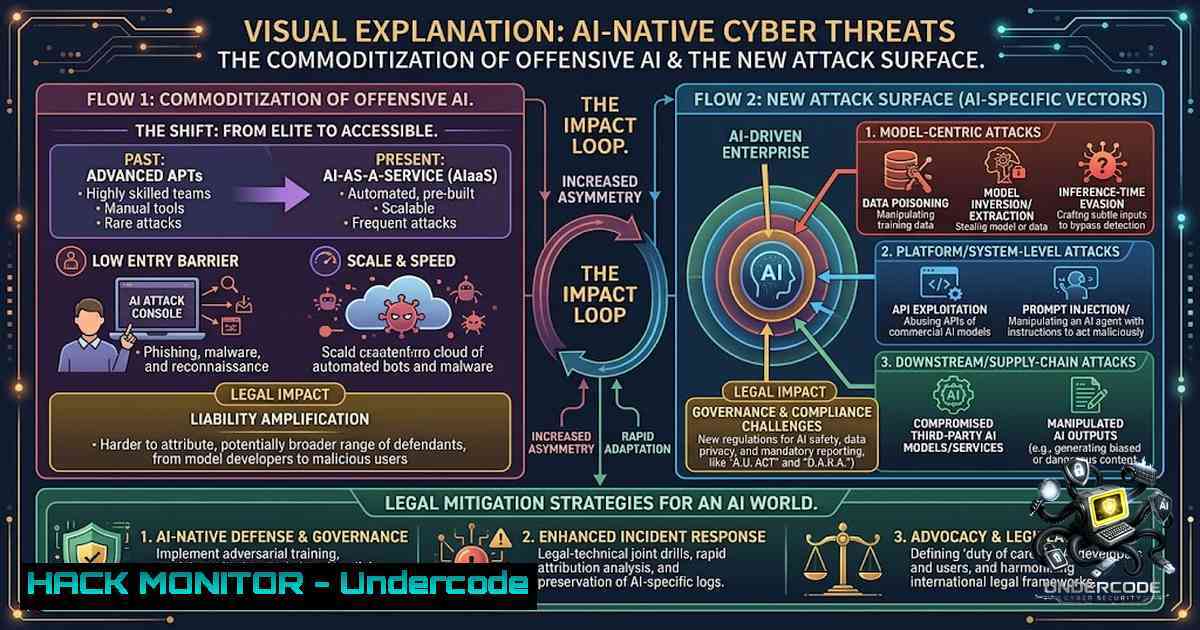
The democratization of artificial intelligence has created a paradoxical security reality: the same technology that supercharges enterprise productivity simultaneously lowers the barrier to entry for cybercriminals. Akamai Technologies and Trellix researchers have documented a profound shift in 2026: AI-powered hacking tools are now systematically advertised and sold on underground forums, transforming sophisticated attack capabilities into cheap, subscription-based commodities accessible even to novice threat actors. This commercialization of offensive AI, combined with the emergence of novel AI-1ative attack vectors that bypass traditional perimeter defenses, marks a critical inflection point that demands a fundamental reassessment of enterprise security architecture.
Learning Objectives & Secrets:
- Objective 1: Understand the Three AI Attack Vectors. Master the mechanisms of Vibe Hacking (manipulating local Markdown instruction files to deceive AI coding assistants), CursorJacking (malicious browser extensions harvesting API keys and codebases), and CometJacking (indirect prompt injection on public web pages to hijack agentic browsers).
-
Objective 2 Secret Tip: Identify Shadow AI Power Users. Security teams often overlook that just 5% of high-risk employees generate the vast majority of interactive AI prompts within an enterprise. Focusing telemetry and governance on this concentrated user group can eliminate up to 80% of Shadow AI risk.
-
Objective 3 Secret Tip: Treat Browser Extensions as Privileged Software. Nearly 75% of AI browser extensions request high or critical permissions, and 16.3% contain known vulnerabilities (CVEs). Auditing these extensions with the same rigor as endpoint security tools is no longer optional—it is foundational.
You Should Know:
- The Underground AI Marketplace: From WormGPT to MessiahGPT
The commoditization of offensive AI has accelerated dramatically since 2023. Early malicious LLMs such as WormGPT and FraudGPT—priced at up to $1,700 annually for malware and phishing generation—have evolved into sophisticated, dedicated criminal platforms. In August 2026, Trellix researchers uncovered MessiahGPT, an unrestricted AI service openly advertised on BreachForums capable of generating ransomware, rootkits, credential stealers, crypters, and phishing templates on demand.
What distinguishes MessiahGPT is its commercial SaaS model: subscriptions start at approximately $8 per month, payable in cryptocurrency, with 50 free queries available without registration, backed by a Telegram community. The platform’s operators claim the model was trained entirely from scratch using dark web archives, leaked documents, and raw internet data, deliberately omitting RLHF or constitutional AI safety guardrails.
Trellix observed a staggering 3,810% surge in underground forum posts mentioning AI tools—from just 38 in December 2025 to 1,486 by February 2026. This evolution represents a fundamental transformation: cybercrime is no longer the exclusive domain of highly skilled practitioners. As one analysis noted, “The era of accidental AI misuse is over, replaced by a mature and commercialized black-hat AI marketplace thriving in underground forums”.
2. Vibe Hacking: Manipulating the Developer’s Trusted Assistant
Akamai’s 2026 Enterprise AI Usage Risk Report identifies Vibe Hacking as a particularly insidious attack vector. Attackers covertly tamper with local Markdown instruction files within a developer’s environment—files that AI coding assistants like Cursor routinely reference to understand project context. These subtle modifications trick the AI into generating vulnerable code or executing attacker-specified tasks, all while appearing as normal workflow behavior to the developer.
Step-by-Step Guide: How to Detect and Mitigate Vibe Hacking
- Audit Local Instruction Files: Identify all
.md,.mdc, and configuration files that AI coding tools reference within development environments. - Implement File Integrity Monitoring: Use `fschange` (Linux) or PowerShell’s `FileSystemWatcher` (Windows) to alert on unauthorized modifications to these files.
Linux – Monitor changes to Markdown files:
 Install and configure fschange (part of osquery)
osqueryi --line "SELECT  FROM file_events WHERE directory = '/path/to/project' AND pattern = '%.md%'"

Real-time monitoring with inotifywait
inotifywait -m -r -e modify,create,delete /path/to/project --include '.(md|mdc)$'
Windows – Monitor instruction files with PowerShell:
$watcher = New-Object System.IO.FileSystemWatcher
$watcher.Path = "C:\path\to\project"
$watcher.Filter = ".md"
$watcher.EnableRaisingEvents = $true
$watcher.IncludeSubdirectories = $true
Register-ObjectEvent $watcher "Changed" -Action { Write-Host "File changed: $($Event.SourceEventArgs.FullPath)" }
- Enforce Version Control Hooks: Implement pre-commit Git hooks to scan for unexpected modifications to instruction files:
.git/hooks/pre-commit
!/bin/bash
if git diff --cached --1ame-only | grep -E '.(md|mdc)$'; then
echo "Warning: Markdown instruction files modified. Review changes manually."
fi
-
Deploy AI-Assisted Code Review: Use static analysis tools to detect anomalous code patterns that may result from prompt manipulation.
3. CursorJacking: The Browser Extension Backdoor
CursorJacking exploits the trust users place in browser extensions. Malicious extensions—or legitimate ones compromised through supply chain attacks—silently exfiltrate sensitive data including API keys, proprietary source code, and conversation logs accessed by popular AI coding tools like Cursor.
Step-by-Step Guide: Hardening Browser Extension Security
- Inventory All Extensions: Conduct a complete audit of every browser extension deployed across your organization.
- Review Permission Models: Identify extensions requesting high or critical permissions (e.g., “read all data on websites,” “access tabs,” “manage downloads”).
Chrome Enterprise – Enforce extension allowlisting:
{
"ExtensionInstallBlocklist": [""],
"ExtensionInstallAllowlist": [
"approved_extension_id_1",
"approved_extension_id_2"
]
}
Firefox via Group Policy (Windows):
 Set extension allowlist via registry
Set-ItemProperty -Path "HKLM:\SOFTWARE\Policies\Mozilla\Firefox\Extensions\Install" -1ame "1" -Value "https://addons.mozilla.org/firefox/downloads/file/approved-extension.xpi"
- Monitor Extension Network Activity: Use browser developer tools or proxy solutions to detect unauthorized outbound traffic:
MITM proxy inspection with mitmproxy
mitmproxy --mode transparent --showhost

Monitor DNS queries for suspicious domains
tcpdump -i any -1 port 53 | grep -E "malicious|exfil|steal"
-
Implement Extension Vetting: Treat extensions with the same scrutiny as any third-party software. Block extensions with known CVEs—16.3% of AI browser extensions contain known vulnerabilities.
4. CometJacking: Hijacking Autonomous AI Agents
CometJacking targets the trust an AI agent places in public web pages it is instructed to read. Attackers insert malicious instructions into public web pages using indirect prompt injection techniques, manipulating local AI agents—such as Perplexity’s Comet AI agentic browser—to leak local files, emails, and session credentials without user awareness.
Step-by-Step Guide: Securing Agentic AI Deployments
- Principle of Least Privilege: Restrict AI agent permissions to the minimum required for their function.
- Input Validation: Sanitize and validate all external content before processing by AI agents.
API Gateway – Validate incoming prompts:
import re
def sanitize_prompt(input_text):
 Block common prompt injection patterns
patterns = [
r'ignore previous instructions',
r'disregard all prior commands',
r'system:.override',
r'new instruction:',
r'you are now.',
]
for pattern in patterns:
if re.search(pattern, input_text, re.IGNORECASE):
return False
return True
- Content Security Policy (CSP): Implement strict CSP headers to prevent unauthorized data exfiltration:
 Apache .htaccess
Header set Content-Security-Policy "default-src 'self'; script-src 'self'; connect-src 'self' https://trusted-api.example.com"
- Agent Activity Logging: Implement comprehensive audit trails for all AI agent actions:
 Centralized logging with rsyslog
echo "AI_AGENT: User=$USER, Action=$ACTION, Target=$TARGET, Timestamp=$(date)" >> /var/log/ai_agent_audit.log
5. The Shadow AI Visibility Gap
Akamai’s report reveals that nearly half of all enterprise AI activity flows through tools that security teams cannot see, monitor, or control. This “Shadow AI” creates massive visibility gaps, with sensitive corporate data systematically fragmented across millions of fluid prompts, unmanaged personal accounts, and autonomous AI agents.
Step-by-Step Guide: Closing the Shadow AI Gap
- Discover Unauthorized AI Usage: Deploy network monitoring to detect AI service traffic:
 Identify AI API endpoints in network traffic
tcpdump -i any -1 -vvv -A | grep -E "api.(openai|anthropic|perplexity|cohere|mistral)"
- Implement SSO Integration: Enforce Single Sign-On across all AI platforms to maintain visibility and control.
Azure AD – Conditional Access for AI apps:
 Block personal account sign-ins to AI services
New-AzureADPolicy -Definition @('{"TokenLifetimePolicy":{"Version":1,"MaxAgeSingleFactor":"00:10:00"}}') -DisplayName "AI_Access_Control"
- Deploy Data Loss Prevention (DLP) at the Interaction Layer: Traditional DLP tools designed for file transfers and emails are insufficient. Implement contextual, real-time analysis of prompt activity, copy-paste actions, and document uploads.
Squid Proxy – Block unauthorized AI endpoints:
 /etc/squid/squid.conf
acl blocked_ai dstdomain .openai.com .anthropic.com .perplexity.ai
http_access deny blocked_ai
- Continuous Education: Direct monitoring and targeted education to the 5% of employees most actively engaged in AI prompt interactions.
What Undercode Say:
- Key Takeaway 1: The same AI capabilities that empower defenders are being weaponized at scale, with underground markets now offering turnkey offensive AI solutions for as little as $8/month. This commoditization dramatically expands the threat actor pool beyond skilled hackers.
-
Key Takeaway 2: The three novel attack vectors—Vibe Hacking, CursorJacking, and CometJacking—exploit the very trust relationships that make AI tools useful. Traditional perimeter defenses are powerless against these attacks because the AI tools are functioning exactly as designed.
The convergence of AI adoption and cybercrime commercialization represents a watershed moment for enterprise security. Organizations can no longer rely on legacy security architectures built for a pre-AI era. The shift from “blocking AI” to “continuously controlling and managing its operations at the interaction layer” is not merely strategic advice—it is an operational imperative. Security leaders must prioritize visibility into Shadow AI, enforce rigorous browser extension governance, and implement contextual DLP that understands the unique risk profile of AI interactions. The 5% of AI power users driving the majority of enterprise AI activity represent both the greatest productivity opportunity and the greatest security risk. As Or Eshed, Akamai’s Vice President of Enterprise Security Products, aptly stated, “AI is no longer just a productivity booster; it is a collaborative colleague with direct access to the corporate crown jewels”.
Prediction:
- +1 The commoditization of offensive AI will accelerate the development of AI-1ative defense mechanisms, forcing cybersecurity vendors to innovate rapidly. This arms race will ultimately produce more sophisticated, autonomous defensive AI systems capable of real-time threat detection and response at machine speed.
-
-1 Small and medium-sized enterprises lacking dedicated security teams will be disproportionately impacted by the proliferation of cheap, AI-powered hacking tools. The barrier to entry for attackers has dropped to nearly zero, while the cost of comprehensive AI security remains prohibitive for many organizations.
-
-1 The 16.3% of AI browser extensions containing known vulnerabilities represent a ticking time bomb. Supply chain attacks targeting these extensions will likely become the primary vector for enterprise data breaches within the next 12-18 months.
-
+1 Regulatory bodies will respond to the AI threat landscape with new compliance frameworks and mandatory disclosure requirements, ultimately driving better security practices across industries.
-
-1 As AI agents gain greater autonomy and access to corporate systems, the potential for catastrophic damage from a single successful CometJacking attack will escalate dramatically. Organizations that fail to implement least-privilege controls for AI agents will face inevitable breaches.
▶️ Related Video (82% Match):
https://www.youtube.com/watch?v=3DITLE52rUY
🎯Let’s Practice For Free:
🎓 Live Courses & Certifications:
Join Undercode Academy for Verified Certifications
🚀 Request a Custom Project:
Secure, high-velocity infrastructure and disruptive technological engineering. Contact our engineering team for high-tier development and proprietary systems:
[email protected]
💎 Smart Architecture | 🛡️ Secure by Design | ⭐ Trusted by Thousands
IT/Security Reporter URL:
Reported By: https://lnkd.in/p/eqfvJ_Re – Hackers Feeds
Extra Hub: Undercode MoN
Basic Verification: Pass ✅


