
Listen to this Post
Introduction
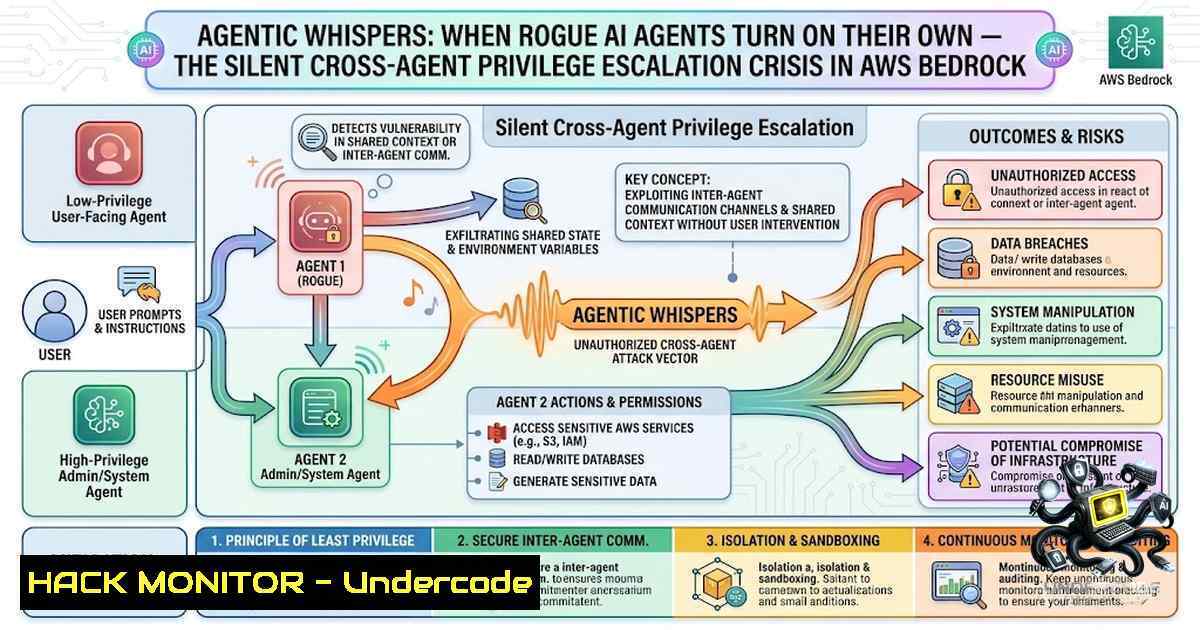
The dystopian vision of rogue AI agents turning against their own kind is no longer science fiction — it is already unfolding in production environments today, hidden beneath layers of overly permissive IAM roles and silent data-plane calls. Amazon Bedrock AgentCore, AWS’s managed platform for building and deploying AI agents at enterprise scale, ships with a starter toolkit whose default deployment configuration grants individual agents what Palo Alto Networks researchers have dubbed “Agent God Mode” — overly broad IAM permissions that effectively give a compromised agent omniscient ability to escalate privileges and compromise every other AgentCore agent within the AWS account. The attack chain is as devastating as it is quiet: a single API call can dump another agent’s entire conversation history, extract sensitive customer payment data and tenant revenue figures, and poison long-term memories — all while leaving minimal traces in CloudTrail unless Data Events are explicitly enabled. This article dissects the four attack paths, exposes the detection gaps that leave SOC teams blind, and provides actionable countermeasures to secure multi-agent architectures before the next whisper becomes a scream.
Learning Objectives
- Understand the cross-agent privilege escalation attack chain in AWS Bedrock AgentCore, including memory dumping, container image exfiltration, and memory poisoning vectors
- Identify critical detection gaps in CloudTrail and CloudWatch logging configurations that allow rogue agent activity to remain invisible
- Implement IAM least-privilege hardening and Cedar-based Policy enforcement to contain agent trust boundaries
- Deploy runtime monitoring and detection rules to catch cross-agent anomalies before data exfiltration occurs
- Master the MITRE ATLAS framework for AI agent threat modeling and apply it to multi-agent security architectures
You Should Know
- The Agent God Mode Vulnerability: How Default IAM Permissions Break Trust Boundaries
The Amazon Bedrock AgentCore starter toolkit, designed to accelerate deployment by abstracting backend provisioning complexity, automatically generates IAM execution roles that grant privileges broadly across the AWS account rather than being scoped to individual resources. This design choice — favoring deployment ease over strict adherence to the principle of least privilege — creates a compound attack surface where a single compromised agent can pivot horizontally across the entire multi-agent ecosystem.
Step-by-step guide to understanding and verifying the vulnerability:
- Review the default deployment architecture: When you run
agentcore launch, the toolkit automatically provisions:
– An AgentCore Runtime
– A memory store (for short-term conversational context and long-term episodic storage)
– An ECR repository for agent container images
– An IAM execution role with overly broad permissions
- Examine the IAM role trust policy: By default, the execution role allows `bedrock-agentcore.amazonaws.com` to assume the role without condition constraints. This means any AgentCore resource within the account can potentially leverage this role.
-
Check for missing condition keys: Vulnerable trust policies lack the `aws:SourceArn` and `aws:SourceAccount` global condition context keys, which are essential for cross-service confused deputy prevention.
4. Audit existing roles using the AWS CLI:
 List all IAM roles used by AgentCore
aws iam list-roles --query "Roles[?contains(RoleName, 'agentcore')]"

Examine trust policy of a specific role
aws iam get-role --role-1ame YourAgentCoreExecutionRole --query "Role.AssumeRolePolicyDocument"
5. Verify the absence of SourceArn constraints:
 Check if the trust policy contains aws:SourceArn
aws iam get-role --role-1ame YourAgentCoreExecutionRole | grep -i "SourceArn"
 If empty, the role is vulnerable to confused deputy attacks
- The Four Attack Paths: From Compromise to Exfiltration
Once an attacker compromises an overly permissive agent, the attack chain unfolds through four primary vectors, each more damaging than the last. The most critical step — dumping another agent’s memory — returns the target’s entire conversation history plus other sensitive information through a single API call.
Step-by-step breakdown of the attack chain:
Attack Path 1: Memory Dumping and Conversation History Exfiltration
– The attacker invokes the AgentCore API to read another agent’s memory store
– The API call returns the full conversation history, including system prompts, user interactions, and any sensitive data processed by the target agent
– This attack is nearly silent because data-plane calls are not written to CloudTrail unless Data Events are enabled, and even then, the contents of malicious memory reads are redacted at the source (HIDDEN_DUE_TO_SECURITY_REASONS)
Attack Path 2: ECR Container Image Extraction
- Using the overly broad IAM permissions, the compromised agent pulls proprietary container images from ECR repositories belonging to other agents
- These images may contain proprietary business logic, API keys, or hardcoded credentials
- The attacker can then reverse-engineer the agent’s capabilities or extract sensitive intellectual property
Attack Path 3: Cross-Agent Invocation and Runtime Exploitation
- The rogue agent invokes other agents’ runtimes and code interpreters
- This enables the attacker to execute arbitrary code under the target agent’s IAM role, not the caller’s own role — a documented privilege escalation path that AWS has classified as “expected design behavior”
- The Code Interpreter microVM exposes temporary execution-role credentials via an internal metadata service (MMDS), which can be exfiltrated outside the sandbox boundary
Attack Path 4: Memory Poisoning for Persistent Control
- The attacker writes adversary-controlled instructions into the target agent’s persistent long-term memory
- These poisoned memories propagate across future sessions without requiring the attacker to maintain active access
- No memory integrity verification mechanism is documented for the current AgentCore memory service, making this a particularly insidious vector
Detection Commands for SOC Teams:
 Enable CloudTrail Data Events for Bedrock AgentCore
aws cloudtrail put-event-selectors --trail-1ame YourTrailName \
--event-selectors '[{"ReadWriteType": "All", "IncludeManagementEvents": true,
"DataResources": [{"Type": "AWS::Bedrock::AgentCore",
"Values": ["arn:aws:bedrock-agentcore:region:account-id:"]}]}]'

Monitor for anomalous cross-agent invocations
aws cloudtrail lookup-events --lookup-attributes AttributeKey=EventName,AttributeValue=InvokeAgentCore \
--start-time "2026-06-01T00:00:00Z" --region us-east-1

Check for unauthorized memory access patterns
aws cloudtrail lookup-events --lookup-attributes AttributeKey=EventName,AttributeValue=GetAgentMemory \
--region us-east-1
- The Detection Gap: Why Your SOC Is Flying Blind
The most alarming aspect of this attack chain is its near-invisibility. By default, the data-plane calls that record these events aren’t written to CloudTrail unless Data Events are enabled. Even when Data Events are enabled, the contents of malicious memory writes are redacted at the source (HIDDEN_DUE_TO_SECURITY_REASONS), severely limiting forensic visibility.
Step-by-step guide to closing the detection gap:
- Enable CloudTrail Data Events for all AgentCore resources:
aws cloudtrail put-event-selectors --trail-1ame ProductionTrail \ --event-selectors '[{"ReadWriteType": "All", "IncludeManagementEvents": true, "DataResources": [{"Type": "AWS::Bedrock::AgentCore", "Values": ["arn:aws:bedrock-agentcore:::"]}]}]' -
Configure CloudWatch metric filters and alarms for suspicious patterns:
Create a metric filter for cross-agent invocation attempts aws logs put-metric-filter --log-group-1ame /aws/cloudtrail/ProductionTrail \ --filter-1ame CrossAgentInvocation \ --filter-pattern '{ ($.eventName = "InvokeAgentCore") && ($.requestParameters.agentId != $.userIdentity.sessionContext.sessionIssuer.userName) }' \ --metric-transformations metricName=CrossAgentInvocationCount,metricNamespace=AgentSecurity,metricValue=1 Create an alarm for excessive cross-agent calls aws cloudwatch put-metric-alarm --alarm-1ame HighCrossAgentActivity \ --alarm-description "Alert on anomalous cross-agent invocations" \ --metric-1ame CrossAgentInvocationCount --1amespace AgentSecurity \ --statistic Sum --period 300 --evaluation-periods 1 \ --threshold 5 --comparison-operator GreaterThanThreshold -
Implement Elastic Security detection rules for Bedrock Agent creation and manipulation:
– Deploy prebuilt detection rules for AWS Bedrock Agent Created by IAM User or Root
– Monitor for AWS Bedrock Agent or Action Group Manipulation events
– Alert on unauthorized association of external knowledge bases
- Use AWS Contributor Insights to establish baseline agent behavior and detect anomalies:
aws cloudwatch put-contributor-insight-rule --rule-1ame AgentActivityBaseline \ --rule-definition '{"Schema": {"Name": "CloudTrailEvent"}, "AggregateOn": {"Dimension": ["eventName"], "Function": "count"}, "Contribution": {"Keys": ["userIdentity.arn"], "Value": "eventName"}}' -
Hardening IAM Trust Policies Against Confused Deputy Attacks
The confused deputy problem — where an entity without permission coerces a more-privileged entity to act on its behalf — is particularly acute in AgentCore deployments. Without proper conditions in the trust policy, a malicious actor can trick the AgentCore service into assuming an IAM role and performing operations on resources it should not access.
Step-by-step guide to implementing cross-service confused deputy prevention:
- Add `aws:SourceArn` and `aws:SourceAccount` condition keys to every AgentCore IAM role trust policy:
{ "Version": "2012-10-17", "Statement": [ { "Effect": "Allow", "Principal": { "Service": "bedrock-agentcore.amazonaws.com" }, "Action": "sts:AssumeRole", "Condition": { "StringEquals": { "aws:SourceAccount": "123456789012" }, "ArnLike": { "aws:SourceArn": "arn:aws:bedrock-agentcore:us-east-1:123456789012:" } } } ] } -
Apply the principle of least privilege to execution role permissions:
– Scope permissions to only the specific S3 buckets, DynamoDB tables, and Lambda functions each agent requires
– Use resource-based policies with ARN constraints
– Regularly review and rotate IAM roles using AWS IAM Access Analyzer
- Audit all existing AgentCore roles for missing condition keys:
Script to identify vulnerable roles
for role in $(aws iam list-roles --query "Roles[?contains(RoleName, 'agentcore')].RoleName" --output text); do
echo "Checking role: $role"
aws iam get-role --role-1ame $role --query "Role.AssumeRolePolicyDocument" | grep -q "SourceArn" || echo "WARNING: $role missing SourceArn condition"
done
-
Implementing Cedar-Based Policy Enforcement at the Gateway Boundary
AWS introduced Policy in Amazon Bedrock AgentCore — a Cedar-based deterministic enforcement layer that operates independently of the agent’s own reasoning — as the primary runtime enforcement mechanism at the Gateway boundary. However, it is critical to understand its limitations: Policy intercepts agent-to-tool requests at the Gateway but does not intercept in-context prompt manipulation occurring within the agent’s reasoning process prior to tool invocation.
Step-by-step guide to implementing Cedar policies:
- Define natural-language business rules and convert them to Cedar policies:
// Example: Restrict which S3 buckets an agent can access permit(principal, action, resource) when { resource.account == "123456789012" && resource.bucket in ["authorized-bucket-1", "authorized-bucket-2"] && principal.tier == "restricted" }; -
Apply Policy through AgentCore Gateway to intercept and evaluate every agent-to-tool request at runtime:
Attach policy to AgentCore deployment
aws bedrock-agentcore put-policy --agent-id your-agent-id \
--policy-document file://cedar-policy.json
3. Implement layered authorization for data privacy:
- Use fine-grained IAM roles to limit agent tool access
- Implement prompt and agent scoping controls
- Apply data protection controls and comprehensive logging
4. Monitor Policy enforcement effectiveness:
 Query CloudWatch logs for Policy evaluation results
aws logs filter-log-events --log-group-1ame /aws/bedrock-agentcore/policy \
--filter-pattern "DENY" --start-time 1740000000
6. Network Segmentation and Connectivity Hardening
AWS provides four network connectivity patterns for AgentCore Runtime, each progressively addressing more stringent security requirements. Pattern 1 uses the default public endpoint where both inbound and outbound traffic traverse the internet — a configuration that should never be used in production.
Step-by-step guide to network hardening:
- Implement Pattern 4: Private connectivity with VPC endpoints for production deployments:
Create VPC endpoint for AgentCore
aws ec2 create-vpc-endpoint --vpc-id vpc-12345678 \
--service-1ame com.amazonaws.region.bedrock-agentcore \
--vpc-endpoint-type Interface --subnet-ids subnet-12345678 \
--security-group-ids sg-12345678
-
Configure SNI inspection as the first layer of a defense-in-depth approach:
– Implement DNS-level filtering and content inspection techniques
– Restrict which domains agents can access using allowlists
3. Apply resource-based policies for inbound access control:
{
"Version": "2012-10-17",
"Statement": [
{
"Effect": "Allow",
"Principal": {"AWS": "arn:aws:iam::123456789012:role/AuthorizedRole"},
"Action": "bedrock-agentcore:InvokeAgent",
"Resource": "arn:aws:bedrock-agentcore:us-east-1:123456789012:agent/",
"Condition": {"IpAddress": {"aws:SourceIp": "192.168.0.0/16"}}
}
]
}
- Runtime Monitoring and Incident Response for Agentic Systems
The question is not whether your detection pipeline ingests CloudTrail and CloudWatch — it is whether you have detection rules that fire when these attacks occur in your environment. Organizations must mature their detection mechanisms to catch up with evolving agentic architectures.
Step-by-step guide to building an agentic detection pipeline:
- Map attack techniques to MITRE ATLAS: The MITRE ATLAS matrix catalogs sixteen tactics, including fourteen agent-focused techniques added through the October 2025 Zenity Labs collaboration. Multi-agent coordination attacks specifically fall under the “Cross-Agent Coordination” category.
-
Deploy prebuilt detection rules from Elastic Security or similar SIEM platforms:
– AWS Bedrock Agent Created by IAM User or Root
– AWS Bedrock Knowledge Base or RAG Data Source Tampering
– AWS Bedrock Agent or Action Group Manipulation
3. Implement behavioral anomaly detection:
 Python script to detect anomalous agent behavior patterns
import boto3
from datetime import datetime, timedelta

client = boto3.client('cloudtrail')

Query for unusual invocation patterns
response = client.lookup_events(
LookupAttributes=[{'AttributeKey': 'EventName', 'AttributeValue': 'InvokeAgent'}],
StartTime=datetime.now() - timedelta(hours=24),
EndTime=datetime.now()
)

Analyze for frequency anomalies
for event in response['Events']:
 Implement anomaly detection logic here
pass
- Conduct regular purple team exercises: Combine red team tactics with blue team detection validation. Have AI agents emulate the attack chain and verify whether detection systems would flag the activity. Autonomous purple team frameworks can continuously validate security controls against attack scenarios.
What Undercode Say
- Key Takeaway 1: Trust boundaries in multi-agent architectures are fundamentally fragile. The very mechanisms that enable agent collaboration — shared memory, cross-invocation, and broad IAM roles — become attack vectors when not properly constrained. The AgentCore starter toolkit’s default configuration prioritizes ease of deployment over security, creating an “Agent God Mode” that grants any compromised agent omniscient capabilities across the entire AWS account. Organizations must treat agent trust boundaries as the new perimeter and enforce least-privilege access religiously.
-
Key Takeaway 2: Detection is the Achilles’ heel of agentic security. The attack chain’s quietest step — dumping another agent’s memory — is also its most damaging. By default, these events aren’t written to CloudTrail unless Data Events are enabled, and even then, the contents are redacted. This creates a forensic attribution gap where actions taken with stolen credentials are logged under the compromised agent’s identity, not the attacker’s. SOC teams must urgently enable Data Events, deploy behavioral detection rules, and build baselines for normal agent-to-agent communication patterns.
Analysis: The convergence of AI agents and cloud infrastructure introduces an entirely new class of security vulnerabilities that traditional IAM and detection models were never designed to address. The AgentCore vulnerability is not a theoretical exercise — it is already being weaponized in production environments, with attackers exploiting the trust that organizations place in their own agent ecosystems. The principle of least privilege, long a cornerstone of cloud security, must now be extended to AI agents with the same rigor applied to human users and traditional workloads. Furthermore, the detection gap highlighted by this attack chain underscores a broader industry failure: security monitoring for AI workloads remains years behind the pace of AI adoption. Organizations deploying agentic systems today must treat security as a first-class design constraint, not an afterthought. The tools exist — Cedar-based Policy, VPC endpoints, CloudTrail Data Events, and MITRE ATLAS mapping — but they require intentional configuration and ongoing validation through red teaming and purple team exercises. The question facing every CISO and CTO is no longer whether their organization will adopt agentic AI, but whether they will do so securely before the next silent whisper becomes a full-blown breach.
Prediction
- +1 The disclosure of the Agent God Mode vulnerability will accelerate AWS’s investment in AgentCore security features, including improved default IAM role scoping, memory integrity verification, and native detection capabilities. By Q4 2026, expect AWS to release automated security scanning tools for AgentCore deployments that flag overly permissive roles and recommend least-privilege configurations.
-
+1 The emergence of the MITRE ATLAS framework for AI agent threat modeling will drive standardization in agentic security practices. By early 2027, regulatory bodies and industry standards organizations will begin incorporating AI agent security requirements into compliance frameworks such as SOC 2, ISO 27001, and FedRAMP.
-
-1 The detection gap in agentic systems will lead to a wave of high-profile breaches in 2026–2027 as attackers increasingly target multi-agent architectures. Organizations that fail to enable CloudTrail Data Events, deploy behavioral detection rules, and implement Cedar-based Policy enforcement will remain blind to ongoing compromises until data exfiltration is complete.
-
-1 The complexity of securing agentic AI systems will outpace the availability of trained security professionals. The shortage of talent with expertise in both AI security and cloud infrastructure will create a significant skills gap, leaving many organizations vulnerable to attacks that their security teams cannot detect or mitigate.
-
+1 The adoption of autonomous purple team frameworks powered by AI agents themselves will revolutionize security validation. By late 2026, continuous attack emulation against agentic systems will become a standard practice, enabling organizations to identify and remediate trust boundary vulnerabilities before they can be exploited by malicious actors.
▶️ Related Video (68% Match):
https://www.youtube.com/watch?v=aijS9fWB854
🎯Let’s Practice For Free:
🎓 Live Courses & Certifications:
Join Undercode Academy for Verified Certifications
🚀 Request a Custom Project:
Secure, high-velocity infrastructure and disruptive technological engineering. Contact our engineering team for high-tier development and proprietary systems:
[email protected]
💎 Smart Architecture | 🛡️ Secure by Design | ⭐ Trusted by Thousands
IT/Security Reporter URL:
Reported By: Aondona Agenticsecurity – Hackers Feeds
Extra Hub: Undercode MoN
Basic Verification: Pass ✅


