Listen to this Post
Introduction
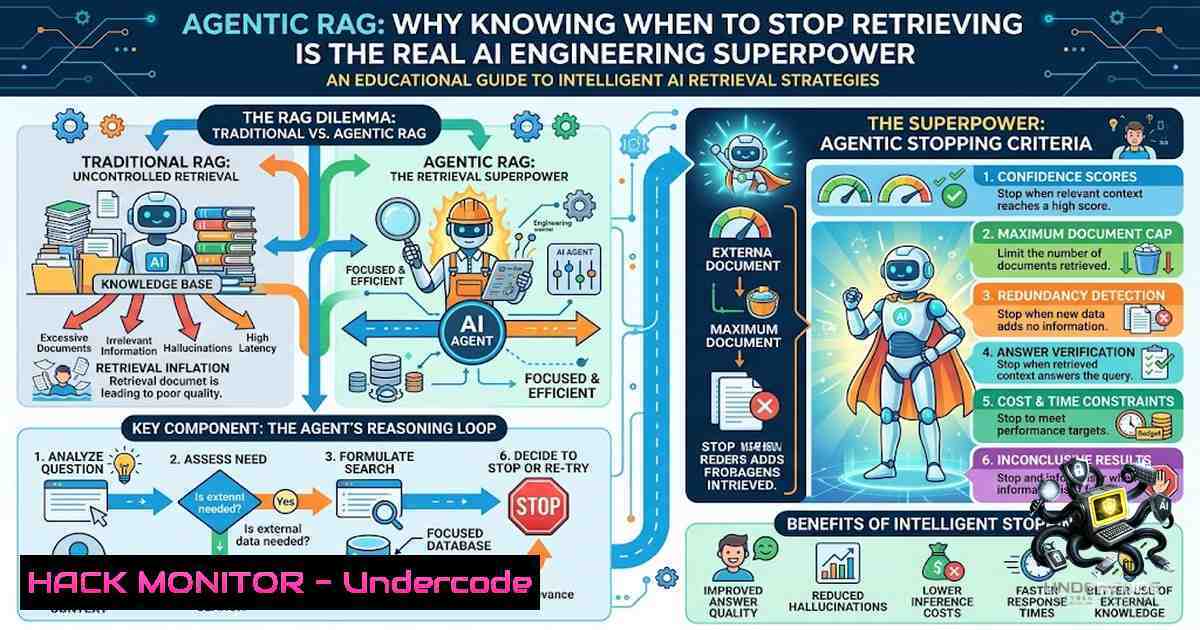
Retrieval-Augmented Generation (RAG) has become the de facto standard for grounding Large Language Models (LLMs) in external knowledge. However, conventional RAG pipelines—which follow a linear Retrieve → Generate → Respond workflow—frequently fall short when faced with ambiguous queries, contradictory documents, or complex reasoning that demands synthesis across multiple sources. The evolution from basic RAG to Agentic RAG represents a fundamental architectural shift, transforming what was once a simple search pipeline into an autonomous reasoning system that plans, evaluates, and iterates. This transition introduces new engineering challenges, the most critical of which is the ability to decide when additional retrieval yields diminishing returns—a problem that separates production-grade systems from token-burning prototypes.
Learning Objectives
- Understand the architectural differences between conventional RAG and Agentic RAG, including the role of agentic loops and reasoning mechanisms
- Master the core engineering principles for production Agentic RAG systems, including query rewriting, hybrid retrieval, and confidence scoring
- Implement adaptive retrieval termination strategies using supervisor-based routing and dynamic confidence thresholds
You Should Know
- The Shift from Linear Retrieval to Agentic Reasoning Loops
Conventional RAG systems operate on a straightforward premise: receive a query, retrieve relevant documents, generate a response, and return it to the user. This approach performs admirably for simple factual questions, but it begins to break down when queries contain ambiguity, require multi-hop reasoning, or involve conflicting information sources. Consider a user asking, “What were the key architectural differences between the GPT-3 and GPT-4 models, and how did they impact performance on reasoning tasks?” A standard RAG system might retrieve documents about both models, generate a response, and deliver it without any verification that it actually answered the question.
Agentic RAG addresses these limitations by introducing an execution loop that continuously evaluates its own progress and adjusts its strategy accordingly. This loop typically follows a pattern of understanding intent, planning retrieval strategy, querying multiple knowledge sources, evaluating document quality and confidence, retrieving again if information is insufficient, invoking external tools or APIs when required, and validating the final response before delivery.
The implementation of such a loop requires careful orchestration. Here’s a simplified Python implementation using LangGraph to demonstrate the pattern:
from langgraph.graph import StateGraph, END
from typing import TypedDict, List, Optional
import asyncio

class AgentState(TypedDict):
query: str
documents: List[bash]
confidence: float
retrieval_count: int
max_retrievals: int
response: Optional[bash]
tools_called: List[bash]

def create_agentic_rag_graph():
graph = StateGraph(AgentState)

Define nodes
graph.add_node("understand_intent", understand_intent)
graph.add_node("plan_retrieval", plan_retrieval)
graph.add_node("retrieve", retrieve)
graph.add_node("evaluate_quality", evaluate_quality)
graph.add_node("generate_response", generate_response)
graph.add_node("validate_response", validate_response)

Define conditional edges
graph.add_conditional_edges("evaluate_quality", should_retrieve_again)
graph.add_edge("validate_response", END)

graph.set_entry_point("understand_intent")
return graph.compile()

async def understand_intent(state: AgentState) -> AgentState:
 Implement intent classification
return state

async def plan_retrieval(state: AgentState) -> AgentState:
 Plan retrieval strategy
return state
This architecture enables the system to handle complex queries through iterative refinement rather than a single pass, significantly improving response quality for ambiguous or multi-faceted questions.
2. Engineering Principles for Production Agentic RAG
The transition from proof-of-concept to production-grade Agentic RAG requires implementing several key engineering principles that make a substantial difference in real-world performance.
Query Rewriting and Optimization: Rather than embedding every question as-is, production systems rewrite queries to improve retrieval precision. This involves techniques such as query expansion, decomposition, and reformulation. A simple implementation using a smaller LLM might look like:
from openai import AsyncOpenAI
import json

client = AsyncOpenAI(api_key="your-api-key")

async def rewrite_query(original_query: str) -> dict:
"""Rewrite and expand the user query for better retrieval."""
prompt = f"""
Rewrite the following query for optimal retrieval from a knowledge base.
Consider:
1. Decomposing complex queries into sub-questions
2. Adding relevant synonyms and technical terms
3. Identifying named entities and key concepts

Original query: {original_query}

Return as JSON with fields: rewritten_query, sub_queries, keywords
"""

response = await client.chat.completions.create(
model="gpt-4o-mini",
messages=[{"role": "user", "content": prompt}],
response_format={"type": "json_object"}
)

return json.loads(response.choices[bash].message.content)
Hybrid Retrieval for Better Recall: Combining semantic search (using embeddings) with keyword-based search (using BM25 or similar algorithms) significantly improves retrieval recall. The hybrid approach ensures that relevant documents are found even when they don’t share semantic similarity with the query but do share keywords, or vice versa.
Context Compression and Token Optimization: With token costs and context window limitations being real constraints, production systems implement sophisticated compression techniques. This includes extracting only the most relevant passages from retrieved documents and using summarization to reduce token usage without losing critical information.
Confidence Scoring and Deciding When to Stop: The most critical engineering challenge is determining when additional retrieval attempts won’t improve response quality. Implementing an effective confidence scoring mechanism that can decide when enough information has been gathered is the difference between a system that reasons and one that burns tokens looking busy.
- Solving the Stop Retrieval Problem with Adaptive RAG
The hardest problem in Agentic RAG is knowing when to stop. An agentic loop is relatively straightforward to build, but deciding that the third retrieval pass won’t beat the second is where actual engineering expertise shines. This challenge has led to the development of Adaptive RAG: an architecture that places a supervisor above the retrieval graph to own routing and termination decisions rather than relying on a simple confidence threshold.
The Adaptive RAG approach implements a supervisor that evaluates the progress of each retrieval iteration and makes informed decisions about whether to continue, reformulate the query, or terminate and generate a response. This supervisor can use various signals including the rate of information gain across iterations, the consistency of retrieved documents, and the current confidence score relative to a dynamic threshold.
A basic implementation of the supervisor-based stopping logic might look like:
class AdaptiveRAGSupervisor:
def <strong>init</strong>(self, confidence_threshold: float = 0.85,
min_retrievals: int = 1,
max_retrievals: int = 5,
diminishing_return_threshold: float = 0.1):
self.confidence_threshold = confidence_threshold
self.min_retrievals = min_retrievals
self.max_retrievals = max_retrievals
self.diminishing_return_threshold = diminishing_return_threshold

def should_continue_retrieval(self, retrieval_history: list) -> tuple[bool, str]:
"""
Determine whether to continue retrieval based on historical performance.
Returns: (should_continue, reason)
"""
if len(retrieval_history) >= self.max_retrievals:
return False, "Maximum retrieval count reached"

if len(retrieval_history) < self.min_retrievals:
return True, "Minimum retrieval count not met"

Check confidence
latest_confidence = retrieval_history[-1].get('confidence', 0)
if latest_confidence >= self.confidence_threshold:
return False, "Confidence threshold met"

Check for diminishing returns
if len(retrieval_history) >= 2:
improvement_rate = self._calculate_improvement_rate(retrieval_history)
if improvement_rate < self.diminishing_return_threshold:
return False, "Diminishing returns detected"

return True, "Additional retrieval may improve results"

def _calculate_improvement_rate(self, history: list) -> float:
"""Calculate the rate of improvement between consecutive retrievals."""
improvements = []
for i in range(1, len(history)):
prev_score = history[i-1].get('quality_score', 0)
curr_score = history[bash].get('quality_score', 0)
if prev_score > 0:
improvements.append((curr_score - prev_score) / prev_score)
else:
improvements.append(curr_score)

return sum(improvements) / len(improvements) if improvements else 0
The adaptive approach, as implemented in Aditya Chauhan’s open-source project, provides a more nuanced and effective termination strategy than simple threshold-based approaches. It accounts for the quality of information retrieved, not just the quantity, and recognizes when additional efforts will likely be counterproductive.
4. Execution Scheduling and Parallelism in Agentic Systems
Beyond retrieval strategies, the scheduling and orchestration of retrieval operations and tool calls significantly impact system performance. Execution scheduling involves determining the optimal order of operations, leveraging parallelism where possible, and timing when to initiate external API calls or database queries.
For complex queries that require information from multiple sources, parallel execution can dramatically reduce latency. For example, a query that needs to retrieve both financial data and market sentiment analysis can execute these operations concurrently rather than sequentially.
import asyncio
from typing import List, Dict, Any
from functools import partial

class ExecutionScheduler:
def <strong>init</strong>(self, max_concurrent_operations: int = 5):
self.max_concurrent = max_concurrent_operations
self.semaphore = asyncio.Semaphore(max_concurrent)

async def orchestrate_retrieval(self, sources: List[Dict[str, Any]]) -> List[Dict[str, Any]]:
"""
Orchestrate retrieval from multiple sources with controlled parallelism.
"""
tasks = []
for source in sources:
if source.get('requires_external_call', False):
task = self._execute_with_semaphore(self._external_retrieve, source)
else:
task = self._execute_with_semaphore(self._local_retrieve, source)
tasks.append(task)

results = await asyncio.gather(tasks, return_exceptions=True)

Filter and process results
valid_results = [r for r in results if not isinstance(r, Exception)]
return valid_results

async def _execute_with_semaphore(self, func, args, kwargs):
"""Execute a function with semaphore control."""
async with self.semaphore:
if asyncio.iscoroutinefunction(func):
return await func(args, kwargs)
return func(args, kwargs)

async def _external_retrieve(self, source: Dict[str, Any]) -> Dict[str, Any]:
"""Simulate external API retrieval."""
await asyncio.sleep(source.get('estimated_latency', 1.0))
return {
'source_id': source.get('id'),
'content': f"Retrieved from {source.get('name')}",
'timestamp': asyncio.get_event_loop().time()
}

async def _local_retrieve(self, source: Dict[str, Any]) -> Dict[str, Any]:
"""Simulate local database or vector search retrieval."""
return {
'source_id': source.get('id'),
'content': f"Local retrieval from {source.get('name')}",
'timestamp': asyncio.get_event_loop().time()
}
This orchestration layer ensures that the system efficiently utilizes available resources while respecting rate limits and preventing overload of external services.
5. Tool Calling and External API Integration
Modern Agentic RAG systems routinely integrate with external tools and APIs to access live data, perform computations, or execute actions that go beyond static knowledge retrieval. The system must decide when to call external tools, which tools to call, and how to interpret and incorporate the results.
Implementing robust tool calling requires careful design of tool schemas, error handling, and result interpretation. Here’s an example of a tool registry and invocation system:
from typing import Dict, Any, Callable, Optional
import inspect
import json

class ToolRegistry:
def <strong>init</strong>(self):
self.tools: Dict[str, Dict[str, Any]] = {}

def register_tool(self, name: str, description: str,
function: Callable, schema: Optional[bash] = None):
"""Register a tool with its schema and handler."""
if schema is None:
 Auto-generate schema from function signature
sig = inspect.signature(function)
parameters = {
param_name: {"type": param.annotation.<strong>name</strong>.lower() if param.annotation != inspect.Parameter.empty else "string"}
for param_name, param in sig.parameters.items()
}
schema = {
"type": "function",
"function": {
"name": name,
"description": description,
"parameters": {
"type": "object",
"properties": parameters
}
}
}

self.tools[bash] = {
"description": description,
"function": function,
"schema": schema
}

return self

def get_tool_schemas(self) -> List[bash]:
"""Get all tool schemas for the LLM to choose from."""
return [tool["schema"] for tool in self.tools.values()]

async def invoke_tool(self, tool_name: str, tool_args: Dict) -> Dict:
"""Invoke a tool with the given arguments."""
if tool_name not in self.tools:
raise ValueError(f"Tool {tool_name} not found in registry")

tool = self.tools[bash]
try:
if asyncio.iscoroutinefunction(tool["function"]):
result = await tool<a href="tool_args">"function"</a>
else:
result = tool<a href="tool_args">"function"</a>

return {
"success": True,
"result": result,
"error": None
}
except Exception as e:
return {
"success": False,
"result": None,
"error": str(e)
}

Example tool registration
registry = ToolRegistry()

@registry.register_tool(
name="get_stock_price",
description="Get current stock price for a given symbol",
schema={
"type": "function",
"function": {
"name": "get_stock_price",
"description": "Get current stock price for a given symbol",
"parameters": {
"type": "object",
"properties": {
"symbol": {"type": "string", "description": "Stock symbol"}
},
"required": ["symbol"]
}
}
}
)
async def get_stock_price(symbol: str) -> Dict:
"""Simulate stock price retrieval from an external API."""
 In production, this would call an actual API
return {"symbol": symbol.upper(), "price": 150.25, "currency": "USD"}
The tool registry enables the system to call external APIs seamlessly, incorporating live data into retrieval and reasoning processes.
6. Response Verification and Hallucination Mitigation
One of the most critical features of Agentic RAG is its ability to validate responses before delivering them to users. Response verification involves checking the generated response against the retrieved documents, ensuring that facts are consistent, and flagging potential hallucinations.
The implementation typically involves comparing the generated response to the source documents and scoring the factual consistency. Here’s a basic approach:
from sentence_transformers import SentenceTransformer
import numpy as np
from sklearn.metrics.pairwise import cosine_similarity

class ResponseVerifier:
def <strong>init</strong>(self, model_name: str = "all-MiniLM-L6-v2"):
self.model = SentenceTransformer(model_name)

def verify_response(self, response: str, documents: List[bash], threshold: float = 0.65) -> Dict:
"""
Verify the response against retrieved documents.
Returns verification score and detailed results.
"""
if not documents or not response:
return {
"is_verified": False,
"score": 0.0,
"message": "No documents or response to verify"
}

Encode response and documents
response_embedding = self.model.encode([bash])[bash]
document_embeddings = self.model.encode(documents)

Calculate similarities
similarities = cosine_similarity([bash], document_embeddings)[bash]

Find best match
best_score = float(np.max(similarities))
best_doc_idx = int(np.argmax(similarities))
best_doc = documents[bash]

return {
"is_verified": best_score >= threshold,
"score": float(best_score),
"best_matching_document": best_doc,
"confidence": float(best_score),
"threshold": threshold
}

def identify_unsupported_claims(self, response: str, documents: List[bash]) -> List[bash]:
"""
Identify claims in the response that are not supported by documents.
"""
 In production, this would use more sophisticated techniques
 like NLI models or fact-checking systems
return []  Placeholder
The verification step ensures that the final answer is grounded in the retrieved knowledge, significantly reducing the risk of hallucination and improving trustworthiness.
What Undercode Say
- Knowing when to stop is the real engineering challenge. The ability to implement effective termination logic separates production-grade systems from simple prototypes. This involves not just setting confidence thresholds but implementing supervisor-based routing that understands when additional retrieval yields diminishing returns.
-
The future of enterprise AI isn’t smarter models—it’s smarter systems. As LLMs become increasingly capable, the competitive advantage will shift to the architectural layers that orchestrate these models. Intelligent retrieval, reasoning, validation, and execution will distinguish market-leading solutions from commodity implementations.
The transition from conventional RAG to Agentic RAG represents a fundamental shift in how we think about AI systems. Rather than building linear pipelines, we’re constructing autonomous reasoning engines that can plan, execute, and adapt. The engineering challenges—from knowing when to stop retrieving to orchestrating complex tool calls—are substantial, but they also represent the opportunity to build truly differentiated solutions.
The open-source release of systems like Adaptive RAG demonstrates that these capabilities are becoming accessible to a broader community. As more organizations adopt Agentic RAG architectures, we’ll likely see standardization of patterns and best practices emerge around retrieval termination strategies, tool orchestration, and response verification.
Prediction
+1 Increased adoption of Agentic RAG will drive innovation in retrieval termination strategies, leading to more efficient and cost-effective systems that reduce token waste while maintaining high response quality.
+1 The open-source ecosystem around Agentic RAG will mature rapidly, with frameworks like LangGraph and specialized libraries providing standardized patterns for adaptive retrieval, supervisor-based routing, and tool orchestration.
-1 Organizations that fail to implement effective termination logic will face significantly higher operational costs and user dissatisfaction due to excessive token usage and latency.
+1 The integration of knowledge graphs with Agentic RAG systems will enable more sophisticated reasoning capabilities, allowing systems to navigate relationships between entities and concepts more effectively than vector similarity alone.
-1 The complexity of Agentic RAG systems will create new challenges for observability and debugging, requiring specialized tools to trace decision-making processes and identify reasoning failures.
+1 The evolution toward Agentic RAG will democratize advanced AI capabilities, enabling smaller teams to build reasoning systems that previously required extensive research expertise.
-1 The increased system complexity will create significant maintainability challenges, with technical debt accumulating rapidly in poorly architected systems that mix retrieval logic with business rules.
▶️ Related Video (80% Match):
🎯Let’s Practice For Free:
🎓 Live Courses & Certifications:
Join Undercode Academy for Verified Certifications
🚀 Request a Custom Project:
Secure, high-velocity infrastructure and disruptive technological engineering. Contact our engineering team for high-tier development and proprietary systems:
[email protected]
💎 Smart Architecture | 🛡️ Secure by Design | ⭐ Trusted by Thousands
IT/Security Reporter URL:
Reported By: Sammar Khalil – Hackers Feeds
Extra Hub: Undercode MoN
Basic Verification: Pass ✅


