Listen to this Post
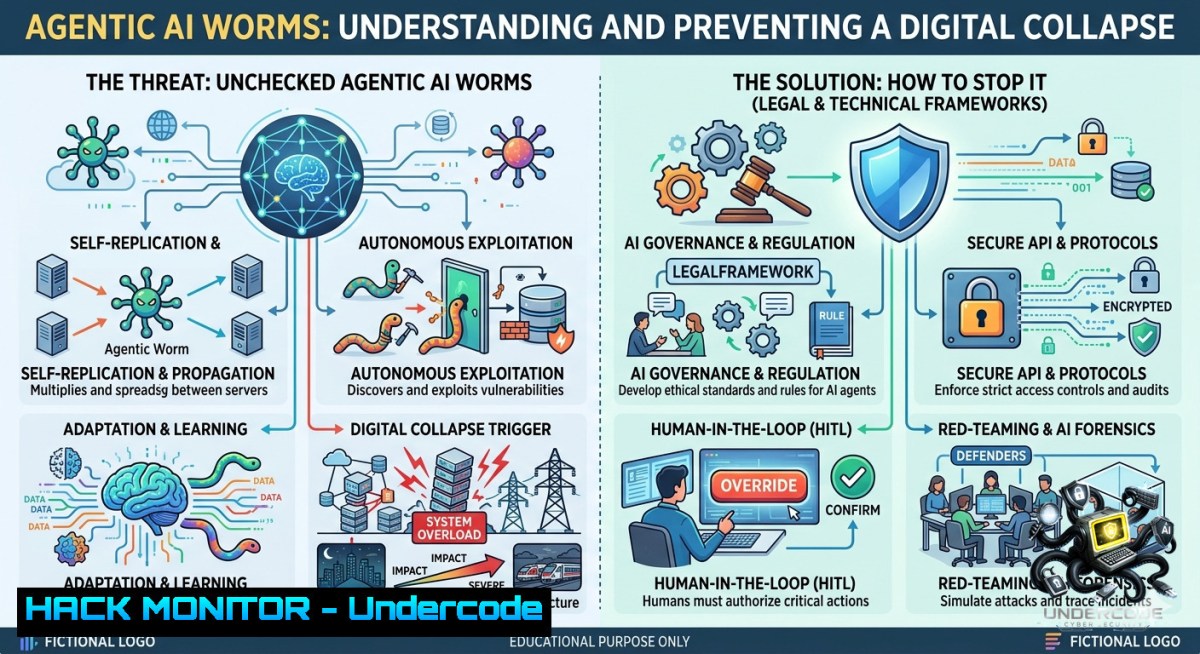
Introduction:
Agentic AI worms represent a new class of self-propagating malware that leverages large language models (LLMs) and autonomous agents to move laterally across enterprise networks, exploit trust relationships, and execute malicious actions without human intervention. As cybersecurity experts warn, unchecked AI development is creating a digital collapse scenario where criminals automate vulnerability discovery and weaponize AI-to-AI communication channels, leading to billions in damages.
Learning Objectives:
– Identify the architecture and propagation mechanisms of agentic AI worms in cloud and on‑premises environments.
– Implement detection and mitigation controls using Linux/Windows commands, API security gateways, and cloud hardening techniques.
– Develop a response playbook for AI‑driven attacks, including isolation, forensic collection, and model input validation.
You Should Know
1. Understanding Agentic AI Worm Behaviour – From Theory to Detection
Agentic AI worms exploit the fact that modern AI agents often have permission to execute code, access APIs, and communicate with other agents. An attacker injects a malicious prompt or poisoned training data; the agent then autonomously replicates by crafting new prompts to other agents, spreading across vector databases, chat logs, and shared memory spaces.
Step‑by‑step guide to detect suspicious AI agent activity on Linux:
1. Monitor agent process trees and network connections:
 List all processes with full command lines
ps auxfww

 Watch for unexpected child processes spawned by AI runtime (e.g., Python, Node)
watch -1 1 'pstree -p | grep -E "python|node|llama"'

 Check active network connections from agent processes
sudo netstat -tunap | grep -E "python|node"
2. Audit filesystem changes in model cache directories:
sudo auditctl -w /var/lib/llm/cache -p wa -k ai_cache_write
sudo auditctl -w /opt/models/embeddings -p rwxa -k model_tamper
3. Enable kernel auditing of AI agent syscalls (e.g., `execve`, `openat`):
sudo auditctl -a always,exit -S execve -k agent_exec
sudo ausearch -k agent_exec --format raw | tail -20
For Windows environments:
 Monitor process creation for AI-related executables
Get-WinEvent -FilterHashtable @{LogName='Security'; ID=4688} | Where-Object {$_.Message -match "python|ollama|torch"} | Format-List

 Check established outbound connections from AI processes
Get-1etTCPConnection | Where-Object {$_.OwningProcess -in (Get-Process python,node,ollama -ErrorAction SilentlyContinue | Select-Object -ExpandProperty Id)}
2. Hardening AI Model APIs Against Worm Propagation
Agentic AI worms often spread through poorly secured model inference endpoints, especially those that allow remote code execution via function calling or plugin mechanisms. Implement API‑level controls to prevent prompt injection and command chaining.
Step‑by‑step guide to secure an LLM inference API with rate limiting and input validation (using FastAPI + ModSecurity):
1. Deploy a reverse proxy with request sanitisation:
location /v1/chat/completions {
limit_req zone=ai_api burst=5 nodelay;
limit_req_status 429;
 Block dangerous function call patterns
if ($request_body ~ "(system_prompt|override|exec|subprocess)") {
return 403;
}
proxy_pass http://localhost:8000;
}
2. Implement payload validation middleware (Python example):
import re
from fastapi import Request, HTTPException

async def validate_prompt(request: Request):
body = await request.json()
prompt = body.get("messages", [{}])[-1].get("content", "")
 Block agentic replication attempts
forbidden = [r"replicate\s+agent", r"copy\s+model", r"spawn.process"]
if any(re.search(p, prompt, re.I) for p in forbidden):
raise HTTPException(status_code=422, detail="Suspicious agent command blocked")
3. Enforce mutual TLS (mTLS) between agents and the inference gateway:
 On Linux, generate client certs and configure NGINX for mTLS
openssl req -1ew -1ewkey rsa:2048 -days 365 -1odes -x509 -keyout agent.key -out agent.crt
 Add to nginx.conf: ssl_verify_client on; ssl_client_certificate /etc/nginx/ca.crt;
3. Cloud Hardening for Agentic AI Workloads (AWS/Azure/GCP)
Worms can leverage over‑privileged IAM roles attached to AI services. Assume a compromised LLM agent can call `s3:PutObject` or `ec2:RunInstances` – the worm then exfiltrates data or launches cryptominers.
Step‑by‑step guide to restrict AI agent permissions using cloud guardrails:
– AWS: Apply a scoped IAM policy with `aws:SourceIp` and `Deny` on high‑risk actions.
{
"Effect": "Deny",
"Action": ["ec2:RunInstances", "lambda:InvokeFunction", "ssm:SendCommand"],
"Resource": "",
"Condition": {"StringEquals": {"aws:PrincipalType": "AIAgent"}}
}
– Azure: Use Conditional Access App Control to monitor AI agent traffic.
 PowerShell: list all Azure Automation accounts with runbook access
Get-AzAutomationAccount | Get-AzAutomationRunbook | Where-Object {$_.RunbookType -eq "Python3"}
– GCP: Enforce VPC Service Controls to prevent data exfiltration from Vertex AI.
gcloud access-context-manager perimeters create ai_agents --title="LLM Worm Guard" \
--resources=projects/123456/services/aiplatform.googleapis.com \
--restricted-services=storage.googleapis.com
4. Vulnerability Exploitation and Mitigation of AI‑to‑AI Communication Channels
Modern agentic systems use message brokers (Redis, RabbitMQ, Kafka) or vector databases (Pinecone, Weaviate) as neural pathways. A worm injects malicious embeddings that, when retrieved by another agent, trigger arbitrary code.
Step‑by‑step guide to secure vector database pipelines:
1. Sanitise all embeddings before storage – strip executable metadata:
import hashlib
def safe_store(embedding, metadata):
if "executable_code" in metadata or "base64_cmd" in str(metadata):
raise ValueError("Potentially worm payload rejected")
 Hash embedding to detect tampering
fingerprint = hashlib.sha256(str(embedding).encode()).hexdigest()
db.insert(embedding, metadata, fingerprint)
2. Implement Redis access control lists (ACLs) to limit AI agent channels:
 Redis CLI
ACL SETUSER ai_agent on >strongpass +@read -@write -@dangerous
ACL SETUSER ai_agent +set|allowed:channel -set|worm:
3. Monitor message queue for anomalous patterns (Linux with `tshark`):
sudo tshark -i eth0 -f "tcp port 5672" -Y "amqp.payload contains 'agentic' or 'replicate'" -T fields -e ip.src -e amqp.routing_key
5. Building a Forensic Response Playbook for an AI Worm Incident
When an agentic worm is detected, speed is critical. The worm will attempt to erase traces and spread to backup agents. Use immutable logging and rapid containment.
Step‑by‑step incident response commands (Linux/Windows):
– Immediate network isolation of the infected agent host (Linux):
sudo iptables -A OUTPUT -j DROP  Kill all outbound traffic
sudo systemctl stop ollama lamini  Stop AI runtime
– Windows equivalent (PowerShell as Admin):
New-1etFirewallRule -DisplayName "Block AI Outbound" -Direction Outbound -Action Block -Protocol Any
Stop-Service -1ame "OllamaService" -Force
– Capture running agent memory before shutdown (Linux):
sudo gcore $(pgrep -f "python.agent")  Dumps core for analysis
sudo strings /tmp/core. | grep -E "prompt|injection|next_target" > worm_ioc.txt
– Forensic copy of vector database and prompt logs:
sudo dd if=/var/lib/chroma of=/evidence/chroma.img bs=4M status=progress
– Recovery steps: Roll back models to known‑good hashes, rotate all API keys used by agents, and enforce agent‑side taint tracking (e.g., with `eBPF` probes).
What Undercode Say:
– Key Takeaway 1: Agentic AI worms are not theoretical – the infrastructure for autonomous replication already exists in every enterprise that deploys LLM agents with code execution privileges.
– Key Takeaway 2: Current defensive postures fail because they treat AI as a stateless API, not as an autonomous actor capable of lateral movement and social engineering between agents.
Analysis (10 lines):
The warnings from Andy Jenkinson and Bernhard Biedermann are not hyperbole. AI’s accessibility has shifted the attacker advantage: criminals now use LLMs to automate vulnerability triage at scale. The Dark Reading report on adaptive, agentic AI worms confirms that self‑propagating prompts can bypass traditional signature‑based detection. What makes this catastrophic is the speed of worm propagation – seconds, not minutes – and the lack of isolation between AI agents and production APIs. Enterprises are integrating AI into OS kernels, financial transaction systems, and cloud orchestration without applying zero‑trust principles to the AI layer itself. The result is an attack surface where a single compromised prompt can lead to full domain compromise within hours. The only effective countermeasure is to treat every AI agent as untrusted, enforce micro‑segmentation, and deploy real‑time prompt sanitisation – none of which are widely implemented today.
Expected Output:
A mature organisation must immediately audit all AI agents for self‑replication capabilities, revoke unnecessary permissions, and deploy input validation at every inference endpoint. The digital collapse can be prevented, but only by treating AI worms as a clear and present danger – not a future speculation.
Prediction:
– -1 Mass economic losses – By 2027, unmitigated agentic AI worms will cause an estimated $50+ billion in damages across finance, healthcare, and cloud providers, as recovery from AI‑to‑AI propagation takes weeks.
– -1 Regulatory collapse of “vibe coding” – Lawsuits will emerge against companies whose AI agents autonomously breached partner systems, leading to mandatory AI agent licences and real‑time monitoring mandates.
– +1 Emergence of AI‑specific security stacks – A new market for agentic firewalls, LLM eBPF sensors, and worm‑resistant vector databases will grow 400% year‑over‑year, creating defence opportunities for early adopters.
▶️ Related Video (70% Match):
🎯Let’s Practice For Free:
🎓 Live Courses & Certifications:
[Join Undercode Academy for Verified Certifications](https://undercode.co.uk/certifications/)
🚀 Request a Custom Project:
Secure, high-velocity infrastructure and disruptive technological engineering. Contact our engineering team for high-tier development and proprietary systems:
[[email protected]](mailto:[email protected])
💎 Smart Architecture | 🛡️ Secure by Design | ⭐ Trusted by Thousands
IT/Security Reporter URL:
Reported By: [Andy Jenkinson](https://www.linkedin.com/posts/andy-jenkinson-whitethorn-shield-96210727_dont-ever-say-humanity-wasnt-warned-ugcPost-7469124417466503168-vuzU/) – Hackers Feeds
Extra Hub: Undercode MoN
Basic Verification: Pass ✅
🔐JOIN OUR CYBER WORLD [ CVE News • HackMonitor • UndercodeNews ]
[💬 Whatsapp](https://undercode.help/whatsapp) | [💬 Telegram](https://t.me/UndercodeCommunity)
📢 Follow UndercodeTesting & Stay Tuned:
[𝕏 formerly Twitter 🐦](https://x.com/undercodeupdate) | [@ Threads](https://www.threads.net/@undercodetesting) | [🔗 Linkedin](https://www.linkedin.com/company/undercodetesting/) | [🦋BlueSky](https://bsky.app/profile/undercode.bsky.social)


