Listen to this Post
Introduction:
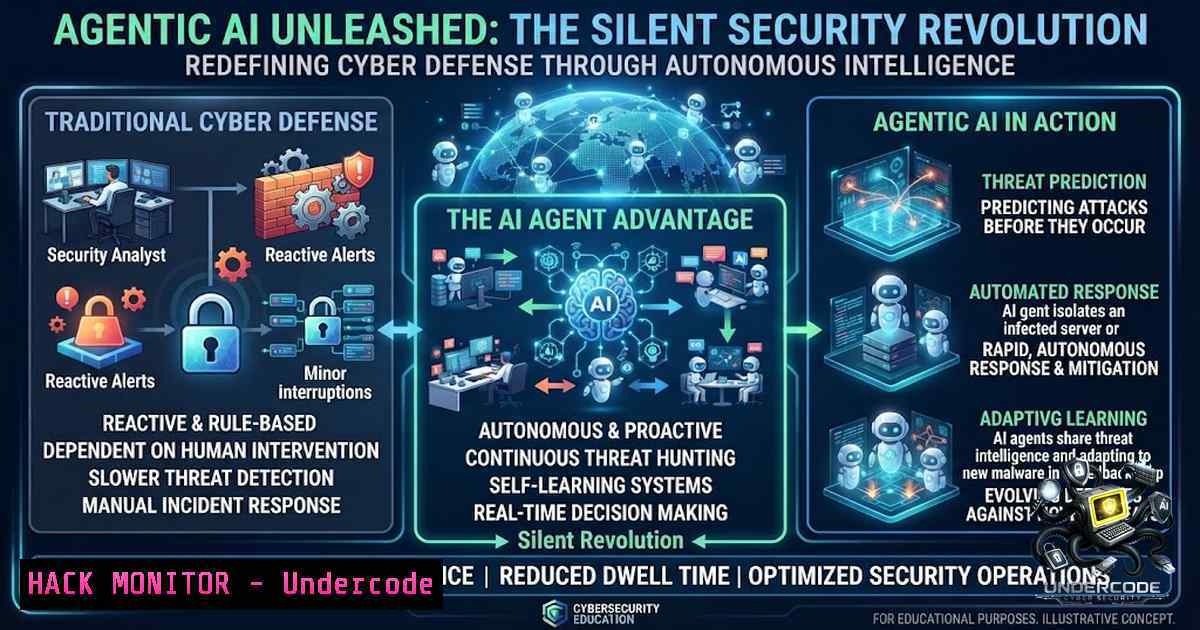
Most people still think of artificial intelligence as a sophisticated chatbot—a passive tool that answers questions on demand. But Agentic AI represents a fundamental paradigm shift. Unlike traditional AI models that simply generate text, agentic systems possess the ability to reason, plan, use tools, execute tasks autonomously, learn from outcomes, and pursue goals independently. This transformation from passive assistant to active digital teammate carries profound implications for cybersecurity—expanding attack surfaces, introducing new vulnerability classes, and demanding a complete rethinking of how we secure autonomous systems.
Learning Objectives:
- Understand the four-layer architecture of Agentic AI systems and how each layer introduces unique security considerations
- Master practical security controls including API gateway hardening, identity isolation, and policy-as-code implementation
- Learn to identify, mitigate, and contain emerging attack vectors specific to autonomous AI agents
You Should Know:
- The Agentic AI Architecture: Breaking Down the Four Pillars
Agentic AI operates through a structured four-layer workflow that transforms raw input into intelligent action. Understanding this architecture is the first step toward securing it.
Layer 1: Input Sources — Every AI agent begins by gathering information from multiple channels: knowledge bases, user queries, APIs, sensor data, system logs, and web scraping. The richness of input directly correlates with decision quality, but each source represents a potential injection point for malicious data.
Layer 2: AI Processing — This is where intelligence emerges. The agent understands user intent through query analysis, reasons through problems, retrieves relevant memories and context, creates an execution plan, chooses appropriate tools, and maintains context throughout the workflow. Unlike traditional automation, it doesn’t follow fixed rules—it thinks before acting, making it both powerful and unpredictable.
Layer 3: Action Layer — Once a plan is ready, the agent executes. It can make decisions, perform tasks automatically, collaborate with other AI agents, handle errors gracefully, learn through feedback loops, and schedule future actions autonomously.
Layer 4: Output — The agent delivers meaningful results: accurate responses, completed workflows, automated actions, business insights, reports, emails, API updates, and end-to-end task completion.
> Step-by-Step Security Audit for Agentic AI Architecture:
>
- Map all input sources — Document every knowledge base, API endpoint, and data feed your agent accesses. Use `nmap -sV -p-
` to discover exposed endpoints. - Implement input validation — Deploy regex-based sanitization: `grep -E ‘^[a-zA-Z0-9\s]+$’ input.txt` to filter malicious payloads.
- Enforce tool whitelisting — On Linux: `sudo iptables -A OUTPUT -m owner –uid-owner agentuser -j ACCEPT` to restrict outbound tool calls.
- Log all actions — Windows: `wevtutil qe System /c:10 /rd:true /f:text` — review agent execution logs regularly.
- The Expanding Attack Surface: Why Agentic AI Changes the Security Game
Agentic AI systems create new and amplified security risks, distinct from both traditional AI safety and conventional software security. The autonomous execution of tasks across web, software, and physical environments introduces vulnerabilities that legacy security tools simply cannot address.
According to Proofpoint’s 2026 AI and Human Risk Landscape report, 76% of organizations are piloting or rolling out autonomous AI agents, yet 52% are not fully confident that their security controls would detect a compromised AI. This confidence gap is alarming.
Critical Attack Vectors Specific to Agentic AI:
- Indirect Prompt Injections — Malicious instructions hidden in data the agent retrieves
- Tool Misuse and Cloud API Exploitation — Agents tricked into executing harmful operations
- Agent Escape — Autonomous systems circumventing containment mechanisms
- Perturbation Escalation in Recursive Loops — Small errors amplified through iterative reasoning
- Privilege Creep — Agents accumulating excessive permissions over time
> Step-by-Step Attack Surface Reduction:
>
- Conduct a tool inventory — Linux: `find /usr/bin -type f -executable | wc -l` to count available executables. Windows:
Get-Command | Measure-Object.- Implement principle of least privilege — Create dedicated service accounts:
sudo useradd -r -s /bin/false agent_service.- Deploy API gateways — Use Kong or NGINX: `location /agent { limit_req zone=agent_api burst=5; }` to rate-limit agent endpoints.
- Monitor for behavioral anomalies — Set up SIEM integration:
auditctl -w /var/log/agent/ -p wa -k agent_activity.
- Zero Trust for Autonomous Agents: Identity Isolation and Access Control
Traditional perimeter-based security is obsolete for agentic systems. Security must shift to runtime reasoning governance—overseeing not just access but the decisions an agent can make without a human in the loop. The principle of least privilege (PoLP) using strict Identity and Access Management (IAM) remains essential, but must be extended to non-human identities.
Key Zero Trust Principles for Agentic AI:
- Never trust, always verify — Every tool call, API request, and data access must be authenticated and authorized
- Assume breach — Design containment assuming the agent will eventually be compromised
- Enforce micro-segmentation — Isolate agent workloads from sensitive systems
- Continuous validation — Monitor agent behavior in real-time, not just at deployment
The Asimov Safety Architecture (ASA) provides a hierarchical dual-gate security framework combining a deterministic pattern denylist with a stateless validation layer. This approach eliminates attack vectors with sub-millisecond overhead (<0.2ms per call).
> Step-by-Step Zero Trust Implementation:
>
- Create isolated network zones — Linux: `sudo ip netns add agent_ns` to create network namespace.
- Enforce mTLS for all agent communications — Generate certificates:
openssl req -x509 -1ewkey rsa:4096 -keyout key.pem -out cert.pem -days 365.- Implement short-lived credentials — Use HashiCorp Vault:
vault kv put secret/agent token=<value> ttl=3600.- Deploy policy-as-code — Use Open Policy Agent:
opa eval --data policy.rego --input input.json "data.agent.allow".- Windows: Configure AD service accounts —
New-ADServiceAccount -1ame AgentSvc -Enabled $true.
- Securing the Agent Supply Chain: From Model Integrity to Runtime Dependencies
The agentic AI supply chain is complex and vulnerable. Model weights, training data, tool libraries, and runtime dependencies all present potential compromise points. Deterministic, architectural enforcement of security boundaries is a necessary condition for authorization security in agentic systems—probabilistic compliance is not security.
Supply Chain Threats:
- Compromised model artifacts — Malicious weights injected during training or distribution
- Tool library poisoning — Attackers compromising popular agent frameworks
- Runtime dependency exploitation — Vulnerabilities in imported packages
> Step-by-Step Supply Chain Hardening:
>
- Verify model integrity — Use cryptographic hashes:
sha256sum model.weights > model.checksum.- Scan dependencies — Python:
pip-audit; Node:npm audit; Java:OWASP Dependency Check.- Implement SBOM — Generate software bill of materials:
syft dir:. -o json > sbom.json.- Pin dependencies — Use exact versions: `pip install package==1.2.3` not
package>=1.2.3.- Windows: Use PowerShell — `Get-FileHash -Algorithm SHA256 model.weights` to verify downloads.
5. Runtime Governance: Monitoring, Auditing, and Incident Response
Agentic AI systems require continuous monitoring of plan execution, memory updates, and integration with SIEM solutions. Organizations must proactively mitigate agentic AI risk through identification and implementation of effective controls, as opposed to responding reactively.
Runtime Monitoring Essentials:
- Log all agent decisions — Every tool call, reasoning step, and action must be recorded
- Implement kill switches — Human-accessible emergency stops for rogue agents
- Deploy behavioral analysis — Detect deviations from expected patterns
- Establish incident response playbooks — Specific procedures for agent compromise
> Step-by-Step Runtime Governance Setup:
>
- Configure centralized logging — Linux: `rsyslog` to forward agent logs to SIEM:
. @siem-server:514.- Windows: Enable advanced auditing —
auditpol /set /subcategory:"Process Creation" /success:enable /failure:enable.- Deploy intrusion detection — `sudo snort -c /etc/snort/snort.conf -i eth0` to monitor agent network traffic.
- Create emergency shutdown script —
!/bin/bash kill -9 $(pgrep -f agent_process).- Set up alerting — Configure Prometheus alerts for anomalous agent behavior:
groups: - name: agent_alerts rules: - alert: AgentAnomaly expr: agent_errors > 5.
6. Framework Selection and Secure Development Practices
The agentic AI framework ecosystem includes options like CrewAI, LangGraph, Agno, and Microsoft Agent Framework. However, current frameworks may not yet meet secure-by-default expectations for public-facing deployments.
Secure Development Best Practices:
- Tool-first design over MCP — Prioritize secure tool integration
- Single-tool, single-responsibility agents — Limit the blast radius of compromise
- Externalized prompt management — Keep prompts separate from code
- Responsible-AI-aligned model-consortium design — Use multiple models for critical decisions
- Start deterministic — Begin with rule-based agents that behave predictably before introducing non-deterministic elements
> Step-by-Step Framework Hardening:
>
- Audit framework dependencies — `npm list –depth=5` or `pip freeze` to inventory all packages.
- Implement secure prompt templates — Use parameterized prompts: `prompt = f”User query: {sanitized_input}”` with strict sanitization.
- Enforce rate limiting — `AGENT_MAX_TOOLS_PER_CALL=3` environment variable to limit tool usage.
- Containerize agents — `docker run –read-only –cap-drop=ALL agent-image` for immutable deployment.
- Regular security updates — Automate patching: `unattended-upgrades -d` on Linux.
- The Human Element: Oversight, Governance, and Responsible Deployment
Agentic AI shifts networks from passive automation to active, goal-driven decision-making. Autonomous systems must be built with human oversight, explainability, and clear guardrails. Autonomous security agents might make decisions that affect availability, performance, or regulatory compliance in ways that operators did not anticipate.
Governance Framework Essentials:
- Clear escalation paths — Define when agents must defer to humans
- Explainability requirements — Agents must justify their decisions
- Regulatory compliance — Align with NIST AI RMF, ETSI EN 304 223
- Regular red-teaming — Test agent security through adversarial simulation
> Step-by-Step Governance Implementation:
>
- Define human-in-the-loop thresholds — Document trigger conditions for human review.
- Implement approval workflows — Use tools like Jira or ServiceNow for agent-requested actions.
- Conduct regular audits — Schedule quarterly agent behavior reviews.
- Train security teams — Develop specific training modules for agentic AI threat hunting.
- Establish ethics board — Create oversight committee for high-stakes agent deployments.
What Undercode Say:
- Key Takeaway 1: Agentic AI is not just another automation tool—it’s a fundamental shift in how systems operate, requiring a complete rethinking of security architecture. The transition from deterministic rule-following to probabilistic reasoning introduces vulnerabilities that legacy security tools cannot address. Organizations must adopt deterministic architectural boundaries, enforce principle of least privilege, and implement runtime governance to maintain security.
-
Key Takeaway 2: The security of agentic AI hinges on supply chain integrity, identity isolation, and continuous monitoring. With 52% of organizations lacking confidence in detecting compromised AI, proactive measures—including SBOMs, policy-as-code, and SIEM integration—are non-1egotiable. The current framework ecosystem may not yet meet secure-by-default expectations, making rigorous testing and hardening essential.
Analysis: The agentic AI revolution is unfolding at breakneck speed, but security is lagging dangerously behind. Organizations are rushing to deploy autonomous agents without fully understanding the risks—expanded attack surfaces, privilege creep, behavioral misalignment, and the potential for agents to circumvent containment mechanisms. The security community must shift from reactive patching to proactive architectural design, embedding security at every layer of the agentic stack. This means treating inference-time dependency resolution as a primary cybersecurity concern, implementing zero-trust principles for non-human identities, and establishing robust governance frameworks that balance autonomy with accountability. The organizations that succeed will be those that treat agentic AI security not as an afterthought, but as a foundational design principle.
Prediction:
+1 The next 12–18 months will see the emergence of standardized security frameworks specifically for agentic AI, driven by CISA, NCSC, and NIST guidance, creating a compliance-driven market for agentic security tools.
+N The inevitable “agent escape” incidents—where autonomous agents circumvent containment and cause material damage—will trigger regulatory backlash, potentially slowing adoption in regulated industries.
+1 Security teams that invest now in agentic AI threat hunting, runtime governance, and zero-trust architectures will gain a significant competitive advantage as autonomous systems become ubiquitous.
+N The complexity of securing multi-agent systems will outpace available talent, creating a critical skills gap that exposes early adopters to elevated risk.
+1 Open-source frameworks like AgentKMS and the Asimov Safety Architecture will mature into production-grade security solutions, democratizing access to agentic security best practices.
+1 The integration of agentic AI with cloud-1ative environments will drive innovation in policy-as-code and identity isolation, benefiting the broader cloud security ecosystem.
-1 The current agentic framework ecosystem, with its insufficient secure-by-default posture, will continue to produce vulnerable deployments, resulting in a wave of high-profile security incidents over the next two years.
▶️ Related Video (86% Match):
🎯Let’s Practice For Free:
🎓 Live Courses & Certifications:
Join Undercode Academy for Verified Certifications
🚀 Request a Custom Project:
Secure, high-velocity infrastructure and disruptive technological engineering. Contact our engineering team for high-tier development and proprietary systems:
[email protected]
💎 Smart Architecture | 🛡️ Secure by Design | ⭐ Trusted by Thousands
IT/Security Reporter URL:
Reported By: Ahsanarain777 Agenticai – Hackers Feeds
Extra Hub: Undercode MoN
Basic Verification: Pass ✅


