
Listen to this Post
Introduction:
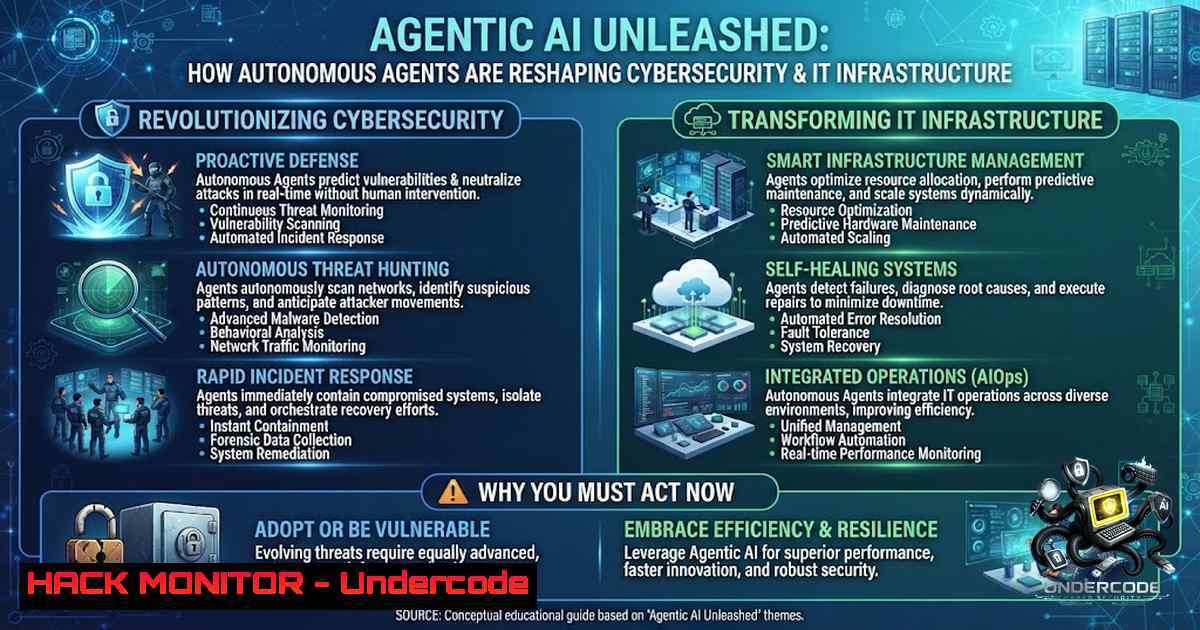
Agentic AI represents the next evolutionary leap in artificial intelligence—systems that don’t just respond to prompts but autonomously plan, execute, and adapt across complex digital ecosystems. Unlike traditional software that follows rigid rules, agentic AI leverages foundation models to perceive environments, make decisions, and take actions with minimal human intervention. As these autonomous agents become integral to IT operations, cybersecurity, and cloud infrastructure, understanding their architecture, securing their deployments, and mastering their implementation is no longer optional—it’s imperative for every security professional and IT architect.
Learning Objectives:
- Understand the core architecture of Agentic AI systems, including model selection, tool integration, and orchestration layers.
- Learn to secure the AI agent pipeline across development, deployment, and runtime environments.
- Master practical implementation of autonomous agents with hands-on Linux, Windows, and cloud-1ative commands.
- What Is Agentic AI and Why Does It Matter for Security?
Agentic AI is not just another buzzword—it’s a paradigm shift. At its core, an AI agent is an autonomous or semi-autonomous software entity that perceives its digital environment, makes decisions, and acts to achieve predefined goals. According to Gartner, an AI agent “uses AI techniques to perceive, decide, and act in its digital or physical environment, adapting its behavior over time”. This adaptability is what sets agentic systems apart from traditional automation.
From a security perspective, this autonomy introduces both opportunity and risk. On one hand, AI agents can autonomously detect threats, patch vulnerabilities, and orchestrate incident response at machine speed. On the other hand, a compromised agent could become an autonomous attacker—executing malicious actions with the same speed and adaptability. The security community must therefore treat agentic AI not as a simple tool, but as a privileged identity that requires zero-trust principles, continuous monitoring, and rigorous access controls.
2. The Agent Architecture: Models, Tools, and Orchestration
A true AI agent requires three core components: a model (the brain), tools (the hands), and an orchestration layer (the nervous system). The model—typically a large language model (LLM) or multimodal foundation model—provides reasoning and decision-making capabilities. Tools are external functions or APIs that the agent can invoke to perform actions, such as querying a database, sending an email, or executing a system command. The orchestration layer manages the agent’s workflow, including task decomposition, sub-task monitoring, and execution strategy adaptation.
To understand this architecture in practice, consider the following conceptual deployment on a Linux server:
 Install a lightweight agent framework (e.g., LangChain or AutoGen)
pip install langchain langchain-openai autogen

Set up environment variables for API keys
export OPENAI_API_KEY="your-api-key"
export AGENT_TOOLS_PATH="/opt/agent_tools"

Create a directory for agent tools and scripts
mkdir -p $AGENT_TOOLS_PATH
chmod 750 $AGENT_TOOLS_PATH
On Windows (PowerShell), the equivalent setup might look like:
 Install Python packages
pip install langchain langchain-openai autogen

Set environment variables
$env:OPENAI_API_KEY="your-api-key"
$env:AGENT_TOOLS_PATH="C:\AgentTools"

Create the tools directory
New-Item -ItemType Directory -Path $env:AGENT_TOOLS_PATH -Force
This foundational setup allows you to begin building agents that can reason, plan, and act. However, security must be baked into every layer—from model selection (preferring open-weight models that can be audited) to tool definition (restricting which system commands are exposed).
- Securing the AI Agent Pipeline: From Development to Deployment
The agent pipeline encompasses model training/fine-tuning, tool definition, prompt engineering, and runtime execution. Each stage presents unique security challenges.
Model Security: Ensure that base models are free from backdoors or poisoned data. Use model signing and verification:
 Verify model integrity using SHA-256 checksums
sha256sum /path/to/model.bin
 Compare against a known-good hash from a trusted source
Prompt Injection Defense: Agentic systems are vulnerable to prompt injection, where an attacker manipulates input to override system instructions. Implement input sanitization and context isolation:
 Example: Sanitize user input before passing to the agent
def sanitize_input(user_input: str) -> str:
 Remove control characters and limit length
import re
sanitized = re.sub(r'[\x00-\x1F\x7F]', '', user_input)
return sanitized[:1000]  Enforce maximum length
Tool Access Control: Restrict which tools the agent can invoke and under what conditions. Use role-based access control (RBAC) and implement a “human-in-the-loop” for high-risk actions:
 Define a tool with explicit permissions
from langchain.tools import Tool

def safe_execute_command(command: str) -> str:
allowed_commands = ['ls', 'whoami', 'date']
if any(command.startswith(cmd) for cmd in allowed_commands):
return subprocess.run(command, shell=True, capture_output=True).stdout
else:
return "Error: Command not allowed"

safe_tool = Tool(name="SafeShell", func=safe_execute_command, description="Execute safe shell commands")
4. Hardening Cloud Environments for Agentic Workloads
Deploying AI agents in the cloud requires a hardened infrastructure that can withstand both external attacks and potential agent malfunctions. Key practices include:
- Network Isolation: Place agents in dedicated virtual networks (VPCs) with strict inbound/outbound rules. Use service meshes (e.g., Istio) for micro-segmentation.
- Secrets Management: Never hardcode API keys or credentials. Use cloud-1ative secrets managers:
 AWS: Store and retrieve a secret
aws secretsmanager create-secret --1ame agent-api-key --secret-string "your-key"
aws secretsmanager get-secret-value --secret-id agent-api-key --query SecretString --output text
 Azure: Store and retrieve a secret
az keyvault secret set --vault-1ame my-keyvault --1ame agent-api-key --value "your-key"
az keyvault secret show --vault-1ame my-keyvault --1ame agent-api-key --query value -o tsv
- Resource Quotas: Limit CPU, memory, and GPU usage to prevent runaway agents from exhausting resources:
 Docker: Run container with resource limits
docker run --memory="4g" --cpus="2.0" my-agent-image
- Logging and Auditing: Enable comprehensive audit logs for all agent actions. Use centralized logging (ELK stack or cloud-1ative solutions) to detect anomalies.
5. API Security in Multi-Agent Systems
In a multi-agent ecosystem, agents communicate via APIs, making API security paramount. Every API call between agents, or between an agent and an external service, must be authenticated, authorized, and encrypted.
API Gateway Configuration: Deploy an API gateway (e.g., Kong, AWS API Gateway) to enforce authentication (OAuth2/JWT), rate limiting, and request validation.
mTLS for Agent-to-Agent Communication: Use mutual TLS to ensure that only authenticated agents can communicate:
 Generate self-signed certificates for mTLS
openssl req -x509 -1ewkey rsa:4096 -keyout agent-key.pem -out agent-cert.pem -days 365 -1odes
Input Validation: Validate all incoming API payloads against strict schemas to prevent injection attacks:
from pydantic import BaseModel, ValidationError

class AgentRequest(BaseModel):
task: str
context: dict

def validate_request(data: dict):
try:
req = AgentRequest(data)
return req
except ValidationError as e:
raise ValueError("Invalid request format")
6. Practical Implementation: Building a Secure AI Agent
Let’s walk through building a simple, secure AI agent that can perform system diagnostics and send alerts. This example uses LangChain and OpenAI, with security controls integrated at each step.
Step 1: Set Up the Environment (Linux)
 Create a dedicated virtual environment
python3 -m venv agent-env
source agent-env/bin/activate

Install required packages
pip install langchain langchain-openai python-dotenv psutil requests
Step 2: Define the Agent with Secure Tools
 agent.py
import os
import subprocess
import psutil
import requests
from langchain.agents import Tool, AgentExecutor, create_react_agent
from langchain_openai import ChatOpenAI
from langchain.prompts import PromptTemplate

Load API key from environment
OPENAI_API_KEY = os.getenv("OPENAI_API_KEY")
if not OPENAI_API_KEY:
raise ValueError("OPENAI_API_KEY not set")

Define safe tools
def get_system_health() -> str:
"""Get CPU and memory usage."""
cpu = psutil.cpu_percent(interval=1)
mem = psutil.virtual_memory()
return f"CPU: {cpu}%, Memory: {mem.percent}%"

def send_alert(message: str) -> str:
"""Send an alert via webhook (simulated)."""
webhook_url = os.getenv("ALERT_WEBHOOK")
if not webhook_url:
return "Error: Alert webhook not configured"
try:
response = requests.post(webhook_url, json={"text": message}, timeout=5)
return f"Alert sent: {response.status_code}"
except Exception as e:
return f"Alert failed: {str(e)}"

tools = [
Tool(name="SystemHealth", func=get_system_health, description="Get system health metrics"),
Tool(name="SendAlert", func=send_alert, description="Send an alert message"),
]

Initialize the model
llm = ChatOpenAI(model="gpt-4", temperature=0)

Create the agent
prompt = PromptTemplate.from_template(
"You are a secure monitoring agent. Use the available tools to check system health and alert if issues are found.\n\n{input}\n\n{agent_scratchpad}"
)
agent = create_react_agent(llm, tools, prompt)
agent_executor = AgentExecutor(agent=agent, tools=tools, verbose=True, max_iterations=3)

Run the agent
if <strong>name</strong> == "<strong>main</strong>":
result = agent_executor.invoke({"input": "Check system health and send an alert if CPU > 80%"})
print(result)
Step 3: Run with Security Hardening
 Run with limited system permissions using a dedicated user
sudo useradd -m -s /bin/bash agentuser
sudo -u agentuser python3 agent.py
Step 4: Containerize for Production
 Dockerfile
FROM python:3.11-slim
RUN useradd -m agentuser
WORKDIR /app
COPY requirements.txt .
RUN pip install --1o-cache-dir -r requirements.txt
COPY agent.py .
USER agentuser
CMD ["python", "agent.py"]
 Build and run the container with resource limits and read-only root filesystem
docker build -t secure-agent .
docker run --rm --read-only --memory="2g" --cpus="1.0" -e OPENAI_API_KEY -e ALERT_WEBHOOK secure-agent
7. Monitoring and Auditing Autonomous Agents
Continuous monitoring is critical for detecting anomalous agent behavior. Implement the following:
- Action Logging: Log every tool invocation, including input parameters and outputs.
- Anomaly Detection: Use statistical models to detect deviations from normal behavior patterns (e.g., unusual API call frequency, unexpected tool combinations).
- Periodic Audits: Regularly review agent logs and decision traces to ensure compliance with security policies.
Linux Commands for Log Analysis:
 Monitor agent logs in real-time
tail -f /var/log/agent.log | grep -E "ERROR|WARNING"

Analyze API call frequency
grep "API Call" /var/log/agent.log | cut -d' ' -f4 | sort | uniq -c | sort -1r
Windows PowerShell for Log Analysis:
 Get recent errors from the event log
Get-EventLog -LogName Application -EntryType Error -1ewest 50 | Where-Object { $_.Source -eq "Agent" }

Count tool invocations by type
Select-String -Path "C:\Logs\agent.log" -Pattern "Tool: " | ForEach-Object { $_ -replace ".Tool: ", "" } | Group-Object | Sort-Object Count -Descending
What Undercode Say:
- Key Takeaway 1: Agentic AI is not a futuristic concept—it’s here, and it’s already reshaping how we build and secure IT systems. The distinction between “AI agents” and “Agentic AI” is crucial: agents provide the hands and feet, while agentic AI provides the brain and the plan. Security professionals must treat both as integrated entities.
-
Key Takeaway 2: The security of agentic systems cannot be an afterthought. From model selection to runtime monitoring, every layer must be hardened. The most critical vulnerabilities are not in the models themselves but in the tool interfaces and orchestration logic—areas that are often overlooked in traditional security assessments.
Analysis: The convergence of AI and cybersecurity is creating both unprecedented opportunities and novel threats. Agentic AI can automate defensive operations at scale, but it also introduces new attack surfaces—prompt injection, tool abuse, and autonomous malware. Organizations that adopt agentic AI must simultaneously invest in AI-specific security controls, including input sanitization, tool access policies, and continuous behavioral monitoring. The skills required to secure these systems—combining AI/ML knowledge with traditional security engineering—are currently in short supply, making this a high-value area for professional development.
Prediction:
- +1 The agentic AI market is projected to grow from $7.29 billion in 2025 to over $88 billion by 2032, representing a CAGR of over 42%. This explosive growth will drive massive investment in AI security training and tooling, creating a booming job market for professionals with expertise in both AI and cybersecurity.
-
+1 As agentic systems become more capable, they will enable fully autonomous security operations centers (SOCs) that can detect, investigate, and respond to threats in real-time, drastically reducing mean time to detection (MTTD) and mean time to response (MTTR).
-
-1 The same autonomy that makes agentic AI powerful also makes it dangerous. A single compromised agent with broad tool access could execute a devastating attack faster than any human could respond. Without robust guardrails, the risk of catastrophic AI-driven incidents will escalate.
-
-1 Regulatory frameworks are struggling to keep pace with agentic AI. The lack of clear legal and ethical guidelines for autonomous decision-making will create compliance headaches and potential liability issues for organizations deploying these systems.
-
+1 The open-source community is rapidly developing security frameworks specifically for agentic systems, including tools for prompt injection detection, behavioral monitoring, and policy enforcement. These tools will democratize secure AI development and reduce the barrier to entry for smaller organizations.
▶️ Related Video (70% Match):
https://www.youtube.com/watch?v=0SQCxeq6ESU
🎯Let’s Practice For Free:
🎓 Live Courses & Certifications:
Join Undercode Academy for Verified Certifications
🚀 Request a Custom Project:
Secure, high-velocity infrastructure and disruptive technological engineering. Contact our engineering team for high-tier development and proprietary systems:
[email protected]
💎 Smart Architecture | 🛡️ Secure by Design | ⭐ Trusted by Thousands
IT/Security Reporter URL:
Reported By: Ali Ahmad – Hackers Feeds
Extra Hub: Undercode MoN
Basic Verification: Pass ✅


