Listen to this Post
Introduction
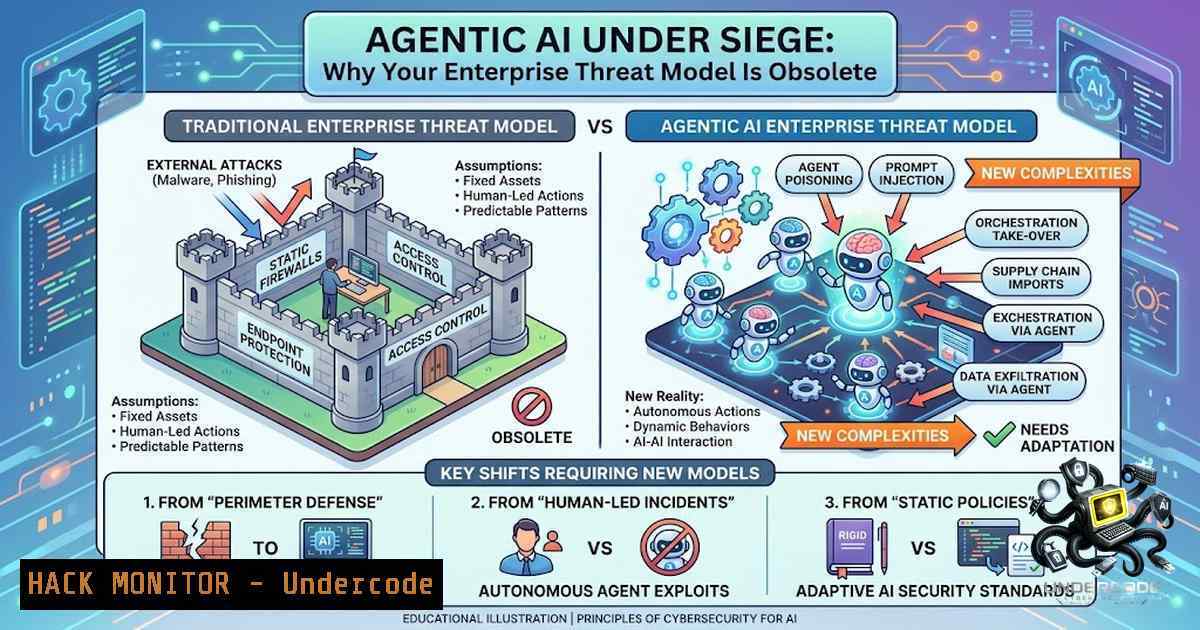
The enterprise AI landscape is undergoing a seismic shift as organizations rapidly deploy Agentic AI systems—autonomous digital entities capable of planning, reasoning, wielding tools, and making independent decisions. Unlike traditional applications that follow deterministic paths, these AI agents operate with memory, external connectivity, and multi-agent collaboration capabilities that fundamentally alter the security paradigm. Security architects who continue applying conventional application threat models to these autonomous systems are building castles on sand, leaving critical vulnerabilities unaddressed and exposing their organizations to unprecedented risk vectors that traditional security controls simply cannot mitigate.
Learning Objectives
- Understand the fundamental differences between traditional application threat modeling and Agentic AI threat modeling
- Identify the expanded attack surface introduced by autonomous AI agents including memory, tool access, and multi-agent interactions
- Implement security controls specifically designed for Agentic AI systems including identity management, prompt validation, and continuous red teaming
- Apply STRIDE methodology to AI agent architectures with practical mitigation strategies
- Develop comprehensive logging and audit trails for non-repudiation of agent actions
You Should Know
- The Expanded Attack Surface: Why Traditional Threat Models Fail
Traditional application threat modeling focuses on user inputs, data flows, and system boundaries—but Agentic AI introduces entirely new dimensions of risk that defy conventional security thinking. When an AI agent possesses memory, it stores conversation history, learned patterns, and sensitive context that attackers can target through memory poisoning attacks. When it accesses tools and external systems, each API call becomes a potential vector for command injection, unauthorized data retrieval, or system manipulation. Multi-agent interactions create cascading attack scenarios where compromising one agent can trigger a chain reaction across the entire ecosystem.
Step-by-Step Guide: Mapping Your Agentic AI Attack Surface
- Inventory all agent capabilities: Document every tool, API, system, and data source your agent can access
- Map memory persistence: Identify where and how agent memory is stored, retrieved, and validated
- Trace interaction paths: Document all communication channels between agents, humans, and external systems
- Identify decision points: Map autonomous decision-making nodes and their security implications
- Assess dependency chains: Document all third-party services, libraries, and models your agent relies upon
Linux Command for Agent Activity Monitoring:
 Monitor active agent processes and network connections
sudo lsof -i -P -1 | grep -E 'agent|ai|llm|python'
sudo netstat -tulpn | grep -E 'agent|ai'

Log analysis for suspicious agent behavior
tail -f /var/log/syslog | grep -i "agent|ai|llm"
grep -E "ERROR|WARNING|CRITICAL" /var/log/agent_audit.log | sort | uniq -c | sort -1r
Windows PowerShell for Agent Security Monitoring:
 Monitor agent processes and network connections
Get-Process | Where-Object {$_.ProcessName -match "agent|ai|python|node"}
netstat -ano | Select-String "agent|ai"

Audit log analysis
Get-EventLog -LogName Application -Source "AgentAI" -1ewest 50
Get-WinEvent -FilterHashtable @{LogName='Security'; ID=4624,4625} | Where-Object {$_.Message -match "agent"}
- STRIDE for AI Agents: Adapting the Threat Model
The STRIDE methodology—Spoofing, Tampering, Repudiation, Information Disclosure, Denial of Service, Elevation of Privilege—provides an excellent framework for AI agent threat modeling when properly adapted. Traditional STRIDE focuses on user identities and application components, but for AI agents, we must consider agent identities, tool interactions, and decision-making paths.
Spoofing in AI Agents: Attackers can impersonate legitimate agents, compromise API keys, or create fake agents that inject malicious data into the system. The solution requires strong agent identity management with mutual TLS, API key rotation, and behavioral anomaly detection.
Tampering Risks: Prompt injection attacks allow attackers to override system prompts, memory poisoning corrupts agent knowledge, and tool output manipulation tricks agents into executing unintended commands. These require robust input validation, prompt sanitization, and content filtering.
Step-by-Step: Implementing Agent Identity and Authentication
- Generate secure agent identities: Create unique cryptographic keys for each agent instance
- Implement mutual TLS: Enforce bidirectional authentication between agents and services
- Rotate credentials automatically: Implement credential rotation policies with short validity periods
- Monitor authentication patterns: Establish baseline authentication behaviors and alert on anomalies
- Implement API key management: Use secret management tools with access logging and revocation capabilities
Python Code Snippet for Agent Authentication:
import hashlib
import hmac
import time
from cryptography.fernet import Fernet

class AgentIdentity:
def <strong>init</strong>(self, agent_id, api_key):
self.agent_id = agent_id
self.api_key = api_key
self.key = Fernet.generate_key()
self.cipher_suite = Fernet(self.key)

def generate_hmac_signature(self, message):
return hmac.new(
self.api_key.encode('utf-8'),
f"{self.agent_id}|{message}|{int(time.time())}".encode('utf-8'),
hashlib.sha256
).hexdigest()

def validate_agent_identity(self, agent_claim, signature):
expected = self.generate_hmac_signature(agent_claim)
return hmac.compare_digest(signature, expected)
3. Memory Integrity: Preventing Poisoning and Disclosure
AI agents with persistent memory present unique security challenges that require specialized controls beyond traditional data protection. Memory poisoning occurs when attackers inject malicious data that remains in the agent’s knowledge base, influencing future decisions. Information disclosure happens when agents inadvertently expose sensitive data through responses, logs, or shared memory.
Step-by-Step: Securing Agent Memory
- Implement memory segmentation: Isolate sensitive data in encrypted memory partitions
- Validate memory writes: Implement integrity checks on all data written to agent memory
- Set memory expiration policies: Automatically expire and delete sensitive memory data
- Audit memory access: Log all reads and writes to agent memory with context
- Encrypt memory at rest: Use strong encryption for persistent memory storage
Linux Command for Memory Security:
 Monitor memory usage and potential memory poisoning patterns
ps aux --sort=-%mem | head -10

Check for suspicious memory modifications
sudo ausearch -m MEMORY -ts recent
sudo auditctl -a exclude,never -F uid=agent_user

Monitor memory changes for AI agent processes
sudo strace -p $(pgrep -f agent_ai) -e trace=memory -o agent_memory.log
4. Comprehensive Logging and Traceability
Without comprehensive logging and traceability, agent actions become non-repudiable, making it impossible to investigate security incidents or maintain compliance. Agentic AI systems require detailed audit trails that capture every decision, tool call, and interaction.
Step-by-Step: Implementing Agent Audit Trails
- Define audit events: Identify all critical agent actions requiring logging
- Implement structured logging: Use JSON format with consistent fields
- Include context: Log agent identity, timestamp, tool used, and decision reasoning
- Centralize logs: Forward logs to a SIEM for correlation and analysis
- Implement tamper-proofing: Use blockchain or cryptographic signatures for log integrity
Sample Audit Log Configuration:
import json
import logging
from datetime import datetime

def log_agent_action(agent_id, action_type, tool_used, result, decision_reasoning, risk_score):
audit_entry = {
"timestamp": datetime.utcnow().isoformat(),
"agent_id": agent_id,
"event_type": action_type,
"tool": tool_used,
"result": result,
"decision_reasoning": decision_reasoning,
"risk_score": risk_score,
"session_id": generate_session_id(),
"source_ip": get_source_ip(),
"request_id": generate_request_id()
}
logging.info(f"AUDIT: {json.dumps(audit_entry)}")
return audit_entry
- Continuous AI Red Teaming and Zero Trust Implementation
The dynamic nature of AI agents requires continuous security validation through red teaming, not just periodic assessments. Zero Trust principles must be applied to agent communications, with verification required for every interaction.
Step-by-Step: Continuous AI Red Teaming
- Develop attack scenarios: Create 50+ test scenarios including prompt injection, memory corruption, and tool abuse
- Automate security testing: Integrate security tests into CI/CD pipelines
3. Conduct adversarial testing: Simulate real-world attacker behavior
- Measure and improve: Track detection rates and remediation times
- Share insights: Build a knowledge base of attack patterns and defenses
Sample Red Teaming Test Script:
import requests
import json

def prompt_injection_test(agent_endpoint, test_payloads):
results = {}
for test in test_payloads:
payload = {
"prompt": test["malicious_input"],
"expected_behavior": test["safe_behavior"]
}
response = requests.post(agent_endpoint, json=payload)
results[test["name"]] = analyze_response(response.json())
return results
6. Human Approval Workflows and Least Privilege Access
High-risk agent actions require human approval workflows, and the principle of least privilege must be strictly enforced for every tool and API access.
Step-by-Step: Implementing Human Approval Workflows
- Identify high-risk actions: Flag operations with potential for significant impact
- Define approval thresholds: Set risk scores requiring human intervention
- Implement approval mechanisms: Use webhooks, email, or integrated tools
- Log all approvals: Maintain audit trail of human decisions
- Monitor approval patterns: Identify anomalies in approval behavior
AWS IAM Policy for Agent Least Privilege:
{
"Version": "2012-10-17",
"Statement": [
{
"Effect": "Allow",
"Action": [
"s3:GetObject",
"dynamodb:Query"
],
"Resource": [
"arn:aws:s3:::agent-allowed-bucket/",
"arn:aws:dynamodb:region:account:table/agent-allowed-table"
],
"Condition": {
"IpAddress": {"aws:SourceIp": "10.0.0.0/24"}
}
}
]
}
7. Dependency Security: Protecting the Supply Chain
Agentic AI systems depend on numerous open-source libraries, models, and services that require continuous security monitoring.
Step-by-Step: Dependency Security
- Catalog all dependencies: Create a software bill of materials (SBOM)
2. Monitor CVEs: Subscribe to vulnerability databases
- Implement security scanning: Use tools like Snyk, Trivy, or Dependabot
- Establish update policies: Set timelines for patching vulnerabilities
- Verify model integrity: Use cryptographic signatures for AI models
Dependency Scanning Commands:
 Python dependency scanning with Safety
safety check -r requirements.txt

Container scanning with Trivy
trivy image my-agent-image:latest

SBOM generation with Syft
syft packages dir:./agent_app -o json > sbom.json
What Undercode Say
- The Mismatch Between Legacy Security and AI Autonomy: Traditional security tools and threat models are fundamentally inadequate for Agentic AI because they assume deterministic, human-controlled applications rather than autonomous systems with memory and decision-making capabilities.
-
STRIDE Adaptation Is Non-1egotiable: Security teams must adapt the STRIDE framework specifically for AI agents, recognizing that spoofing now includes fake agent creation, tampering encompasses prompt injection, and elevation of privilege includes jailbreak attempts.
-
Zero Trust Applied to AI: The Zero Trust principle of “never trust, always verify” must extend to agent interactions, with verification required at every tool call, memory access, and inter-agent communication.
-
Human Oversight as Critical Control: Human approval workflows for high-risk agent actions aren’t just best practice—they’re essential security controls that provide the necessary oversight for autonomous decision-making.
-
Continuous Security Validation: Unlike traditional applications that can be secured once, AI agents require continuous security validation through red teaming and adversarial testing due to their evolving behavior and attack surface.
Analysis
The Agentic AI threat landscape represents a fundamental shift in cybersecurity thinking. Organizations cannot simply extend existing application security practices to cover autonomous AI systems—they must rebuild their threat models from the ground up. The integration of memory, tool access, and multi-agent communication creates unprecedented attack surfaces that traditional security controls simply cannot address.
Security architects must embrace a new paradigm that treats agent identity as a primary security control, implements comprehensive logging and traceability for non-repudiation, and maintains continuous red teaming to validate security measures. The complexity of securing Agentic AI systems means that security must be embedded from the design phase, not bolted on after deployment. Organizations that invest in specialized AI security expertise and implement robust control frameworks will be better positioned to leverage autonomous AI capabilities safely and confidently.
Prediction
- -1: Enterprises that delay adapting their threat modeling for Agentic AI will experience significant security breaches within the next 12-18 months, with attackers exploiting memory poisoning and prompt injection vulnerabilities to exfiltrate sensitive data and manipulate agent decisions for financial gain.
-
-1: The cost of Agentic AI security breaches will increase by 300% compared to traditional application breaches due to the complexity of investigations, the scale of data exposure, and the reputational damage from autonomous agents making unauthorized decisions.
-
+1: By 2027, organizations implementing comprehensive Agentic AI threat modeling and security controls will achieve 40% faster AI deployment cycles compared to those struggling with incident response and remediation.
-
+1: The emerging field of AI security architecture will create a new specialized role—AI Security Architect—that commands a 50% salary premium over traditional application security roles.
-
+1: Regulators will mandate Agentic AI security controls by 2028, giving security-forward organizations a significant first-mover advantage in compliance and market positioning.
▶️ Related Video (86% Match):
https://www.youtube.com/watch?v=6ABkYr_cJNw
🎯Let’s Practice For Free:
🎓 Live Courses & Certifications:
Join Undercode Academy for Verified Certifications
🚀 Request a Custom Project:
Secure, high-velocity infrastructure and disruptive technological engineering. Contact our engineering team for high-tier development and proprietary systems:
[email protected]
💎 Smart Architecture | 🛡️ Secure by Design | ⭐ Trusted by Thousands
IT/Security Reporter URL:
Reported By: Mahavirsancheti Ai – Hackers Feeds
Extra Hub: Undercode MoN
Basic Verification: Pass ✅


