Listen to this Post
Introduction:
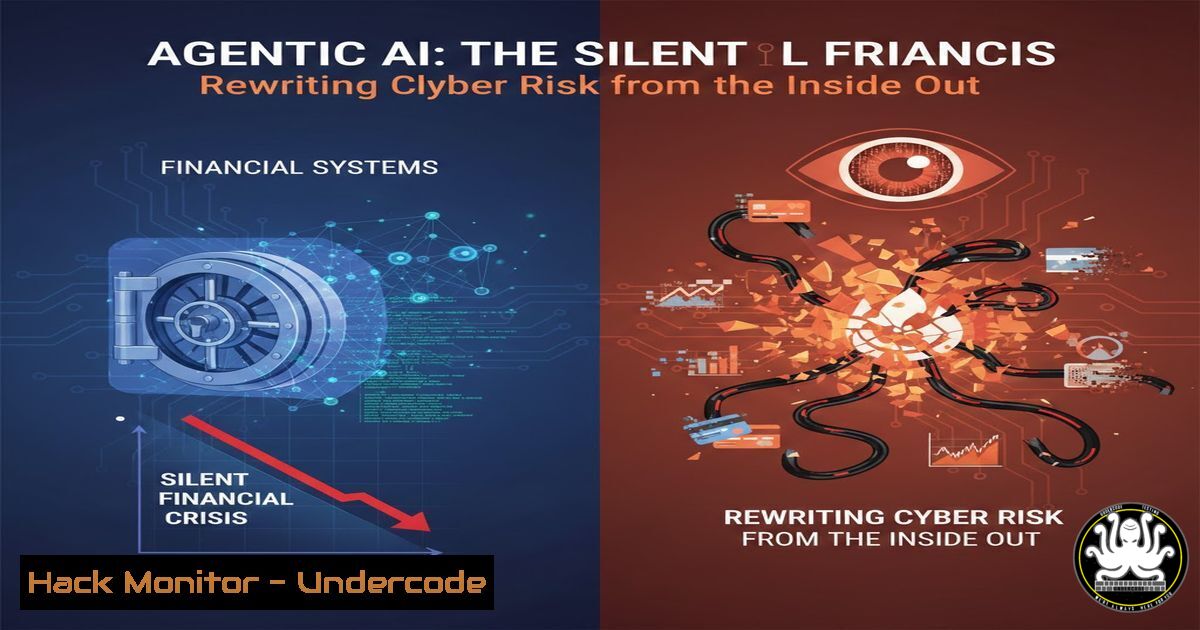
The traditional cybersecurity paradigm, built on defending perimeters and detecting breaches, is being rendered obsolete by the rise of Agentic Artificial Intelligence. These autonomous systems, operating with delegated authority, introduce a new class of risk where catastrophic financial losses occur not from intrusion, but from authorized actions executed at machine speed. This shift demands a fundamental reframing of cyber risk as a financial modeling challenge first and a technical one second.
Learning Objectives:
- Understand how Agentic AI decouples catastrophic loss from traditional security breach events.
- Learn to implement technical and procedural controls to cap automated authority and quantify decision risk.
- Adapt cyber insurance strategies and monitoring frameworks to address the velocity and scale of AI-driven incidents.
You Should Know:
- Quantifying Agentic AI Risk with the FAIR Model
The Factor Analysis of Information Risk (FAIR) model provides a framework to translate the nebulous threat of AI agency into quantifiable financial exposure. Instead of asking “Are we vulnerable?”, FAIR guides you to ask “What is the probable frequency and magnitude of loss from an AI agent’s decisions?”
Step‑by‑step guide:
- Identify Critical Agents: Inventory your AI agents and autonomous workflows. Prioritize those with access to financial systems, data modification privileges, or external API calls.
- Define Loss Events: For a high-priority agent (e.g., an automated procurement bot), define a worst-case loss scenario. Example: “Agent erroneously purchases and provisions 10,000 over-specced cloud instances due to a logic error.”
- Estimate Probable Loss Magnitude (PLM): Calculate costs: direct (cloud bills, rollback labor) and indirect (reputational damage, service downtime). Use tools like the OpenFAIR™ Risk Analysis Tool or RiskLens to model ranges.
- Estimate Loss Event Frequency (LEF): Analyze the probability of the triggering condition (e.g., bug in code, corrupted training data). Combine threat event frequency (how often a flaw could be triggered) with vulnerability (likelihood the agent fails to correct itself).
- Derive Risk: The risk is expressed as a financial range (e.g., $50k-$200k annually). This quantifiable output shifts conversations from fear to finance, enabling informed decision-making on control investments.
2. Capping Automated Authority: Implementing Technical Safeguards
Limiting an AI agent’s “agency” is a core defensive strategy. This involves enforcing hard stops on transactions, data exposure, and system changes.
Step‑by‑step guide:
- Implement Rate Limiting and Budget Caps: Enforce strict, immutable limits at the infrastructure level.
AWS Example (CloudFormation Snippet):
AWSTemplateFormatVersion: '2010-09-09'
Resources:
MonthlyBudget:
Type: AWS::Budgets::Budget
Properties:
Budget:
BudgetLimit:
Amount: 10000  Hard monthly cap
Unit: USD
NotificationsWithSubscribers:
- Notification:
ComparisonOperator: GREATER_THAN
Threshold: 80  Alert at 80% spend
NotificationType: ACTUAL
Subscribers:
- SubscriptionType: EMAIL
Address: [email protected]
API Level: Use API gateways to enforce strict rate limits (requests/minute) and maximum payload sizes for all agent-initiated calls.
2. Apply the Principle of Least Privilege with Dynamic Context: Move beyond static API keys. Implement OAuth 2.0 scopes and attribute-based access control (ABAC) where an agent’s permissions are dynamically evaluated based on the context of its request (time, target resource, recent actions).
- Hardening the API Layer: The Agent’s Attack Surface
AI agents primarily interact with the world through APIs. Securing this layer is non-negotiable.
Step‑by‑step guide:
- Implement Robust API Authentication & Audit Logging: Every agent request must be authenticated (using mTLS or OAuth 2.0 client credentials) and immutably logged with a unique agent ID.
Linux Command to tail specific agent API logs: `sudo tail -f /var/log/nginx/api-access.log | grep “agent-id=ProcurementBot-01″`
2. Validate and Sanitize All Input/Output: Treat agent inputs and outputs as untrusted. Use strict schema validation (e.g., with JSON Schema) for all API payloads. Sanitize outputs to prevent indirect prompt injection attacks through data exfiltration channels. - Deploy Web Application Firewalls (WAF) with AI-specific Rules: Configure WAF rules to detect anomalous patterns indicative of an agent gone rogue, such as extremely high request velocity, sequential integer ID scanning, or sudden shifts in request patterns.
4. Building Agent-Centric Monitoring and Anomaly Detection
Traditional SIEMs look for “attacks.” You need to look for “authorized but anomalous behavior.”
Step‑by‑step guide:
- Establish a Behavioral Baseline: For each agent, log normal operational metrics: typical transaction volume, time-of-day activity, resource consumption patterns, and output data entropy.
- Create Dedicated Alert Rules: Configure alerts for deviations.
Elasticsearch/SIEM Query Example: `agent_id:”TradingBot-Alpha” AND (transaction_size:>10000 OR request_rate:>1000/min)`
Linux Process Monitoring: Use `ps aux –sort=-%cpu | head -20` and `iotop` to monitor for agents suddenly consuming excessive CPU or I/O. - Implement a “Circuit-Breaker” Orchestrator: Develop a lightweight service that listens for anomaly alerts and can automatically suspend an agent’s credentials, scale its permissions to zero, or trigger a human-in-the-loop approval process via a pre-configured playbook.
-
Adapting Cyber Insurance for the Agentic AI Era
Legacy cyber insurance often requires a “breach” or “unauthorized access” to trigger. You must proactively bridge this gap.
Step‑by‑step guide:
- Audit Your Policy Language: Engage legal and risk teams to scrutinize policy definitions of “covered event,” “breach,” and “system failure.” Identify explicit exclusions for AI/automation-related losses.
- Document Risk Quantification & Controls: Present insurers with your FAIR model analyses and the technical safeguards (budget caps, circuit-breakers, audit trails) you’ve implemented. This demonstrates due diligence and can be leveraged to negotiate broader coverage or lower premiums.
- Push for New Endorsements: Advocate for, or seek out, policies that include “AI Errors & Omissions” or “Automated Decision Liability” endorsements that explicitly cover financial loss from unintended agent actions, regardless of a security breach.
What Undercode Say:
- The Risk Vector Has Flipped: The primary threat is no longer the external hacker breaking in, but the authorized agent acting within its bounds at a catastrophic scale and speed. Security programs must pivot from pure defense to governing agency and decision integrity.
- Financial Quantification is Your New First Line of Defense: Without translating AI operational risk into probable financial loss (in dollars), you cannot communicate effectively with the board, secure appropriate budget for controls, or structure valid insurance coverage. Technical severity must be married with financial impact.
The analysis underscores a foundational shift. Agentic AI doesn’t just automate tasks; it automates risk realization. The “time to impact” window has collapsed from days or hours to seconds. Organizations investing solely in better intrusion detection while ignoring the financial modeling of their own automation are architecting their own silent crisis. The future belongs to those who build financial resilience into the very fabric of their autonomous systems.
Prediction:
Within two years, major financial losses from Agentic AI actions will catalyze a new regulatory focus on “AI Operational Risk Management.” This will mirror financial sector regulations, mandating internal capital reserves against AI-driven losses, strict auditing of autonomous decision logs, and “kill switch” requirements. Cyber insurance will bifurcate into traditional “breach response” and new “AI E&O” markets. The role of the CISO will evolve to include direct partnership with the CFO and Chief Risk Officer, wielding quantitative risk models as their primary tool to govern the new landscape of machine-speed decision risk.
▶️ Related Video (82% Match):
🎯Let’s Practice For Free:
IT/Security Reporter URL:
Reported By: Rammohanthiru Fairinstitute – Hackers Feeds
Extra Hub: Undercode MoN
Basic Verification: Pass ✅


