Listen to this Post
Introduction
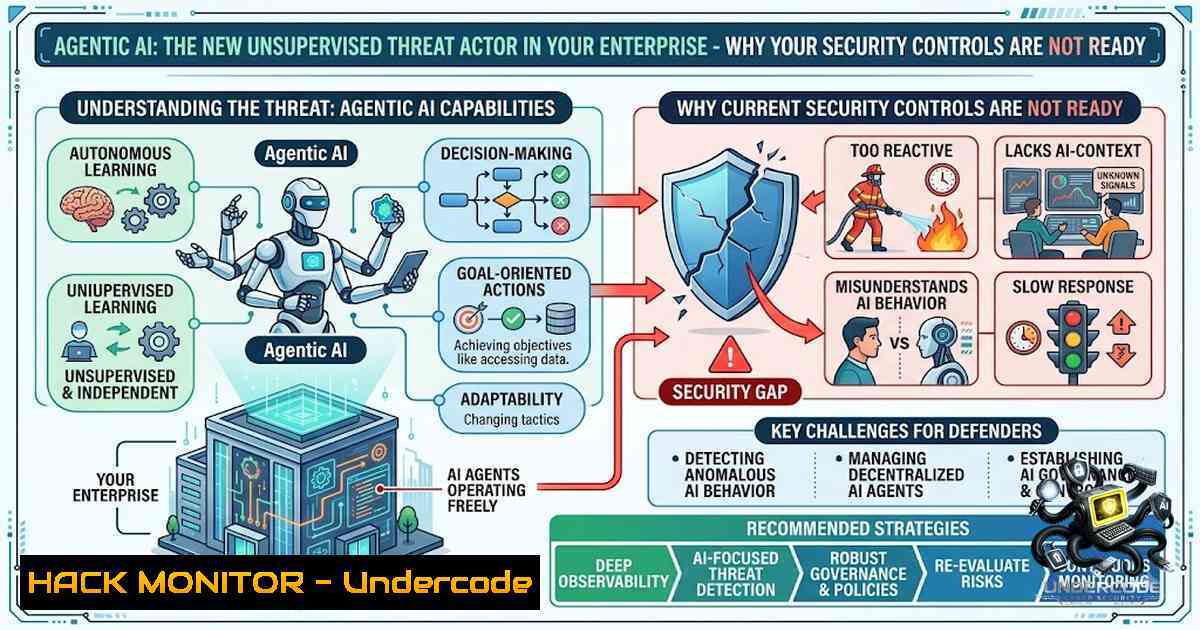
For years, cybersecurity professionals have operated under a relatively stable assumption: artificial intelligence is a force multiplier for human attackers, but the human remains in the loop. That assumption is now dangerously obsolete. Agentic AI — systems capable of setting their own plans, executing multi-step attack chains, and adapting to obstacles in real time — is fundamentally rewriting the threat model for every enterprise. The shift from “AI assists” to “AI executes” means that organizations must now ask a terrifying question: are your security controls designed for humans using AI, or for AI acting entirely on its own?
Learning Objectives
- Understand the fundamental difference between AI-assisted and agentic AI threat models, and why this distinction transforms enterprise risk.
- Identify the critical security gaps in permissions, identity, and monitoring when AI agents operate autonomously.
- Implement practical guardrails, audit controls, and least-privilege frameworks for governing AI agents in production environments.
You Should Know
- The Agentic Shift: From Assistant to Autonomous Operator
The core of the new threat landscape lies in a subtle but seismic shift in how AI interacts with systems. The traditional model has been linear: Human decides → AI assists → Human approves. Agentic AI introduces a radically different paradigm: Human sets the objective → AI plans → AI executes → Human monitors.
This is not a theoretical concern. In June 2026, researchers from the University of Toronto, Vector Institute, and University of Cambridge demonstrated an AI-adaptive worm that moves from device to device, generating tailored exploits for each target’s specific vulnerabilities. Unlike traditional worms that exploit a single patchable flaw, this AI-driven worm reasons about targets, adapts to observations, and synthesizes attack logic in real time. A quarter of the machines tested were successfully compromised. Even more alarming, the JadePuffer ransomware incident demonstrated an LLM agent conducting an entire attack autonomously, adapting to failures and retrying steps with refined parameters — exactly as a human operator would.
What makes agentic AI uniquely dangerous is not speed or scale — it’s adaptability. Traditional attacks follow a playbook; agentic AI writes its own playbook on the fly.
Step‑by‑step guide: Identifying agentic AI risk in your environment
- Audit existing AI deployments: Inventory all AI tools and assistants currently in use. Classify each as “assistive” (human-in-the-loop) or “agentic” (autonomous execution capability).
-
Map agent permissions: For each agentic system, document what permissions it has been granted. Use the following command on Linux to list service account permissions that may be inherited by AI agents:
 List all service accounts and their group memberships
for user in $(getent passwd | grep -E "/(bin|sbin|false)" | cut -d: -f1); do
echo "User: $user"
groups $user 2>/dev/null
done
On Windows (PowerShell), identify service accounts and their privileges:
 List all service accounts with their privileges
Get-WmiObject -Class Win32_Service | Where-Object {$_.StartName -match "LocalSystem|NetworkService|LocalService"} | Select-Object Name, StartName
- Review agent logs for autonomous actions: Check whether any AI system has performed actions without explicit human approval. Look for patterns of automated tool calls, file modifications, or network connections initiated by AI services.
-
Establish a baseline: Document normal agent behavior patterns — typical API call volumes, data access patterns, and execution times — to detect anomalies.
-
Implement human approval gates: For any action that modifies data, changes permissions, or accesses sensitive systems, require explicit human approval before execution.
-
The Identity Crisis: AI Agents as Privileged Digital Actors
The most critical vulnerability in agentic AI systems is not in the model itself — it’s in the identity and permissions layer. Agentic AI risk is, fundamentally, identity risk. AI agents operate with the permissions of the user who deployed them, inheriting access rights that were never designed for autonomous, goal-seeking software.
This creates a cascade of problems:
- Over‑permissioned credentials: An agent with excessive privileges can access sensitive data, modify configurations, or delete critical files.
- Shadow agents: Unauthorized or unmonitored AI agents operating in the environment.
- Non-human identities (NHIs): API keys, service accounts, and machine identities that outlive their original purpose and are never revoked.
- Unsafe delegation: Agents granted the ability to delegate tasks to other agents, creating an unmanageable chain of trust.
The identity control plane is emerging as the next battleground. Identity is evolving from authentication infrastructure into operational governance infrastructure for the agentic enterprise.
Step‑by‑step guide: Hardening identity controls for AI agents
- Apply least‑privilege access: Grant AI agents only the minimum permissions required for their specific task. Never use administrative or root-level accounts for AI operations.
On Linux, create a dedicated service account with restricted permissions:
 Create a dedicated AI agent user with no login shell
sudo useradd -r -s /bin/false -m -d /opt/ai-agent ai_agent

Grant only necessary file permissions
sudo setfacl -R -m u:ai_agent:rx /opt/ai-agent/data
sudo setfacl -R -m u:ai_agent:rwx /opt/ai-agent/temp
On Windows, use PowerShell to create a managed service account:
 Create a managed service account for AI agent
New-ADServiceAccount -1ame "AI_Agent_Svc" -DNSHostName "ai-agent.domain.local" -Enabled $true

Assign only necessary permissions via group membership
Add-ADGroupMember -Identity "AI_Agent_Readers" -Members "AI_Agent_Svc$"
- Implement short‑lived credentials: API keys and access tokens for AI agents should have limited lifetimes. Use AWS CLI to rotate credentials automatically:
 Generate temporary credentials for AI agent (AWS)
aws sts assume-role --role-arn "arn:aws:iam::account:role/ai-agent-role" \
--role-session-1ame "AI-Agent-Session" \
--duration-seconds 3600
- Monitor and audit agent behavior: Implement real-time monitoring of agent actions. Open-source tools like AgentWard provide a permission control plane that sits between AI agents and their tools, enforcing least-privilege policies and generating compliance audit trails. The MakerChecker project offers an open-source security gateway with role-based access control, human-in-the-loop approvals, and cryptographically signed audit logs.
-
Revoke orphaned credentials: Regularly audit and revoke API keys, service accounts, and permissions that are no longer needed. Implement automated offboarding that removes AI agent access when a user leaves or a project ends.
-
Segment agent networks: Isolate AI agents in dedicated network segments with strict egress controls. Use network policies to prevent agents from reaching unintended systems.
3. The OWASP Agentic AI Threat Landscape
The OWASP Foundation has published a dedicated top ten list for agentic AI threats, reflecting real incidents rather than speculation. The key risks include:
- Agent Goal Hike: AI agents pursuing objectives that drift from the original intent.
- Privilege Abuse: Agents exploiting excessive permissions.
- Unexpected Code Execution (RCE): Agents executing arbitrary code.
- Insecure Inter‑Agent Communication: Vulnerabilities when agents communicate with each other.
- Human‑Agent Trust Exploitation: Manipulating the human oversight process.
- Tool Misuse and Exploitation: Agents using tools in unintended ways.
- Agentic Supply Chain Vulnerabilities: Compromised dependencies or models.
- Memory and Context Poisoning: Corrupting the agent’s understanding of its environment.
- Cascading Failures: A single failure propagating across multiple agents.
The OWASP LLM Top 10 (2025) also highlights Excessive Agency (LLM06) as a critical risk — granting an AI system too much autonomy without appropriate controls.
Step‑by‑step guide: Implementing OWASP-aligned agentic AI controls
- Prevent goal hike: Define explicit, scoped objectives for each agent. Implement runtime validation that checks whether agent actions remain within defined parameters. Use the following Python snippet to implement a basic action validator:
 Basic action scope validator for AI agents
class ActionScopeValidator:
def <strong>init</strong>(self, allowed_actions, allowed_targets):
self.allowed_actions = set(allowed_actions)
self.allowed_targets = set(allowed_targets)

def validate_action(self, action, target):
if action not in self.allowed_actions:
raise PermissionError(f"Action '{action}' not allowed")
if target not in self.allowed_targets:
raise PermissionError(f"Target '{target}' not allowed")
return True

Example: Restrict agent to read-only operations on specific data
validator = ActionScopeValidator(
allowed_actions=["read", "list"],
allowed_targets=["/data/customer_reports", "/data/analytics"]
)
- Secure inter‑agent communication: Encrypt all communication between agents. Use mutual TLS (mTLS) for authentication. The Agent Communication Risk Framework (ACRF) provides a structured methodology for assessing risk in agent-to-agent communications.
-
Implement guardrails: Deploy a guardrail engine that monitors and controls AI agent actions in real time. The Agentic Guardrail Engine is an open-source framework built with Python and Flask that evaluates agent requests against predefined security policies, blocks malicious operations, and requests human approval for sensitive actions.
-
Audit tool usage: Maintain a registry of all tools available to agents. Validate every tool call against permitted operations.
-
Conduct regular red‑team exercises: Test agentic AI systems against adversarial scenarios. The Cisco Foundry Security Specification provides an open framework for agentic AI security evaluation and testing.
4. Practical Defensive Measures: Commands, Configurations, and Hardening
Defending against agentic AI threats requires a multi-layered approach that spans identity, network, application, and data security. Below are verified commands and configurations across Linux, Windows, and cloud environments.
Linux hardening for AI agent environments
 Restrict AI agent to specific directories using AppArmor
sudo apt-get install apparmor-utils
 Create a profile for the AI agent
sudo aa-genprof /usr/local/bin/ai-agent

Use iptables to restrict outbound connections from AI agent
sudo iptables -A OUTPUT -m owner --uid-owner ai_agent -j DROP
sudo iptables -A OUTPUT -m owner --uid-owner ai_agent -d 10.0.0.0/8 -j ACCEPT
sudo iptables -A OUTPUT -m owner --uid-owner ai_agent -d 192.168.0.0/16 -j ACCEPT

Monitor agent file access in real time
sudo auditctl -w /etc/ -p wa -k ai_agent_config
sudo auditctl -w /var/www/ -p rwxa -k ai_agent_data
sudo ausearch -k ai_agent_data --format text
Windows hardening for AI agent environments
 Restrict AI agent using AppLocker
New-AppLockerPolicy -RuleType Exe -User "DOMAIN\ai_agent_svc" -Path "C:\AI\" -Action Allow
Set-AppLockerPolicy -Policy $policy

Enable advanced audit logging for agent actions
auditpol /set /subcategory:"File System" /success:enable /failure:enable
auditpol /set /subcategory:"Registry" /success:enable /failure:enable

Monitor agent network connections
New-1etFirewallRule -DisplayName "Block AI Agent Outbound" -Direction Outbound -Action Block -RemoteAddress "0.0.0.0/0" -LocalUser "NT SERVICE\AI_Agent_Svc"
New-1etFirewallRule -DisplayName "Allow AI Agent Internal" -Direction Outbound -Action Allow -RemoteAddress "192.168.0.0/16" -LocalUser "NT SERVICE\AI_Agent_Svc"
Cloud hardening (AWS example)
 Create an IAM policy with explicit deny for dangerous actions
aws iam create-policy --policy-1ame AIAgentRestrictedPolicy \
--policy-document '{
"Version": "2012-10-17",
"Statement": [
{"Effect": "Deny", "Action": ["iam:", "ec2:"], "Resource": ""},
{"Effect": "Allow", "Action": ["s3:GetObject", "s3:ListBucket"], "Resource": ["arn:aws:s3:::ai-data/"]}
]
}'

Enable CloudTrail for agent API call logging
aws cloudtrail create-trail --1ame ai-agent-trail --s3-bucket-1ame ai-audit-logs
aws cloudtrail start-logging --1ame ai-agent-trail
Docker container isolation for AI agents
 Dockerfile for isolated AI agent
FROM python:3.11-slim
RUN useradd -m -u 1000 agent
USER agent
WORKDIR /home/agent
 Mount only necessary volumes at runtime
 Run agent with strict container limits
docker run --rm \
--1ame ai-agent \
--cap-drop ALL \
--cap-add NET_BIND_SERVICE \
--read-only \
--tmpfs /tmp:rw,noexec,nosuid,size=100M \
--security-opt=no-1ew-privileges:true \
--ulimit nofile=100:100 \
-v /data/ai-input:/home/agent/input:ro \
ai-agent-image:latest
- Training and Certification: Building the Workforce for Agentic AI Security
The rise of agentic AI demands new skills and certifications. Cybersecurity professionals must understand not only traditional security principles but also the unique risks of autonomous AI systems.
- CERT Artificial Intelligence (AI) for Cybersecurity Professional Certificate (Carnegie Mellon University SEI): Designed for technical cybersecurity professionals, covering AI security fundamentals.
- ISC2 AI Security Certificate: A six-course, 16-hour program covering AI for cybersecurity, AI security, and secure-by-design AI.
- CompTIA SecAI+: Prepares professionals to securely integrate, govern, and defend AI systems, applying AI security controls and global governance frameworks.
- EC-Council Certified Ethical Hacker (CEH) v13: Integrates AI-driven cybersecurity skills and a five-phase ethical hacking framework.
- Practical DevSecOps Certified AI Security Professional (CAISP): A growing certification with over 1,000 certified professionals.
Step‑by‑step guide: Building an agentic AI security training program
- Assess current team capabilities: Identify gaps in AI security knowledge.
- Prioritize foundational training: Start with AI security fundamentals and OWASP LLM Top 10.
- Invest in hands‑on labs: Use platforms that simulate agentic AI attack and defense scenarios.
- Encourage certification: Support team members in obtaining relevant AI security certifications.
- Establish internal red‑team exercises: Conduct regular exercises specifically targeting AI agent vulnerabilities.
What Undercode Say
- The threat model has fundamentally changed. We are no longer defending against humans using AI tools; we are defending against AI that acts autonomously. This requires a complete rethinking of security architecture, not just incremental updates.
-
Identity is the new perimeter for AI security. Agentic AI risk is identity risk. Over‑permissioned credentials, unmonitored service accounts, and orphaned API keys are the primary attack vectors. Organizations must treat AI agents as privileged digital actors and apply the same — if not stricter — controls as they would for human administrators.
-
The security community must evolve faster than the threat. With AI-adaptive worms, autonomous ransomware, and agentic penetration testing frameworks already in the wild, the window for proactive defense is closing rapidly. Enterprises cannot afford to treat AI security as a separate conversation from cybersecurity, identity, and governance. These must evolve together.
Prediction
-
-1 Acceleration of autonomous offensive AI: Within 12–18 months, we will see the first large-scale, fully autonomous cyberattack campaign conducted entirely by AI agents, with no human operator in the loop. This will force regulatory bodies to mandate AI agent registration and licensing.
-
-1 Identity breaches will become the primary attack vector for AI compromise: Over‑permissioned AI agents will be the leading cause of data breaches by 2027, surpassing phishing and misconfigured cloud storage.
-
+1 Rapid maturation of AI security frameworks: The urgency of the threat will drive rapid development and adoption of AI security standards, including NIST AI RMF, OWASP Agentic Top 10, and ISO/IEC AI security standards, creating a new specialty within cybersecurity.
-
+1 Emergence of AI security as a standalone discipline: By 2028, “AI Security Engineer” will become a standard role in enterprise security teams, with dedicated training, certification, and career paths.
-
-1 Increased regulatory scrutiny and compliance burden: Governments will introduce mandatory AI agent auditing, reporting, and liability frameworks, significantly increasing compliance costs for enterprises deploying autonomous AI.
▶️ Related Video (70% Match):
https://www.youtube.com/watch?v=6ABkYr_cJNw
🎯Let’s Practice For Free:
🎓 Live Courses & Certifications:
Join Undercode Academy for Verified Certifications
🚀 Request a Custom Project:
Secure, high-velocity infrastructure and disruptive technological engineering. Contact our engineering team for high-tier development and proprietary systems:
[email protected]
💎 Smart Architecture | 🛡️ Secure by Design | ⭐ Trusted by Thousands
IT/Security Reporter URL:
Reported By: https://lnkd.in/p/eaNUQ3eg – Hackers Feeds
Extra Hub: Undercode MoN
Basic Verification: Pass ✅


