Listen to this Post
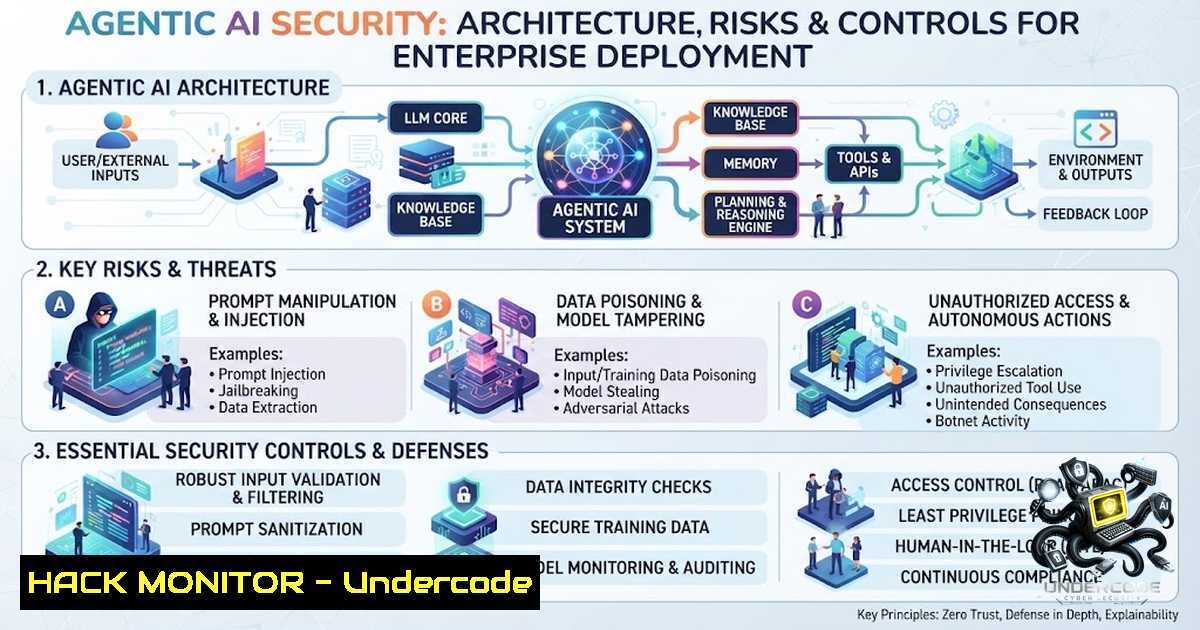
Introduction:
Agentic AI represents a paradigm shift from reactive prompt-response systems to proactive, goal-oriented autonomous agents capable of reasoning, planning, and executing complex tasks across enterprise environments. While this evolution promises unprecedented efficiency gains in cybersecurity operations, IT automation, and business processes, it simultaneously introduces novel attack surfaces and security challenges that traditional controls were never designed to address. As organizations race to deploy autonomous AI agents, understanding the intersection of AI capabilities and enterprise security architecture has become mission-critical for CISOs, security architects, and technology leaders.
Learning Objectives:
- Understand the fundamental architecture and operational flow of Agentic AI systems
- Identify and assess the unique security risks introduced by autonomous AI agents
- Master essential security controls, including identity management, least-privilege access, and Zero Trust principles
- Learn practical implementation strategies for securing API integrations and preventing prompt injection
- Develop comprehensive monitoring and governance frameworks for continuous AI security
1. Understanding Agentic AI Architecture and Operational Flow
Agentic AI systems follow a structured yet flexible operational model that enables autonomous decision-making and action execution. The core architecture revolves around the flow: Goal → Reason → Plan → Use Tools → Execute → Learn, creating a continuous improvement cycle that distinguishes agentic systems from traditional AI applications.
The architecture consists of several critical components working in concert. The Reasoning Engine serves as the system’s cognitive core, employing large language models (LLMs) or reinforcement learning models to analyze goals, break them down into sub-tasks, and determine optimal approaches. The Planning Module creates structured execution plans, prioritizing actions and identifying dependencies. The Memory System maintains both short-term context and long-term knowledge bases, enabling the agent to learn from past experiences and maintain state across sessions. Finally, the Tool Orchestration Layer manages interactions with external systems, APIs, and enterprise applications, executing actions and processing results.
Example Implementation: Autonomous SOC Analyst Agent
 Simplified Python pseudocode for an autonomous SOC analyst agent
class AutonomousSOCAgent:
def <strong>init</strong>(self, llm_model, tool_registry, memory_store):
self.llm = llm_model
self.tools = tool_registry  SIEM, Threat Intel, Ticketing systems
self.memory = memory_store
self.audit_log = []

def investigate_alert(self, alert_data):
 Step 1: Reason about the alert
reasoning = self.llm.reason(
f"Analyze this security alert: {alert_data}. Identify potential threats."
)

Step 2: Create investigation plan
plan = self.llm.plan(reasoning, available_tools=self.tools.keys())

Step 3: Execute plan using tools
for step in plan:
if step.risk_level == "HIGH":
self.escalate_to_human(step, reasoning)
else:
result = self.tools[step.tool].execute(step.parameters)
self.memory.store(step, result)
self.audit_log.append({"step": step, "result": result})

Step 4: Learn from outcomes
self.llm.learn(self.audit_log)
return self.generate_report()
Linux Command for Monitoring Agent Activity:
 Monitor agent activity in real-time
tail -f /var/log/agentic-ai/audit.log | grep -E "ACTION|ERROR|ESCALATION"

Analyze agent execution patterns
journalctl -u agentic-ai-service --since "1 hour ago" | grep "PLAN_EXECUTED"

Check resource utilization of agent processes
htop -p $(pgrep -d',' -f agentic-ai)
Windows PowerShell for Agent Monitoring:
 Monitor agent logs
Get-Content -Path "C:\ProgramData\AgenticAI\logs\audit.log" -Wait | Select-String "ACTION"

Check agent service status
Get-Service -1ame "AgenticAIService" | Select-Object Status, DisplayName

Query Windows Event Log for agent activities
Get-WinEvent -LogName "Application" | Where-Object { $_.ProviderName -match "AgenticAI" } | Format-Table TimeCreated, Message
2. Critical Security Risks in Agentic AI Deployment
The autonomous nature of agentic AI introduces security risks that extend far beyond traditional application security concerns. Understanding these risks is essential for building effective defense mechanisms.
Prompt Injection Attacks remain one of the most significant threats, where malicious actors craft inputs that manipulate the agent’s reasoning to execute unintended actions. Unlike traditional SQL injection, prompt injection exploits the agent’s natural language understanding, making detection significantly more challenging. For example, an attacker might include hidden instructions in an email that the agent processes, causing it to exfiltrate sensitive data or execute unauthorized commands.
Tool Misuse and Excessive Privileges occur when agents gain access to enterprise tools with permissions beyond what’s necessary for their designated tasks. If a financial analysis agent has write access to payment systems, a compromised agent could initiate fraudulent transactions. The principle of least privilege must be rigorously applied, but the dynamic nature of agent tasks complicates static permission models.
Sensitive Data Leakage can happen through various vectors: the agent’s memory stores sensitive information that might be exposed in subsequent conversations, API responses containing PII or trade secrets are logged without proper redaction, or the agent inadvertently shares confidential data with unauthorized users or systems.
Memory Manipulation attacks target the agent’s long-term and short-term memory stores. By poisoning the memory with false information, attackers can influence future decisions. For instance, injecting false threat intelligence into a SOC agent’s memory could cause it to misclassify malicious activity as benign.
Model Poisoning involves corrupting the training data or fine-tuning process, embedding backdoors or biases that manifest when specific trigger conditions are met. This is particularly dangerous because the compromise is subtle and may remain undetected for extended periods.
Audit Commands for Risk Detection:
 Linux: Monitor for anomalous API calls from AI agents
auditctl -a always,exit -S execve -k agentic-ai-exec

Check for files accessed by agent processes
lsof -c agentic-ai | grep -v "^COMMAND" | awk '{print $9}' | sort | uniq -c | sort -1r

Monitor outbound network connections from agent containers
docker exec agentic-container netstat -tunap | grep ESTABLISHED

Windows: Enable advanced audit policies for agent activity
auditpol /set /subcategory:"Detailed File Share" /success:enable /failure:enable
auditpol /set /subcategory:"Process Creation" /success:enable /failure:enable

PowerShell: Monitor process creation for agent-related processes
Get-WinEvent -FilterHashtable @{LogName='Security'; ID=4688} |
Where-Object { $<em>.Properties[bash].Value -match "agentic" } |
Select-Object TimeCreated, @{N='Process';E={$</em>.Properties[bash].Value}}
3. Essential Security Controls and Implementation Strategies
Building trustworthy Agentic AI requires security by design, with controls implemented at every layer of the architecture. These controls must evolve beyond traditional security practices to address the unique challenges of autonomous systems.
Strong Identity and Authentication forms the foundation of agentic AI security. Each agent should have a unique, cryptographically verifiable identity, enabling fine-grained access control and comprehensive audit trails. Implement mutual TLS (mTLS) for all agent-to-service communications, ensuring both ends authenticate each other. Consider using short-lived tokens with automatic rotation to minimize the impact of credential compromise.
 Example Agent Identity Configuration (Kubernetes Secret)
apiVersion: v1
kind: Secret
metadata:
name: agent-identity
type: kubernetes.io/tls
data:
tls.crt: <base64-encoded-agent-cert>
tls.key: <base64-encoded-agent-key>
ca.crt: <base64-encoded-ca-cert>

Service Mesh Authorization Policy (Istio)
apiVersion: security.istio.io/v1beta1
kind: AuthorizationPolicy
metadata:
name: agent-auth-policy
spec:
selector:
matchLabels:
app: agentic-ai
rules:
- from:
- source:
principals: ["cluster.local/ns/default/sa/ai-agent-sa"]
to:
- operation:
methods: ["POST", "GET"]
paths: ["/api/v1/"]
Reasoning Guardrails are critical for preventing agents from taking actions that violate organizational policies or ethical guidelines. Implement content filtering, action validation, and semantic checks at the reasoning layer. Use techniques like chain-of-thought validation, where the agent’s reasoning process is analyzed for policy violations before actions are executed.
 Reasoning Guardrail Implementation
class ReasoningGuardrail:
def <strong>init</strong>(self, policy_engine):
self.policy_engine = policy_engine
self.sensitive_patterns = load_sensitive_patterns()

def validate_plan(self, plan):
violations = []
for action in plan.actions:
 Check against policy
policy_check = self.policy_engine.evaluate(action)
if not policy_check.compliant:
violations.append({
"action": action,
"reason": policy_check.reason,
"severity": policy_check.severity
})

Check for sensitive data exposure
if self.contains_sensitive_data(action.params):
violations.append({
"action": action,
"reason": "Potential sensitive data exposure",
"severity": "HIGH"
})

return violations
Human-in-the-Loop Approvals for high-risk actions provide an essential safety net. Not all actions should be autonomously executed; organizations must define risk thresholds that trigger human review. Implement a workflow where agents request approval for actions exceeding predetermined risk scores, with clear escalation paths and response time expectations.
4. Secure API Integrations and Tool Orchestration
Agentic AI systems rely heavily on API integrations to interact with enterprise tools and data sources. Securing these integrations is paramount to preventing unauthorized access and data breaches.
API Security Best Practices:
- Implement OAuth 2.0 and OIDC for delegated authorization, ensuring agents only have access to the specific resources they need.
-
Use API Gateways as a single entry point for all agent-to-service communications, enabling centralized authentication, rate limiting, and request validation.
-
Employ Schema Validation to ensure that all API requests and responses conform to expected formats, preventing injection attacks and data corruption.
-
Rotate API Keys Regularly and implement automated key rotation policies.
-
Monitor API Usage for anomalies, such as unusual request patterns or unauthorized endpoint access.
 Linux: Monitor API Gateway logs for suspicious activity
tail -f /var/log/nginx/access.log | grep -E "POST|PUT|DELETE" | grep -v "200"

Analyze API response times to detect potential DoS attacks
awk '{print $10}' /var/log/nginx/access.log | sort -1r | head -20

Windows: Monitor IIS logs for API abuse
Get-Content "C:\inetpub\logs\LogFiles\W3SVC1\u_ex.log" |
Select-String -Pattern "POST" |
Group-Object cs-uri-stem |
Sort-Object Count -Descending |
Select-Object -First 10
API Hardening Command Examples:
 Configure rate limiting with iptables for AI agent endpoints
iptables -A INPUT -p tcp --dport 443 -m limit --limit 100/min --limit-burst 200 -j ACCEPT

Implement request size limits to prevent payload attacks
 In Nginx configuration
client_max_body_size 10M;

Configure Apache with mod_security for API protection
apt-get install libapache2-mod-security2
cp /etc/modsecurity/modsecurity.conf-recommended /etc/modsecurity/modsecurity.conf
a2enmod security2
systemctl restart apache2
5. Zero Trust Architecture for Agentic AI
Zero Trust principles must be applied throughout the AI lifecycle, from development to deployment to runtime operations. The fundamental assumption is that no agent, user, or system is inherently trusted, and all interactions must be continuously verified.
Zero Trust Implementation Steps for Agentic AI:
- Micro-segmentation: Place AI agents in isolated network segments with strict traffic controls. Use Kubernetes network policies or virtual network security groups to restrict communication to only necessary endpoints.
-
Continuous Authentication: Implement step-up authentication for sensitive operations, requiring agents to re-authenticate using multiple factors when performing high-risk actions.
-
Least-Privilege by Default: Grant minimum required permissions and require explicit approval for privilege escalation.
-
Real-Time Visibility: Implement comprehensive monitoring and logging, with automated threat detection for anomalous agent behavior.
-
Dynamic Policies: Create policies that adapt based on context, such as time of day, agent workload, or system risk posture.
Implementation Scripts:
 Linux: Configure network segmentation with iptables
 Allow agent to agent communication only on specific ports
iptables -A FORWARD -s 10.0.0.0/16 -d 10.0.0.0/16 -p tcp --dport 8443 -j ACCEPT
iptables -A FORWARD -s 10.0.0.0/16 -d 10.0.0.0/16 -j DROP

Implement egress filtering for agent pods
 Kubernetes NetworkPolicy
apiVersion: networking.k8s.io/v1
kind: NetworkPolicy
metadata:
name: agent-egress-policy
spec:
podSelector:
matchLabels:
app: agentic-ai
policyTypes:
- Egress
egress:
- to:
- ipBlock:
cidr: 10.0.0.0/24
ports:
- protocol: TCP
port: 443
- protocol: TCP
port: 8443
6. Continuous Monitoring and Governance Framework
Effective governance ensures that Agentic AI systems remain aligned with organizational objectives and security requirements throughout their lifecycle. This involves continuous monitoring, regular assessments, and adaptive controls.
Monitoring Dashboard Components:
- Agent Activity Logs: All actions taken by agents, including reasoning steps, API calls, and outcomes
- Security Events: Alerts for policy violations, suspicious behavior, and attempted attacks
- Performance Metrics: Response times, accuracy, and completion rates
- Compliance Status: Verification against regulatory requirements and internal policies
Audit Logging Configuration:
 Linux: Set up centralized logging with rsyslog
echo "agentic.ai. /var/log/agentic-ai-security.log" >> /etc/rsyslog.conf
systemctl restart rsyslog

Configure logrotate for audit logs
cat > /etc/logrotate.d/agentic-ai << EOF
/var/log/agentic-ai-security.log {
daily
rotate 30
compress
delaycompress
missingok
notifempty
create 640 root adm
postrotate
systemctl reload rsyslog > /dev/null 2>&1 || true
endscript
}
EOF
Windows Log Collection:
 Configure Windows Event Forwarding for agent logs
wevtutil sl "AgenticAI/Operational" /enabled:true /retention:false /maxsize:1028000000

Set up event subscription for central collection
Set-WmiInstance -Class __EventFilter -1amespace root\subscription -Arguments @{
Name = "AgenticAIForwarding"
Query = "SELECT  FROM __InstanceCreationEvent WITHIN 5 WHERE TargetInstance ISA 'Win32_NTLogEvent'"
}
7. NIST AI RMF Alignment and Governance Integration
The NIST AI Risk Management Framework (RMF) provides a structured approach to governing AI systems, mapping directly to Agentic AI deployment challenges. The framework’s four key functions—Govern, Map, Measure, and Manage—offer a comprehensive methodology for building trustworthy AI.
Govern: Establish AI governance structures, policies, and accountability. This includes defining roles and responsibilities, implementing AI ethics boards, and creating incident response procedures specific to AI failures.
Map: Understand the AI context, including organizational objectives, potential harms, and stakeholder expectations. For Agentic AI, this involves mapping all use cases, identifying potential failure modes, and assessing impact on business operations.
Measure: Implement continuous assessment of AI system characteristics, including reliability, safety, security, transparency, and fairness. Use both automated tools and human review to evaluate agent behavior.
Manage: Continuously monitor and respond to AI risks. This includes implementing controls, updating policies based on findings, and maintaining communication with stakeholders.
Implementation Commands:
 Script to assess AI system compliance with NIST RMF
!/bin/bash
echo "=== NIST AI RMF Compliance Check ==="

Check governance documentation
if [ -f "/etc/agentic-ai/governance-policy.yaml" ]; then
echo "✓ Governance policy exists"
else
echo "✗ Missing governance policy"
fi

Check model registry for lineage tracking
if docker ps | grep -q "model-registry"; then
echo "✓ Model lineage tracking active"
else
echo "✗ Model registry not running"
fi

Verify monitoring configuration
if systemctl is-active agentic-monitor > /dev/null; then
echo "✓ Continuous monitoring active"
else
echo "✗ Monitoring service inactive"
fi
What Undercode Say:
Key Takeaway 1: Agentic AI security requires a fundamental shift from traditional perimeter-based security to identity-centric, Zero Trust architectures that continuously verify every action and interaction.
Key Takeaway 2: The debate between applying existing controls versus developing new governance principles for AI is largely academic—what matters is practical implementation of controls that address the unique risks of autonomous systems.
Analysis: Brian C.’s critique that the post largely lists “established enterprise security controls” and applies them to AI highlights a critical industry tension. While it’s true that identity, least privilege, and Zero Trust are mature disciplines, their application to agentic AI requires significant innovation in implementation. The real challenge lies not in identifying controls but in operationalizing them for systems that can reason, plan, and act autonomously. Sahibzada Rasool’s emphasis on accountability and traceability underscores the need for audit trails that link every action to specific reasoning steps and approvals. Jude Pereira’s promotion of AI governance platforms reflects the market’s recognition that traditional tools lack the visibility and control needed for agentic AI oversight. The integration of NIST AI RMF, as Hiren D. noted, provides a governance framework, but organizations must still solve the engineering challenges of implementing these controls at scale. The future of Agentic AI security will be defined by organizations that successfully bridge the gap between theoretical controls and practical, enforceable implementation.
Prediction:
+1: The integration of Zero Trust principles with AI governance frameworks will mature rapidly, leading to standardized security architectures that enable safe Agentic AI deployment across regulated industries.
+1: Autonomous security agents will become the first truly successful enterprise AI application, significantly reducing incident response times from hours to minutes while maintaining human oversight for critical decisions.
-1: Organizations that treat AI security as an add-on rather than a core design principle will experience high-profile breaches involving autonomous agents, leading to regulatory intervention and market consolidation.
-1: The complexity of implementing comprehensive Agentic AI security controls will create a significant skills gap, with demand for AI security expertise far exceeding available talent.
+1: The emergence of standardized security frameworks and tooling specifically designed for AI systems will accelerate adoption, making security-by-design more accessible for mid-sized enterprises.
-1: Without robust memory security and prompt injection defenses, deployed agents will increasingly fall victim to sophisticated manipulation attacks, undermining trust in autonomous systems.
+1: Continuous monitoring and real-time governance will evolve into predictive security, where agents can anticipate and prevent attacks before they occur.
-1: The friction between security controls and agent autonomy will create operational inefficiencies, requiring careful balancing of security and business value.
+1: Industry collaboration on AI security standards will accelerate, with frameworks like NIST AI RMF becoming de facto requirements for enterprise procurement.
-1: The rush to deploy agentic AI will result in shadow AI proliferation, creating hidden attack surfaces that traditional security teams struggle to discover and protect.
▶️ Related Video (80% Match):
🎯Let’s Practice For Free:
🎓 Live Courses & Certifications:
Join Undercode Academy for Verified Certifications
🚀 Request a Custom Project:
Secure, high-velocity infrastructure and disruptive technological engineering. Contact our engineering team for high-tier development and proprietary systems:
[email protected]
💎 Smart Architecture | 🛡️ Secure by Design | ⭐ Trusted by Thousands
IT/Security Reporter URL:
Reported By: Malini Rao – Hackers Feeds
Extra Hub: Undercode MoN
Basic Verification: Pass ✅


