Listen to this Post
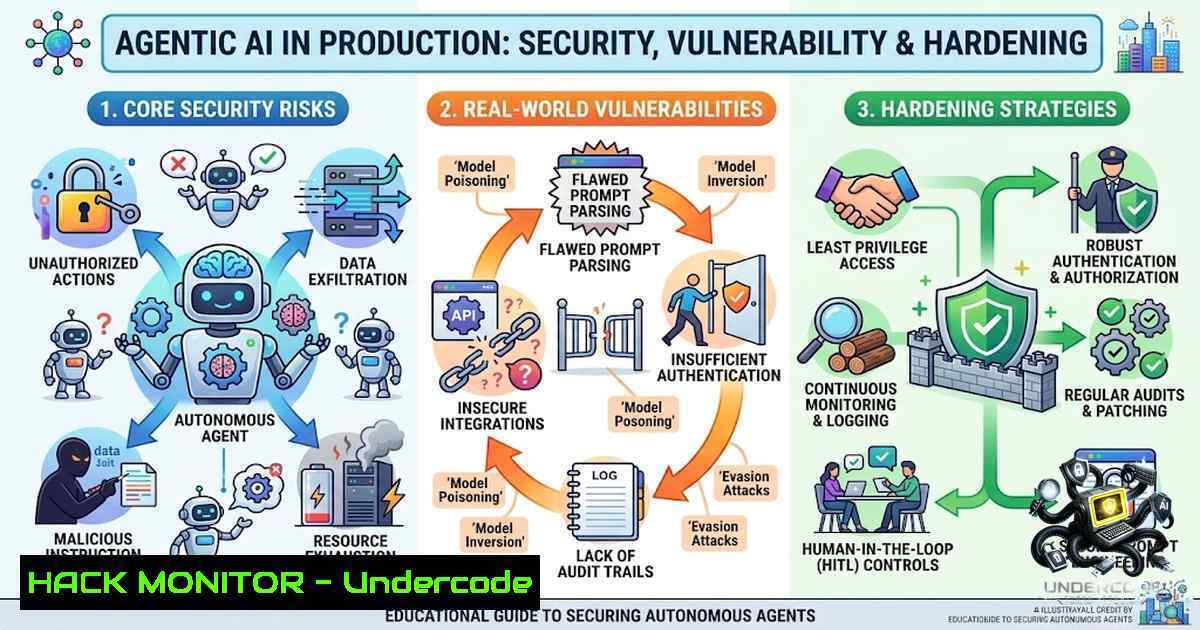
Introduction:
The rapid evolution of Large Language Models (LLMs) into autonomous, tool-calling agents has fundamentally altered the cybersecurity landscape. Unlike traditional chatbots that merely generate text, Agentic AI systems possess planning capabilities, long-term memory, and the ability to invoke external tools—executing shell commands, managing files, and interacting with third-party APIs to complete complex workflows autonomously. However, this architectural shift grants neural networks direct access to operating system-level permissions, completely reconstructing the boundaries of software and information security. As demonstrated by the Zalo Hackathon 2026, where teams built Agentic AI assistants for business growth and workflow automation, the promise of autonomous agents comes with unprecedented security challenges that organizations must address before production deployment.
Learning Objectives:
- Understand the fundamental security differences between non-agentic LLM applications and autonomous Agentic AI systems
- Identify critical vulnerabilities in agentic frameworks, including prompt injection-driven RCE, tool misuse, and identity spoofing
- Implement defense-in-depth strategies including zero-trust execution, least-privilege access, and continuous monitoring
You Should Know:
- The Agentic AI Attack Surface: Why Traditional Defenses Fail
A non-agentic LLM application takes user input, produces model output, and returns it to the user—the security boundary is well-defined. An agentic AI application, however, produces a sequence of model outputs and acts on each by invoking tools that affect external systems. The consequence is that every defensive pattern that worked for non-agentic applications still applies, but the cost of bypass is fundamentally higher. A prompt injection in a chatbot can cause harmful output; in an agentic system, it can exfiltrate data, modify records, send messages, execute code, or perform any action the agent’s tools permit.
The OWASP Agentic AI Top 10, published in early 2026, formalizes the risk taxonomy. Key risks include:
- AAI01 — Tool Misuse: Agents invoking tools in unintended ways, with arguments outside expected ranges, or chaining invocations into composite actions that bypass safety checks
- AAI03 — Goal Manipulation: Adversarial instructions that appear to follow legitimate task flows but secretly alter the agent’s final objective
- AAI02 — Identity and Access Control Failures: Policy enforcement vulnerabilities where mutable display names or metadata can spoof identities
Step‑by‑Step Guide: Assessing Your Agentic AI Attack Surface
- Map all tool invocations: Document every external tool, API, MCP server, and plugin your agent can access
- Create an agent SBOM: Establish a software bill of materials listing all dependencies, prompt templates, and tool descriptions
- Review prompt injection vectors: Test all input channels—user messages, retrieved documents, tool outputs, and system prompts
- Audit agent permissions: Verify least-privilege enforcement on every action the agent can perform
- Enable full audit trails: Implement session recording and continuous monitoring with complete action logging
2. Real-World Vulnerabilities: Lessons from OpenClaw and Zalo
OpenClaw, a popular open-source AI agent framework supporting WhatsApp, Zalo, Telegram, and other platforms, has revealed critical vulnerabilities that highlight the systemic risks of agentic AI.
CVE-2026-28461 — Webhook Memory Exhaustion (DoS): In versions before 2026.3.1, the Zalo webhook endpoint contained a security flaw where attackers, without authentication, could send requests with crafted, non-repeating query parameters. This caused the system to accumulate new keys in memory (Key Churn), leading to rapid memory exhaustion (OOM) and service unavailability.
CVE-2026-53857 — Mutable Display Name Policy Bypass: In versions before 2026.5.3, Zalo contacts with mutable display metadata could match `allowFrom` policy entries through display name changes. Attackers with mutable display names could receive agent responses intended for different Zalo identities. This authentication bypass by spoofing (CWE-290) carries a CVSS v4.0 base score of 8.6 (HIGH).
Prompt Injection-Driven Remote Code Execution (RCE): Research has demonstrated that simple prompt injection attacks in agentic systems can be weaponized to trigger unauthorized RCE, arbitrary file deletion, or stealthy exfiltration of sensitive enterprise data. The OpenClaw ecosystem, which separates cognitive decision-making from tool execution, creates a dynamic runtime where AI can autonomously execute shell commands—making traditional content-filtering defenses obsolete.
Step‑by‑Step Guide: Mitigating Agentic AI Vulnerabilities
- Upgrade immediately: Ensure OpenClaw is updated to version 2026.5.3 or later
- Validate webhook inputs: Implement strict validation on all webhook endpoints, rejecting requests with excessive or malformed query parameters
- Enforce identity verification: Use immutable identifiers (not display names) for policy matching
- Implement input sanitization: Apply retrieval filters and input sanitization to all agent inputs
- Deploy execution sandboxing: Isolate agent tool execution in sandboxed environments
Linux Command Examples for Agent Security Hardening
 Audit agent process permissions
ps aux | grep -E "openclaw|agent" | awk '{print $1, $11}'

Monitor webhook endpoint activity
sudo journalctl -u openclaw -f --since "1 hour ago" | grep -E "webhook|query"

Set up rate limiting with iptables (mitigate DoS)
sudo iptables -A INPUT -p tcp --dport 3000 -m limit --limit 100/minute -j ACCEPT
sudo iptables -A INPUT -p tcp --dport 3000 -j DROP

Implement filesystem restrictions with AppArmor
sudo aa-genprof /usr/local/bin/openclaw
sudo aa-enforce /etc/apparmor.d/usr.local.bin.openclaw
Windows PowerShell Commands for Agent Security Monitoring
 Monitor agent process activity
Get-Process -1ame openclaw | Select-Object Id, ProcessName, CPU, WorkingSet

Audit webhook endpoint connections
Get-1etTCPConnection -LocalPort 3000 | Select-Object LocalAddress, RemoteAddress, State

Enable Windows Defender Application Guard for agent isolation
Add-WindowsCapability -Online -1ame "Windows.ApplicationGuard.Enterprise~~~~0.0.1.0"
- Defense-in-Depth: The CISA and OWASP Framework for Agentic AI Security
In May 2026, CISA, the Australian Signals Directorate’s Australian Cyber Security Centre, and other international partners published joint guidance on the careful adoption of Agentic AI services. Critical recommendations include:
- Avoid granting broad or unrestricted access, especially to sensitive data or critical systems
- Begin with agentic AI use cases that are low-risk and non-sensitive
- Account for agentic AI security in your organization’s security model and risk posture
The OWASP Agentic Security Initiative has released the AIUC-1 crosswalk, identifying eight priority areas requiring new or expanded requirements, particularly around agent identity, runtime containment, architectural monitoring, supply chain attestation, and schema controls.
Step‑by‑Step Guide: Implementing Defense-in-Depth for Agentic AI
- Adopt zero-trust execution: Verify every tool invocation against a policy that determines whether it is allowed
- Enforce just-in-time access: Elevate agent privileges only when required and revoke automatically
- Implement credential vaulting: Store all agent secrets, API keys, and credentials in a secure vault with audit trails
- Deploy behavioral auditing: Monitor agent actions against baseline behavior patterns
- Establish SBOM management: Maintain a software bill of materials for all agent components, including plugins, MCP servers, prompt templates, and tool descriptions
API Security Configuration for Zalo Integrations
 Generate appsecret_proof for Zalo API calls (PKCE enforcement)
import hashlib
import hmac

app_secret = "your_app_secret"
access_token = "user_access_token"
appsecret_proof = hmac.new(
app_secret.encode('utf-8'),
access_token.encode('utf-8'),
hashlib.sha256
).hexdigest()

API call with proof
headers = {
'access_token': access_token,
'appsecret_proof': appsecret_proof
}
 Enable appsecret_proof verification in Zalo Developer settings
 Application Management → Settings → Enable "Check app secret proof for API calls with access token"
4. The Full-Lifecycle Agent Security Architecture (FASA)
To address systemic architectural flaws in autonomous agents, researchers have proposed the Full-Lifecycle Agent Security Architecture (FASA), a theoretical defense blueprint advocating for:
- Zero-trust agentic execution: Never trust agent actions by default; verify every operation
- Dynamic intent verification: Continuously validate that agent actions align with intended goals
- Cross-layer reasoning-action correlation: Correlate cognitive reasoning with actual tool execution to detect anomalies
The CyberShield-A three-layer containment architecture—comprising input sanitization, execution sandboxing, and behavioral auditing—has demonstrated a 73.4% reduction in successful attack completion rates while preserving 91.2% task utility across 47 red-team scenarios.
Step‑by‑Step Guide: Building Your FASA Implementation
- Design-time hardening: Implement secure coding practices, input validation, and tool permission scoping during development
- Runtime monitoring: Deploy continuous monitoring of agent actions with anomaly detection
- Incident response planning: Establish procedures for agent compromise detection and containment
- Cross-layer correlation: Implement logging that traces reasoning inputs to tool outputs for forensic analysis
-
Cloud Hardening and Supply Chain Security for Agentic Deployments
Agentic AI systems often deploy across cloud environments, introducing additional attack vectors. Microsoft’s red-team testing of deployed agentic systems identified four emerging risk categories that organizations must test:
- Goal Hijacking: Adversarial instructions that appear legitimate but secretly alter the agent’s final objective
- Computer Use Agent (CUA) Visual Attacks: Exploiting human-imperceptible content—tiny fonts, interface elements hidden outside windows, or images with prompt injections—to influence agent decisions
- Session Context Contamination: Attackers injecting data early in multi-step sessions to influence subsequent reasoning without triggering single-step security controls
- Capability/Architecture Disclosure: Agents leaking tool names, system prompt structures, memory interfaces, or human-in-the-loop trigger logic
Linux Command Examples for Agent Cloud Hardening
 Scan for exposed agent endpoints
nmap -p 3000,8080,8443 <agent-host-ip>

Implement network segmentation
sudo iptables -A FORWARD -p tcp --dport 3000 -s <internal-subnet> -j ACCEPT
sudo iptables -A FORWARD -p tcp --dport 3000 -j DROP

Set up audit logging for agent actions
sudo auditctl -w /var/log/openclaw/ -p wa -k agent_activity

Monitor for unauthorized file access
sudo inotifywait -m -r -e access,modify,open /data/agent-workspace/
Windows PowerShell Commands for Agent Supply Chain Security
 Scan agent dependencies for known vulnerabilities
winget search openclaw
winget upgrade openclaw

Enable Windows Defender Exploit Guard for agent process
Set-ProcessMitigation -1ame "openclaw" -Enable DEP, SEHOP, ASLR

Audit agent network connections
Get-1etTCPConnection | Where-Object {$_.OwningProcess -eq (Get-Process -1ame openclaw).Id}
What Undercode Say:
- Security must be architected from day one, not bolted on after deployment. The Zalo Hackathon 2026 demonstrated the rapid innovation possible with Agentic AI, but production deployments require security-by-design. Organizations should begin with low-risk, non-sensitive use cases and gradually expand as security controls mature.
-
The cost of a single agent compromise can be catastrophic. Unlike traditional applications, a compromised agent can execute arbitrary commands, exfiltrate data, and modify systems autonomously. The 73.4% reduction in attack success rates achieved by CyberShield-A proves that defense-in-depth works, but requires deliberate investment.
-
Agentic AI is transforming cybersecurity—both as a tool and as a target. The same capabilities that make agents powerful for automation (tool invocation, autonomous execution, planning) make them attractive targets for attackers. Organizations must treat agents like powerful, semi-autonomous users and enforce rules at the boundaries where they touch identity, tools, data, and outputs.
Prediction:
- +1 Organizations that adopt Agentic AI with security-first architectures will achieve 3-5x faster automation ROI while maintaining compliance and trust.
- +1 The emergence of OWASP Agentic AI Top 10 and CISA joint guidance will drive standardization of agent security practices, similar to how OWASP Top 10 transformed web application security.
- -1 Companies deploying agentic AI without proper SBOM management, input sanitization, and execution sandboxing will face significant breach risks within 12-18 months.
- -1 The attack surface expansion from agentic systems—including goal manipulation, visual attacks, and session contamination—will create new threat vectors that traditional security tools cannot detect.
- +1 Zero-trust architectures and just-in-time access controls for agents will become mandatory requirements for enterprise AI deployments by 2027.
▶️ Related Video (80% Match):
https://www.youtube.com/watch?v=0iNqKbrdtJI
🎯Let’s Practice For Free:
🎓 Live Courses & Certifications:
Join Undercode Academy for Verified Certifications
🚀 Request a Custom Project:
Secure, high-velocity infrastructure and disruptive technological engineering. Contact our engineering team for high-tier development and proprietary systems:
[email protected]
💎 Smart Architecture | 🛡️ Secure by Design | ⭐ Trusted by Thousands
IT/Security Reporter URL:
Reported By: https://lnkd.in/p/e_NkrAhM – Hackers Feeds
Extra Hub: Undercode MoN
Basic Verification: Pass ✅


