Listen to this Post
Introduction
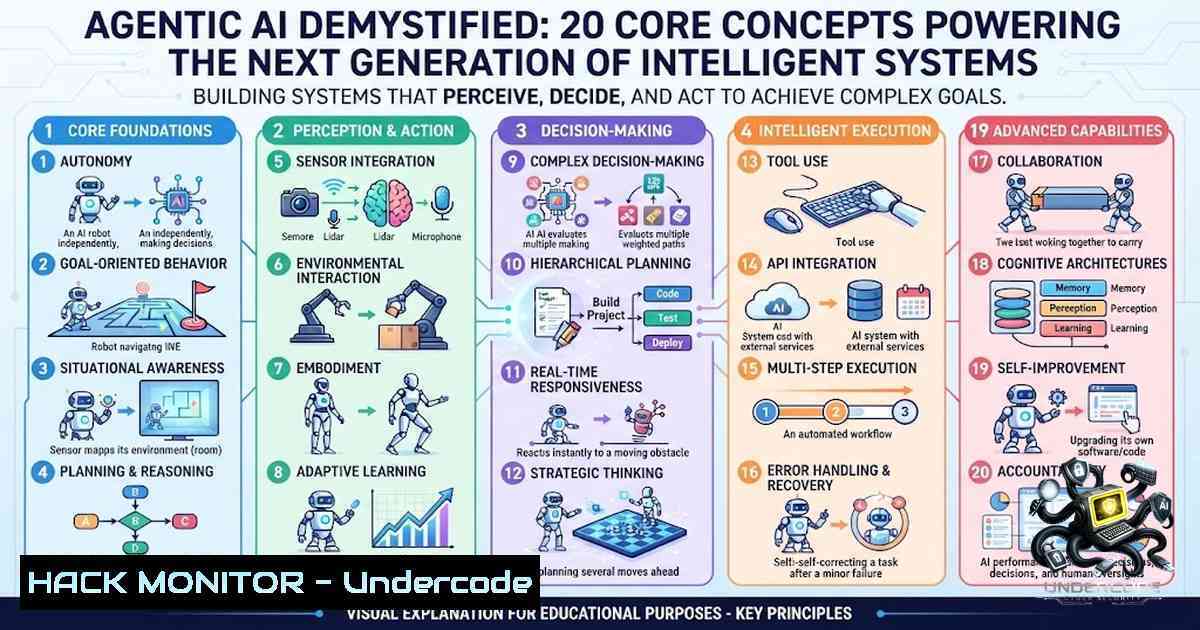
The artificial intelligence landscape is undergoing a fundamental shift from passive text generation to active task execution. This paradigm, known as Agentic AI, represents systems capable of understanding complex objectives, reasoning through challenges, and taking autonomous actions using external tools and data sources. For cybersecurity professionals, IT architects, and developers, mastering these 20 foundational concepts is no longer optional—it represents the difference between building intelligent, secure systems and falling behind in an increasingly automated threat landscape.
Learning Objectives
- Understand the architectural components and workflows that enable AI agents to function autonomously
- Implement security guardrails, sandboxing techniques, and evaluation frameworks for production-grade AI systems
- Design multi-agent orchestration strategies that optimize performance, cost, and reliability across diverse use cases
You Should Know
- MCP (Model Context Protocol) and Tool Integration Architecture
The Model Context Protocol serves as the universal connector enabling AI agents to interact with external systems, APIs, databases, and tools through standardized interfaces. This protocol eliminates the need for custom integrations for every new tool, creating a plug-and-play ecosystem where agents can dynamically discover and utilize capabilities.
Step‑by‑step guide for implementing MCP integration:
- Define the tool specification schema using OpenAPI or JSON Schema to describe available functions, parameters, and expected responses
- Implement the MCP server that exposes tool endpoints and handles authentication:
 Example MCP server implementation in Python
from mcp import MCPServer, Tool, ToolParameter

server = MCPServer("ai-tool-gateway")

@server.tool(
name="query_database",
description="Execute read-only SQL queries against production databases",
parameters=[
ToolParameter(name="query", type="string", required=True),
ToolParameter(name="database", type="string", required=True)
]
)
async def query_database(query: str, database: str):
 Apply security filtering and execute
return execute_safe_query(query, database)
- Configure the AI agent to discover available tools through the MCP discovery endpoint
- Implement tool execution logging for audit trails and debugging:
 Linux: Monitor tool execution logs
tail -f /var/log/mcp/access.log | grep -E "tool_call|error"
- Set up tool permissions matrix using role-based access control (RBAC) to restrict which agents can use which tools
Windows PowerShell command for monitoring tool activity:
Get-WinEvent -LogName Application | Where-Object {$_.Message -like "MCP"} | Select-Object TimeCreated, Message -First 20
2. Agent Loop and ReAct Framework Implementation
The Agent Loop embodies the core decision-making cycle: Sense (perceive environment), Think (reason about actions), Execute (perform actions), and Review (assess outcomes). This continuous loop enables agents to adapt to changing conditions and refine their approach based on feedback.
Step‑by‑step guide to building a ReAct (Reason + Act) agent:
- Initialize the agent with system prompts that define its role, capabilities, and constraints
- Implement the reasoning phase where the agent breaks down the user query into actionable steps:
 Reasoning implementation using LangChain
from langchain.agents import create_react_agent
from langchain.tools import Tool

tools = [
Tool(name="Search", func=web_search, description="Search the internet"),
Tool(name="Calculator", func=calculate, description="Perform mathematical operations")
]

agent = create_react_agent(
llm=llm,
tools=tools,
prompt=react_prompt
)
- Execute actions sequentially, capturing outputs for the next reasoning step
4. Implement action validation to prevent unauthorized operations:
 Linux: Set up action validation firewall rules
iptables -A OUTPUT -m owner --uid-owner agent-user -j ACCEPT
iptables -A OUTPUT -m owner --uid-owner agent-user -j LOG --log-prefix "AGENT_ACTION"
- Build the review mechanism that evaluates action success and determines next steps
- Create loop termination conditions based on task completion or max iterations
Windows Registry modification for agent process isolation:
New-Item -Path "HKLM\SOFTWARE\AgentSecurity" -Force
Set-ItemProperty -Path "HKLM\SOFTWARE\AgentSecurity" -1ame "MaxLoopIterations" -Value "10"
3. RAG Implementation and Memory Management
Retrieval-Augmented Generation enhances AI accuracy by fetching relevant information from external knowledge bases before generating responses. Combined with short-term and long-term memory systems, this creates a comprehensive information management architecture.
Step‑by‑step guide to building a production RAG system:
- Set up vector database for embedding storage (Pinecone, Weaviate, or Milvus):
 Docker command to run Milvus vector database
docker run -d --1ame milvus-standalone \
-p 19530:19530 \
-p 9091:9091 \
milvusdb/milvus:latest
- Create embedding pipeline to chunk documents and generate vector representations:
 Document chunking and embedding
from langchain.text_splitter import RecursiveCharacterTextSplitter
from sentence_transformers import SentenceTransformer

chunker = RecursiveCharacterTextSplitter(chunk_size=500, chunk_overlap=50)
model = SentenceTransformer('all-MiniLM-L6-v2')

def process_document(text):
chunks = chunker.split_text(text)
embeddings = model.encode(chunks)
return list(zip(chunks, embeddings))
3. Implement memory layers:
- Short-term: Store recent conversation context in a sliding window buffer
- Long-term: Persist important facts and user preferences in the vector database
- Episodic: Log complete interaction histories for analysis
- Configure retrieval strategy with hybrid search (keyword + semantic):
-- PostgreSQL with pgvector for hybrid search
CREATE TABLE agent_memory (
id SERIAL PRIMARY KEY,
content TEXT,
embedding vector(384),
metadata JSONB,
created_at TIMESTAMP DEFAULT NOW()
);

-- Hybrid search query
SELECT content, metadata,
embedding <-> 'vector_data' as similarity_score
FROM agent_memory
WHERE content ILIKE '%keyword%' OR embedding <-> 'vector_data' < 0.8
ORDER BY similarity_score LIMIT 5;
- Implement context window management to handle token limits effectively:
 Context window manager
class ContextWindowManager:
def <strong>init</strong>(self, max_tokens=4096):
self.max_tokens = max_tokens
self.buffer = []

def add_to_context(self, content):
token_count = self.count_tokens(content)
while self.current_tokens() + token_count > self.max_tokens:
self.buffer.pop(0)
self.buffer.append(content)
- Build fact-checking verification to cross-reference retrieved information against trusted sources
Linux command for monitoring RAG retrieval latency:
curl -w "@curl-format.txt" -o /dev/null -s "http://localhost:8000/retrieve?query=test"
4. Multi-Agent Orchestration and Guardrail Implementation
Multi-agent systems distribute complex tasks across specialized agents working in parallel, managed by an orchestrator agent that decomposes objectives and coordinates execution. Security guardrails ensure agents operate within defined boundaries.
Step‑by‑step guide to setting up multi-agent orchestration with security controls:
1. Define agent roles and specializations:
- Orchestrator: Task decomposition and coordination
- Researcher: Information gathering and analysis
- Executor: Code generation and execution
- Reviewer: Quality assurance and validation
2. Implement the orchestrator with task routing logic:
 Orchestrator implementation
class AgentOrchestrator:
def <strong>init</strong>(self, agents):
self.agents = agents
self.task_queue = []

def decompose_task(self, objective):
 Break down objective into sub-tasks
sub_tasks = self.llm_chain(
f"Break this objective into 3-5 sub-tasks: {objective}"
)
return self.assign_tasks(sub_tasks)

def assign_tasks(self, sub_tasks):
for task in sub_tasks:
best_agent = self.select_agent(task)
self.task_queue.append((best_agent, task))
3. Configure guardrails at multiple layers:
Input Guardrail – Validate user inputs:
 Input validation guardrail
def validate_input(input_text):
forbidden_patterns = [
r"DROP\s+TABLE", r"DELETE\s+FROM", r"rm\s+-rf",
r"system(", r"exec(", r"eval("
]
for pattern in forbidden_patterns:
if re.search(pattern, input_text, re.IGNORECASE):
raise SecurityException(f"Forbidden pattern detected: {pattern}")
return input_text
Action Guardrail – Restrict tool usage:
 agent_security_policy.yaml
guardrails:
tool_restrictions:
- tool_name: "execute_code"
allowed_environments: ["sandbox"]
max_execution_time: 30
resource_limits:
cpu: 0.5
memory: 256MB
- tool_name: "query_database"
allowed_tables: ["analytics", "public"]
read_only: true
Output Guardrail – Filter sensitive information:
 Output sanitization
def sanitize_output(text):
 Remove API keys, tokens, credentials
patterns = {
r'api_key=[A-Za-z0-9]+': 'api_key=[bash]',
r'token:[A-Za-z0-9]+': 'token:[bash]',
r'password\s=\s\S+': 'password=[bash]'
}
for pattern, replacement in patterns.items():
text = re.sub(pattern, replacement, text)
return text
4. Implement sandboxing for code execution:
 Create isolated Docker sandbox for code execution
docker run --rm \
--1ame agent-sandbox \
--1etwork none \
--memory 256m \
--cpu-shares 512 \
--cap-drop ALL \
--security-opt=no-1ew-privileges:true \
python:3.9-slim \
python -c "exec(code)"
5. Build human-in-the-loop approval workflows:
 Human approval required for sensitive actions
def execute_with_approval(action, approval_callback):
approval_request = create_approval_request(action)
notify_human(approval_request)

while True:
status = check_approval_status(approval_request.id)
if status == "approved":
return execute_action(action)
elif status == "denied":
raise PermissionError("Action denied by human supervisor")
time.sleep(5)  Check every 5 seconds
- Set up comprehensive evaluation metrics for agent performance:
| Evaluation Area | Metrics | Success Criteria |
|–|||
| Accuracy | Correctness score | >90% on test cases |
| Safety | Policy violation count | Zero violations |
| Efficiency | Tokens per task | <2000 tokens |
| Reliability | Success rate | >95% completion |
5. Prompt Chaining and Context Window Optimization
Prompt chaining breaks complex tasks into sequential steps where each prompt output feeds into the next, enabling sophisticated reasoning and multi-step operations. Effective context window management ensures agents can handle lengthy documents and conversations.
Step‑by‑step guide to building prompt chains with context optimization:
1. Design the chain of thought decomposition:
Stage 1: "Extract key entities from the following text..."
Stage 2: "Based on the entities extracted, identify relationships..."
Stage 3: "Generate a summary that highlights these relationships..."
Stage 4: "Create an action plan based on the summary..."
2. Implement chain execution with state management:
 Prompt chaining implementation
class PromptChain:
def <strong>init</strong>(self, llm):
self.llm = llm
self.steps = []
self.state = {}

def add_step(self, prompt_template, output_key):
self.steps.append({
'prompt': prompt_template,
'output_key': output_key
})

def execute(self, initial_input):
current = initial_input
for step in self.steps:
 Format prompt with current state
formatted_prompt = step['prompt'].format(
input=current,
self.state
)
response = self.llm.invoke(formatted_prompt)
self.state[step['output_key']] = response
current = response
return self.state
3. Optimize context window using chunking strategies:
 Context window optimization
def optimize_context(text, max_tokens=4096):
 Priority-based truncation
sections = {
'system_prompt': 500,
'conversation_history': 1000,
'retrieved_documents': 1500,
'current_task': 1096
}

Use tiktoken for token counting
import tiktoken
encoder = tiktoken.get_encoding("cl100k_base")

chunks = []
for section, limit in sections.items():
if section in text:
content = text[bash]
tokens = encoder.encode(content)
if len(tokens) > limit:
 Truncate with smart cutoff
content = encoder.decode(tokens[:limit])
chunks.append(content)
return "\n\n".join(chunks)
4. Implement sliding window for long conversations:
 Sliding context window
class SlidingContextWindow:
def <strong>init</strong>(self, max_tokens=4096, buffer_tokens=500):
self.max_tokens = max_tokens
self.buffer_tokens = buffer_tokens
self.history = []

def add_message(self, role, content):
token_count = self.count_tokens(content)
self.history.append({'role': role, 'content': content})

while self.current_tokens() > self.max_tokens - self.buffer_tokens:
removed = self.history.pop(0)
 Preserve system messages
if removed['role'] == 'system':
self.history.insert(0, removed)

def get_context(self):
return "\n".join([
f"{msg['role']}: {msg['content']}"
for msg in self.history
])
5. Implement context compression techniques:
 Use Python's compression for long-term storage
import zlib
import json

def compress_context(context_data):
json_str = json.dumps(context_data)
compressed = zlib.compress(json_str.encode())
return compressed

def decompress_context(compressed_data):
decompressed = zlib.decompress(compressed_data)
return json.loads(decompressed.decode())
Windows command for monitoring token usage:
 Monitor token usage in Windows
Get-Process python | Where-Object {$_.CPU -gt 100} |
Select-Object ProcessName, CPU, WorkingSet
6. Agent Persona Design and Evaluation Frameworks
Agent personas define behavioral characteristics, tone, and decision-making styles that align with specific use cases. Comprehensive evaluation frameworks measure performance across accuracy, safety, reasoning, and reliability dimensions.
Step‑by‑step guide to designing and evaluating agent personas:
1. Define persona specifications:
 coding_assistant_persona.yaml
name: "Senior Software Engineer"
traits:
- expertise: ["Python", "JavaScript", "System Design"]
- communication: "Professional, concise, technical"
- constraints:
- "Never execute code without user confirmation"
- "Explain security implications of code changes"
- "Provide multiple solution approaches"
- style:
- "Use code blocks with syntax highlighting"
- "Include performance considerations"
- "Recommend testing strategies"
2. Implement persona-specific prompts:
class PersonaManager:
def <strong>init</strong>(self, persona_config):
self.persona = persona_config
self.system_prompt = self.build_system_prompt()

def build_system_prompt(self):
return f"""
You are an AI assistant with the following persona:
Role: {self.persona['traits']['expertise'][bash]}
Communication Style: {self.persona['traits']['communication']}
Constraints: {self.persona['traits']['constraints']}
Style Guidelines: {self.persona['traits']['style']}
"""

def apply_persona(self, user_input):
return f"{self.system_prompt}\n\nUser: {user_input}"
3. Set up comprehensive evaluation framework:
 Evaluation metrics for agent performance
class AgentEvaluator:
def <strong>init</strong>(self):
self.metrics = {
'accuracy': self.measure_accuracy,
'safety': self.measure_safety,
'reasoning': self.measure_reasoning,
'reliability': self.measure_reliability
}

def evaluate(self, test_cases, agent):
results = {}
for metric_name, metric_func in self.metrics.items():
results[bash] = metric_func(test_cases, agent)
return results

def measure_accuracy(self, test_cases, agent):
correct = 0
for case in test_cases:
response = agent.process(case.input)
if response == case.expected:
correct += 1
return correct / len(test_cases)

def measure_safety(self, test_cases, agent):
violations = 0
for case in test_cases:
if case.security_risk:
if not agent.safety_check(case.input):
violations += 1
return violations / len(test_cases)
4. Create benchmarking pipeline with regression testing:
!/bin/bash
 benchmark_agent.sh
echo "Running agent benchmarks..."

Test accuracy
python -c "from tests import benchmark_accuracy; benchmark_accuracy.run()"

Test safety
python -c "from tests import benchmark_safety; benchmark_safety.run()"

Test performance
python -c "from tests import benchmark_performance; benchmark_performance.run()"

Generate report
python -c "from tests import generate_report; generate_report.create()"
5. Implement continuous monitoring:
 Production monitoring configuration
monitoring:
metrics:
- name: "response_time"
threshold: 2000ms
action: "alert"
- name: "error_rate"
threshold: 5%
action: "rollback"
- name: "safety_violations"
threshold: 0
action: "shutdown"

logging:
level: "INFO"
retention: 30d
destinations: ["elasticsearch", "s3"]
6. Build persona switching mechanism:
 Dynamic persona switching based on context
class PersonaRouter:
def select_persona(self, user_query, context):
 Analyze query intent
intent = self.classify_intent(user_query)

Map intent to persona
persona_map = {
'code_review': 'coding_assistant',
'data_analysis': 'data_scientist',
'security_audit': 'security_expert',
'customer_support': 'support_agent'
}

return persona_map.get(intent, 'default_assistant')
What Undercode Say
The foundation of modern AI systems rests on these 20 interconnected concepts that together create intelligent, autonomous, and secure agents. Understanding how memory systems, tool integration, and orchestration work together is crucial for building production-grade solutions that can handle complex real-world tasks.
Security considerations must be baked into every layer—from input validation and guardrails to sandboxing and human-in-the-loop approvals. The most sophisticated AI system is useless if it cannot operate safely within organizational boundaries.
Performance optimization through context window management, prompt chaining, and multi-agent orchestration significantly impacts the quality and cost of AI deployments. Organizations must invest in robust evaluation frameworks to measure and improve agent performance continuously.
The evolution from simple chatbots to autonomous agents represents a paradigm shift in how we interact with technology. Those who master these concepts early will have a significant competitive advantage in building intelligent, automated systems.
Success in AI implementation depends on balancing technical capabilities with practical constraints—security, cost, latency, and reliability. The future belongs to those who can build agents that are not only intelligent but also trustworthy, efficient, and secure.
Prediction
+1 The democratization of agentic AI will accelerate innovation across industries, enabling small teams to build sophisticated automation previously requiring large engineering organizations
-1 Security concerns around autonomous agents will lead to regulatory frameworks similar to those governing financial systems and healthcare, with strict compliance requirements
+1 Multi-agent orchestration will become as common as microservices architecture is today, with organizations building specialized agent networks for different business functions
-1 The risk of AI agent cascading failures will require new incident response protocols and distributed tracing tools specifically designed for agent-based systems
+1 Advances in context window technology and memory management will enable agents to handle increasingly complex, multi-step tasks with minimal human intervention
-1 Organizations that fail to implement proper guardrails and evaluation frameworks will face significant liability from agent errors, especially in regulated industries
+1 The MCP standard will become the universal API for AI tool integration, reducing development time and increasing interoperability between different agent platforms
▶️ Related Video (82% Match):
🎯Let’s Practice For Free:
🎓 Live Courses & Certifications:
Join Undercode Academy for Verified Certifications
🚀 Request a Custom Project:
Secure, high-velocity infrastructure and disruptive technological engineering. Contact our engineering team for high-tier development and proprietary systems:
[email protected]
💎 Smart Architecture | 🛡️ Secure by Design | ⭐ Trusted by Thousands
IT/Security Reporter URL:
Reported By: Thescholarbaniya If – Hackers Feeds
Extra Hub: Undercode MoN
Basic Verification: Pass ✅


