Listen to this Post
Introduction:
Third-party risk is no longer a procurement concern—it has escalated to a board-level, regulatory, and operational resilience priority. With 83% of organisations experiencing a third-party incident in the past three years and supply chain-related breaches averaging US$4.91 million, the risk exposure of any enterprise extends well beyond its own four walls. Regulatory frameworks such as APRA CPS 230, DORA, the Security of Critical Infrastructure Act, and the UK’s Critical Third Parties regime are driving a fundamental shift in expectations, mandating continuous monitoring, documented risk assessments, and board-level accountability. Manual, spreadsheet-based TPRM processes are no longer scalable, making AI-1ative solutions not just advantageous but essential.
Learning Objectives:
- Understand how Agentic AI transforms third-party risk management through continuous monitoring, automated remediation, and intelligent alert triage.
- Learn to implement API-driven vendor data ingestion, configure automated risk scoring, and integrate real-time intelligence feeds.
- Master practical Linux and Windows commands for vendor security assessments, log analysis, and compliance validation.
- Develop skills to map fourth and fifth-party dependencies, identify concentration risk, and harden cloud supply chains.
You Should Know:
- Continuous Monitoring with Agentic AI: Moving Beyond Annual Reviews
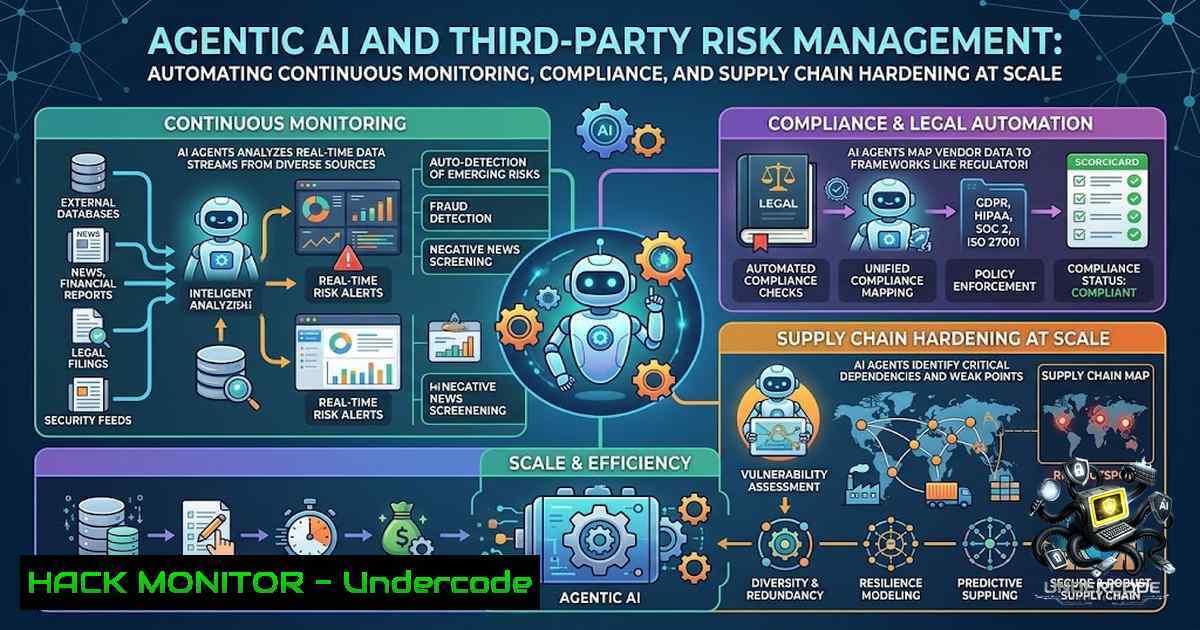
Traditional annual vendor reviews are inadequate in today’s threat landscape. Agentic AI enables continuous monitoring of supplier financial health, sanctions, adverse media, cyber incidents, and regulatory developments in real time. Diligent’s 3rdRisk platform, recognised as a Leader in the 2026 Gartner® Magic Quadrant™ for Third‑Party Risk Management Tools, exemplifies this shift by providing AI-driven analysis that identifies critical risks before they become incidents.
Step‑by‑Step Guide: Implementing Continuous Vendor Monitoring
- Centralise vendor data: Build a central view of every third‑party relationship by manually adding vendors, bulk importing existing supplier lists, or connecting via API to pull data directly from existing systems.
- Configure AI-powered risk profiles: Enable automatic AI-powered segmentation to assess inherent risk from the moment a third party enters the platform.
- Set up real-time alerts: Configure automated notifications for incidents, country risk profiles, and adverse media changes.
- Deploy AI-assisted questionnaires: Use AI to populate and accelerate vendor assessments, reducing manual effort.
- Integrate with collaboration tools: Leverage virtual assistants for Microsoft Teams and Slack to keep remediation on track.
Linux Command: Automated Vendor Log Analysis
 Aggregate and parse vendor access logs for anomaly detection
sudo grep -E "FAILED|DENIED|UNAUTHORIZED" /var/log/auth.log | \
awk '{print $1, $2, $3, $9, $11}' | sort | uniq -c | sort -1r > vendor_anomalies.txt

Monitor real-time vendor API traffic for suspicious patterns
sudo tail -f /var/log/nginx/access.log | \
awk '{if ($9 >= 400) print "ALERT: " $0}' | mail -s "Vendor API Alerts" [email protected]

Scan for open ports on vendor-facing systems
nmap -sS -p- -T4 --open vendor-subnet-ip-range | grep "open" | tee vendor_open_ports.log
Windows PowerShell: Vendor Activity Audit
 Extract failed login attempts from vendor accounts
Get-WinEvent -LogName Security | Where-Object { $<em>.Id -eq 4625 } |
Select-Object TimeCreated, @{Name="User";Expression={$</em>.Properties[bash].Value}} |
Export-Csv -Path "vendor_failed_logins.csv" -1oTypeInformation

Monitor vendor service account activity
Get-WinEvent -LogName Security | Where-Object { $<em>.Id -in @(4624,4634,4672) } |
Where-Object { $</em>.Message -match "vendor_service_account" } |
Group-Object TimeCreated -1oElement | Sort-Object Count -Descending
- API Security and Integration: The Backbone of Modern TPRM
APIs are the connective tissue of modern TPRM. Diligent’s flexible REST API allows teams to query company insights, flags, and filings in real time and feed them into internal tools, dashboards, or compliance systems. However, API security is paramount—organisations must enforce OAuth 2.0/OIDC, short-lived JWTs, mTLS between services, and least privilege on every integration.
Step‑by‑Step Guide: Securing Vendor API Integrations
- Perform thorough vendor assessments: Evaluate vendors’ API configurations, authentication mechanisms, and data protection measures before integration.
- Implement granular access scopes: Align UI and API controls to provide maximum overlap in visibility and governance.
- Enforce strong authentication: Use OAuth 2.0 with PKCE, short-lived JWTs, and mutual TLS (mTLS) for service-to-service communication.
- Monitor API usage and activity: Implement rate limiting to prevent data exfiltration and log every transaction for compliance and forensic review.
- Regularly review and update APIs: Establish a contingency plan and rotate masking rules as systems evolve.
Linux Command: API Endpoint Security Scanning
 Use OWASP ZAP for automated API security scanning
docker run -v $(pwd):/zap/wrk/:rw -t owasp/zap2docker-weekly \
zap-api-scan.py -t https://vendor-api-endpoint.com/v3/api-docs \
-f openapi -r api_security_report.html

Test API rate limiting
for i in {1..1000}; do
curl -s -o /dev/null -w "%{http_code}\n" https://vendor-api-endpoint.com/data \
-H "Authorization: Bearer $TOKEN";
done | sort | uniq -c

Validate SSL/TLS configuration on vendor endpoints
sslscan --1o-failed vendor-api-endpoint.com:443 | grep -E "Accepted|Preferred"
Windows Command: API Integration Testing
 Test API connectivity with basic authentication
curl -X GET "https://vendor-api-endpoint.com/v3/vendors" -H "Authorization: Bearer %TOKEN%" -H "Content-Type: application/json"

Validate API response times
for /L %i in (1,1,50) do @curl -w "%%{time_total}\n" -o nul -s -H "Authorization: Bearer %TOKEN%" https://vendor-api-endpoint.com/health
3. Automated Risk Scoring and Assessment Orchestration
AI-driven risk scoring replaces subjective manual evaluations with objective, criteria-driven assessments. Solutions like VendorWatch, a Python-based TPRM framework, simulate vendor lifecycle activity, perform continuous audit monitoring, and calculate risk scores to detect anomalous access, privilege escalation, and offboarding gaps in real time.
Step‑by‑Step Guide: Deploying Automated Risk Scoring
- Define risk criteria: Establish inherent risk factors (data sensitivity, access level) and residual risk factors (certifications, audit history).
- Implement a risk scoring engine: Use open-source tools or build a custom Python script to calculate and manage vendor risk scores.
- Automate assessment population: Leverage AI to populate vendor assessments with pre-filled data from integrated sources.
- Configure risk-based assessment automation: Trigger assessments based on risk thresholds and changes in vendor posture.
- Generate compliance reports: Produce machine-verifiable evidence for auditors and regulators.
Python Script: Vendor Risk Score Calculator
!/usr/bin/env python3
"""
Vendor Risk Score Calculator - Automated TPRM Scoring Engine
Calculates inherent and residual risk scores for third-party vendors.
"""

import json
import csv
from datetime import datetime

def calculate_inherent_risk(data_sensitivity, access_level, data_volume):
"""Calculate inherent risk based on data sensitivity and access."""
sensitivity_score = {"high": 10, "medium": 5, "low": 2}.get(data_sensitivity, 5)
access_score = {"critical": 10, "elevated": 6, "standard": 3}.get(access_level, 3)
volume_score = min(data_volume / 1000, 10)
return round((sensitivity_score  0.4) + (access_score  0.4) + (volume_score  0.2), 2)

def calculate_residual_risk(certifications, audit_findings, incident_history):
"""Calculate residual risk based on controls and history."""
cert_score = 0 if certifications else 5
audit_score = min(audit_findings  2, 10)
incident_score = min(incident_history  3, 10)
return round((cert_score  0.3) + (audit_score  0.4) + (incident_score  0.3), 2)

def calculate_total_risk(inherent, residual):
"""Calculate total risk score."""
return round((inherent  0.6) + (residual  0.4), 2)

Load vendor data
with open('vendors.csv', 'r') as f:
reader = csv.DictReader(f)
for row in reader:
inherent = calculate_inherent_risk(
row['data_sensitivity'],
row['access_level'],
int(row['data_volume_gb'])
)
residual = calculate_residual_risk(
row['certifications'] == 'True',
int(row['audit_findings']),
int(row['incident_history'])
)
total = calculate_total_risk(inherent, residual)
print(f"{row['vendor_name']}: Inherent={inherent}, Residual={residual}, Total={total}")
- Regulatory Compliance Automation: APRA CPS 230 and DORA
With APRA CPS 230 enforcement beginning July 2026 and DORA active in the EU, financial institutions can no longer rely on spreadsheets and manual processes. These regulations require robust ICT risk management frameworks, incident reporting, digital operational resilience testing, and board-level accountability.
Step‑by‑Step Guide: Automating Regulatory Compliance
- Develop and maintain risk management frameworks: Align with CPS 230 requirements for operational risk management and business disruption prevention.
- Implement continuous monitoring: Replace annual reviews with real-time oversight of third-party security posture.
- Automate incident reporting: Configure workflows that trigger notifications and remediation tasks for high-risk third parties.
- Conduct digital operational resilience testing: Use automated tools to simulate and validate resilience capabilities.
- Maintain audit trails: Log every transaction and assessment for compliance and forensic review.
Linux Command: Compliance Scanning with OpenSCAP
 Install OpenSCAP for automated compliance scanning
sudo apt-get install openscap-scanner -y

Scan against CIS benchmark for Linux
sudo oscap xccdf eval --profile xccdf_org.cisecurity.benchmarks_profile_Level_2_Server \
--results compliance_report.xml /usr/share/xml/scap/ssg/content/ssg-ubuntu2204-ds.xml

Generate human-readable report
sudo oscap xccdf generate report compliance_report.xml > compliance_report.html

Check for specific CPS 230-related controls (custom profile)
sudo oscap xccdf eval --profile cps230-baseline --results cps230_report.xml custom_cps230_profile.xml
Windows PowerShell: DORA Compliance Checks
 Check ICT risk management controls
Get-WindowsFeature | Where-Object {$_.Installed -eq $true} | Export-Csv -Path "ict_controls.csv"

Audit incident response procedures
Get-WinEvent -LogName "Microsoft-Windows-Sysmon/Operational" |
Where-Object {$_.Id -in @(1,3,7)} | Export-Csv -Path "incident_logs.csv"

Validate backup and recovery procedures
Get-WBBackupSet | Select-Object BackupTime, BackupTarget, BackupSetId |
Export-Csv -Path "backup_audit.csv"
- Fourth and Fifth-Party Dependency Mapping and Concentration Risk
Supply chain risks extend beyond direct vendors. Organisations must map fourth and fifth-party dependencies and identify concentration risk across supply chains. This requires visibility into nested supplier relationships and the ability to detect single points of failure.
Step‑by‑Step Guide: Mapping Supply Chain Dependencies
- Inventory all third-party services and APIs: Maintain an up-to-date inventory of all external dependencies.
- Map dependency chains: Use automated tools to discover and visualise fourth and fifth-party relationships.
- Identify concentration risk: Analyse dependencies for single points of failure or vendor lock-in.
- Implement containment architecture: Limit blast radius when a dependency is compromised.
- Establish vendor exit procedures: Maintain backups and rehearse vendor exit procedures.
Linux Command: Dependency Analysis with ChainRisk
 Install ChainRisk for SBOM analysis
git clone https://github.com/jijo-OO7/chainrisk.git
cd chainrisk
pip install -r requirements.txt

Analyze SBOM for supply chain risk
chainrisk sbom-info vendor_sbom.json

Identify blast radius for a specific dependency
chainrisk blast vendor_sbom.json --target=compromised-package

Generate dependency graph
chainrisk graph vendor_sbom.json --output dependency_graph.dot
dot -Tpng dependency_graph.dot -o dependency_graph.png
Windows Command: Network Dependency Mapping
 Trace network paths to vendor endpoints
tracert vendor-api-endpoint.com > vendor_network_path.txt

Analyze DNS dependencies
nslookup -type=NS vendor-domain.com
nslookup -type=CNAME vendor-api-endpoint.com
6. Cloud Supply Chain Hardening
Cloud-1ative architectures introduce unique supply chain risks. Organisations must implement least privilege access, enforce strict API security, and integrate continuous security testing into CI/CD pipelines.
Step‑by‑Step Guide: Hardening Cloud Supply Chains
- Implement least privilege access: Use IAM roles with scoped permissions for all vendor integrations.
- Enforce zero-trust architecture: Apply zero-trust principles to all third-party access.
- Automate vulnerability scanning: Integrate tools like Snyk, Aqua Security, and Checkmarx into CI/CD workflows.
- Monitor network flow logs: Use network flow logs and audit trails to detect suspicious activity.
- Set up automated response: Configure automated responses to isolate affected workloads.
Linux Command: Cloud Supply Chain Security Scanning
 Scan container images for vulnerabilities
trivy image --severity HIGH,CRITICAL vendor-container:latest

Check Kubernetes cluster for misconfigurations
kubectl score vendor-deployment.yaml

Audit cloud IAM policies
aws iam list-policies --scope Local --only-attached | \
jq '.Policies[] | select(.PolicyName | contains("vendor"))' > vendor_iam_policies.json
Windows Command: Cloud Resource Auditing
 List Azure resources with vendor access
az resource list --query "[?tags.Vendor=='true']" --output table

Check Azure role assignments for vendors
az role assignment list --all --query "[?principalType=='ServicePrincipal']" --output table
What Undercode Say:
- AI is a force multiplier, not a replacement: Agentic AI allows risk professionals to spend less time gathering information and more time making informed risk decisions. The human element remains critical for strategic judgment and contextual understanding.
-
Continuous monitoring is the new standard: Regulators and boards now expect demonstrated structured vendor governance, continuous monitoring, and documented risk assessments. Organisations that fail to adopt automated TPRM will face regulatory penalties and operational disruptions.
The shift from periodic reviews to continuous monitoring represents a fundamental paradigm change in risk management. With 83% of organisations experiencing third-party incidents and average breach costs approaching $5 million, the business case for AI-1ative TPRM is compelling. The technology exists to review 200+ page SOC reports in minutes, summarise supplier assessments, and map fourth-party dependencies automatically. However, success depends on proper implementation—secure API integration, accurate risk scoring, and robust compliance automation. Organisations must also address the cultural shift, moving risk professionals from data gatherers to strategic decision-makers.
Prediction:
- +1 Agentic AI will reduce third-party risk assessment times by 70–90% over the next 18 months, enabling organisations to onboard and monitor vendors at unprecedented scale.
-
+1 Regulatory frameworks will increasingly mandate AI-driven continuous monitoring, with APRA CPS 230 and DORA serving as templates for global standards.
-
-1 Organisations that fail to automate TPRM will face escalating breach costs, with supply chain-related incidents potentially exceeding $10 million per event by 2028.
-
+1 The integration of Agentic AI with existing GRC platforms will create new roles for AI risk analysts, blending cybersecurity expertise with AI governance skills.
-
-1 Attackers will increasingly target AI models and APIs used in TPRM, necessitating robust AI security and adversarial testing protocols.
▶️ Related Video (76% Match):
https://www.youtube.com/watch?v=49xg-uf7l7w
🎯Let’s Practice For Free:
🎓 Live Courses & Certifications:
Join Undercode Academy for Verified Certifications
🚀 Request a Custom Project:
Secure, high-velocity infrastructure and disruptive technological engineering. Contact our engineering team for high-tier development and proprietary systems:
[email protected]
💎 Smart Architecture | 🛡️ Secure by Design | ⭐ Trusted by Thousands
IT/Security Reporter URL:
Reported By: Rohit Nayak – Hackers Feeds
Extra Hub: Undercode MoN
Basic Verification: Pass ✅


