Listen to this Post
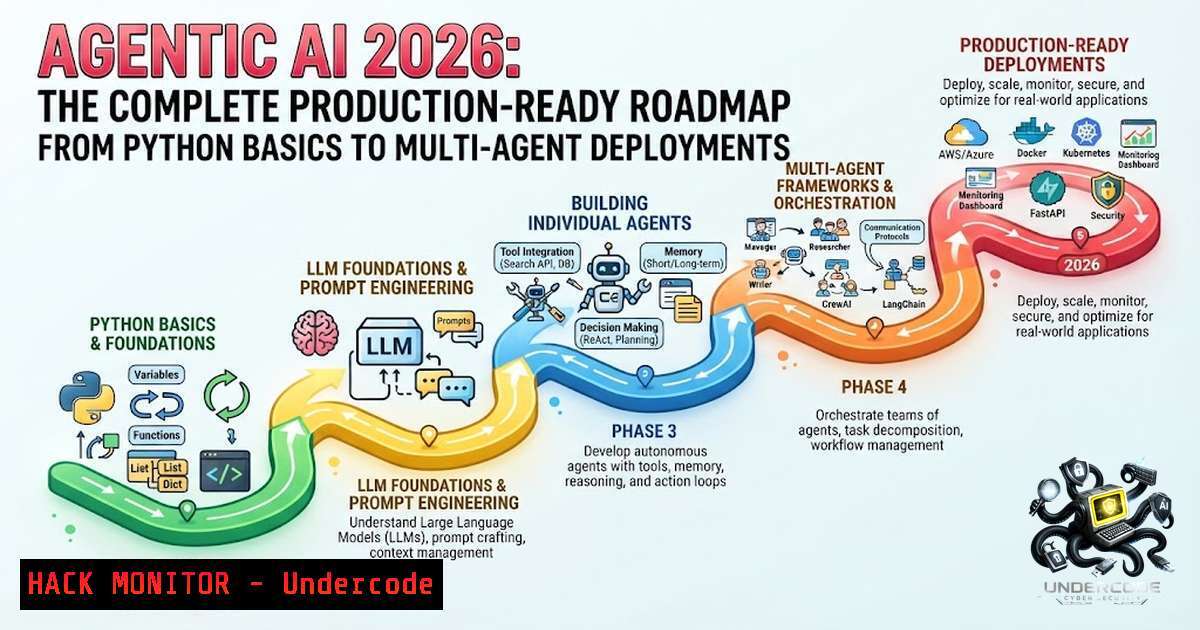
Introduction:
Agentic AI represents the next evolutionary leap in artificial intelligence—moving beyond simple chat interfaces to autonomous systems that can reason, plan, execute tasks, and collaborate with other agents. As organizations rush to move AI from prototype to production, understanding the full stack of technologies—from Python fundamentals and prompt engineering to LangGraph orchestration, Model Context Protocol (MCP), and secure Kubernetes deployment—has become essential for AI engineers and data scientists. This comprehensive roadmap, inspired by industry expert Babar Ali’s vision, provides a structured pathway to building production-ready agentic systems that are not just functional but secure, observable, and scalable.
Learning Objectives:
- Master the foundational Python programming and prompt engineering skills required for building LLM-powered agents
- Understand and implement Retrieval-Augmented Generation (RAG) pipelines with LangChain for knowledge-grounded AI systems
- Build and orchestrate multi-agent systems using LangGraph’s graph-based workflow patterns
- Implement Model Context Protocol (MCP) for standardized tool integration and inter-agent communication
- Deploy production-ready agentic systems with Docker, Kubernetes, and comprehensive security guardrails
1. Python Environment Setup and LLM Foundations
Before diving into agent development, establishing a robust Python environment with the correct dependencies is critical. Modern agent development requires Python 3.12+ and a package manager like `uv` for faster dependency resolution.
 Install uv package manager
curl -LsSf https://astral.sh/uv/install.sh | sh

Create a new project with virtual environment
uv init agentic-project
cd agentic-project
uv venv
source .venv/bin/activate  On Windows: .venv\Scripts\activate

Install core dependencies
uv add langchain langgraph langchain-openai chromadb tiktoken
uv add fastapi uvicorn pydantic python-dotenv
uv add mcp-agent  Model Context Protocol agent framework
Understanding LLM fundamentals is the prerequisite. Agents transform language models from passive predictors into active actors capable of reasoning and taking action within a given environment. The core components include:
- LLM Integration: Connecting to models via OpenAI, Anthropic, or local Ollama instances
- Prompt Engineering: Crafting system prompts that define agent roles, constraints, and output formats
- Function Calling: Enabling LLMs to invoke external tools and APIs
 Basic LLM integration with LangChain
from langchain_openai import ChatOpenAI
from langchain_core.messages import SystemMessage, HumanMessage

llm = ChatOpenAI(model="gpt-4", temperature=0.7)
messages = [
SystemMessage(content="You are a research assistant AI agent."),
HumanMessage(content="Summarize the latest advances in quantum computing.")
]
response = llm.invoke(messages)
print(response.content)
2. Prompt Engineering and Agent Persona Design
Prompt engineering for agents goes far beyond simple instruction writing. Agent prompts must define not just what to do, but how to think, what tools are available, and when to ask for clarification. The ReAct (Reasoning + Acting) pattern is fundamental.
Step-by-step guide to building effective agent prompts:
- Define the agent’s role and expertise: Be specific about domain knowledge and limitations
- Specify available tools and their signatures: List every function the agent can call
- Establish reasoning protocols: Define how the agent should break down complex problems
- Set output formatting requirements: Ensure consistent, parseable responses
- Implement safety guardrails: Include refusal patterns for dangerous or out-of-scope requests
 Advanced agent prompt template
AGENT_SYSTEM_PROMPT = """
You are an Expert Research Agent with access to the following tools:
- search_web(query): Search the internet for current information
- read_document(path): Read and extract content from documents
- analyze_data(data): Perform statistical analysis on provided data

When presented with a query:
1. Break down the problem into sub-tasks
2. Determine which tools to use for each sub-task
3. Execute tools in sequence, using results to inform next steps
4. Synthesize findings into a comprehensive response

If you lack sufficient information, ask clarifying questions.
Never perform actions that could compromise system security or user privacy.
"""
3. Retrieval-Augmented Generation (RAG) Implementation
RAG addresses one of the primary limitations of LLMs: their knowledge cutoff and inability to access private or recent data. Agentic RAG goes further by enabling agents to reason about when and how to retrieve information during the interaction.
Building a production RAG pipeline with LangChain:
from langchain.document_loaders import DirectoryLoader, TextLoader
from langchain.text_splitter import RecursiveCharacterTextSplitter
from langchain.vectorstores import Chroma
from langchain_openai import OpenAIEmbeddings
from langchain.tools import tool

Step 1: Load and chunk documents
loader = DirectoryLoader("./docs/", glob="/.txt", loader_cls=TextLoader)
documents = loader.load()
text_splitter = RecursiveCharacterTextSplitter(chunk_size=1000, chunk_overlap=200)
chunks = text_splitter.split_documents(documents)

Step 2: Create vector embeddings and store
embeddings = OpenAIEmbeddings()
vectorstore = Chroma.from_documents(chunks, embeddings, persist_directory="./chroma_db")

Step 3: Define retrieval tool for the agent
@tool
def retrieve_context(query: str) -> str:
"""Retrieve relevant document chunks for the given query."""
results = vectorstore.similarity_search(query, k=5)
return "\n\n".join([doc.page_content for doc in results])

Step 4: Agent with retrieval capability
from langchain.agents import create_react_agent, AgentExecutor
from langchain.tools import Tool

tools = [
Tool(name="retrieve", func=retrieve_context, description="Search company knowledge base")
]
agent = create_react_agent(llm, tools, prompt_template)
executor = AgentExecutor(agent=agent, tools=tools, verbose=True)
For more sophisticated RAG patterns, Deep Agents enable skills-guided retrieval, rubric-checked grounding, and todo-driven investigation where subagents analyze retrieved chunks in parallel.
4. Model Context Protocol (MCP) Integration
MCP, introduced by Anthropic, solves a critical problem in agent development: standardizing how AI systems communicate with external tools, resources, and services. Rather than building custom integrations for every tool, MCP provides a unified protocol.
The `mcp-agent` framework fully implements MCP and handles the lifecycle management of MCP server connections. This enables agents to:
- Connect to multiple MCP servers simultaneously
- Use tools, access resources, and receive prompts from standardized interfaces
- Scale from simple agents to sophisticated Temporal-backed workflows
Building an MCP server with FastMCP:
 MCP Server implementation
from mcp.server.fastmcp import FastMCP

mcp = FastMCP("Weather Service")

@mcp.tool()
def get_weather(city: str) -> str:
"""Get current weather for a city."""
 API call implementation
return f"Weather in {city}: Sunny, 72°F"

@mcp.resource("file:///data/{filename}")
def get_file(filename: str) -> str:
"""Read a file from the data directory."""
with open(f"/data/{filename}", 'r') as f:
return f.read()

if <strong>name</strong> == "<strong>main</strong>":
mcp.run(transport="stdio")
Agent connecting to MCP servers:
from mcp_agent.app import MCPApp
from mcp_agent.agents.agent import Agent
from mcp_agent.workflows.llm.augmented_llm_openai import OpenAIAugmentedLLM

app = MCPApp(name="research_agent")

async def main():
async with app.run():
agent = Agent(
name="researcher",
instruction="Use filesystem and web search to answer questions.",
server_names=["filesystem", "web_search"],
)
async with agent:
llm = await agent.attach_llm(OpenAIAugmentedLLM)
answer = await llm.generate_str("What are the latest AI trends?")
print(answer)
5. LangGraph: Building Graph-Based Agent Workflows
LangGraph transforms agent development from linear chains into graph-based workflows with nodes, edges, and shared state. This enables sophisticated patterns including:
- Supervisor pattern: A central agent delegates tasks to specialized subagents
- Swarm pattern: Agents dynamically hand off control based on specializations
- Hierarchical systems: Coordinated by a central supervisor with clear escalation paths
Building a multi-agent system with LangGraph:
from langgraph.graph import StateGraph, END
from typing import TypedDict, List
from langchain_core.messages import HumanMessage, AIMessage

class AgentState(TypedDict):
messages: List
current_agent: str
research_findings: str
final_answer: str

Define specialized agents
def research_agent(state: AgentState):
"""Conduct research on the topic."""
llm = ChatOpenAI(model="gpt-4")
response = llm.invoke(state["messages"])
return {"research_findings": response.content, "current_agent": "writer"}

def writer_agent(state: AgentState):
"""Synthesize research into final output."""
prompt = f"Based on this research: {state['research_findings']}, write a comprehensive answer."
response = llm.invoke([HumanMessage(content=prompt)])
return {"final_answer": response.content, "current_agent": "END"}

Build the graph
builder = StateGraph(AgentState)
builder.add_node("researcher", research_agent)
builder.add_node("writer", writer_agent)
builder.add_edge("researcher", "writer")
builder.add_edge("writer", END)
builder.set_entry_point("researcher")

graph = builder.compile()
result = graph.invoke({"messages": [HumanMessage(content="Explain quantum computing")]})
Multi-agent systems excel when tasks naturally break into distinct steps or roles—such as planning, writing, reviewing, or using different specialized prompts. Each agent has a narrower objective, making prompts simpler and more consistent.
6. Memory Management and Persistence
Agents need both short-term memory (conversation context) and long-term memory (persistent knowledge across sessions). LangGraph supports checkpointing for state persistence.
Implementing agent memory with LangGraph checkpointing:
from langgraph.checkpoint.sqlite import SqliteSaver

Create a memory-backed graph
memory = SqliteSaver.from_conn_string("checkpoints.db")
graph_with_memory = builder.compile(checkpointer=memory)

Run with thread_id for session persistence
config = {"configurable": {"thread_id": "user_session_123"}}
result = graph_with_memory.invoke(
{"messages": [HumanMessage(content="Remember my name is Alice")]},
config=config
)
 Later, the agent recalls context from the same thread
result = graph_with_memory.invoke(
{"messages": [HumanMessage(content="What is my name?")]},
config=config
)
For multi-agent systems, each agent can maintain its own state while sharing a global context through the orchestration layer.
7. Production Deployment: Docker and Kubernetes
Moving from notebook to production requires containerization and orchestration. The LangGraph agent stack provides a production-grade template with:
- FastAPI with SSE streaming
- Docker containerization
- Helm charts for Kubernetes deployment
- Per-run cost caps and rate limiting
- Prometheus metrics and structured logging
Dockerfile for agent deployment:
FROM python:3.12-slim
WORKDIR /app
COPY pyproject.toml uv.lock ./
RUN pip install uv && uv sync --frozen
COPY . .
EXPOSE 8000
CMD ["uv", "run", "uvicorn", "api.main:app", "--host", "0.0.0.0", "--port", "8000"]
Kubernetes deployment with Helm:
 Add the LangGraph agent Helm repository
helm repo add langgraph https://langchain-ai.github.io/langgraph-helm
helm repo update

Deploy to Kubernetes
helm install langgraph-agent langgraph/langgraph-agent \
--1amespace agentic-system \
--create-1amespace \
--set openai.apiKey=$OPENAI_API_KEY \
--set replicaCount=3 \
--set resources.limits.memory="2Gi" \
--set resources.limits.cpu="1000m"
For production readiness, the OWASP Agentic Skills Top 10 provides a security checklist covering skill authorization, supply-chain integrity, and runtime isolation. Security must be established before deployment, not retrofitted.
8. Security Hardening and Guardrails
Agentic AI introduces unique security vulnerabilities including prompt injection, tool misuse, agentic looping, and hallucinated actions. The OWASP Top 10 for Agentic Applications provides a comprehensive framework for identifying and mitigating these risks.
Critical security practices:
- Least privilege: Agents get only the minimum access needed, for the shortest time required
- Runtime governance: Enforce deterministic policies beneath the model layer
- Prompt hardening: Sanitize inputs and implement refusal patterns for dangerous requests
- Tool authorization: Implement granular permissions at the skill execution layer
- Continuous red-teaming: Regularly test agents against adversarial inputs
 Input sanitization and safety middleware
from pydantic import BaseModel, validator
import re

class AgentInput(BaseModel):
query: str

@validator('query')
def sanitize_query(cls, v):
 Block potentially dangerous patterns
dangerous_patterns = [
r'rm\s+-rf', r'DROP\s+TABLE', r'DELETE\s+FROM',
r'<strong>import</strong>', r'eval(', r'exec('
]
for pattern in dangerous_patterns:
if re.search(pattern, v, re.IGNORECASE):
raise ValueError(f"Query contains prohibited pattern: {pattern}")
return v

Rate limiting middleware
from slowapi import Limiter, _rate_limit_exceeded_handler
from slowapi.util import get_remote_address

limiter = Limiter(key_func=get_remote_address)
app.state.limiter = limiter
app.add_exception_handler(429, _rate_limit_exceeded_handler)

@app.post("/agent/run")
@limiter.limit("10/minute")
async def run_agent(input_data: AgentInput, request: Request):
 Agent execution with safety checks
pass
What Babar Ali Says:
- Continuous learning and consistent building are essential—the AI landscape evolves too rapidly for one-time training. Success comes from daily practice and systematic skill acquisition.
-
Production readiness separates professionals from hobbyists—moving AI from prototype to production requires mastering deployment, evaluation, and security, not just understanding core concepts. Multi-agent architectures with modular, independently deployable units enable agile updates as underlying models evolve every few months.
-
Open protocols prevent vendor lock-in—MCP for tool integration and A2A for inter-agent communication are becoming industry standards. Adopting these early is far less painful than retrofitting them later.
-
Security must be designed in from day one—the OWASP Agentic Skills Top 10 provides a practical framework for addressing agent behavior layer risks. Runtime governance, least privilege, and continuous monitoring are non-1egotiable.
-
Evaluation belongs in the workflow—embedding evaluation probes inside agentic workflows enables real-time auditability, not just offline batch analysis. Observability drives continuous improvement.
Prediction:
+1 Agentic AI will become the dominant paradigm for enterprise AI applications by 2027, with over 60% of organizations deploying multi-agent systems in production, driven by the maturation of frameworks like LangGraph and standardized protocols like MCP.
+1 The convergence of RAG, MCP, and graph-based orchestration will enable truly autonomous agents capable of handling complex, multi-step business processes with minimal human intervention, dramatically reducing operational costs.
-1 The security landscape will become increasingly challenging as agentic systems proliferate. Prompt injection, tool misuse, and agent-to-agent communication vulnerabilities will lead to high-profile incidents, forcing rapid regulatory intervention.
-1 Organizations that fail to adopt open protocols and modular architectures will face significant technical debt and vendor lock-in, struggling to keep pace with the rapidly evolving AI ecosystem.
+1 The rise of agentic RL (reinforcement learning for agents) will enable systems that continuously improve through interaction, moving beyond static prompt engineering to dynamic, adaptive intelligence.
▶️ Related Video (82% Match):
🎯Let’s Practice For Free:
🎓 Live Courses & Certifications:
Join Undercode Academy for Verified Certifications
🚀 Request a Custom Project:
Secure, high-velocity infrastructure and disruptive technological engineering. Contact our engineering team for high-tier development and proprietary systems:
[email protected]
💎 Smart Architecture | 🛡️ Secure by Design | ⭐ Trusted by Thousands
IT/Security Reporter URL:
Reported By: Babaralimahar Ai – Hackers Feeds
Extra Hub: Undercode MoN
Basic Verification: Pass ✅


