Listen to this Post
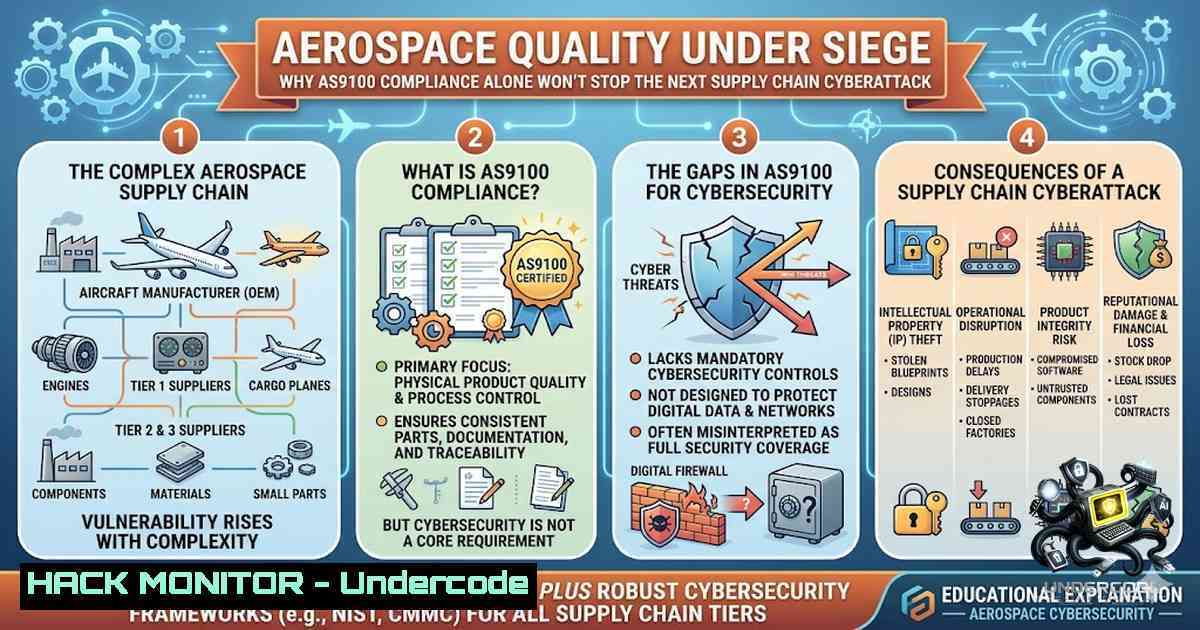
Introduction:
The aerospace industry’s quality management systems—built around AS9100, AS13100, and rigorous supplier oversight—are increasingly becoming targets for cyber exploitation. As quality managers and engineers race to implement Zero-Defect programs and drive continuous improvement, the convergence of operational technology (OT) with enterprise IT has created a sprawling attack surface that traditional audit checklists fail to address. This article bridges the gap between aerospace quality engineering and cybersecurity, revealing how the very processes designed to ensure product safety—supplier audits, First Inspection Reports (FAIR), and root cause corrective actions—can be weaponized or compromised if not secured with the same rigor applied to physical manufacturing.
Learning Objectives:
- Identify cyber-physical attack vectors within aerospace quality workflows, including supplier portals, MRP systems (SAP), and AS9102 FAIR data exchanges.
- Implement technical controls and verification commands to audit and harden quality management IT assets against supply chain compromise.
- Apply root cause analysis (8D, A3, 5 Why) methodologies to cybersecurity incidents within manufacturing environments, extending traditional quality tools to digital forensics.
You Should Know:
- The Digital Thread: Mapping Aerospace Quality Workflows to Cyber Risk
The modern aerospace quality engineer operates at the intersection of physical parts and digital data. The job description for the Supplier Quality Engineer role in Coventry explicitly requires proficiency in SAP or similar MRP systems, execution of supplier audit plans, and review of First Inspection Reports to AS9102. Each of these touchpoints represents a potential entry point for adversaries.
When a supplier submits an FAIR electronically, that PDF or XML file could contain embedded macros or exploits targeting the recipient’s quality management system. When a quality manager updates a Control Plan or PFMEA in a cloud-based PLM platform, misconfigured permissions could expose proprietary manufacturing processes to nation-state actors. The Zero-Defect program roll-out to key suppliers—while admirable for reducing defective parts per million—introduces a dependency on suppliers’ own cybersecurity postures. If a Tier 2 supplier’s network is breached, the attacker can pivot to the prime contractor’s OT environment via trusted VPN connections or automated EDI transactions.
Step-by-Step Guide: Auditing Your Supplier Data Exchange Security
- Inventory External Data Flows: Use `nmap -sV -p- –open
` (Linux) to scan all open ports on your supplier-facing file transfer servers. On Windows, use `Test-1etConnection -ComputerName -Port ` to verify expected services only. - Review AS9102 FAIR Transmission Methods: If using FTP/SFTP, verify encryption. Run `sudo grep -i “cipher” /etc/ssh/sshd_config` to ensure SFTP uses strong ciphers (e.g.,
[email protected]). For Windows SFTP servers, check `Get-Service -1ame sshd` and verify `Protocol` and `Ciphers` in%ProgramData%\ssh\sshd_config. - Assess Supplier Portal Authentication: Test for basic credential hygiene. Use `curl -I https://
/` to check if HTTPS is enforced and examine `Strict-Transport-Security` header. For internal portals, run `openssl s_client -connect :443 -tls1_2` to validate TLS version. - Implement File Sandboxing: Before any FAIR or PPAP file is ingested into the core QMS, route it through a sandbox. On Linux, use `clamscan –recursive –infected /path/to/supplier_files` as a first-layer AV check. For deeper analysis, configure `cuckoo` or `CAPE` sandbox to execute files in an isolated environment.
2. Zero-Defect, Zero-Trust: Rethinking Supplier Quality Audits
The Quality Manager role description emphasizes leading root cause analysis and corrective actions using 8D, A3, and 5 Why methodologies. In a cybersecurity context, these same tools are indispensable for investigating a breach that originates from a compromised supplier. However, traditional quality audits focus on process adherence and product conformity—not on the supplier’s information security controls. The AS9100 standard includes clauses on risk management, but rarely are they interpreted to include cyber-risk to the physical production line.
Consider the Source Transfer programme mentioned in the Supplier Quality Engineer responsibilities. When a manufacturing process is transferred from one supplier to another, the digital blueprints, NC programs, and inspection routines are transferred as well. If this transfer occurs over unencrypted email or unsecured cloud storage, the intellectual property (and potentially the means to produce counterfeit parts) is exposed.
Step-by-Step Guide: Conducting a Cyber-Physical Supplier Audit
- Request Cybersecurity Evidence: During the audit, request a copy of the supplier’s SOC 2 Type II report or ISO 27001 certificate. If unavailable, ask for their NIST CSF self-assessment. This is a non-1egotiable extension of the AS9100 audit plan.
- Verify Network Segmentation: Ask the supplier to demonstrate that their OT network (CNC machines, CMMs) is segmented from their corporate IT network. Remotely, you can use `traceroute -1
` to map the path and infer segmentation boundaries. For on-site audits, use a laptop with `wireshark` to capture broadcast traffic and identify if OT devices are responding on the same subnet as IT workstations. - Test for Default Credentials: A significant number of manufacturing execution systems (MES) ship with default credentials. Use `nmap –script http-default-accounts
` to check for known defaults on web interfaces. On Windows, use `Get-WmiObject -Class Win32_UserAccount -Filter “LocalAccount=True”` to list local accounts and spot suspicious or default-1amed users. - Evaluate Patch Management: Ask for the patching policy for OT devices. Then, verify externally if possible: `nmap –script vuln
` can reveal known vulnerabilities in exposed services. For internal OT, use `openvas` or `nessus` to scan a representative sample of their manufacturing equipment (with permission). - Review Incident Response Playbook: Request their plan for responding to a ransomware attack that encrypts their CMM inspection data. A robust supplier will have a documented process that includes isolation procedures and data recovery from immutable backups.
-
Automating Compliance: AI in Aerospace Quality and Security
The drive for continuous improvement and operational excellence, as highlighted in the LinkedIn post, is increasingly leveraging Artificial Intelligence. AI can analyze nonconforming data and make recommendations for supplier/process improvements. However, AI models are themselves software artifacts that require secure development and deployment. An adversary could poison the training data used by an AI-powered visual inspection system, causing it to falsely accept defective parts—a cyber-physical attack that bypasses traditional quality gates.
Furthermore, AI-driven predictive maintenance systems constantly ingest data from sensors on critical equipment. If the data pipeline is compromised, the AI might predict false failures (causing costly downtime) or, worse, mask true anomalies that indicate a part is out of tolerance.
Step-by-Step Guide: Securing AI-Enabled Quality Systems
- Inventory AI/ML Models: Identify all AI models used in quality processes (e.g., defect classification, predictive maintenance). Run `ps aux | grep python` on Linux servers to find running ML processes and their associated scripts. On Windows, use
Get-Process | Where-Object {$_.ProcessName -match "python|tensorflow|pytorch"}. - Secure the Data Pipeline: Ensure data feeding the AI is authenticated and integrity-checked. For MQTT-based sensor data, enforce TLS: `mosquitto_sub -h
-p 8883 –cafile ca.crt -t “sensors/”` to verify encryption. For REST APIs feeding the model, check for API keys and rate limiting using curl -X GET https://<ai-api>/health -H "Authorization: Bearer <token>". - Implement Model Version Control: Use tools like `mlflow` or `dvc` to track model versions and prevent unauthorized model swaps. Run `mlflow models list` to audit deployed models. Store model binaries in a secure, access-controlled repository.
- Conduct Adversarial Testing: Test the AI’s robustness by feeding it slightly altered images (for visual inspection) or anomalous sensor data to see if it misclassifies. This can be done using Python libraries like `cleverhans` or
foolbox. Document the results as part of the PFMEA, treating the AI as a potential failure mode. - Monitor Model Drift: Set up alerts for when model performance deviates from baseline. Use `prometheus` and `grafana` to monitor inference latency and accuracy. A sudden drop in accuracy could indicate a data poisoning attack or a sensor malfunction.
4. Hardening the MRP System: SAP and Beyond
Both job descriptions explicitly mention SAP or similar MRP system experience. SAP systems are the crown jewels of aerospace manufacturing—they control procurement, inventory, production planning, and quality records. A compromise of the SAP system can lead to fraudulent supplier payments, alteration of quality certificates, or manipulation of batch records to cover up defects.
Securing SAP requires a layered approach, starting with the underlying operating system and database.
Step-by-Step Guide: Securing the SAP/ERP Environment
- Database Hardening: If the backend is Oracle or MSSQL, ensure strong passwords and minimal privileges. On Linux for Oracle, run `sqlplus / as sysdba` and `SELECT username, account_status FROM dba_users;` to review accounts. On Windows for MSSQL, use `Get-SqlUser -ServerInstance
` in PowerShell. - OS-Level Security: For Linux-based SAP servers, run `sudo apt-get update && sudo apt-get upgrade -y` (Debian/Ubuntu) or `sudo yum update -y` (RHEL) to patch the OS. Use `ufw` or `iptables` to restrict access to SAP ports (e.g., 3200, 3300) to only authorized IP addresses:
sudo ufw allow from <internal_subnet> to any port 3200. - SAP Authorizations: Conduct a review of SAP user roles and authorizations using transaction codes SUIM and PFCG. Look for users with SAP_ALL or SAP_NEW profiles. Generate a report of users who haven’t logged in for 90 days using SUIM -> Users -> Users by Last Logon Date.
- Audit Logging: Enable detailed audit logging in SAP (transaction SM19/SM20). Configure alerts for critical activities like changes to vendor bank details or mass changes to material master data. Integrate these logs with a SIEM using `syslog-1g` or
splunk forwarder. - Network Segmentation: Ensure the SAP system is not directly accessible from the internet. Use `netstat -tulpn | grep 3200` to check listening interfaces. The SAP system should only listen on internal interfaces. Place it behind a WAF if any web-facing components (like SAP Fiori) are exposed.
5. Incident Response: Applying 8D to a Cyberattack
When a cyber incident occurs, the quality manager’s familiarity with 8D (Eight Disciplines) problem-solving is a superpower. The 8D methodology can be directly mapped to cybersecurity incident response:
D0 (Prepare): Have a cyber incident response plan that includes quality representatives.
D1 (Team): Form a cross-functional team including IT, quality, and operations.
D2 (Problem Description): Describe the cyber incident in technical terms (e.g., “Ransomware encrypted all CMM inspection files on the file server”).
D3 (Interim Containment): Isolate the affected systems from the network. In Linux, use iptables -A INPUT -s <attacker_IP> -j DROP; in Windows, use New-1etFirewallRule -DisplayName "Block_Attacker" -Direction Inbound -RemoteAddress <attacker_IP> -Action Block.
D4 (Root Cause): Perform a digital forensic investigation. Use `journalctl -u
D5 (Permanent Corrective Action): Implement security patches, change passwords, and reconfigure firewalls.
D6 (Implement): Roll out the corrective actions across all similar systems.
D7 (Prevent Recurrence): Update the supplier audit checklist to include the vulnerability that was exploited.
D8 (Close): Document the incident and share lessons learned with the quality team.
Step-by-Step Guide: Forensic Data Collection from Quality Systems
- Preserve Evidence: Immediately create a forensic image of affected systems. On Linux, use
dd if=/dev/sda of=/mnt/evidence/image.dd bs=4M status=progress. On Windows, use `FTK Imager` to create a logical or physical image. - Collect Logs: Gather logs from the QMS, MRP, and OS. Use `ausearch -ts today` on Linux to check audit logs. On Windows, use `wevtutil epl Security C:\forensics\security.evtx` to export event logs.
- Analyze Network Traffic: If you have pcap files, use `tshark -r capture.pcap -Y “http.request”` to extract HTTP requests. Look for exfiltration attempts to unusual external IPs.
- Check for Persistence: Run `crontab -l` on Linux to list scheduled tasks. On Windows, use `schtasks /query /fo LIST /v` to review scheduled tasks. Also check startup folders and registry run keys (
reg query HKLM\Software\Microsoft\Windows\CurrentVersion\Run).
What Undercode Say:
- Key Takeaway 1: The aerospace quality engineer of 2026 must be a hybrid professional—equally adept at reading an AS9102 FAIR as they are at interpreting an Nmap scan. The lines between product quality and information security have permanently blurred.
- Key Takeaway 2: Supplier audits are no longer just about verifying process adherence; they must include a rigorous assessment of the supplier’s cybersecurity maturity. A supplier with excellent product quality but poor cyber hygiene is a liability that can bring down the entire value stream.
The LinkedIn post rightly calls for quality professionals passionate about “continuous improvement” and “operational excellence.” However, continuous improvement must now encompass the security of the digital infrastructure that supports quality. The Zero-Defect program cannot succeed if the data that defines a defect is corrupted by malware. The drive to reduce defective parts per million is noble, but a single ransomware attack that halts production for a week will wipe out any gains from defect reduction. Therefore, quality managers must champion cyber-resilience as a core quality metric. They need to embed security requirements into APQP and PPAP, treat cybersecurity incidents as quality non-conformances, and apply the same rigorous root cause analysis to a phishing email that they would to a fractured turbine blade. The future of aerospace quality is digital, and digital demands defense.
Prediction:
- -1: Within 24 months, major aerospace primes will mandate cyber-supplier audits as a prerequisite for AS9100 certification, leading to a wave of consolidation among smaller suppliers who cannot afford the necessary security investments.
- -1: The rise of AI-driven quality inspection will introduce new classes of adversarial machine learning attacks, forcing the industry to develop new standards (e.g., AS9100D, Annex SL) that specifically address AI model integrity and data provenance.
- +1: Quality engineers who upskill in cybersecurity fundamentals (e.g., CISSP, GICSP) will command a significant salary premium and become the new strategic leaders in manufacturing, bridging the gap between the shop floor and the C-suite.
▶️ Related Video (78% Match):
🎯Let’s Practice For Free:
🎓 Live Courses & Certifications:
Join Undercode Academy for Verified Certifications
🚀 Request a Custom Project:
Secure, high-velocity infrastructure and disruptive technological engineering. Contact our engineering team for high-tier development and proprietary systems:
[email protected]
💎 Smart Architecture | 🛡️ Secure by Design | ⭐ Trusted by Thousands
IT/Security Reporter URL:
Reported By: Charlottesujeeun Calling – Hackers Feeds
Extra Hub: Undercode MoN
Basic Verification: Pass ✅


