Listen to this Post
Introduction:
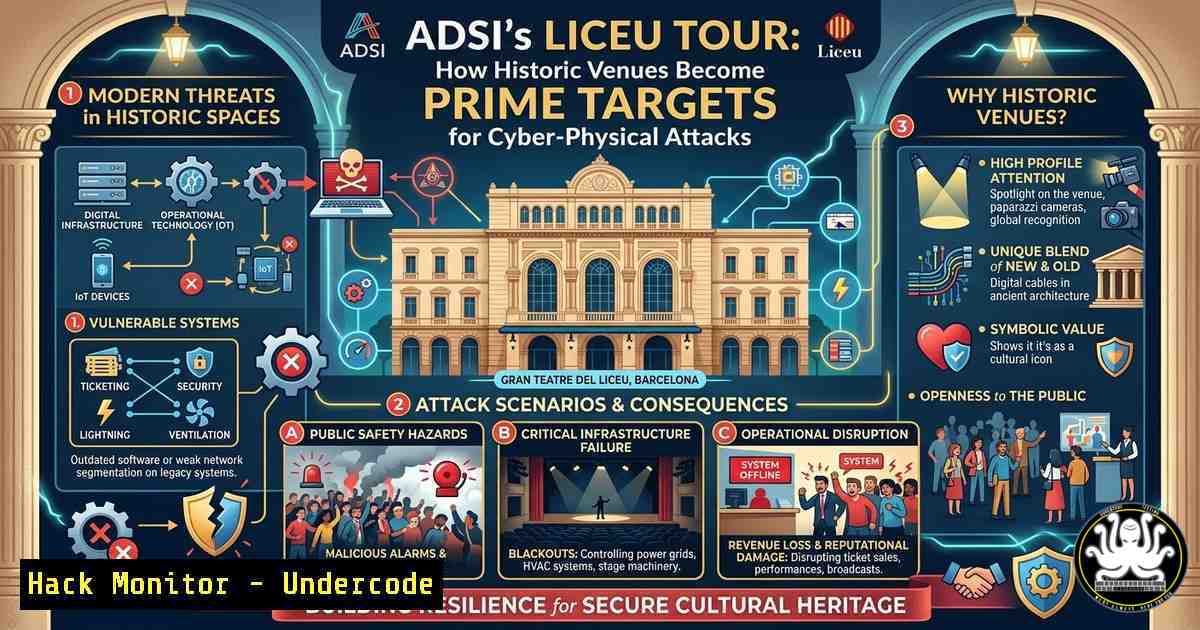
While the ADSI Asociación Directivos Seguridad Integral’s recent tour of the Gran Teatre del Liceu focused on physical security, access control, and fire prevention, the modern reality is that historic landmarks are no longer safe by walls alone. In an era of converged IT/OT (Operational Technology), the systems that manage lighting, stage machinery, access turnstiles, and fire suppression are now connected to the network. This integration, while efficient, transforms cultural landmarks into high-value targets for ransomware groups and hacktivists who understand that disrupting a national icon yields maximum chaos. This article explores how to secure the “smart building” infrastructure hidden behind historic facades, providing blue teams and security architects with actionable steps to defend these hybrid environments.
Learning Objectives:
- Understand the convergence of physical security systems (CCTV, turnstiles) with corporate IT networks.
- Identify common vulnerabilities in Building Management Systems (BMS) and IoT devices.
- Learn to perform basic reconnaissance and hardening of networked access control systems.
You Should Know:
- Mapping the Network Perimeter of a Historic Landmark
The first step in securing a venue like the Liceu is understanding that the network extends beyond the box office. Physical security devices (IP cameras, door controllers, fire alarm panels) often reside on flat networks or VLANs with weak segmentation. To audit this, a security professional can perform a passive reconnaissance of the local subnet to identify these devices.
Step‑by‑step guide (Linux – Network Mapping):
- Identify your network interface and IP range: `ip a`
2. Use `nmap` to perform a ping sweep to find live hosts on the physical security subnet (e.g., 192.168.1.0/24):
`sudo nmap -sn 192.168.1.0/24`
- Once live hosts are identified, perform a service scan to detect common physical security protocols (HTTP for camera interfaces, RTSP for video streams, or proprietary ports for access control):
`sudo nmap -sV -p 80,443,554,161,8080 192.168.1.100`
- Check for default credentials on discovered web interfaces by using tools like `hydra` or simply navigating to the IP in a browser and attempting common manufacturer defaults (admin/admin, root/1234).
2. Auditing Windows-Based Security Workstations
Most security operations centers (SOCs) in large venues run Windows-based workstations to manage CCTV (Video Management Software) and access control. These machines are often poorly maintained to avoid disrupting legacy software.
Step‑by‑step guide (Windows – Security Hardening):
- Check for Unpatched Vulnerabilities: Run a quick Windows Update check or use `wmic` to list installed patches:
`wmic qfe list brief /format:texttable`
- Review Local Users and Groups: Ensure no stale accounts exist that could be used for persistence:
`lusrmgr.msc`
- Check Open Ports: Use `netstat` to see if the VMS software is exposing unnecessary listening ports to the network:
`netstat -an | find “LISTENING”`
- Review Services: Look for third-party services running with SYSTEM privileges that shouldn’t be:
`services.msc`
3. Securing the API of the “Smart Stage”
Modern theaters use IoT devices for lighting and stage automation (DMX controllers over IP). These devices often have REST APIs for remote control. If exposed to the internet or internal network without authentication, an attacker could cause a physical blackout during a performance—a potentially dangerous situation.
Step‑by‑step guide (API Security Testing):
- Discover the API Endpoint: Using a tool like `curl` or Burp Suite, intercept traffic from the control software.
- Test for Broken Object Level Authorization (BOLA): If the API uses IDs (e.g.,
/api/lighting/fixture/1), try incrementing the ID to `/fixture/2` to see if you can control lights without permission. - Check for Missing Authentication: Send a simple `GET` request to the base API URL:
`curl -X GET http://[IP of Controller]/api/status`
If it returns data without requiring a token or basic auth, it is critically vulnerable. - Mitigation: Implement API gateways and mutual TLS (mTLS) for communication between the stage machinery and the control servers.
4. Hardening the Fire Suppression and BMS Interfaces
The Liceu’s history includes a tragic fire in 1994. Today, fire suppression systems (like FM200 or sprinklers) are often connected to the Building Management System (BMS) via BACnet or Modbus protocols. These protocols are notoriously insecure.
Step‑by‑step guide (Network Segmentation – The “Air Gap” Illusion):
1. Identify BMS Protocols: Use a packet analyzer like Wireshark on the OT network segment to look for BACnet (port 47808) or Modbus (port 502) traffic.
2. Implement Strict ACLs: On the managed switch, create Access Control Lists (ACLs) that only allow the specific BMS server to communicate with the fire panel. Block all other IPs.
Cisco CLI Example:
access-list 100 permit tcp host [bash] host [bash] eq 502
access-list 100 deny tcp any host [bash] eq 502
access-list 100 permit ip any any
3. VLAN Segmentation: Ensure the OT network (fire, stage machinery) is on a completely separate VLAN from the guest Wi-Fi and corporate IT network, with a firewall enforcing strict stateful inspection between them.
5. Physical Access Control Logic Testing
The tour highlighted “control de accesos.” These systems use magnetic locks and RFID readers. If the controller is compromised, doors can be unlocked remotely.
Step‑by‑step guide (Penetration Testing Access Control):
- Relay Attack Simulation: Use tools like the Proxmark3 or simply attempt to capture RFID communication.
- Controller Compromise: If the door controller is IP-based, attempt to connect to its debug port (often Telnet or SSH). Use `nmap` to check for port 23 or 22 on the controller’s IP.
`nmap -p 23,22 [bash]`
- Fail-Safe vs. Fail-Secure: Identify the physical fail state. If power is cut to the controller, do the doors lock (fail-secure) or unlock (fail-safe for emergency egress)? Test this by pulling the network cable or power supply to the magnetic lock circuit (ensure legal permission first).
6. Linux-Based DVR/NVR Hardening
CCTV DVRs often run on embedded Linux. They are frequent targets for botnets (like Mirai) due to default credentials.
Step‑by‑step guide (Linux Embedded Device Hardening):
- Change Default Credentials Immediately. This is the single most important step.
- Disable Unused Services: If the device runs Telnet (insecure), disable it and force SSH.
`systemctl disable telnet.socket`
`systemctl stop telnet.socket`
- Firewall Configuration (iptables): Restrict access to the DVR’s video stream ports (e.g., 554 for RTSP) so only the VMS server can pull the feed.
`iptables -A INPUT -p tcp –dport 554 -s [bash] -j ACCEPT`
`iptables -A INPUT -p tcp –dport 554 -j DROP`
What Undercode Say:
- The Security Convergence Gap: Physical security teams and IT security teams often operate in silos. The Liceu tour is a perfect reminder that the CISO must now understand fire panel logic, and the Head of Physical Security must understand network segmentation. The door controller is an endpoint, just like a laptop.
- Legacy Systems are the Achilles’ Heel: Historic venues rely on long-lifecycle hardware. A stage lift controller installed in 1999 likely runs an unpatched OS. The only viable defense for these systems is strict network micro-segmentation and continuous monitoring for anomalous traffic patterns (like a stage lift suddenly communicating with an IP in a foreign country).
Prediction:
Within the next 24 months, we will see a major ransomware attack targeting a national theater or opera house, not for financial gain, but for “cultural ransom”—locking the stage automation systems hours before a premier to demand payment in exchange for the show going on. This will force governments to classify major cultural venues as Critical National Infrastructure (CNI), mandating the same level of cyber resilience as power grids.
▶️ Related Video (84% Match):
🎯Let’s Practice For Free:
IT/Security Reporter URL:
Reported By: Adsi Asociaci%C3%B3n – Hackers Feeds
Extra Hub: Undercode MoN
Basic Verification: Pass ✅


