
Listen to this Post
Introduction:
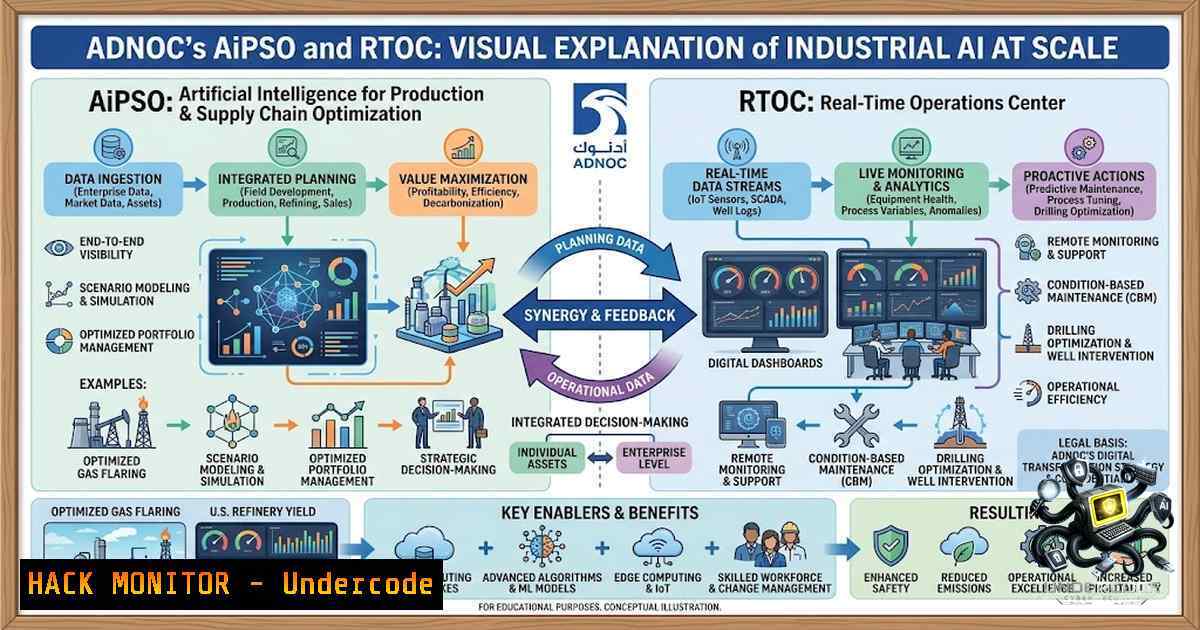
The energy sector is undergoing a paradigm shift as industrial AI moves from proof-of-concept to enterprise-wide deployment. ADNOC Group, in partnership with SLB and Cognite, has launched the AI-powered Production System Optimization (AiPSO) platform and an AI-enabled Real-Time Operations Center (RTOC), demonstrating how massive-scale data fusion, machine learning, and agentic AI can transform upstream operations. This article provides a technical examination of the architectures, workflows, and security considerations behind these deployments, offering actionable insights for IT, cybersecurity, and AI professionals.
Learning Objectives & Secrets:
- Objective 1: Understand Industrial Data Fusion Architectures – Learn how platforms like Cognite Data Fusion® and SLB’s Lumi™ contextualize millions of real-time data points across thousands of wells and hundreds of facilities, enabling AI-driven decision-making.
- Objective 2 Secret Tip: Proactive vs. Reactive Monitoring – Implement real-time anomaly detection and predictive maintenance workflows that shift operations from reactive troubleshooting to proactive optimization, reducing incident response times by 4–12 hours.
- Objective 3 Secret Tip: Scaling AI with Agentic Workflows – Deploy agentic AI solutions like ENERGYai that autonomously execute complex tasks, freeing engineers to focus on value-adding activities and completing tasks up to ten times faster.
You Should Know:
1. Industrial Data Fusion and Contextualization
ADNOC’s AiPSO platform is powered by SLB’s Lumi™ data and AI platform and leverages Cognite Data Fusion® to create a unified data foundation. This architecture ingests data from thousands of hydrocarbon wells and hundreds of processing facilities, contextualizing it through an industrial knowledge graph. The platform enables smart workflows that connect office and field operations in real time, allowing engineers to diagnose issues and optimize wells in minutes instead of days.
Step‑by‑step guide to implementing a similar data fusion pipeline:
1. Ingest Telemetry Data: Use MQTT or OPC UA to stream real-time sensor data from PLCs and SCADA systems into a time-series database (e.g., InfluxDB).
2. Contextualize with Asset Hierarchies: Build a knowledge graph linking sensor tags to physical assets (wells, separators, compressors) using a graph database like Neo4j.
3. Apply Physics-Based Models: Integrate domain-specific models (e.g., reservoir simulation, flow assurance) to validate AI predictions.
4. Deploy ML Pipelines: Use Kubeflow or MLflow to train and deploy models that detect anomalies and recommend optimization actions.
5. Visualize in Dashboards: Create real-time dashboards using Grafana or Power BI for engineer decision support.
Linux command to monitor MQTT data flow:
mosquitto_sub -h broker.emqx.io -t "adnoc/wells/+/pressure" -v
Windows PowerShell script to query time-series data:
Invoke-RestMethod -Uri "http://influxdb:8086/query?db=adnoc" -Method POST -Body "q=SELECT FROM pressure WHERE time > now() - 1h"
2. Real-Time Operations Center (RTOC) Architecture
ADNOC has deployed an AI-enabled RTOC across its fleet of more than 120 onshore and offshore drilling rigs. Enabled by SLB’s DrillOps technology, the RTOC consolidates live drilling data into a single platform, enabling engineers to oversee more rigs simultaneously and reducing engineering effort by 30–40%. The system can identify potential issues before they escalate, helping reduce incident response times by 4–12 hours and avoid one to two days of rig downtime.
Step‑by‑step guide to setting up a similar RTOC:
- Centralize Data Streams: Aggregate WITSML (wellsite information transfer standard markup language) data from rig sensors into a central data lake (e.g., AWS S3 or Azure Data Lake).
- Implement Real-Time Analytics: Use Apache Kafka for stream processing and Apache Flink for real-time anomaly detection.
- Deploy AI Models: Containerize predictive models using Docker and orchestrate with Kubernetes for scalability.
- Build a Command Center Dashboard: Develop a web-based dashboard using React and D3.js that displays rig status, alerts, and recommended actions.
- Integrate with Incident Management: Connect the RTOC to a CMMS (e.g., IBM Maximo) to automatically generate work orders for predicted failures.
Python script for real-time anomaly detection using Isolation Forest:
from sklearn.ensemble import IsolationForest
import numpy as np

Load real-time sensor data (e.g., pressure, temperature, RPM)
X = np.array([[pressure, temp, rpm]])

Train model on historical data
model = IsolationForest(contamination=0.01)
model.fit(historical_data)

Predict anomaly
prediction = model.predict(X)
if prediction[bash] == -1:
print("ALERT: Anomaly detected in rig operations!")
3. API Security and Data Governance
Given the sensitive nature of oil and gas operational data, ADNOC has deployed these AI platforms within its sovereign cloud environment, ensuring data remains stored in UAE data centers. This approach addresses data sovereignty concerns while enabling secure API access for AI workflows.
Step‑by‑step guide to securing industrial AI APIs:
- Implement OAuth 2.0: Use Azure AD or Okta for identity and access management (IAM).
- Enforce TLS 1.3: Encrypt all data in transit between edge devices, cloud, and AI platforms.
- Apply Zero-Trust Principles: Use mutual TLS (mTLS) for service-to-service authentication.
- Audit API Access: Enable detailed logging and monitoring of all API calls using tools like Splunk or ELK stack.
- Conduct Regular Penetration Testing: Simulate attacks on API endpoints to identify vulnerabilities.
Linux command to test API endpoint with curl:
curl -X GET "https://api.adnoc.ai/v1/wells/status" -H "Authorization: Bearer $TOKEN" -H "Content-Type: application/json"
Windows PowerShell script to rotate API keys:
$newKey = -join ((65..90) + (97..122) + (48..57) | Get-Random -Count 32 | % {[bash]$_})
Set-AzKeyVaultSecret -VaultName "adnoc-kv" -1ame "api-key" -SecretValue (ConvertTo-SecureString $newKey -AsPlainText -Force)
4. Cloud Hardening for Industrial AI Workloads
ADNOC’s partnership with Microsoft highlights the importance of cloud security in industrial AI deployments. Hardening cloud environments involves securing data lakes, AI training pipelines, and inference endpoints.
Step‑by‑step guide to hardening a cloud-based AI platform:
- Enable Azure Defender or AWS GuardDuty: Continuously monitor for threats and misconfigurations.
- Implement Network Segmentation: Use virtual networks (VNets) and security groups to isolate AI training, staging, and production environments.
- Encrypt Data at Rest: Use Azure Key Vault or AWS KMS to manage encryption keys for data lakes and databases.
- Apply Least Privilege Access: Use Azure RBAC or AWS IAM to restrict permissions to only what is necessary.
- Deploy Web Application Firewall (WAF): Protect AI dashboard endpoints from common web exploits.
Azure CLI command to enable Defender for Cloud:
az security pricing create -1 VirtualMachines --tier Standard
AWS CLI command to enable GuardDuty:
aws guardduty create-detector --enable
5. Vulnerability Exploitation and Mitigation in AI Pipelines
As AI becomes central to operations, securing the ML supply chain is critical. Threats include adversarial attacks, data poisoning, and model theft.
Step‑by‑step guide to securing AI pipelines:
- Validate Training Data: Implement data validation checks to detect outliers and potential poisoning attempts.
- Use Model Encryption: Encrypt model artifacts using AWS KMS or Azure Key Vault.
- Implement Adversarial Robustness: Use techniques like adversarial training or defensive distillation to make models resilient to evasion attacks.
- Monitor Model Drift: Continuously monitor model performance and retrain when drift is detected.
- Conduct Red-Teaming Exercises: Simulate adversarial attacks on AI models to identify weaknesses.
Python script to detect data drift using Kolmogorov–Smirnov test:
from scipy import stats

Compare reference and current data distributions
statistic, p_value = stats.ks_2samp(reference_data, current_data)
if p_value < 0.05:
print("ALERT: Significant data drift detected! Consider retraining.")
6. Integrating Agentic AI for Autonomous Operations
ADNOC’s AiPSO complements ENERGYai, the first agentic AI solution for the industry. Agentic AI systems can autonomously execute complex workflows, from production optimization to predictive maintenance.
Step‑by‑step guide to deploying an agentic AI assistant:
- Define Agent Goals: Clearly specify the objectives (e.g., “optimize well production while maintaining safety constraints”).
- Build a Knowledge Base: Populate a vector database with operational manuals, historical reports, and domain expertise.
- Implement a Reinforcement Learning (RL) Agent: Use RL to train the agent to make decisions that maximize long-term rewards.
- Deploy with Human-in-the-Loop: Allow engineers to override agent decisions during initial rollout.
- Monitor and Iterate: Continuously evaluate agent performance and refine the reward function.
Docker command to deploy an agentic AI container:
docker run -d --1ame energyai-agent -p 8080:8080 adnoc/energyai:latest
What Undercode Say:
- Key Takeaway 1: ADNOC’s AiPSO and RTOC deployments demonstrate that industrial AI at scale is achievable when data fusion, physics-based modeling, and agentic workflows are integrated into a secure, sovereign cloud architecture.
- Key Takeaway 2: The shift from reactive to proactive monitoring, enabled by real-time analytics and predictive models, can reduce downtime by up to two days per incident and cut engineering effort by 30–40%, delivering measurable operational value.
The technical blueprint behind ADNOC’s success—combining Cognite Data Fusion for contextualization, SLB’s Lumi for AI orchestration, and Microsoft’s cloud for secure scaling—offers a replicable model for other industries pursuing digital transformation. The $500M in operational value delivered from 2021–2024, followed by a $340M commitment in 2025, underscores the financial impact of these technologies. However, security practitioners must remain vigilant, as the convergence of OT and IT introduces new attack surfaces that require zero-trust architectures, continuous monitoring, and robust incident response plans.
Prediction:
- +1 Industrial AI platforms like AiPSO will become the standard for upstream energy operations by 2030, driving a 15–20% increase in production efficiency across the sector.
- +1 The integration of agentic AI with human decision-making will create new roles for “AI operations engineers,” blending domain expertise with data science skills.
- -1 The rapid deployment of AI in critical infrastructure will attract sophisticated cyber threats, necessitating increased investment in OT security and AI-specific defense mechanisms.
▶️ Related Video (82% Match):
🎯Let’s Practice For Free:
🎓 Live Courses & Certifications:
Join Undercode Academy for Verified Certifications
🚀 Request a Custom Project:
Secure, high-velocity infrastructure and disruptive technological engineering. Contact our engineering team for high-tier development and proprietary systems:
[email protected]
💎 Smart Architecture | 🛡️ Secure by Design | ⭐ Trusted by Thousands
IT/Security Reporter URL:
Reported By: https://lnkd.in/p/e7FBM862 – Hackers Feeds
Extra Hub: Undercode MoN
Basic Verification: Pass ✅


