Listen to this Post
Introduction:
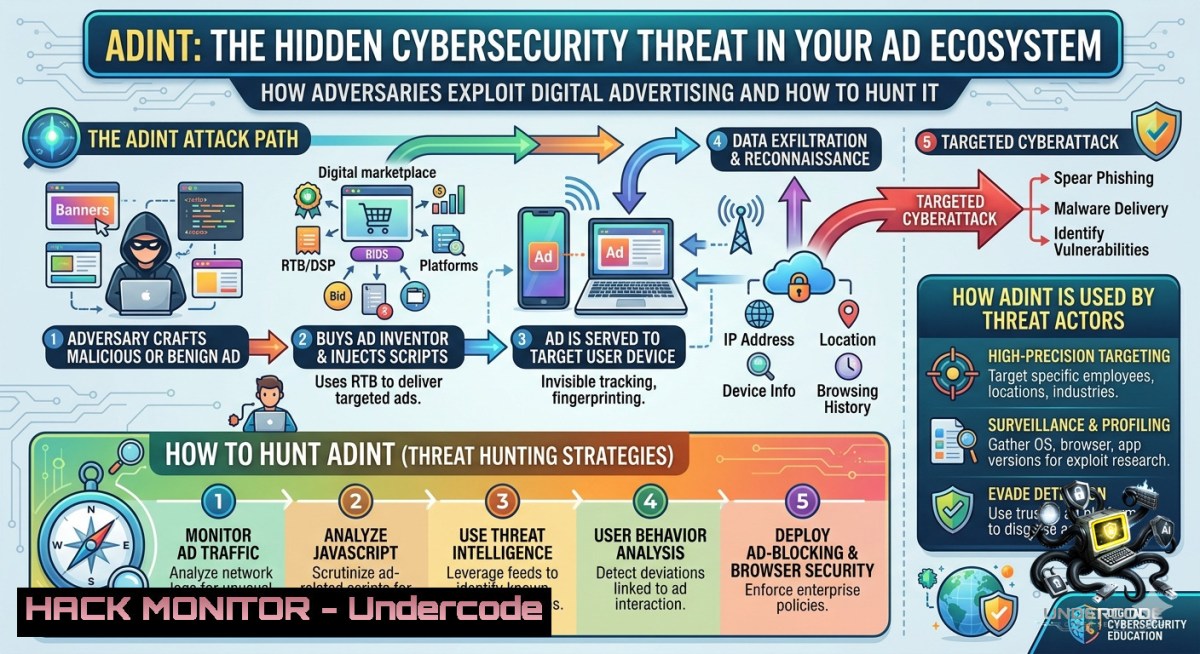
Advertising Intelligence (ADINT) goes far beyond marketing analytics—it is the collection and exploitation of device identifiers, location patterns, tracking pixels, SDK telemetry, and behavioral metadata generated by the digital advertising ecosystem. While OSINT focuses on publicly available data, ADINT taps into the invisible signals that every connected device emits, making it a powerful reconnaissance tool for attackers and a blind spot for many defenders.
Learning Objectives:
– Identify and extract common advertising identifiers (IDFA, GAID, cookie-based IDs) from live traffic
– Analyze tracking infrastructure to uncover malicious campaigns and command-and-control patterns
– Implement defensive controls to detect ADINT-based reconnaissance and mitigate data leakage
You Should Know:
1. Extracting Device Identifiers from Network Traffic
Advertising identifiers are broadcasted in countless requests to ad exchanges, analytics endpoints, and tracking servers. Attackers can capture these identifiers to build persistent profiles, track user movement across apps and websites, or pivot to deeper reconnaissance.
What this does: Monitors HTTP/HTTPS traffic for common advertising ID parameters and logs them for analysis.
Step‑by‑step guide (Linux – using tcpdump and grep):
 Capture HTTP traffic on port 80 (unencrypted) and filter for GAID (Google Advertising ID) pattern
sudo tcpdump -i eth0 -A -s 0 'tcp port 80' | grep -E "gdid=|gaid=|android_id="

 For HTTPS traffic, use mitmproxy to decrypt (requires proxy setup on a test device)
mitmproxy --mode transparent --showhost -q | grep -E "(advertising_id|IDFA)"

 Example output: GET /collect?gdid=12345678-90AB-CDEF-1234-567890ABCDEF&...
Step‑by‑step guide (Windows – using PowerShell and NetSh):
 Start a packet capture on Windows (requires admin)
netsh trace start capture=yes tracefile=C:\adint.etl

 After capture, convert to text and filter for ad IDs
netsh trace convert C:\adint.etl output=C:\adint.txt
Select-String -Path C:\adint.txt -Pattern "gdid|gaid|IDFA|advertising_id"
Mitigation: Randomize advertising IDs on mobile devices (Android → Settings → Google → Ads → Reset advertising ID; iOS → Privacy → Apple Advertising → View Ad Targeting Information → Reset Identifier). For enterprise, block outbound requests to known ad exchanges via DNS filtering.
2. Mapping Ad Infrastructure to Uncover Malicious Campaigns
Attackers often hide malicious payloads inside legitimate ad networks (malvertising). By analyzing domain patterns, SSL certificates, and redirect chains, defenders can spot anomalies before a user gets exploited.
What this does: Traces the full redirect chain of an ad request and extracts infrastructure fingerprints.
Step‑by‑step guide (using curl and dig on Linux/macOS):
 Follow redirects and show all intermediate domains
curl -L -s -o /dev/null -w "%{url_effective}\n" -D - https://example-ad-click.com/click

 Enumerate SSL certificate details for each domain
for domain in $(curl -sL -w "%{url_effective}\n" -o /dev/null https://example.com/ad); do
echo "=== $domain ==="
openssl s_client -servername $domain -connect $domain:443 2>/dev/null | openssl x509 -1oout -issuer -subject -dates
done

 Use Amass to find related ad infrastructure
amass enum -d doubleclick.net -o ad_infra.txt
Windows alternative (PowerShell):
 Resolve DNS and fetch headers
Resolve-DnsName -1ame ads.example.com
Invoke-WebRequest -Uri https://ads.example.com -MaximumRedirection 0 -ErrorAction SilentlyContinue
Detection: Monitor for suspicious patterns like short-lived domains, mismatched SSL issuers, or high-entropy subdomains commonly used by malvertising networks.
3. Simulating ADINT-Based Reconnaissance (Red Team Exercise)
Understanding ADINT from an attacker’s perspective helps defenders build better controls. This step demonstrates how an adversary could collect location and behavioral data through programmatic ad exchanges.
What this does: Uses a Python script to request a test ad impression and log the metadata returned by an open ad exchange.
Step‑by‑step guide (Python script – run on Linux/Windows with Python 3):
import requests
import json
import uuid

 Generate fake device identifiers for testing
gaid = str(uuid.uuid4()).upper()
headers = {
"User-Agent": "Mozilla/5.0 (Linux; Android 13) AppleWebKit/537.36",
"X-Forwarded-For": "203.0.113.45"  spoofed IP
}
ad_request = {
"id": "test-impression",
"device": {
"ifa": gaid,  advertising ID
"geo": {"lat": 40.7128, "lon": -74.0060, "accuracy": 100},
"os": "android",
"language": "en-US"
},
"app": {"bundle": "com.test.app", "name": "Test Harness"}
}

response = requests.post("https://test.adx.example.com/openrtb2/auction",
json=ad_request, headers=headers)
print("ADINT metadata collected:")
print(json.dumps(response.json(), indent=2))
Analysis: The script reveals what data an exchange returns—often including location, device model, and carrier. Defenders should question whether their own applications leak similar data to untrusted partners.
4. Hardening Cloud Environments Against ADINT Leakage
Advertising SDKs embedded in cloud-hosted applications can exfiltrate sensitive metadata via ad calls. This section covers how to audit and restrict that flow in AWS and Azure.
What this does: Identifies egress traffic to ad networks and enforces allowlisting.
Step‑by‑step guide (AWS VPC Flow Logs + Athena):
-- Query VPC Flow Logs for outbound connections to known ad networks
SELECT day, dstaddr, COUNT() as connections
FROM vpc_flow_logs
WHERE dstaddr LIKE '%.doubleclick.net'
OR dstaddr LIKE '%.adsrvr.org'
OR dstaddr LIKE '%.moat.com'
GROUP BY day, dstaddr
ORDER BY connections DESC;
Linux command to test egress filtering:
 Test outbound access to popular ad domains
for domain in "doubleclick.net" "googleadservices.com" "criteo.com"; do
timeout 2 nc -zv $domain 443 2>&1 | tee -a ad_egress.log
done
Windows PowerShell for egress test:
$adDomains = @("doubleclick.net","googleadservices.com","criteo.com")
foreach ($domain in $adDomains) {
Test-1etConnection -ComputerName $domain -Port 443 | Select-Object ComputerName, TcpTestSucceeded
}
Mitigation: Create a deny list on firewalls/proxies for advertising domains. For cloud workloads, deploy a transparent Squid proxy with a blocklist to prevent accidental data leakage.
5. Detecting ADINT in Logs and SIEM
Traditional SIEM rules rarely include ADINT-specific indicators. This section adds detection logic for anomalous ad identifier volumes or rare geo-spoofing attempts.
What this does: Splunk/KQL query to identify a single GAID appearing from multiple distinct IP addresses in a short window (credential stuffing or device spoofing).
Step‑by‑step guide (KQL for Microsoft Sentinel):
let AdIds = dynamic(["gaid","gdid","advertising_id"]);
let TimeWindow = 10m;
WebProxyLogs
| where UrlParameters has_any (AdIds)
| extend GAID = extract("([a-fA-F0-9]{8}-([a-fA-F0-9]{4}-){3}[a-fA-F0-9]{12})", 1, UrlParameters)
| where isnotempty(GAID)
| summarize DistinctIPs = dcount(ClientIP) by GAID, bin(TimeGenerated, TimeWindow)
| where DistinctIPs > 5
| join kind=inner (WebProxyLogs) on GAID
| project TimeGenerated, GAID, DistinctIPs, ClientIP, Url
Linux log analysis with awk:
 Extract GAID from Apache logs
awk '/gdid=/{match($0, /gdid=([a-f0-9-]+)/, a); print a[bash], $1}' /var/log/apache2/access.log | sort | uniq -c | sort -1r
Alert threshold: More than 3 distinct locations per GAID within 5 minutes indicates potential device farm or spoofing attack.
What Undercode Say:
– Key Takeaway 1: ADINT is not optional. Attackers are already using ad identifiers for reconnaissance, and most organizations have zero visibility into this data stream.
– Key Takeaway 2: Defensive ADINT requires merging network analysis (tcpdump, mitmproxy), cloud egress controls, and SIEM detection—not just privacy policies.
Analysis (10 lines):
Ryan Williams correctly highlights that the gap between OSINT and ADINT leaves defenders vulnerable. While OSINT deals with public posts and documents, ADINT operates on the silent metadata layer that users cannot opt out of easily. The post emphasizes that ad ecosystems are not just marketing tools but reconnaissance infrastructure. Attackers can harvest device IDs from malicious creatives, combine them with location pings, and build precise movement profiles without ever touching a traditional exploit. Defenders trained only on firewall logs or endpoint detection miss these signals. The practical commands and scripts above show that ADINT hunting is achievable with existing tools—it’s a mindset shift, not a budget problem. Organizations that ignore ADINT risk becoming transparent to any adversary who understands programmatic advertising.
Expected Output:
Prediction:
– -1 Advertisers and ad exchanges will resist transparency, prolonging the window where ADINT-based attacks succeed without detection.
– +1 Privacy regulations (GDPR 22, CPRA) will eventually force real-time consent checks on every ad identifier, reducing abuse.
– -1 Small and medium businesses without dedicated threat intel teams will remain blind to ADINT reconnaissance for at least 3–5 years.
– +1 Open-source tools for ADINT detection (like the scripts above) will emerge and become standard in threat hunting frameworks by 2027.
▶️ Related Video (76% Match):
🎯Let’s Practice For Free:
🎓 Live Courses & Certifications:
[Join Undercode Academy for Verified Certifications](https://undercode.co.uk/certifications/)
🚀 Request a Custom Project:
Secure, high-velocity infrastructure and disruptive technological engineering. Contact our engineering team for high-tier development and proprietary systems:
[[email protected]](mailto:[email protected])
💎 Smart Architecture | 🛡️ Secure by Design | ⭐ Trusted by Thousands
IT/Security Reporter URL:
Reported By: [Ryan Williams](https://www.linkedin.com/posts/ryan-williams-4068351b8_a-peek-behind-the-curtain-ugcPost-7469555289999073280-dDHp/) – Hackers Feeds
Extra Hub: Undercode MoN
Basic Verification: Pass ✅
🔐JOIN OUR CYBER WORLD [ CVE News • HackMonitor • UndercodeNews ]
[💬 Whatsapp](https://undercode.help/whatsapp) | [💬 Telegram](https://t.me/UndercodeCommunity)
📢 Follow UndercodeTesting & Stay Tuned:
[𝕏 formerly Twitter 🐦](https://x.com/undercodeupdate) | [@ Threads](https://www.threads.net/@undercodetesting) | [🔗 Linkedin](https://www.linkedin.com/company/undercodetesting/) | [🦋BlueSky](https://bsky.app/profile/undercode.bsky.social)


