
Listen to this Post
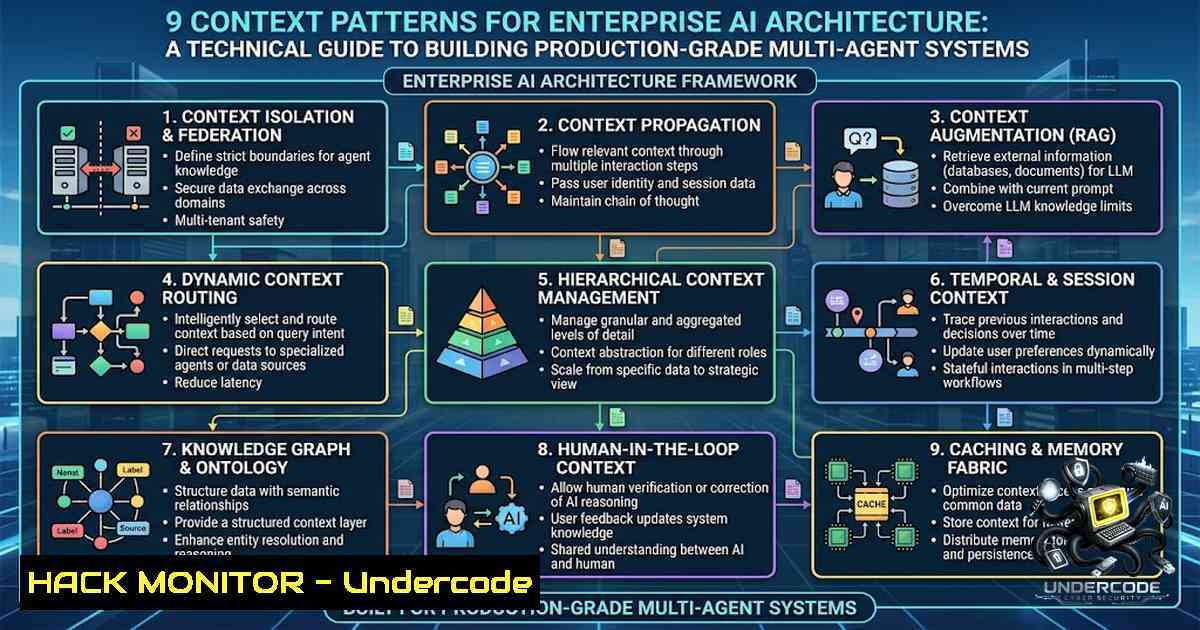
Introduction:
Enterprise AI architecture has moved beyond single-model prompting into a new era defined by structured context engineering and multi-agent orchestration. As organizations scale AI from experimental chatbots to production-grade autonomous systems, the way context is curated, delivered, and governed across agents determines success or failure. This guide examines nine measured context patterns—drawn from both Domain-Driven Design’s context mapping tradition and modern agentic workflow patterns—offering architects a framework for selecting, implementing, and governing enterprise AI systems with tradeoffs, benchmarks, and a practical selection workflow.
Learning Objectives & Secrets:
- Objective 1: Master the Nine Context Patterns – Understand how Partnership, Shared Kernel, Customer/Supplier, Conformist, Anticorruption Layer (ACL), Open Host Service (OHS), Published Language, Separate Ways, and Big Ball of Mud define bounded context interactions in enterprise AI.
-
Objective 2 Secret Tip: Context Is Constructed, Not Appended – Most builders drown the model in tokens. Use layered context and compaction to keep the context window lean and relevant, applying JIT retrieval and progressive disclosure to prevent context rot.
-
Objective 3 Secret Tip: Workflow Design Beats Prompt Engineering – Better prompts won’t scale. Structured AI workflows—from Prompt Chaining and Routing to Orchestrator–Worker and Evaluator–Optimizer—are what separate production-ready systems from chatbots.
You Should Know:
1. The Nine Context Patterns Defined
Context patterns describe how bounded contexts—distinct domain models within an enterprise—interact and share information. In enterprise AI, these patterns directly translate to how agents, data sources, and services communicate:
| Pattern | Description | AI Application |
||-|-|
| Partnership | Two contexts collaborate closely and evolve together | Tightly coupled agent pairs (e.g., planner + executor) |
| Shared Kernel | Contexts share a subset of the domain model | Shared ontology or knowledge graph across agents |
| Customer/Supplier | One context provides data/services to another | Data provider agent serving downstream analytics |
| Conformist | One context conforms to another’s model | Legacy system integration with AI layer |
| Anticorruption Layer (ACL) | Protective translation layer between contexts | API gateway sanitizing external data before agent ingestion |
| Open Host Service (OHS) | Well-defined API for external interaction | Public-facing agent endpoints with versioned schemas |
| Published Language | Standardized format for cross-context communication | JSON Schema or Protobuf definitions for agent messages |
| Separate Ways | Contexts operate independently | Isolated agent pods with no cross-talk |
| Big Ball of Mud | Chaotic, poorly defined relationships | Anti-pattern to be actively avoided |
Step‑by‑Step Guide: Implementing Context Mapping in Your AI Architecture
- Inventory all bounded contexts – Document every agent, data source, API, and service in your AI ecosystem.
- Map relationships – Identify upstream/downstream dependencies between contexts. Draw a context map showing integration points and data flow.
- Assign patterns per relationship – Use ACL for third-party integrations, Shared Kernel for internal shared models, OHS for public endpoints.
- Define Published Language – Standardize message formats using JSON Schema or Protobuf. Example schema:
{
"$schema": "http://json-schema.org/draft-07/schema",
"type": "object",
"properties": {
"agent_id": { "type": "string" },
"context_type": { "enum": ["user", "system", "retrieval", "tool"] },
"payload": { "type": "object" },
"governance_tags": { "type": "array", "items": { "type": "string" } }
},
"required": ["agent_id", "context_type", "payload"]
}
- Implement ACL gateways – For each external integration, deploy a translation layer that sanitizes, validates, and transforms data before it reaches your agents.
-
Agentic Workflow Patterns: From Single Calls to Autonomous Systems
Modern AI systems rely on nine core agentic workflow patterns that 90% of production AI systems use:
- Prompt Chaining – Sequential prompts where each output feeds the next
- Parallelization – Multiple agents process subtasks concurrently
- Orchestrator–Worker – A central orchestrator delegates to specialized workers
- Evaluator–Optimizer – One agent generates, another critiques and refines
- Routing – Input classified and routed to the most capable agent
- Autonomous Workflow – Agents operate with minimal human intervention
- Reflexion – Agents self-critique and improve their own outputs
- ReWOO – Reasoning without observation: plan-then-execute patterns
- Plan & Execute – Decompose goals into plans, then execute stepwise
Step‑by‑Step Guide: Selecting the Right Workflow Pattern
- Assess task complexity – Simple Q&A → Prompt Chaining or Routing. Complex multi-step goals → Orchestrator–Worker or Plan & Execute.
- Evaluate latency requirements – Parallelization for speed; Reflexion for accuracy at cost of latency.
3. Implement Orchestrator–Worker with LangGraph:
from langgraph.graph import StateGraph, END
from typing import TypedDict, List

class AgentState(TypedDict):
query: str
subtasks: List[bash]
results: List[bash]
final_answer: str

def orchestrator(state: AgentState):
 Decompose query into subtasks
state["subtasks"] = decompose_query(state["query"])
return state

def worker(state: AgentState):
 Execute each subtask in parallel
state["results"] = [execute_task(t) for t in state["subtasks"]]
return state

def aggregator(state: AgentState):
state["final_answer"] = synthesize_results(state["results"])
return state

builder = StateGraph(AgentState)
builder.add_node("orchestrator", orchestrator)
builder.add_node("worker", worker)
builder.add_node("aggregator", aggregator)
builder.set_entry_point("orchestrator")
builder.add_edge("orchestrator", "worker")
builder.add_edge("worker", "aggregator")
builder.add_edge("aggregator", END)
graph = builder.compile()
- Context Engineering: The Critical Discipline for Production AI
Context engineering—curating everything an LLM sees at inference—has emerged as the successor to prompt engineering. Research from MIT NANDA found that 95% of enterprise GenAI pilots deliver no P&L impact; the fix is context, not bigger models.
Key Context Engineering Patterns:
- JIT Retrieval – Fetch context only when needed, not pre-loaded
- Compaction – Summarize and compress context to fit windows
- Progressive Disclosure – Reveal context incrementally as agents request it
- Context Rotation – Prevent stale context from polluting responses
Step‑by‑Step Guide: Building a Context API
- Define metadata schemas – Column descriptions, business definitions, data lineage, classification tags.
- Implement retrieval endpoints – REST or gRPC endpoints that deliver curated metadata on demand.
- Enforce governance at API layer – Access controls, compliance rules, and freshness signals.
- Adopt MCP (Model Context Protocol) – Replace custom integrations with a composable standard.
Linux Command: Monitoring Context API Performance
 Monitor context API latency and error rates
curl -s http://localhost:8080/metrics | grep -E "context_api_(latency|errors)"
 Set up alerting for p95 latency > 500ms
Windows PowerShell: Testing Context API Endpoints
 Test context retrieval endpoint with governance headers
Invoke-RestMethod -Uri "http://localhost:8080/context/agent123" `
-Headers @{"X-Governance-Tier"="production"; "X-Tenant-ID"="acme-corp"} `
-Method Get | ConvertTo-Json -Depth 3
4. Governance, Security, and Hardening for Enterprise AI
Enterprise AI requires robust governance across all nine patterns. Key security considerations:
- Zero-Trust Architecture – Every agent and context request must be authenticated and authorized
- Security Sandboxing – Isolate agent tool execution from production environments
- API Security – Implement rate limiting, input validation, and output sanitization at every context boundary
- Technical Debt Management – Agentic AI deployments accumulate technical debt rapidly; implement observability and root cause analysis
Step‑by‑Step Guide: Hardening Your Context API
- Implement API key rotation – Rotate keys every 90 days using HashiCorp Vault or AWS Secrets Manager.
- Deploy rate limiting – Use Redis-based counters per tenant and agent ID.
- Enable audit logging – Log every context request with tenant, agent, timestamp, and governance tags.
Linux Command: Setting Up Rate Limiting with iptables
 Rate limit context API requests to 100 per minute per IP
iptables -A INPUT -p tcp --dport 8080 -m recent --1ame context_api --set
iptables -A INPUT -p tcp --dport 8080 -m recent --1ame context_api --update --seconds 60 --hitcount 100 -j DROP
Windows PowerShell: Audit Logging Configuration
 Enable detailed audit logging for context API
New-Item -Path "C:\Logs\ContextAPI\" -ItemType Directory -Force
Set-Content -Path "C:\Logs\ContextAPI\audit_config.json" -Value @"
{
"log_level": "verbose",
"fields": ["timestamp", "tenant_id", "agent_id", "context_type", "governance_tags", "response_size"],
"retention_days": 90,
"encryption": "AES-256"
}
"@
- Selection Workflow: Choosing the Right Patterns for Your Use Case
Murali Sid’s framework emphasizes a measured selection workflow with tradeoffs and benchmarks. Follow this decision matrix:
| Use Case | Recommended Patterns | Tradeoffs |
|-||–|
| Customer support chatbot | Routing + Prompt Chaining | Low latency, moderate accuracy |
| Research synthesis | Orchestrator–Worker + Evaluator–Optimizer | High accuracy, higher latency |
| Code generation | Autonomous Workflow + Reflexion | High quality, needs guardrails |
| Data analytics | Plan & Execute + Parallelization | Scalable, complex orchestration |
| Legacy system integration | ACL + Published Language | Protection, integration overhead |
Step‑by‑Step Guide: Pattern Selection Workflow
- Define success metrics – Latency, accuracy, cost per request, governance compliance.
- Run benchmark tests – Compare patterns on your specific dataset.
- Implement pilot – Start with simplest pattern that meets requirements; iterate.
What Undercode Say:
- Key Takeaway 1: Context Engineering Is the New Frontier – Prompt engineering alone doesn’t scale. The nine context patterns provide a rigorous framework for moving from ad-hoc AI to enterprise-grade systems. Organizations that master context curation—through JIT retrieval, compaction, and progressive disclosure—will see measurable P&L impact where 95% of pilots currently fail.
-
Key Takeaway 2: Workflow Design Determines Production Readiness – The difference between a chatbot and a production AI system is workflow design. The nine agentic patterns—from Prompt Chaining to Autonomous Workflow—aren’t buzzwords; they’re architectural choices with concrete tradeoffs in latency, accuracy, and cost. Architects must select patterns based on measured benchmarks, not hype.
Analysis: The convergence of DDD context mapping and agentic workflow patterns represents a maturation of enterprise AI. Just as the OSI model standardized networking, these nine patterns provide a common language for AI architects. The critical insight is that context isn’t passive—it must be engineered, governed, and delivered through standardized APIs like MCP. Security, observability, and technical debt management are not afterthoughts but core design considerations. The pattern selection workflow—defining metrics, running benchmarks, and iterating—ensures that architectural decisions are data-driven rather than fashion-driven. As organizations scale from single agents to multi-agent systems, these patterns provide the scaffolding for reliable, secure, and governable AI that delivers real business value.
Prediction:
- +1 Enterprise AI will standardize around MCP (Model Context Protocol) within 18–24 months, replacing custom context integration with composable architectures.
-
+1 Context engineering roles will emerge as a distinct discipline, separate from prompt engineering, with dedicated tooling and certification pathways.
-
-1 Organizations that fail to adopt structured context patterns will see agentic AI projects fail at 90%+ rates, mirroring the early days of big data where lack of governance led to widespread project abandonment.
-
+1 Multi-agent orchestration platforms (LangGraph, AutoGen, CrewAI) will incorporate these nine patterns as native primitives, reducing implementation complexity.
-
-1 The security attack surface of agentic AI will expand dramatically, with context poisoning and ACL bypass becoming top threat vectors requiring zero-trust architectures.
-
+1 Open-source context mapping tools and Miro-based starter kits will accelerate adoption, making pattern selection accessible to non-specialists.
▶️ Related Video (78% Match):
https://www.youtube.com/watch?v=1NsXqVj8ckU
🎯Let’s Practice For Free:
🎓 Live Courses & Certifications:
Join Undercode Academy for Verified Certifications
🚀 Request a Custom Project:
Secure, high-velocity infrastructure and disruptive technological engineering. Contact our engineering team for high-tier development and proprietary systems:
[email protected]
💎 Smart Architecture | 🛡️ Secure by Design | ⭐ Trusted by Thousands
IT/Security Reporter URL:
Reported By: https://lnkd.in/p/eWiD2qDs – Hackers Feeds
Extra Hub: Undercode MoN
Basic Verification: Pass ✅


