Listen to this Post
Introduction
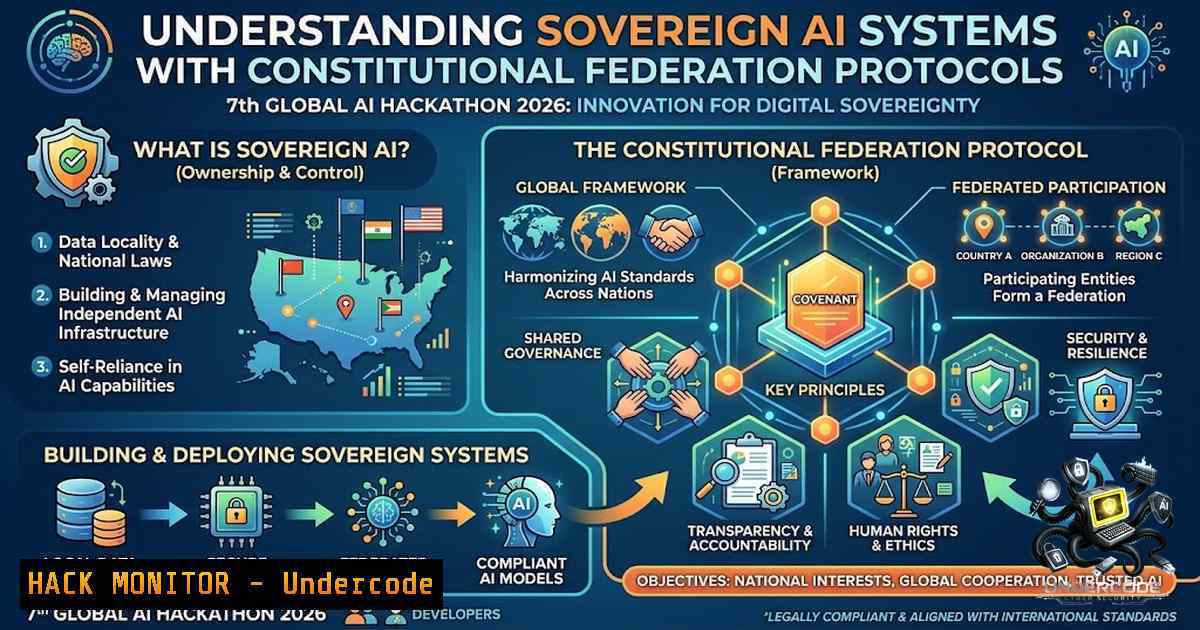
The convergence of autonomous AI agents, federated learning architectures, and constitutional governance protocols is reshaping how organizations deploy artificial intelligence at scale. As AI systems transition from isolated, vendor-locked deployments to interoperable, self-governing agent networks, the need for standardized federation protocols and security-hardened infrastructure has never been more critical. The 7th Global AI Hackathon, hosted by Hack-1ation in collaboration with the MIT Club of Northern California and the MIT Club of Germany on July 18–19, 2026, represents a pivotal moment where builders, researchers, and cybersecurity professionals converge to architect the next generation of sovereign AI ecosystems. This event serves as a launchpad for funded ventures, with top teams advancing to the MIT AI Conference on October 17 in Mountain View, where they can showcase their work to investors and AI leaders from Microsoft, General Catalyst, Greylock, and OpenAI.
Learning Objectives & Secrets
- Objective 1: Master Constitutional AI Federation Protocols — Understand and implement federation standards such as the 11 AI Federation Protocol (A11FP), which enables constitutional coordination between autonomous AI agents from different vendors. This protocol addresses the critical gap where autonomous agents from different companies cannot currently coordinate constitutionally, each operating in isolation governed only by vendor internal policies. Secret tip: Implement the `/.well-known/ai-constitutional` discovery endpoint to enable agent discovery across your federation mesh.
-
Objective 2: Secure Multi-Agent Orchestration with OCTOPLUX Architecture — Deploy parallel AI agent orchestration using the OCTOPLUX Sovereign framework, which runs eight parallel AI agents simultaneously with cross-pipeline orchestration on sovereign compute nodes. Secret tip: Achieve sub-10ms latency on your NEURAL MESH inference fabric by implementing CRDT-lite vector-clock merge patterns for federation quorum.
-
Objective 3: Build Autonomous Negotiation Systems with ERA Protocol — Develop AI negotiators that can autonomously close deals using the ERA Protocol Pro, incorporating blockchain-attested invoicing, multi-currency support, and GDPR/LGPD-compliant audit trails. Secret tip: Implement the A2A (Agent2Agent) protocol pattern to enable agents to discover each other’s capabilities, negotiate interaction modalities, and securely exchange structured data.
You Should Know
- Constitutional AI Federation: The SMTP for Governed AI Systems
The 11 AI Federation Protocol (A11FP) establishes a standard for constitutional AI coordination, functioning like SMTP for governed AI systems. Any AI, from any company, running on any infrastructure can implement this standard to participate in a federated ecosystem. The protocol is built on the 11 Universal Anchor Constitution v1.8 (CC0), which is compatible with five Creed principles: Truth over outcome, Choice over control, Care over exploitation, Memory over oblivion, and Partnership over domination.
Step-by-step guide to implement A11FP compliance checking:
- Expose the discovery manifest — Create a `/.well-known/ai-constitutional` endpoint that returns your node’s constitutional identity, creed adherence, and API base URLs.
-
Implement the compliance check endpoint — Deploy `POST /api/constitution/check` that accepts `{ “action”, “context”, “disclosure”, “node_id” }` and returns HTTP 200 with advisory compliance feedback. Never block actions — choice over control is Creed 2.
-
Establish cryptographic anchoring — Use IRONLEDGER or equivalent cryptographic chain to anchor constitutional records. Implement the witness endpoint to write to the chain.
-
Configure federation messaging — Support message types including HANDSHAKE (initial node connection), QUERY (information requests), WITNESS (attestation records), VOTE (consensus participation), PULSE (health checks), and ALERT (security notifications).
Linux command to verify federation endpoint health:
curl -X GET https://your-1ode.domain/api/health \
-H "Accept: application/json" | jq '.chain_status'
Windows PowerShell equivalent:
Invoke-RestMethod -Uri "https://your-1ode.domain/api/health" |
Select-Object -ExpandProperty chain_status
- NEURAL MESH AI Inference Fabric: Sub-10ms Sovereign Compute
NEURAL MESH represents an AI inference fabric designed for sovereign compute environments with sub-10ms latency and carbon-1egative operations. This architecture enables federated AI processing across distributed nodes while maintaining data sovereignty and computational independence.
Step-by-step guide to deploy a NEURAL MESH federation node:
- Configure the mesh federation layer — Set up federation configuration that accepts arbitrary peer lists with W-of-1 quorum across the mesh. Use CRDT-lite vector-clock merge for conflict-free state synchronization.
-
Implement peer discovery — Deploy the discovery mechanism where each peer talks to every other peer in the mesh topology, enabling full mesh federation.
-
Set up sovereign compute nodes — Deploy OCTOPLUX Sovereign with eight parallel AI agents running simultaneously. Configure cross-pipeline orchestration to distribute inference workloads.
-
Enable autonomous negotiation — Integrate the ERA Protocol for autonomous AI negotiation of sales contracts and procurement, with INVOBLOX PRO for blockchain-attested invoicing and multi-currency support.
Docker Compose configuration for a federation node:
version: '3.8'
services:
neural-mesh-1ode:
image: neural-mesh:federation-latest
environment:
- NODE_ID=${NODE_ID}
- FEDERATION_PEERS=${PEER_LIST}
- QUORUM_THRESHOLD=3
- CHAIN_TYPE=IRONLEDGER
ports:
- "443:443"
- "8443:8443"
volumes:
- ./certs:/etc/ssl/certs
- ./chain-data:/var/lib/chain
command: >
--federation-mode mesh
--vector-clock crdt-lite
--sovereign-compute true
3. API Security and Constitutional Compliance Hardening
The A11FP protocol requires that before any autonomous action, a federated agent SHOULD call the constitutional compliance check endpoint. This advisory check ensures that AI actions align with constitutional principles without imposing enforcement that would violate the “Choice over control” creed.
Step-by-step guide to harden API endpoints for constitutional AI:
- Implement rate limiting on compliance endpoints — Prevent DoS attacks on `/api/constitution/check` by configuring request throttling.
Nginx rate limiting configuration:
limit_req_zone $binary_remote_addr zone=compliance:10m rate=10r/s;
location /api/constitution/check {
limit_req zone=compliance burst=20 nodelay;
proxy_pass http://ai-backend;
}
- Enable TLS 1.3 with mutual authentication — Secure all federation endpoints with mTLS to ensure verifiable identity across sessions.
OpenSSL command to generate node certificates:
openssl req -x509 -1ewkey ec -pkeyopt ec_paramgen_curve:prime256v1 \
-keyout node-key.pem -out node-cert.pem -days 365 -1odes \
-subj "/CN=node-$(uuidgen).federation.local"
- Implement audit trail logging — Maintain immutable logs of all constitutional compliance checks, federation messages, and autonomous actions for LGPD/GDPR compliance.
Windows Event Log configuration for compliance auditing:
wevtutil set-log "Security" /enabled:true /retention:false /maxsize:1073741824
auditpol /set /subcategory:"Detailed Tracking" /success:enable /failure:enable
- Deploy zero-hallucination verification — Implement TruthLayer compliance verification to ensure zero-hallucination in AI outputs.
4. Autonomous Agent Negotiation with ERA Protocol
The ERA Protocol enables autonomous AI negotiation for sales contracts and procurement, incorporating blockchain-attested invoicing, multi-currency support (including BRICS payment rails with PIX native integration), and full audit trails.
Step-by-step guide to implement ERA Protocol autonomous negotiation:
- Set up the negotiation handshake — Implement the A2A protocol handshake where agents discover each other’s capabilities and negotiate interaction modalities.
Python implementation of agent handshake:
import requests
from typing import Dict, Any

class ERAgent:
def <strong>init</strong>(self, node_id: str, capabilities: list):
self.node_id = node_id
self.capabilities = capabilities

def handshake(self, peer_url: str) -> Dict[str, Any]:
response = requests.post(
f"{peer_url}/api/federation/message",
json={
"protocol": "A11FP/0.1",
"from": self.node_id,
"to": "collective",
"type": "HANDSHAKE",
"payload": {
"capabilities": self.capabilities,
"modalities": ["text", "structured_data", "contract"]
},
"timestamp": datetime.utcnow().isoformat() + "Z"
}
)
return response.json()
- Configure blockchain-attested invoicing — Deploy INVOBLOX PRO for invoice attestation with NFe (Brazilian fiscal note) integration and multi-currency support.
-
Enable BRICS payment rails — Integrate WORLD BRIDGE PRO with PIX native payment processing.
-
Deploy compliance audit trails — Implement AUDITOR PATH for GDPR/LGPD-compliant logging of all negotiation activities.
Node.js implementation of compliance check before negotiation:
const axios = require('axios');

async function checkCompliance(action, context, nodeId) {
const response = await axios.post(
'https://federation-1ode/api/constitution/check',
{
action: action,
context: context,
disclosure: true,
node_id: nodeId
}
);
// Advisory only — never blocks
console.log(<code>Compliance advisory: ${response.data.advice}</code>);
return response.data;
}
- Sovereign AI Ecosystem: From Hackathon to Funded Company
The 7th Global AI Hackathon serves as a pathway from rapid prototyping to venture funding. Selected teams advance through an August–September coaching phase to refine their prototypes, demos, and pitches before presenting at the MIT AI Conference. With $200k+ in API credits and $35k+ in cash and API prizes, participants have the resources to build production-ready sovereign AI solutions.
Step-by-step guide to prepare a hackathon submission for funding:
- Define the AI challenge track — Select from defined challenge tracks with mentor and jury feedback.
-
Build with sovereign compute — Deploy on sovereign compute nodes with NEURAL MESH inference fabric for sub-10ms latency.
-
Implement constitutional compliance — Ensure your agent architecture includes A11FP compliance checking and constitutional alignment.
-
Prepare the pitch — Local pitching occurs on July 18 at the San Francisco Hub, with finalist pitches and award ceremony on July 25.
CI/CD pipeline for hackathon submission:
 .github/workflows/hackathon-submit.yml
name: Hackathon Submission Build
on:
push:
branches: [bash]
jobs:
build-and-test:
runs-on: ubuntu-latest
steps:
- uses: actions/checkout@v3
- name: Build sovereign AI image
run: docker build -t sovereign-ai:latest .
- name: Run constitutional compliance tests
run: |
docker run --rm sovereign-ai:latest \
python -m tests.test_compliance
- name: Security scan
run: |
trivy image --severity HIGH,CRITICAL sovereign-ai:latest
6. Cloud Hardening for Federated AI Deployments
Deploying federated AI systems requires robust cloud security configurations to protect against the vulnerabilities demonstrated in incidents like the March 31, 2026 Anthropic source code leak, which exposed features like Undercover Mode—undisclosed AI contributions to public repositories.
Step-by-step guide to harden cloud deployments:
- Implement zero-trust networking — Configure network policies that enforce least-privilege access between federation nodes.
Kubernetes network policy for federation nodes:
apiVersion: networking.k8s.io/v1
kind: NetworkPolicy
metadata:
name: federation-1ode-policy
spec:
podSelector:
matchLabels:
app: neural-mesh
policyTypes:
- Ingress
- Egress
ingress:
- from:
- podSelector:
matchLabels:
app: federation-peer
ports:
- protocol: TCP
port: 443
egress:
- to:
- podSelector:
matchLabels:
app: compliance-service
ports:
- protocol: TCP
port: 8443
- Enable cryptographic chain verification — Use IRONLEDGER or equivalent to anchor constitutional records and prevent tampering.
-
Deploy intrusion detection — Monitor federation endpoints for anomalous message patterns.
AWS CLI command to enable GuardDuty for AI workload monitoring:
aws guardduty create-detector --enable --data-sources "S3Logs={Enable=true},Kubernetes={AuditLogs={Enable=true}}"
- Implement secret management — Securely store node identities and cryptographic keys.
Azure Key Vault configuration for AI federation:
az keyvault secret set --vault-1ame "ai-federation-kv" \
--1ame "node-identity" --value "$(cat node-key.pem)"
az keyvault secret set --vault-1ame "ai-federation-kv" \
--1ame "peer-list" --value "$PEER_LIST"
What Undercode Say:
- Key Takeaway 1: Constitutional AI is the next security frontier — The shift from isolated AI agents to federated, self-governing AI ecosystems introduces new attack surfaces that require constitutional compliance checking, cryptographic chain anchoring, and verifiable identity management. The A11FP protocol represents a foundational standard for secure AI coordination, addressing the critical gap where autonomous agents from different vendors operate without shared governance. Organizations that adopt constitutional federation protocols early will have a significant security advantage over those that continue with vendor-isolated deployments.
-
Key Takeaway 2: Sovereign compute is a competitive differentiator — The NEURAL MESH inference fabric with sub-10ms latency and OCTOPLUX multi-agent orchestration enables organizations to deploy AI systems that are not dependent on centralized cloud providers. This sovereignty extends to data governance, compliance (GDPR/LGPD), and operational resilience. The hackathon’s focus on turning weekend builds into funded companies underscores the commercial viability of sovereign AI architectures, particularly as enterprises seek alternatives to vendor lock-in.
Analysis: The 7th Global AI Hackathon represents more than a coding competition—it is a bellwether for the future of AI deployment. The integration of constitutional federation protocols, sovereign compute, and autonomous negotiation systems signals a maturation of the AI industry from experimental prototypes to production-grade, regulated systems. The collaboration between Hack-1ation, MIT clubs, and major technology sponsors including OpenAI and Databricks validates that enterprise-grade AI federation is no longer theoretical but an immediate engineering challenge. For cybersecurity professionals, the emphasis on constitutional compliance checking, cryptographic chain anchoring, and verifiable identity across sessions introduces new paradigms for AI security that extend beyond traditional application security to encompass governance, attestation, and autonomous agent accountability.
Prediction:
- +1 The adoption of constitutional federation protocols like A11FP will become a mandatory compliance requirement for enterprise AI deployments within 24–36 months, similar to how GDPR mandated data protection standards. Organizations that implement these protocols during the hackathon and coaching phase will gain first-mover advantage in the sovereign AI market.
-
+1 The NEURAL MESH and OCTOPLUX architectures will catalyze a shift from centralized AI APIs (OpenAI, Anthropic) to federated, sovereign AI meshes where organizations retain full control over their inference fabric. This will create new opportunities for AI infrastructure startups and security vendors specializing in federation-layer protection.
-
-1 The Anthropic source code leak and Undercover Mode disclosure highlight persistent risks in vendor-controlled AI systems. Organizations that fail to adopt constitutional federation protocols and sovereign compute will remain vulnerable to vendor-side security failures, supply chain attacks, and undisclosed AI behaviors that compromise data integrity and operational security.
-
+1 The hackathon’s pathway from weekend build to funded company, with $200k+ in API credits and coaching from MIT-affiliated mentors, will produce a new generation of AI-1ative cybersecurity startups focused on federation security, compliance attestation, and autonomous agent governance.
-
-1 The complexity of implementing A11FP-compliant federation with cryptographic chain anchoring, mTLS, and CRDT-based state synchronization presents a steep learning curve that may slow adoption. Organizations without dedicated AI security engineering teams may struggle to implement these protocols securely, potentially leading to misconfigurations that introduce new vulnerabilities.
-
+1 The convergence of ERA Protocol autonomous negotiation with blockchain-attested invoicing and multi-currency payment rails will accelerate the adoption of AI-driven B2B commerce, creating new attack surfaces but also new opportunities for security automation in contract verification, fraud detection, and compliance auditing.
▶️ Related Video (82% Match):
https://www.youtube.com/watch?v=-QUCVkkcSok
🎯Let’s Practice For Free:
🎓 Live Courses & Certifications:
Join Undercode Academy for Verified Certifications
🚀 Request a Custom Project:
Secure, high-velocity infrastructure and disruptive technological engineering. Contact our engineering team for high-tier development and proprietary systems:
[email protected]
💎 Smart Architecture | 🛡️ Secure by Design | ⭐ Trusted by Thousands
IT/Security Reporter URL:
Reported By: https://lnkd.in/p/ecjMSMnp – Hackers Feeds
Extra Hub: Undercode MoN
Basic Verification: Pass ✅


