Listen to this Post
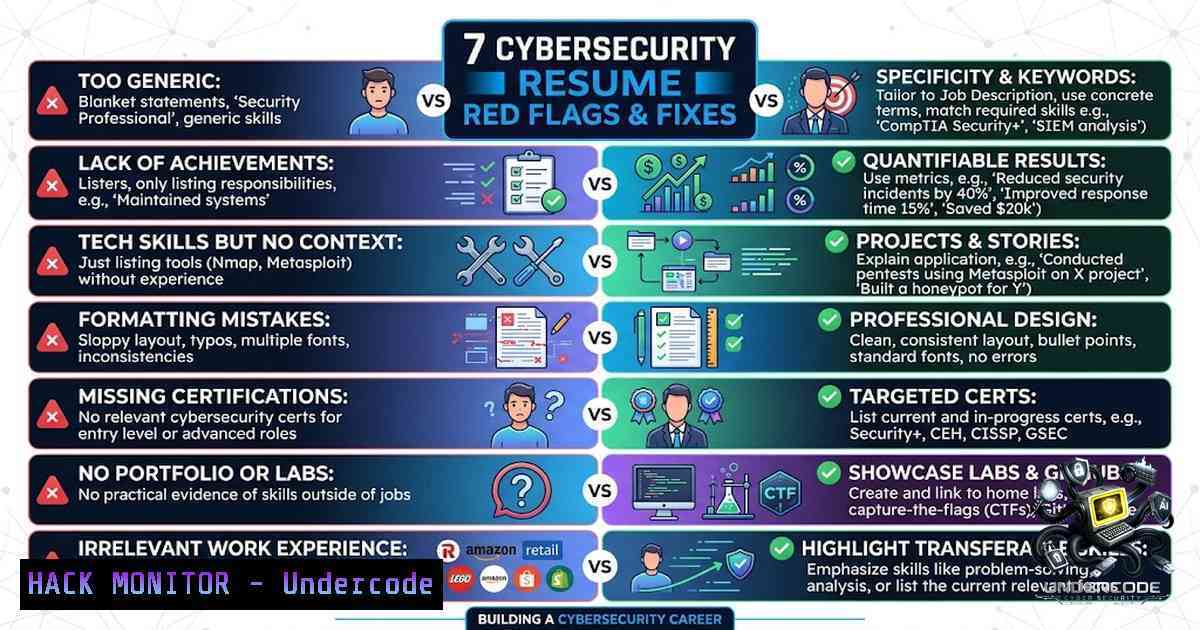
Introduction:
In the high-stakes world of cybersecurity, IT, and artificial intelligence, your resume is often the first—and sometimes only—line of defense against being overlooked for your dream role. Recruiters in these technical fields spend mere seconds scanning each application, and small, seemingly insignificant details can instantly move you from “maybe” to “no”. This article dissects the most common resume pitfalls that plague even seasoned professionals and provides actionable, step-by-step strategies to transform your CV into a powerful tool that opens doors.
Learning Objectives:
- Identify the top 7 resume red flags that immediately disqualify candidates in cybersecurity and IT.
- Master the “6-Second Glance” test to ensure your resume makes an instant impact.
- Implement a comprehensive resume review checklist to guarantee perfection before every application.
You Should Know:
- The Generic Objective Statement: Your Resume’s Silent Killer
A generic objective statement is the fastest way to signal to a recruiter that you lack focus and direction. In cybersecurity, where specialization is key (e.g., cloud security, penetration testing, GRC), a vague statement like “Seeking a challenging position in IT” is a death sentence.
Step‑by‑step guide to fix it:
- Delete the objective – it’s outdated and takes up valuable real estate.
- Replace it with a professional summary – 2–3 lines that highlight your specific niche, years of experience, and key certifications (e.g., CISSP, CEH, OSCP).
- Tailor it for each role – use keywords from the job description to pass ATS filters.
- Add a “Core Competencies” section – list 6–8 technical skills (e.g., “Cloud Security (AWS/Azure)”, “SIEM Management”, “Python Scripting”).
- The Job Description Mismatch: Failing the ATS Test
Many organizations use Applicant Tracking Systems (ATS) to screen resumes before a human ever sees them. If your resume doesn’t contain the specific keywords and phrases from the job description, it will never reach the hiring manager.
Step‑by‑step guide to fix it:
- Copy the job description into a word cloud tool to identify the most frequently used terms.
- Map your experience to these terms. For example, if the job asks for “incident response,” ensure that exact phrase appears in your bullet points.
- Use both acronyms and full forms – e.g., “SIEM (Security Information and Event Management)” – to maximize searchability.
- Create a “Technical Skills” section at the top of your resume that mirrors the job’s required skills.
3. Employment Date Discrepancies: The Trust Breaker
Discrepancies between employment dates, education timelines, or certification dates can lead employers to question your honesty and attention to detail. In cybersecurity, where integrity is paramount, this is a fatal flaw.
Step‑by‑step guide to fix it:
- Double-check every date against your personal records or previous tax documents.
- Use a consistent format – e.g., “MM/YYYY – MM/YYYY” – throughout the resume.
- Explain gaps transparently – use a brief parenthetical like “(Career Break – Family Care)” or “(Professional Development)” to account for any unemployment periods.
- Verify certifications – ensure the issuing body and date are correctly listed; consider including the certification ID if applicable.
- Lack of Quantifiable Achievements: The “What Did You Actually Do?” Problem
Cybersecurity professionals often list responsibilities instead of achievements. “Managed firewalls” tells a recruiter nothing. “Reduced security incidents by 40% through proactive firewall rule optimization” tells them everything.
Step‑by‑step guide to fix it:
- Use the STAR method (Situation, Task, Action, Result) for each bullet point.
- Quantify everything – use metrics like percentages, dollar amounts, or time saved.
- Focus on outcomes – instead of “Performed vulnerability assessments,” write “Conducted 50+ vulnerability assessments, identifying and remediating 200+ critical CVEs across 1,000+ endpoints.”
- Include relevant commands – if you automated a task, mention the tools (e.g., “Automated log analysis using Python and the ELK stack, reducing manual review time by 70%”).
5. Spelling and Grammar Errors: The Unforgivable Sin
In a field where precision is life-or-death, a single typo can be the difference between an interview and the rejection pile. Recruiters view errors as a sign of carelessness.
Step‑by‑step guide to fix it:
- Read your resume aloud – this helps catch awkward phrasing and errors.
- Use a grammar checker like Grammarly, but don’t rely on it exclusively.
- Ask a colleague to proofread – a fresh pair of eyes, especially one with technical knowledge, can spot context-specific errors (e.g., confusing “penetration test” with “penetration tasting”).
- Check all hyperlinks – ensure your LinkedIn, GitHub, or portfolio links work and point to professional profiles.
6. Overloading with Technical Jargon (Without Context)
While it’s important to demonstrate technical proficiency, dumping a list of every tool you’ve ever touched without context is overwhelming and often backfires.
Step‑by‑step guide to fix it:
- Categorize your skills – group them into “Expert,” “Proficient,” and “Familiar” if you wish, or simply list them under relevant experience sections.
- Provide context – instead of just listing “Nessus,” write “Utilized Nessus to perform weekly internal vulnerability scans, resulting in a 30% reduction in high-risk findings.”
- Focus on relevancy – only include tools and technologies that are relevant to the target role. If you’re applying for a cloud security role, emphasize AWS/Azure/GCP experience over legacy on-premises tools.
7. The “One-Size-Fits-All” Resume: The Ultimate Career Limiter
Sending the same resume to every job opening is the most common and costly mistake. A generic resume signals a lack of genuine interest and effort.
Step‑by‑step guide to fix it:
- Create a master resume – list all your experience, skills, and achievements in one document.
- Tailor a new version for each application – customize the summary, core competencies, and even reorder bullet points to highlight the most relevant experience.
- Research the company – mention specific projects, technologies, or challenges the company faces and how you can address them.
- Use the job description as your guide – ensure every requirement listed is addressed somewhere in your resume.
What Undercode Say:
- Key Takeaway 1: Your resume is not a historical document; it’s a marketing tool. Every word should be chosen to sell your ability to solve the employer’s specific problems.
- Key Takeaway 2: In cybersecurity, trust is non-1egotiable. Inaccuracies, whether in dates or technical claims, are not just red flags—they’re deal-breakers.
Analysis:
The modern cybersecurity job market is fiercely competitive, with ATS systems and time-pressed recruiters acting as the first gatekeepers. The strategies outlined above are not just about getting past these filters; they are about presenting yourself as a meticulous, results-driven professional—qualities that are absolutely essential in the field. By treating your resume with the same rigor you would apply to a security audit, you transform it from a passive list of experiences into a compelling narrative of your value. Remember, the goal is not just to get an interview, but to arrive at that interview with a resume that has already framed the conversation around your achievements and potential.
Prediction:
- +1: As AI-driven recruitment tools become more sophisticated, resumes that are optimized with relevant keywords and quantifiable achievements will have a significant advantage, potentially bypassing human screening altogether.
- +1: The demand for specialized cybersecurity skills (cloud, AI security, zero-trust architecture) will continue to outpace supply, making a well-crafted, niche-focused resume even more critical for standing out.
- -1: Candidates who fail to adapt their resumes to the evolving landscape—particularly those who rely on generic templates—will find themselves increasingly marginalized, regardless of their actual technical competence.
▶️ Related Video (72% Match):
🎯Let’s Practice For Free:
🎓 Live Courses & Certifications:
Join Undercode Academy for Verified Certifications
🚀 Request a Custom Project:
Secure, high-velocity infrastructure and disruptive technological engineering. Contact our engineering team for high-tier development and proprietary systems:
[email protected]
💎 Smart Architecture | 🛡️ Secure by Design | ⭐ Trusted by Thousands
IT/Security Reporter URL:
Reported By: Chris Romano – Hackers Feeds
Extra Hub: Undercode MoN
Basic Verification: Pass ✅


