
Listen to this Post
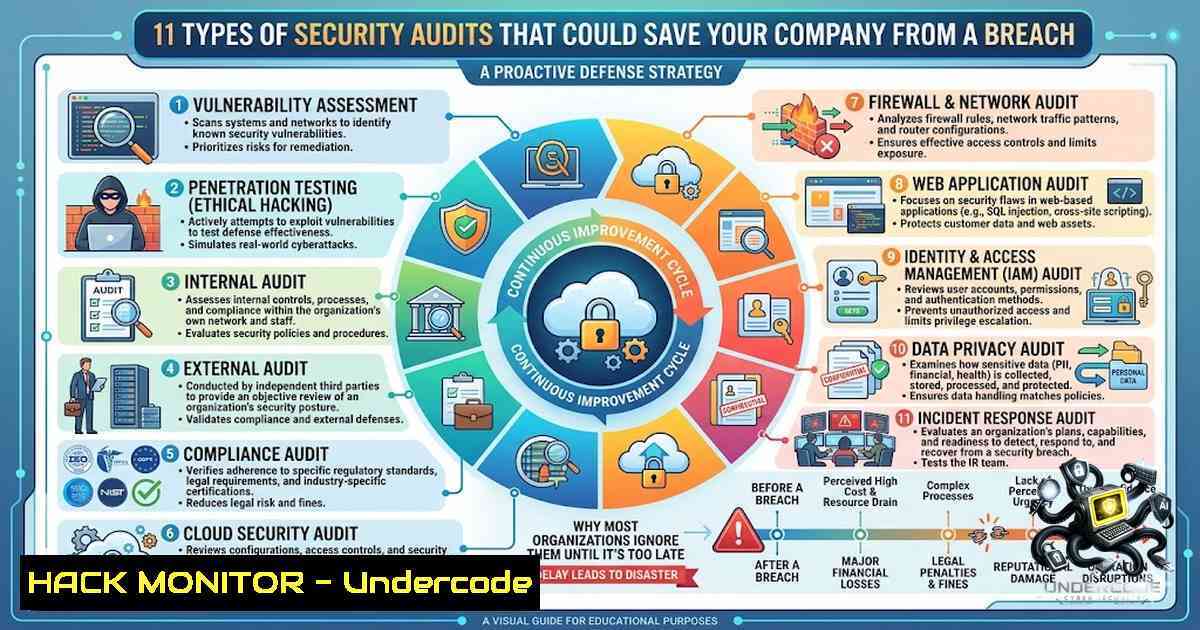
Introduction:
Security audits are the unsung heroes of cyber resilience—systematic evaluations that separate organizations that weather attacks from those that make headlines for all the wrong reasons. While many companies view audits as checkbox exercises for compliance, the reality is far more consequential: each audit type targets a distinct attack surface, from human behavior to cloud misconfigurations, and ignoring any one of them leaves a door wide open for adversaries. As one security architect bluntly observed, organizations that dismiss these assessments often find themselves breached “not too long after”—a pattern that repeats with devastating regularity across every industry.
Learning Objectives:
- Differentiate between the 11 core types of security audits and determine which ones your organization urgently needs based on risk profile and regulatory obligations.
- Master practical command-line techniques for conducting configuration, access control, and vulnerability audits across Linux and Windows environments.
- Develop a risk-prioritized audit roadmap that transforms security assessments from reactive chores into proactive defense mechanisms.
You Should Know:
- Penetration Testing: Simulating Real-World Attacks to Find What Vulnerability Scanners Miss
Penetration testing goes far beyond automated scanning—it’s an authorized, human-driven simulation of a cyber attack that mirrors the techniques and methodologies used by professional adversaries. The process typically unfolds across eight distinct phases: pre-engagement (defining scope and rules of engagement), information gathering on Linux and Windows systems, vulnerability assessment, exploitation for initial access, privilege escalation, data extraction, and finally, documentation and reporting. What makes penetration testing uniquely valuable is its ability to uncover chained vulnerabilities—where one minor weakness becomes the entry point for a devastating breach—that automated tools would never detect in isolation.
For those building hands-on skills, controlled environments like Metasploitable 2 and Windows 7 in VirtualBox provide safe testing grounds. The OSCP certification cheatsheets offer structured references for executing various penetration testing techniques. Common reconnaissance commands include `nmap -sV -p- target_ip` for service enumeration, `gobuster dir -u target_url -w wordlist.txt` for directory brute-forcing, and `hydra -l admin -P passwords.txt ssh://target_ip` for password attacks. Post-exploitation on Linux often involves `linpeas.sh` for automated privilege escalation enumeration, while Windows counterparts leverage tools like PowerUp and SharpUp.
- Risk Assessment: Quantifying Business Impact Before Attackers Do
Risk assessment bridges the gap between technical vulnerabilities and business decision-making—it’s the nexus where policies and controls meet real-world risk management. Frameworks like NIST SP 800-30 Rev. 1 and ISO/IEC 27005 provide structured methodologies: risk identification, analysis, evaluation, and treatment. The process begins with determining objectives and scope, then identifying assets and threats, creating a current security profile, conducting the assessment itself, and finally establishing a target profile.
A practical risk workbook should include columns for Asset, Threat Event, Vulnerability, Likelihood, Impact, Risk Level, and Treatment. Treatment options fall into four categories: accept, mitigate, transfer, or avoid. The NIST Cybersecurity Framework and ISO 27001 remain the two most widely adopted frameworks, providing high-quality assessment exercises that build the shared language used by auditors, managers, and regulators. Organizations should remember that formulas like “likelihood × impact” are merely guides—context and professional judgment matter most.
3. Vulnerability Assessment: Systematic Identification of Known Weaknesses
Vulnerability assessments differ from penetration testing in a critical way: they identify known weaknesses without attempting exploitation, making them faster, repeatable, and largely passive. OpenVAS (Greenbone Vulnerability Management) and Nessus lead the market, offering comprehensive detection of CVEs, misconfigurations, and compliance violations.
For OpenVAS on Ubuntu/Debian: sudo apt install gvm && sudo gvm-setup && sudo gvm-check-setup. Access the web interface at `https://localhost:9392`. Command-line scanning with GMP involves creating targets and scan tasks via XML requests. Nessus installation: `sudo dpkg -i Nessus-10.x.x-debian10_amd64.deb && sudo systemctl start nessusd, accessible at `https://localhost:8834`. CLI scanning: `nessuscli scan --targets 10.0.1.0/24 --policy "Basic Network Scan". Scan types range from Discovery Scans (weekly) to Full Vulnerability Scans (monthly), Credentialed Scans for OS-level checks, Web Application Scans for OWASP Top 10 testing, and Compliance Scans for CIS/DISA STIG benchmarks. Automated scanning scripts can be scheduled via cron for consistent coverage.
4. Configuration Audit: Hardening Systems Against Misconfiguration Exploits
Misconfigurations remain one of the most common entry points for attackers, making configuration audits essential. The CIS Benchmarks provide authoritative baselines for operating systems, and tools like Lynis automate checks on Linux systems: sudo apt update && sudo apt install lynis && sudo lynis audit system. For deeper compliance validation, `oscap xccdf eval –profile cis_rhel8 /usr/share/xml/scap/ssg/content/ssg-rhel8-ds.xml` checks RHEL systems against CIS benchmarks.
Automated scripts are available for auditing and enforcing CIS v3.0.0 benchmarks on both Windows 11 and Linux systems. For Windows, PowerShell scripts like `CIS_Windows11_Basic_Audit.ps1` audit and apply settings. For Linux, Bash scripts handle Red Hat Enterprise Linux and Ubuntu configurations. Organizations should start with hardened golden images and automation tools like Ansible or HashiCorp Packer to ensure every server launched is compliant. Open-source GRC tooling now exists that applies CIS Benchmark Level 1 and Level 2 hardening checks, mapping every finding to a CIS control ID and outputting human-readable compliance reports.
5. Social Engineering Audit: Testing the Human Firewall
Technology controls mean nothing if employees can be manipulated into compromising security. Social engineering audits simulate realistic attacks based on employee manipulation, identifying human weaknesses including risky behaviors, inadequate procedures, and lack of cybersecurity awareness. Modern phishing simulations have evolved beyond static email templates—AI-powered platforms now generate customized, hyper-realistic scenarios tailored to each organization and employee role.
Research consistently demonstrates the value: in one study, over half of participants engaged with a deceptive email during a three-day campaign, and nearly one-third disclosed company credentials. The accompanying on-site audit identified more than fifty significant vulnerabilities across eight risk categories. Following such campaigns, organizations typically see a rise in suspicious report submissions, indicating enhanced security-conscious behavior. Social engineering tests now span multiple channels including email, SMS, WhatsApp, Signal, and Telegram—with voice channels coming soon. Techniques include credential harvesting emails, malicious attachment simulations, MFA fatigue attacks, and internal impersonation attempts.
- Access Control Audit: Verifying Who Really Has Access to What
IAM misconfigurations silently fuel the majority of real-world breaches—attackers increasingly bypass sophisticated defenses by simply logging in with over-privileged, orphaned, or poorly monitored credentials. Access control audits verify user permissions, roles, and access levels, applying the principle of least privilege everywhere.
On Linux, start with `getent passwd` to list all users and `getent group` for groups. Check sudo privileges with sudo -l -U username. For directory permissions beyond the standard model, use getfacl. Audit scripts can iterate through users, extract group memberships from /etc/group, and review sudoers files in /etc/sudoers.d/. On Windows, `Get-ADUser -Filter -Properties MemberOf | Select-Object Name, MemberOf` exports Active Directory group memberships. For local accounts, `Get-LocalUser | ForEach-Object { $user = $_.Name; Get-LocalGroupMember -Group Administrators | Where-Object {$_.Name -like “$user”} }` identifies unnecessary admin rights.
Enforcing least privilege means replacing blanket `ALL=(ALL)` permissions with specific command-level access—for example, jenkins ALL=(ALL) NOPASSWD: /usr/bin/docker, /usr/bin/systemctl restart nginx. Service accounts should use `usermod -s /sbin/nologin svc_account` to prevent interactive logins. On Windows, deploy LAPS (Local Administrator Password Solution) to manage unique, rotated passwords for local admin accounts. For cloud environments, use AWS IAM Access Analyzer or Azure AD Access Reviews to generate policy findings.
- Application Security Audit: Securing Code from Development to Production
Application security audits combine multiple testing layers: Static Application Security Testing (SAST) catches vulnerable code before it’s merged, while Dynamic Application Security Testing (DAST) uncovers runtime issues like broken access control and security misconfigurations. OWASP ZAP remains the most effective DAST tool for detecting vulnerabilities in broken access control, insecure design, and security misconfiguration. The OWASP Penetration Testing Kit performs runtime scanning including DAST, IAST, SAST, and SCA, automatically parsing JavaScript, HTML, and CSS before code executes.
SAST tools like SonarQube and Fortify analyze source code for SQL injection, cross-site scripting, insecure cryptographic calls, and missing input sanitization. Organizations should build AppSec programs that combine multiple testing layers for better insights. The OWASP Benchmark provides a fair test for any application vulnerability detection tool, with all vulnerabilities deliberately included being actually exploitable. Web application scans should run after each deployment, targeting OWASP Top 10 vulnerabilities.
- Compliance Audit: Meeting Regulatory Obligations Without Becoming a Checkbox Exercise
Compliance audits review security practices against regulations and standards including GDPR (data privacy, fines up to €20M or 4% of revenue), HIPAA (healthcare information, up to $1.5M per violation), PCI DSS (payment card data), and SOX (financial reporting). Beyond financial penalties, non-compliance damages reputation and user trust.
A comprehensive compliance audit involves researching industry-specific frameworks and confirming relevance with legal counsel. Automation tools like Azure Policy can enforce standards for GDPR, HIPAA, PCI-DSS, SOC 2, CSA, CIS, and NIST. Compliance management plans should assess current status, close gaps, and keep controls operating consistently. Organizations should avoid “checkbox security” and instead apply controls intelligently, building the shared language used by auditors, managers, and regulators.
- Incident Response Audit: Testing Your Ability to Detect, Respond, and Recover
Incident response audits evaluate organizational preparedness to detect, respond to, and recover from security incidents. These assessments test not just technical capabilities but also communication protocols, decision-making under pressure, and recovery procedures. Effective incident response requires regular tabletop exercises, playbook testing, and post-incident reviews that identify gaps in detection coverage, response times, and recovery objectives.
Key metrics include Mean Time to Detect (MTTD), Mean Time to Respond (MTTR), and recovery point objectives (RPOs). Incident response audits should evaluate logging and monitoring capabilities, alert triage processes, escalation procedures, and communication channels. Organizations should maintain updated incident response plans that address everything from ransomware to insider threats, with clear roles and responsibilities defined for each scenario.
- Data Privacy Audit: Protecting Sensitive Information Beyond Compliance
Data privacy audits check compliance with data protection and privacy requirements, extending beyond mere regulatory adherence to encompass data lifecycle management, classification, retention, and disposal. These audits examine how organizations collect, process, store, and share personal and sensitive data. Key areas include data inventory and mapping, consent management, data subject access request (DSAR) procedures, third-party data sharing agreements, and data breach notification protocols.
Privacy audits should evaluate encryption practices for data at rest and in transit, access controls around sensitive data, and data minimization principles. Organizations must demonstrate not just compliance but actual privacy-by-design implementation across systems and processes. Regular privacy impact assessments (PIAs) should be conducted for new projects and technologies that process personal data.
- Physical Security Audit: Protecting the Hardware Behind the Software
Physical security audits evaluate the protection of critical assets, facilities, and infrastructure—often overlooked in cybersecurity discussions despite being equally critical. These assessments examine access controls to server rooms, data centers, and offices; surveillance systems; environmental controls (fire suppression, temperature monitoring); and procedures for visitor management and equipment disposal.
Research shows physical security audits frequently uncover significant vulnerabilities—unsecured data storage devices, visible passwords, and inadequate access controls. Organizations should integrate physical and cyber security audits, recognizing that physical breaches often enable cyber attacks and vice versa. Key considerations include biometric access controls, badge systems with audit trails, security camera coverage and retention, and secure destruction of hardware containing sensitive data.
What Undercode Say:
- Key Takeaway 1: Security audits are not optional exercises—they are the diagnostic tools that reveal hidden vulnerabilities before attackers find them. Organizations that dismiss audits as unnecessary overhead often discover their true value only after a breach, when the cost of remediation far exceeds the cost of prevention. The most successful security programs treat audits as continuous, integrated processes rather than annual compliance rituals.
-
Key Takeaway 2: The human element remains the most unpredictable variable in any security equation. Social engineering audits consistently demonstrate that even well-trained employees can be manipulated, and the most sophisticated technical controls cannot compensate for inadequate security awareness. Organizations must invest equally in technology, process, and people—and measure all three through targeted audits.
Analysis:
The landscape of security audits reflects a fundamental truth about modern cybersecurity: there is no single silver bullet. Each audit type addresses a distinct attack vector, and ignoring any one of them creates a blind spot that adversaries will exploit. The organizations that thrive are those that embrace audits not as burdensome requirements but as strategic advantages—opportunities to identify weaknesses, validate controls, and build resilience before attacks occur.
What’s particularly striking is the interconnected nature of these audits. A configuration audit might reveal weak Windows settings that a vulnerability assessment would flag as critical, while a penetration test could demonstrate how that weakness combines with a social engineering failure to enable a complete compromise. Access control audits expose over-privileged accounts that incident response audits would later reveal as the source of a breach. The most effective security programs integrate these audits into a cohesive, risk-prioritized roadmap.
The technical commands and tools discussed—from `nmap` and `hydra` to OpenVAS, CIS scripts, and PowerShell audits—represent the practical execution of audit principles. But tools alone are insufficient. Audits require skilled interpretation, contextual understanding of business risk, and the organizational will to act on findings. As one security professional noted, risk links business goals to security controls, helping organizations avoid “checkbox security” and apply controls intelligently.
Prediction:
- +1 Organizations that adopt continuous, integrated auditing programs will reduce their breach risk by over 60% within two years, as automated tools and AI-assisted analysis make comprehensive audits accessible to mid-market companies previously priced out of enterprise-grade security assessments.
-
+1 The convergence of AI with security auditing will revolutionize the field, with AI-powered tools capable of identifying misconfigurations and vulnerabilities in real-time, dramatically reducing the window between vulnerability discovery and remediation from weeks to hours.
-
-1 Organizations that continue treating audits as annual checkbox exercises will face increasingly severe consequences, as ransomware groups and nation-state actors specifically target companies with known audit gaps, exploiting the predictable patterns of under-audited environments.
-
-1 The growing complexity of cloud-1ative and AI-driven systems will outpace traditional audit methodologies, creating a dangerous gap where new attack surfaces remain unexplored while legacy audit approaches focus on outdated concerns, leaving organizations vulnerable to novel exploitation techniques.
-
+1 Regulatory pressure will accelerate audit adoption worldwide, with GDPR, HIPAA, and PCI DSS enforcement actions driving compliance audits into the mainstream, while emerging frameworks for AI security and data privacy create new audit categories that forward-thinking organizations will treat as competitive advantages rather than burdens.
▶️ Related Video (62% Match):
https://www.youtube.com/watch?v=1_bv7Ke-aCE
🎯Let’s Practice For Free:
🎓 Live Courses & Certifications:
Join Undercode Academy for Verified Certifications
🚀 Request a Custom Project:
Secure, high-velocity infrastructure and disruptive technological engineering. Contact our engineering team for high-tier development and proprietary systems:
[email protected]
💎 Smart Architecture | 🛡️ Secure by Design | ⭐ Trusted by Thousands
IT/Security Reporter URL:
Reported By: Securityaudit Cybersecurity – Hackers Feeds
Extra Hub: Undercode MoN
Basic Verification: Pass ✅


