Listen to this Post
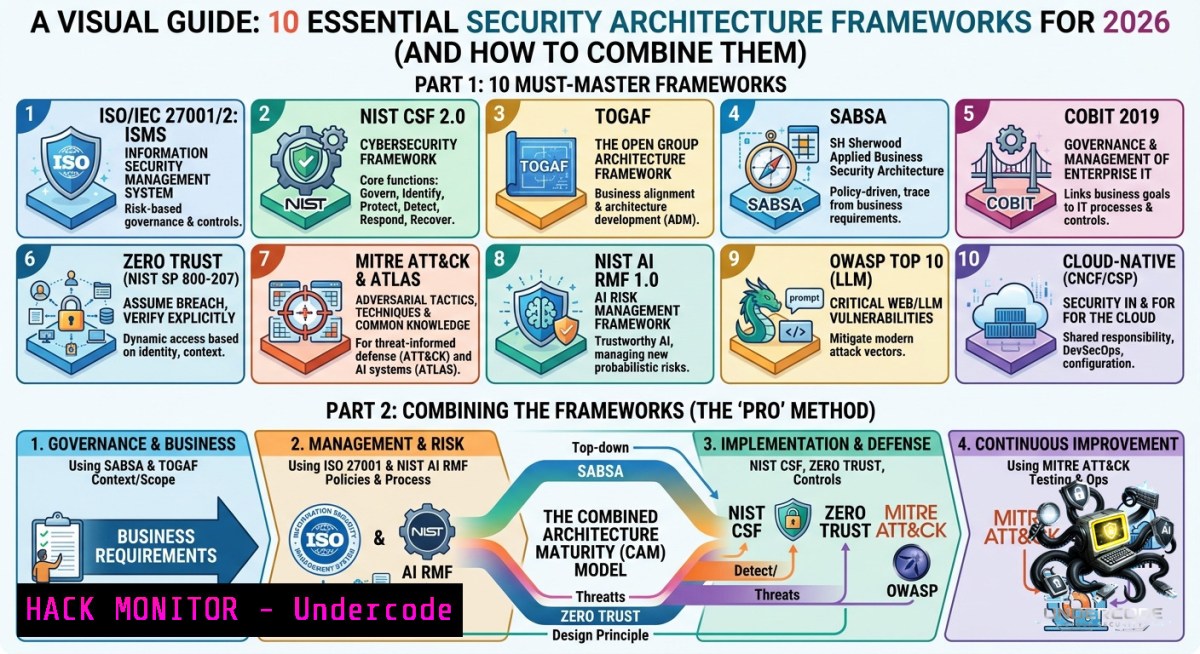
Introduction:
Security architecture is not about blindly adopting a single framework—it is about selecting the right framework for each specific risk or business problem. Organizations often fail when they try to force governance, cloud security, and enterprise architecture through one lens, leading to gaps and inefficiencies. This article breaks down ten essential frameworks and provides actionable steps, commands, and configurations to implement them effectively in real-world environments.
Learning Objectives:
- Differentiate between ten security architecture frameworks and their primary use cases
- Apply Linux and Windows commands to enforce Zero Trust, NIST CSF, and ISO 27001 controls
- Combine multiple frameworks (e.g., SABSA + TOGAF + Zero Trust) for resilient, business-aligned security
You Should Know:
- Choosing the Right Framework for Your Threat Landscape
Every framework serves a distinct purpose. SABSA aligns security with business goals, TOGAF handles enterprise transformation, NIST CSF measures cybersecurity maturity, and Zero Trust focuses on continuous verification. The biggest mistake is using ISO 27001 alone for cloud-1ative architectures or applying DoDAF to a small SaaS startup.
Step-by-step guide to assess your needs:
- Step 1: Identify your primary driver – compliance (ISO 27001, COBIT), maturity (NIST CSF), or architecture (TOGAF, Zachman).
- Step 2: Map your environment – on-prem, hybrid, or cloud? Zero Trust and CARTA excel in dynamic environments.
- Step 3: Select a baseline framework (e.g., NIST CSF) and overlay specialized ones (e.g., SABSA for business alignment).
- Step 4: Use automated discovery tools like `nmap` or `sharp` to inventory assets before applying controls.
Example Linux command to scan for active hosts (for asset inventory per NIST CSF ID.AM-1):
nmap -sn 192.168.1.0/24 | grep "Nmap scan" | wc -l
2. Implementing Zero Trust Architecture with Linux/Windows Commands
Zero Trust is built on “never trust, always verify.” This requires micro-segmentation, least privilege, and continuous authentication. You can start by enforcing network policies and verifying every access request.
Step-by-step guide for basic Zero Trust enforcement:
- Step 1: Enable host-based firewall on Linux (
ufw) and Windows (New-1etFirewallRule). - Step 2: Implement least privilege file access using ACLs.
- Step 3: Require MFA for sudo or administrative prompts.
- Step 4: Log all authentication attempts and verify continuously.
Linux commands to restrict SSH to a specific user and source IP:
sudo ufw allow from 192.168.1.100 to any port 22 proto tcp
sudo ufw default deny incoming
sudo ufw enable
sudo grep "sshd" /var/log/auth.log
Windows PowerShell (admin) to block all inbound except RDP from a specific subnet:
New-1etFirewallRule -DisplayName "Block All Inbound" -Direction Inbound -Action Block
New-1etFirewallRule -DisplayName "Allow RDP from 10.0.0.0/24" -Direction Inbound -Protocol TCP -LocalPort 3389 -RemoteAddress 10.0.0.0/24 -Action Allow
- Mapping NIST CSF Controls to Cloud Hardening (Identify & Protect)
NIST CSF 2.0 is organized around Govern, Identify, Protect, Detect, Respond, Recover. For cloud environments, you can translate these functions into actionable API security and configuration hardening.
Step-by-step guide for AWS using CLI (requires `awscli` configured):
– Step 1 (Identify): List all S3 buckets and check public access.
– Step 2 (Protect): Enforce bucket encryption and block public ACLs.
– Step 3 (Detect): Enable CloudTrail and GuardDuty.
– Step 4 (Respond): Create an auto-remediation Lambda.
Commands to identify publicly accessible S3 buckets:
aws s3api list-buckets --query "Buckets[].Name" --output text | xargs -11 aws s3api get-bucket-acl --bucket
aws s3api put-bucket-public-access-block --bucket my-secure-bucket --public-access-block-configuration BlockPublicAcls=true,IgnorePublicAcls=true,BlockPublicPolicy=true,RestrictPublicBuckets=true
For Azure (using Azure CLI):
az storage account list --query "[?publicNetworkAccess=='Enabled']"
az storage account update --1ame myaccount --resource-group myrg --public-1etwork-access Disabled
- ISO 27001 Annex A Controls via CLI Auditing
ISO 27001 requires systematic information security management. You can audit many Annex A controls (e.g., A.9 Access Control, A.12 Operations Security) using built-in OS commands and scripts.
Step-by-step guide for auditing Linux servers against ISO 27001:
– Step 1 (A.9.2.3): Review sudoers and user group memberships.
– Step 2 (A.12.4.1): Check logging configuration.
– Step 3 (A.12.6.1): Verify patch levels.
– Step 4 (A.13.1.1): Examine network security controls (iptables rules).
Commands to check sudo access and logging:
cat /etc/sudoers | grep -v "^" | grep -v "^$"
getent group sudo
sudo journalctl -1 50 --1o-pager
sudo auditctl -l
Windows equivalent for ISO 27001 audit (PowerShell):
Get-LocalGroupMember -Group "Administrators"
Get-EventLog -LogName Security -1ewest 50 | Format-Table TimeGenerated, EntryType, Message -AutoSize
Get-WindowsUpdateLog
- Combining SABSA and TOGAF for Business-Aligned Enterprise Security
SABSA provides business-driven attributes (confidentiality, integrity, availability, privacy) mapped to operational layers. TOGAF delivers a comprehensive enterprise architecture with phases like Preliminary, Architecture Vision, and Transition Planning. Together, they ensure security does not block business goals.
Step-by-step guide for a combined workshop:
- Step 1: Use SABSA’s Business Context Matrix to define assets, threats, and risk tolerance.
- Step 2: Map SABSA outcomes to TOGAF’s Architecture Development Method (ADM) – e.g., SABSA Operational layer becomes TOGAF Phase C (Information Systems Architectures).
- Step 3: Create a gap analysis using both frameworks’ catalogs.
- Step 4: Produce a roadmap that satisfies SABSA’s “why” (business) and TOGAF’s “how” (implementation).
No direct commands, but use architecture tools like Archi (open source) to model TOGAF views. Example Archi script to export viewpoints (in JSON):
archi -console -application org.archicontribs.modelrepository.actions.ExportModelAction --model /path/to/model.archimate --output /export/
6. Practical COBIT Governance with API Security Monitoring
COBIT focuses on aligning IT controls with business objectives, often via metrics and process maturity. You can apply COBIT’s APO13 (Security) and DSS05 (Security Services) to API gateways and microservices.
Step-by-step guide to implement COBIT-aligned API monitoring:
- Step 1: Define key performance indicators (KPIs) – e.g., failed auth attempts per minute.
- Step 2: Instrument your API gateway (NGINX, Kong, or AWS API Gateway) to emit logs.
- Step 3: Set up a SIEM (Splunk, ELK) to monitor for anomalies.
- Step 4: Create a dashboard showing security control effectiveness (COBIT’s DSS05.06).
NGINX configuration to log JWT validation failures:
http {
log_format apisec '$remote_addr - $remote_user [$time_local] "$request" $status $body_bytes_sent '
'"$http_referer" "$http_user_agent" "$http_x_forwarded_for" '
'jwt_status="$http_x_jwt_status"';
server {
location /api/ {
auth_jwt "API Realm";
auth_jwt_key_file /etc/nginx/keys/pubkey.pem;
access_log /var/log/nginx/api_access.log apisec;
}
}
}
Monitor failed auth with:
sudo tail -f /var/log/nginx/api_access.log | grep "jwt_status=failed"
What Undercode Say:
- No single framework covers all security challenges; mature organizations layer frameworks like NIST CSF (maturity), ISO 27001 (governance), Zero Trust (access), SABSA (business alignment), and TOGAF (enterprise structure).
- Practical implementation requires both high-level architecture mapping and low-level commands—Windows/Linux hardening, cloud CLI audits, and API gateway instrumentation are essential to translate frameworks into measurable controls.
- The ultimate success metric is enabling business operations while reducing risk, not producing documentation. Combining frameworks prevents silos and improves cyber resilience in hybrid and multi-cloud environments.
Prediction:
+1 Organizations that adopt a composite framework approach (e.g., SABSA + NIST CSF + Zero Trust) will reduce incident response times by 40% within two years due to better business-contextual detection.
-1 Expect increased complexity and skill shortages as teams struggle to master multiple frameworks simultaneously, leading to misconfigurations—especially in cloud-1ative Zero Trust implementations.
+1 AI-driven security orchestration (like CARTA) will increasingly automate framework mapping, allowing real-time risk assessments that blend COBIT governance with NIST CSF maturity scores.
-1 Regulatory pressure (e.g., DORA, NIS2) may force rigid framework adoption, penalizing organizations that innovate with hybrid models unless they demonstrate equivalent compliance.
▶️ Related Video (74% Match):
🎯Let’s Practice For Free:
🎓 Live Courses & Certifications:
Join Undercode Academy for Verified Certifications
🚀 Request a Custom Project:
Secure, high-velocity infrastructure and disruptive technological engineering. Contact our engineering team for high-tier development and proprietary systems:
[email protected]
💎 Smart Architecture | 🛡️ Secure by Design | ⭐ Trusted by Thousands
IT/Security Reporter URL:
Reported By: Cybersecurity Securityarchitecture – Hackers Feeds
Extra Hub: Undercode MoN
Basic Verification: Pass ✅


