
Listen to this Post
Introduction:
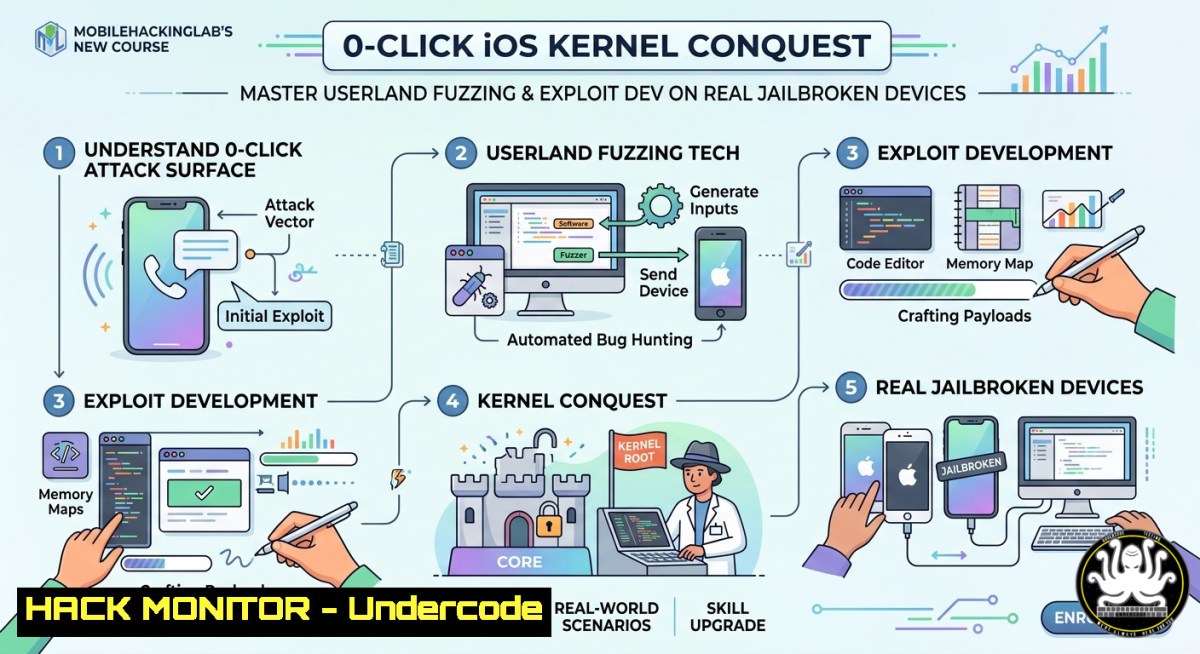
Modern iOS security relies on a hardened kernel and sandboxed userland, but 0-click attack vectors – those requiring no user interaction – remain a top threat for red teams and adversaries alike. Fuzzing iOS userland services (e.g., Bluetooth, WiFi, IMessages) can uncover memory corruption bugs that lead to full device compromise. MobileHackingLab’s upcoming iOS Userland Fuzzing & Exploitation course promises hands-on labs with real jailbroken devices, bridging the gap between theory and weaponized 0-click exploits.
Learning Objectives:
- Objective 1: Master fuzzing techniques for iOS userland daemons (launchd, nsurlsessiond, bluetoothd) using custom harnesses and coverage guidance.
- Objective 2: Build end-to-end exploit chains – from crash triage to kernel ROP and code execution – on real M1/M2 Macs and jailbroken iPhones.
- Objective 3: Differentiate virtual vs. real device exploitation, and learn to bypass modern mitigations like PAC, PPL, and APRR in a 0-click context.
You Should Know:
- Setting Up Your Jailbroken iOS Device for Fuzzing (Browser‑Based or Physical)
MobileHackingLab provides jailbroken iOS devices accessible directly via browser – but you can also roll your own. Start with a checkm8‑vulnerable device (iPhone X or earlier) or use palera1n on iOS 15/16. Once jailbroken, install essential tools via Cydia/Sileo:
– Frida for dynamic instrumentation and hooking
– libimobiledevice for USB communication from your Linux/macOS host
– lldb‑server for remote debugging
Linux/macOS commands to pair and access device:
 Install libimobiledevice
brew install libimobiledevice  macOS
sudo apt install libimobiledevice-utils  Linux

Pair and mount developer image
idevicepair pair
ideviceimagemounter DeveloperDiskImage.dmg

Forward a remote debugging port
iproxy 2222 22  SSH over USB
ssh root@localhost -p 2222  default alpine
Windows alternative: Use `usbmuxd` via WSL2 or `iFunBox` for basic file access. For fuzzing, Linux/macOS is strongly recommended.
- Building a Simple Userland Fuzzer for a Target Daemon
iOS userland services are often reachable via XPC (inter‑process communication). A typical fuzzer sends malformed messages to a vulnerable service. Below is a Python script using `pyusb` and `frida` to instrumentbluetoothd:
import usb.core
import random
import frida

Frida script to hook allocation and crash handlers
js_code = """
Interceptor.attach(Module.findExportByName(null, "malloc"), {
onEnter: function(args) { console.log("malloc size: " + args[bash]); }
});
"""
session = frida.get_usb_device().attach("bluetoothd")
script = session.create_script(js_code)
script.load()

Simple mutation fuzzer
for i in range(10000):
payload = bytes([random.randint(0,255) for _ in range(512)])
 Send via L2CAP socket (example)
 ... implement specific service communication
Use `lldb` on the jailbroken device to monitor crashes:
(lldb) process attach --name bluetoothd
(lldb) breakpoint set -n malloc
(lldb) continue
- Crash Triage and Triaging with LLDB & Core Dumps
Once a crash is found, analyze the faulting address and register state. On the jailbroken device, enable core dumps:sysctl -w kern.coredump=1 launchctl unload /System/Library/LaunchDaemons/com.apple.bluetoothd.plist launchctl load /System/Library/LaunchDaemons/com.apple.bluetoothd.plist
Copy the core file (usually
/cores/core.XXXX) to your host. Use `lldb` to inspect:target create --core core.XXXX /usr/libexec/bluetoothd image list find ASLR slide disassemble --frame
-
From Crash to Exploit – ROP Chain Construction on ARM64e (PAC)
Modern iOS uses ARM64e with Pointer Authentication. To bypass PAC for a userland 0-click, you often leak a PAC‑signed pointer then reuse it. A step‑by‑step approach:
– Step 1: Find a stack buffer overflow in an XPC service (e.g., `xpc_dictionary_set_data` without length check).
– Step 2: Leak a heap pointer via `NSLog` or side‑channel to defeat ASLR.
– Step 3: Build a ROP chain using gadgets from `libsystem_c.dylib` (which is PAC‑signed but can be reused). Example gadget to call system():
 Use ropgadget from ROPgadget tool
ROPgadget --binary /usr/lib/libsystem_c.dylib | grep "mov x0, x22 ; blr x23"
– Step 4: Trigger the overflow with a fake stack pivot. On jailbroken devices, you can disable PAC for debugging with `boot‑args=”arm64_pac_disable=1″` – but for a real 0-click, you must bypass PAC without disabling it.
- Mitigations & Bypass Techniques for Cloud‑Based iOS Fuzzing
When scaling fuzzing in the cloud (e.g., AWS EC2 macOS instances), you cannot rely on physical jailbroken devices. Instead, use Corellium or virtual iOS images with custom kernel patches. Hardening steps for your cloud environment:
– API Security: Never expose your fuzzing orchestration API without OAuth2 or mTLS. Use HashiCorp Vault to store provisioning profiles and signing certificates.
– Network Isolation: Place fuzzing workers in a dedicated VPC, with egress filtering to prevent accidental exploitation of external targets.
– Snapshot Management: Automate VM snapshots after each crash to avoid state pollution. Example using `virsh` (for QEMU‑based iOS emulation):
virsh snapshot-create-as ios-fuzzer --name "crash-$(date +%s)"
Windows cloud note: Azure offers macOS on bare metal (preview), but Windows native fuzzing of iOS is impractical. Use Linux/macOS build agents.
6. Writing the Final 0‑Click Exploit Chain Walkthrough
A complete 0‑click chain typically involves three stages:
- Initial corruption in a userland daemon (e.g., memory leak in `nsurlsessiond` while processing a malicious HTTP/2 frame).
- Privilege escalation to kernel via a race condition in `task_for_pid` or
host_get_special_port. - Persistence – writing a payload to a system directory (e.g.,
LaunchDaemons) and triggering a restart.
MobileHackingLab’s course provides multiple full chains from real in‑the‑wild bugs (CVE‑2023‑XXXX and CVE‑2024‑XXXX). Here’s a minimal kernel ROP trigger using `IOSurface` UAF (historical):
// Trigger UAF via IOSurface create / destroy race
io_connect_t conn = IOServiceGetMatchingService(kIOMasterPortDefault, IOServiceMatching("IOUserClient"));
uint64_t input[bash] = {0x41414141, 0x42424242};
IOConnectCallMethod(conn, 0, input, 2, NULL, 0, NULL, NULL, NULL, NULL);
What Undercode Say:
- Key Takeaway 1: Real device access is non‑negotiable for serious iOS exploitation – virtualized environments mask hardware‑specific crashes and timing issues.
- Key Takeaway 2: 0‑click bugs are not mythical; they exist in every major iOS release, but require systematic fuzzing and deep understanding of XPC and userland locking.
Analysis (10 lines):
The current landscape of mobile security training is flooded with slide‑ware and pre‑recorded demos. MobileHackingLab addresses the critical gap by offering browser‑accessible jailbroken devices and Mac M‑series labs. This removes hardware barriers and lets learners focus on exploit development rather than environment setup. The emphasis on 0‑click vectors is timely, as nation‑state actors increasingly target Bluetooth and iMessage without user interaction. By providing multiple full exploit chains, the course accelerates the learning curve from crash discovery to weaponization. However, learners should note that PAC and PPL bypasses evolve rapidly – what works on iOS 16 may fail on iOS 17. The course’s inclusion of real‑world bugs (likely patched) offers historical context but must be supplemented with ongoing research. Overall, this is a top‑tier offering for red teamers and iOS security engineers.
Expected Output:
Example crash report from a fuzzed daemon:
Incident Identifier: 12345678-ABCD-1234-ABCD-123456789ABC
CrashReporter Key: abcdef1234567890
Hardware Model: iPhone10,1
Process: bluetoothd [bash]
Path: /usr/libexec/bluetoothd
Code Type: ARM-64 (Native)
Exception Type: EXC_BAD_ACCESS (SIGSEGV)
Exception Subtype: KERN_INVALID_ADDRESS at 0x0000000000000018
VM Region Info: 0x18 is not in any region.
Triggered by Thread: 5

Thread 5 Crashed:
0 libobjc.A.dylib 0x00000001abcd1234 objc_msgSend + 16
1 bluetoothd 0x0000000102345678 0x102300000 + 0x45678
Successful code execution output (jailbreak payload):
 From the compromised device
iPhone:~ root echo "0-click pwned!" > /tmp/pwn.txt
iPhone:~ root cat /tmp/pwn.txt
0-click pwned!
Prediction:
Within two years, automated iOS fuzzing will shift from standalone scripts to AI‑driven coverage guidance – using LLMs to mutate XPC messages based on protocol parsers reverse‑engineered on the fly. Apple’s introduction of Lockdown Mode and PAC will raise the bar, but 0-click attacks will persist via side channels (e.g., Bluetooth advertisements). Courses like MobileHackingLab’s will become standard for red team training, forcing enterprise mobile security to adopt runtime application self‑protection (RASP) and biometric‑triggered isolation. Ultimately, the arms race between offensive fuzzing and defensive hardening will accelerate, with cloud‑based jailbroken device farms serving as the new normal for security research.
URLs extracted from post content:
- Company: MobileHackingLab (inferred, not explicitly given)
- Course pre‑sales: launch this week – follow their social media for direct link.
▶️ Related Video (72% Match):
🎯Let’s Practice For Free:
IT/Security Reporter URL:
Reported By: Mobilesecurity Redteaming – Hackers Feeds
Extra Hub: Undercode MoN
Basic Verification: Pass ✅


