Listen to this Post
Introduction:
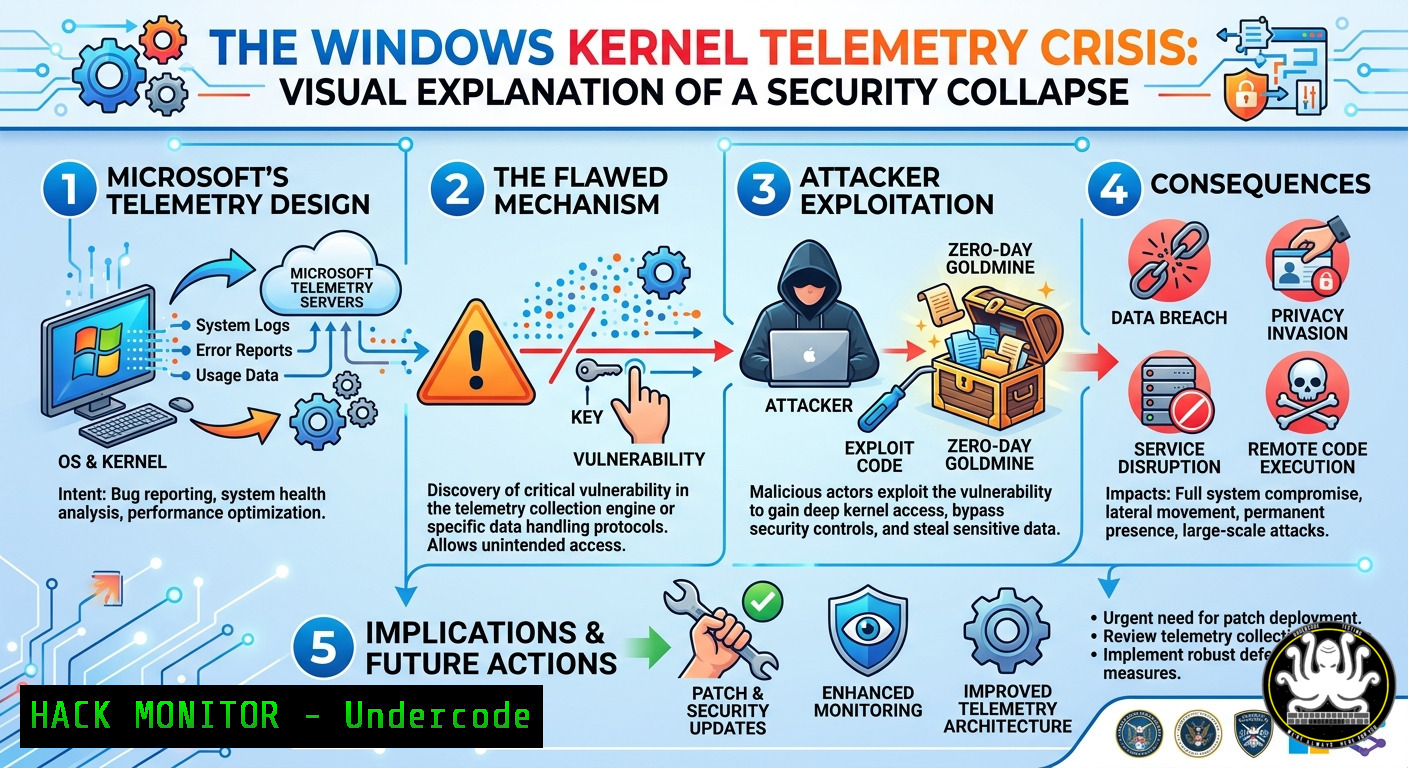
Microsoft’s recent architectural changes have severely restricted syscall inspection capabilities for third-party EDRs, effectively blinding endpoint detection to critical kernel-level exploit behavior. While defenders once relied on rich syscall telemetry to catch post-exploitation activity, the current kernel instrumentation exposes only a fraction of necessary events—leaving organizations vulnerable to even mediocre local exploits. This article dissects the technical gap, explores the Process Instrumentation Callback (PIC) interface as a potential workaround, and provides hands-on commands to audit your own telemetry visibility.
Learning Objectives:
- Understand how Microsoft’s syscall inspection limitations degrade EDR detection for zero-day exploits
- Analyze the performance trade-offs of alternative kernel callbacks like Process Instrumentation
- Implement Linux and Windows commands to audit syscall visibility and kernel telemetry coverage
You Should Know:
1. Auditing Syscall Visibility on Windows and Linux
The core issue raised by Marcus Hutchins is that Microsoft has “defanged” EDRs by limiting syscall inspection. To verify your current telemetry capabilities, use these commands.
Windows – Check ETW (Event Tracing for Windows) syscall providers:
 List available kernel providers including syscall-related ones
logman query providers | findstr -i "syscall"

Enable syscall tracing temporarily (requires admin)
logman start SyscallTrace -p "Microsoft-Windows-Kernel-Process" 0x10 -o syscall.etl -ets
logman stop SyscallTrace -ets
Windows – View loaded kernel callbacks (including EDR drivers):
fltmc filters List filter drivers (many EDRs register here)
Linux – Compare syscall visibility (for context, as Linux offers better introspection):
 Trace all syscalls with strace on a process
strace -e trace=all -p <PID>

Monitor syscalls system-wide with auditd
auditctl -a always,exit -F arch=b64 -S all -k syscall_log
ausearch -k syscall_log --format raw
What this does: The Windows commands reveal whether your system is capturing syscall-level events via ETW. If providers are missing or limited, you have reduced exploit detection. Linux commands show how a more transparent syscall interface operates.
- Enabling Process Instrumentation Callback (PIC) for Deeper Telemetry
Marcus mentions “process instrumentation callback interface” as a possible opportunity. PIC is a Windows kernel mechanism that notifies registered callbacks on process creation, termination, and image loads—but with severe performance caveats.
Step-by-step to enable PIC monitoring (developer/research context):
- Install Windows Driver Kit (WDK) and Visual Studio.
- Create a kernel-mode driver that registers a `PsSetCreateProcessNotifyRoutineEx` callback.
- Within the callback, use `PsSetCreateThreadNotifyRoutine` and `PsSetLoadImageNotifyRoutine` for comprehensive coverage.
- Compile and deploy the driver (requires test-signing mode or valid certificate).
Code snippet for registering PIC-like callbacks (C):
NTSTATUS DriverEntry(PDRIVER_OBJECT DriverObject, PUNICODE_STRING RegistryPath) {
PsSetCreateProcessNotifyRoutineEx(ProcessNotifyCallback, FALSE);
PsSetCreateThreadNotifyRoutine(ThreadNotifyCallback);
PsSetLoadImageNotifyRoutine(LoadImageCallback);
return STATUS_SUCCESS;
}
Performance impact: Each callback invocation increases syscall roundtrip time—by up to 30% in high-process environments. Microsoft’s own documentation warns that PIC-based instrumentation can degrade system performance significantly, which is why they limited syscall inspection in the first place.
- Testing EDR Blind Spots with a Local Exploit Simulator
To understand the severity, simulate a local privilege escalation exploit and measure whether your EDR detects it.
Compile a minimal syscall-based exploit (Windows – educational use only):
include <windows.h>
int main() {
// Direct syscall to NtRaiseHardError (no API hooking)
// Use inline assembly or SysWhispers2 for syscall stubs
// This bypasses user-mode hooks
return 0;
}
Detectability test steps:
- Run the compiled binary on a Windows machine with your EDR enabled.
- Monitor with Sysinternals Procmon – filter by `Process Name` and `Operation` =
Process Create. - Check if the EDR logs the syscall event. Many will miss it because they rely on user-mode hooks.
Mitigation: Enable kernel-mode Call Stack Stacking in Windows Defender (if using Microsoft’s own AV) via:
Set-MpPreference -EnableControlledFolderAccess Enabled
Set-MpPreference -AttackSurfaceReductionRules_Ids 9e6c4e1f-7d60-472f-ba1a-a39ef669e4b2 -AttackSurfaceReductionRules_Actions Enabled
4. Cloud Hardening for Kernel-Telemetry Gaps
In cloud environments (Azure/AWS), you cannot modify the hypervisor’s kernel telemetry. Use alternative detection layers.
Azure – Enable Syscall Monitoring via Azure Monitor Agent:
 Install MMA agent for Linux VMs to capture syscalls via auditd
$workspaceId = "<your-workspace-id>"
$workspaceKey = "<your-key>"
./AzureMonitorAgentInstaller --workspace-id $workspaceId --workspace-key $workspaceKey --enable-syslog
AWS – Use Falco for runtime security (supports syscall filtering):
 Install Falco on EC2 (Amazon Linux)
sudo yum install falco -y
 Configure rules to detect syscall anomalies
sudo falco -c /etc/falco/falco.yaml -r /etc/falco/rules/custom_syscalls.yaml
Cloud-specific detection rule (Falco):
- rule: Suspicious Syscall from Container
desc: Detect raw syscalls that bypass EDR hooks
condition: evt.type in (execve, ptrace, process_vm_writev) and container.id != host
output: "Raw syscall detected (syscall=%evt.type)"
priority: WARNING
5. API Security in a Post-Syscall World
If kernel telemetry fails, attackers pivot to API abuse. Hardening API gateways becomes critical.
Implement API request signing to prevent replay attacks (Node.js example):
const crypto = require('crypto');
function signRequest(body, secret) {
return crypto.createHmac('sha256', secret).update(JSON.stringify(body)).digest('hex');
}
// Validate timestamp to prevent replay
if (Math.abs(Date.now() - parseInt(req.headers['x-timestamp'])) > 30000) return reject();
Deploy ModSecurity WAF with syscall-inspired anomaly scoring:
 On Ubuntu, install ModSecurity for Nginx
sudo apt install libmodsecurity3 nginx-modsecurity
 Configure to block anomalous request patterns (e.g., too many syscalls in a second)
6. Vulnerability Exploitation Mitigation Without Full Telemetry
Given limited syscall inspection, adopt a “least-telemetry” approach.
Windows – Enable Kernel-mode Hardware-enforced Stack Protection (if supported):
 Check support
Get-ComputerInfo -Property "HyperV", "DeviceGuard"
 Enable via Group Policy: Computer Config > Admin Templates > System > Device Guard > Turn on Virtualization Based Security
Linux – Use seccomp-bpf to filter syscalls per container:
 Apply strict seccomp profile to Docker container
docker run --security-opt seccomp=/path/to/deny-all-but-necessary.json myapp
Example seccomp rule to block `ptrace` and `process_vm_writev` (common exploit syscalls):
{
"defaultAction": "SCMP_ACT_ALLOW",
"architectures": ["SCMP_ARCH_X86_64"],
"syscalls": [
{"names": ["ptrace", "process_vm_writev", "process_vm_readv"], "action": "SCMP_ACT_ERRNO"}
]
}
What Undercode Say:
- Microsoft’s syscall limitation creates a dangerous asymmetry – attackers using direct syscalls evade EDRs while defenders lose visibility. The Process Instrumentation Callback offers a partial fix but at unsustainable performance cost.
- Organizations must layer detection strategies – combine limited kernel telemetry with cloud-native runtime security (Falco, Azure Monitor) and strict syscall filtering (seccomp, VBS). No single solution works post-zero-day.
- The industry needs a new kernel telemetry standard – either Microsoft restores safe syscall inspection or defenders migrate to eBPF on Windows (still experimental). Until then, assume your EDR is blind to local exploits.
Prediction:
Within 18 months, attackers will weaponize this telemetry gap via “syscall-less” exploits that manipulate existing kernel callbacks to evade even the Process Instrumentation interface. Microsoft will likely introduce a restricted eBPF for Windows as a response, but early adopters will face stability nightmares. Forward-thinking SOCs will pivot to behavioral detection at the network and cloud API layers, treating kernel telemetry as unreliable. Expect a surge in “EDR bypass” CVEs targeting Microsoft’s callback filtering logic.
▶️ Related Video (84% Match):
🎯Let’s Practice For Free:
IT/Security Reporter URL:
Reported By: Malwaretech Me – Hackers Feeds
Extra Hub: Undercode MoN
Basic Verification: Pass ✅


