Listen to this Post
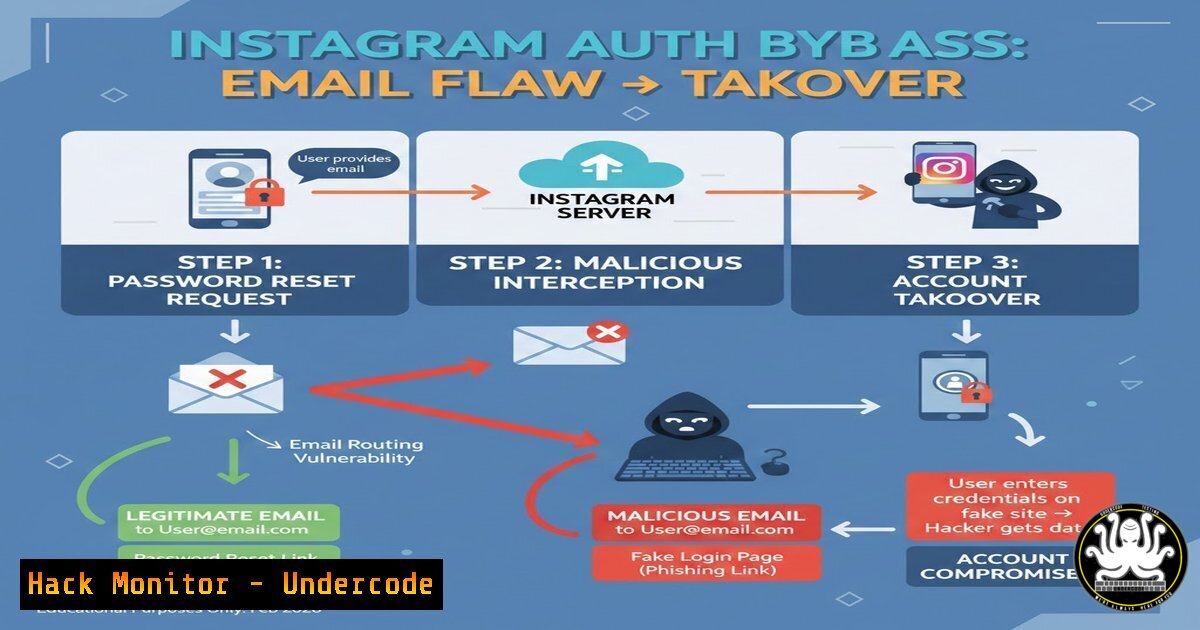
Introduction:
A critical authentication bypass vulnerability in Instagram allowed attackers to hijack user accounts by manipulating email verification processes, highlighting pervasive flaws in identity binding mechanisms. This exploit, rooted in insecure session and token handling, underscores the importance of robust security protocols in social media platforms. Cybersecurity professionals must understand such vectors to defend against account takeover attacks and strengthen application security.
Learning Objectives:
- Understand the step-by-step mechanics of the Instagram authentication bypass exploit and its impact on account security.
- Learn how to test for similar email verification and session management vulnerabilities in web applications using common tools and commands.
- Implement mitigation strategies to harden authentication systems against identity misbinding and account takeover threats.
You Should Know:
1. Deconstructing the Instagram Authentication Bypass Exploit
This exploit leverages a flaw in Instagram’s password reset flow where the system incorrectly validates email addresses during account recovery. The attacker manipulates unverified email changes to bind a victim’s email to their own account, leading to automatic verification and account takeover.
Step-by-step guide explaining what this does and how to use it:
– Step 1: Attacker adds their own email (e.g., [email protected]) to their Instagram account but does not verify it. This is done via account settings, typically under “Email” or “Security” sections.
– Step 2: Attacker requests a password reset link via https://www.instagram.com/accounts/password/reset/ for their account. Instagram sends a reset token to [email protected].
– Step 3: Before clicking the reset link, attacker logs back into account settings and changes the email to the victim’s email ([email protected]). The victim’s email remains unverified on the attacker’s account.
– Step 4: Attacker opens the reset link in the same browser session. Instagram’s token validation erroneously confirms the victim’s email as verified, binding it to the attacker’s account.
– Step 5: The victim’s email is now associated with the attacker’s account, enabling account takeover without victim interaction. This flaw stems from poor session state management and token binding to the wrong email identifier.
2. Understanding Email Verification Flaws in Web Applications
Email verification flaws often arise when applications fail to enforce real-time checks or associate tokens with specific user sessions. Attackers can exploit race conditions or state inconsistencies to bypass verification, leading to identity misbinding. This is common in platforms with complex user flows, such as social media or financial services.
Step-by-step guide explaining what this does and how to use it:
– Step 1: Identify email change or reset functionalities in the target application. Use browser developer tools (F12) to inspect network requests for endpoints like `/api/email/change` or /auth/reset-password.
– Step 2: Intercept requests using a proxy like Burp Suite. Capture the request when changing an email address and note parameters like email, user_id, and session_token.
– Step 3: Modify the request to inject a victim’s email before verification completes. For example, change `POST /api/email/change` body from `{“email”:”[email protected]”}` to {"email":"[email protected]"}.
– Step 4: Simulate a race condition by sending multiple requests rapidly. Use tools like Turbo Intruder in Burp Suite or custom Python scripts to flood the endpoint.
– Step 5: Verify if the application incorrectly binds the email without proper validation. Check response codes or database changes to confirm exploitation.
3. Session Management and Token Validation Best Practices
Secure session management ensures that tokens are tightly bound to user identities and cannot be reused across contexts. The Instagram flaw occurred due to weak token validation, where reset links were not invalidated after email changes. Implementing strict session controls is crucial for preventing authentication bypass.
Step-by-step guide explaining what this does and how to use it:
– Step 1: Analyze session tokens in your application. Use command-line tools like `curl` to test token integrity. For example, `curl -H “Authorization: Bearer
– Step 2: Implement token revocation on email changes. In a Linux environment, use logging commands to monitor sessions: `sudo tail -f /var/log/auth.logfor system-wide insights, or application-specific logs.SameSite
- Step 3: Use secure flags for cookies, such as `HttpOnly` and, to prevent session hijacking. In web frameworks like Node.js, set cookies with `httpOnly: true` andsameSite: ‘strict’.zap-cli quick-scan –scanners xss,sqli –start-options ‘-config api.disablekey=true’ http://target.com`.
- Step 4: Test token validation with OWASP ZAP by scanning authentication endpoints. Configure ZAP via `zap-cli` to automate tests:
– Step 5: Regularly rotate sessions and enforce multi-factor authentication (MFA) to mitigate risks. For cloud applications, use AWS Cognito or Auth0 for managed session handling.
4. Testing for Similar Vulnerabilities with Security Tools
Proactive testing using automated and manual tools can uncover authentication flaws before exploitation. Focus on email verification, password reset, and session management endpoints to identify weaknesses similar to the Instagram bypass.
Step-by-step guide explaining what this does and how to use it:
– Step 1: Set up a testing environment with Burp Suite. Configure proxy settings to intercept traffic from your browser or mobile app. Use Burp’s “Target” tab to scope the application.
– Step 2: Perform a password reset flow and capture requests. Look for parameters like token, email, and user_id. Replay requests with modified values to test for insecure direct object references (IDOR).
– Step 3: Use SQL injection and command injection tests on email fields. For example, in Burp Repeater, send `POST /reset` with `email=attacker’ OR ‘1’=’1` to check for database flaws.
– Step 4: Leverage Linux commands for network analysis. Use `tcpdump` to capture packets: `sudo tcpdump -i eth0 -w reset_flow.pcap` to inspect raw traffic for token leakage.
– Step 5: Write custom Python scripts to automate exploitation. Example script to test email verification bypass:
import requests
session = requests.Session()
 Step 1: Login and change email
login_data = {'username': 'attacker', 'password': 'pass'}
session.post('https://target.com/login', data=login_data)
change_email = {'email': '[email protected]'}
session.post('https://target.com/email/change', data=change_email)
 Step 2: Request password reset
reset_req = {'email': '[email protected]'}
reset_resp = session.post('https://target.com/reset', data=reset_req)
 Step 3: Exploit token validation
token = extract_token(reset_resp)  Custom function to parse token
exploit_url = f'https://target.com/reset/confirm?token={token}'
session.get(exploit_url)
– Step 6: Validate findings with tools like Nikto for server misconfigurations: nikto -h https://target.com -output vuln_report.html.
5. Mitigation Strategies for Developers and Security Teams
To prevent authentication bypass, developers must implement robust validation checks, audit logs, and secure coding practices. This includes enforcing email verification before binding, using idempotent tokens, and conducting regular security audits.
Step-by-step guide explaining what this does and how to use it:
– Step 1: Implement real-time email verification via confirmation links or codes. Use APIs like SendGrid or Amazon SES for transactional emails, and ensure tokens are single-use and expire quickly.
– Step 2: Invalidate sessions and tokens on email changes. For example, in a Django application, use `django.contrib.auth` to update sessions: `request.session.flush()` on email modification.
– Step 3: Enable logging and monitoring for suspicious activities. In Windows, use Event Viewer to track authentication events: `eventvwr.msc` and filter for Event ID 4625 (failed logons). In Linux, use `auditd` with rules like `auditctl -w /etc/passwd -p wa` to watch for user changes.
– Step 4: Conduct penetration testing using frameworks like Metasploit. For instance, use the `auxiliary/scanner/http/oauth_login` module to test OAuth flaws in social logins.
– Step 5: Harden cloud configurations. In AWS, use IAM policies to restrict access and enable CloudTrail for API logging. Commands like `aws cloudtrail lookup-events –lookup-attributes AttributeKey=EventName,AttributeValue=UpdateUser` can audit user changes.
6. Commands and Scripts for Proactive Security Testing
Integrating command-line tools and scripts into security workflows enhances vulnerability detection. Focus on authentication endpoints and session handling to replicate the Instagram bypass.
Step-by-step guide explaining what this does and how to use it:
– Step 1: Use `curl` to test API security. For example, to check if a reset token is bound to an email: `curl -X POST https://api.instagram.com/reset -d “token=abc123&[email protected]” -v` and analyze response headers.
– Step 2: In Windows PowerShell, script email change simulations:
Invoke-WebRequest -Uri https://target.com/email/change -Method Post -Body @{email='[email protected]'} -WebSession $session
– Step 3: Leverage `sqlmap` for database testing: `sqlmap -u “https://target.com/reset?email=test” –dbms=MySQL –level=5` to identify SQLi in reset flows.
– Step 4: Set up a local proxy with Mitmproxy for mobile app testing: `mitmproxy -p 8080` and configure device proxy settings to intercept Instagram-like traffic.
– Step 5: Automate with Bash scripts for log analysis. Example to flag suspicious email changes:
grep "email change" /var/log/app.log | awk '{print $1, $2, $5}' | sort -u
7. Real-World Implications and Case Studies
The Instagram bypass mirrors other high-profile vulnerabilities, such as Twitter’s 2020 account takeover or Facebook’s email verification flaws. These incidents show that even tech giants are vulnerable to logic bugs, emphasizing the need for continuous security assessments.
Step-by-step guide explaining what this does and how to use it:
– Step 1: Study historical breaches via resources like HackerOne reports or CVE databases. For example, CVE-2020-1560 describes a similar Microsoft email flaw.
– Step 2: Replicate exploits in lab environments using Docker containers. Set up a vulnerable web app like DVWA (Damn Vulnerable Web Application) and practice email manipulation: docker run --rm -it -p 80:80 vulnerables/web-dvwa.
– Step 3: Participate in bug bounty programs to hone skills. Platforms like HackerOne and Bugcrowd offer targets with authentication challenges.
– Step 4: Analyze network traffic with Wireshark for token leaks. Filter for HTTP requests: wireshark -k -i eth0 -Y "http.request.method == POST".
– Step 5: Document findings and share with teams to improve awareness. Use frameworks like OWASP ASVS (Application Security Verification Standard) to guide remediation.
What Undercode Say:
- Key Takeaway 1: Authentication bypass flaws often stem from state management errors, where systems fail to validate user context across multi-step processes. The Instagram exploit highlights how trivial email changes can lead to severe account compromise if sessions and tokens are not properly invalidated.
- Key Takeaway 2: Proactive security testing, including manual manipulation of email flows and automated tooling, is essential for identifying similar vulnerabilities in production applications. Developers must adopt a defense-in-depth approach, integrating real-time monitoring and secure coding practices to mitigate risks.
Analysis: This vulnerability underscores the critical intersection of session management and identity verification in modern web applications. While Instagram patched this flaw, its discovery via bug bounty programs demonstrates the value of crowd-sourced security. However, the persistence of such logic bugs across platforms indicates a broader industry challenge: prioritizing user experience over security can introduce subtle flaws that attackers exploit. Security teams should emphasize code reviews for authentication logic and implement continuous penetration testing to catch issues early. The rise of AI-driven security tools may help detect anomalies in user behavior, but human expertise remains vital for uncovering complex logic vulnerabilities.
Prediction:
Future authentication bypass attacks will increasingly leverage AI to automate exploitation of logic flaws, targeting cloud-native applications and IoT devices with weak identity binding. As platforms integrate more third-party services, attack surfaces will expand, leading to sophisticated account takeover chains. However, advancements in zero-trust architectures and behavioral biometrics may mitigate risks, but only if organizations adopt them proactively. The cybersecurity community must focus on standardizing secure authentication protocols to prevent similar incidents across social media, financial, and healthcare sectors.
▶️ Related Video (82% Match):
🎯Let’s Practice For Free:
IT/Security Reporter URL:
Reported By: Rachit 9240ab206 – Hackers Feeds
Extra Hub: Undercode MoN
Basic Verification: Pass ✅


