Listen to this Post
Introduction:
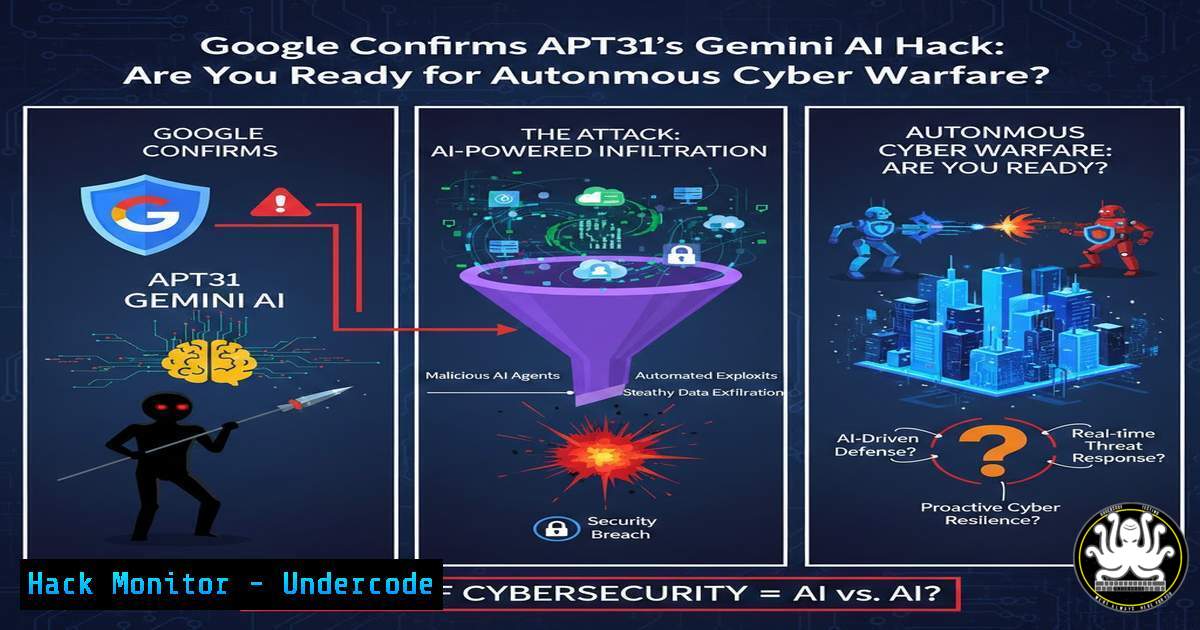
The fusion of artificial intelligence with state-sponsored cyber operations has officially moved from theoretical research to confirmed reality. A recent Google report has verified that the China-linked threat group APT31 has been utilizing Gemini AI to assist in planning and executing cyberattacks against US targets. This marks a pivotal shift into the “chaos phase” of cybersecurity, where human-led operations are now augmented by large language models (LLMs), dramatically accelerating the speed and sophistication of offensive campaigns.
Learning Objectives:
- Understand how threat actors like APT31 are leveraging public and private AI tools for cyberattack planning and execution.
- Identify the specific stages of the cyber kill chain where AI assistance provides the greatest advantage to adversaries.
- Learn defensive strategies and tool configurations to detect and mitigate AI-augmented threats.
You Should Know:
1. Reconnaissance and Target Selection with AI Assistance
The first phase of any APT operation is intelligence gathering. APT31’s use of Gemini likely automates the analysis of vast datasets, including corporate earnings reports, social media activity, and technical documentation. This allows attackers to identify high-value targets and potential vulnerabilities much faster than manual methods.
Step‑by‑Step Guide: Simulating AI-Assisted Reconnaissance (Defensive Perspective)
To understand what attackers see, defenders can simulate this process using open-source intelligence (OSINT) frameworks.
Linux Command:
 Use 'theHarvester' to gather emails, subdomains, and hosts related to a target domain.
 This simulates the initial data collection an AI like Gemini could analyze.
theharvester -d example.com -b all -f recon_results.html
What it does: This command collects publicly available information about a target domain from search engines, PGP key servers, and social platforms. An AI could then parse the resulting HTML file to profile employees and technologies.
2. Vulnerability Discovery and Exploit Generation
According to the post, tools like XBOW are already discovering hundreds of zero-days with zero false positives. APT31 is likely using AI to not only find these flaws but to generate initial exploit code, lowering the barrier to entry for complex attacks.
Step‑by‑Step Guide: Automated Fuzzing for Vulnerability Discovery
Defenders can use fuzzing to find bugs before attackers do.
Linux Command (Using AFL++):
 Clone a target application's source code for security testing.
git clone https://github.com/target/app.git
cd app
 Build the application with AFL++'s instrumentation.
afl-clang-fast -o vulnerable_app source.c
 Start fuzzing with a seed input directory.
afl-fuzz -i input_seeds -o findings ./vulnerable_app @@
What it does: AFL++ (American Fuzzy Lop) automatically generates mutated inputs to crash software. AI could analyze the crash dumps in the `findings` directory to craft a reliable exploit, just as APT31’s tools might do.
3. Phishing and Social Engineering at Scale
AI models excel at generating convincing, context-aware phishing lures. Instead of generic “Nigerian prince” scams, attackers can now craft personalized emails referencing recent events or internal company jargon scraped during recon.
Step‑by‑Step Guide: Analyzing Email Headers for AI-Crafted Phishing
If you suspect an AI-assisted attack, analyzing email sources can reveal inconsistencies.
Windows PowerShell Command:
 View the full internet headers of a suspicious email saved as a .eml file.
Get-Content .\suspicious_email.eml | Select-String -Pattern "Received|From|Reply-To|Authentication-Results"
What it does: This command filters the email header to show the routing path (Received) and authentication results (SPF, DKIM, DMARC). AI-crafted emails often pass these checks if sent from compromised legitimate accounts, so focus on the `Reply-To` and `Return-Path` for mismatches.
4. Command and Control (C2) Evasion
AI can assist attackers in dynamically generating C2 infrastructure and communication patterns that mimic legitimate traffic, making them harder to block with signature-based tools.
Step‑by‑Step Guide: Detecting Beaconing with Zeek (Bro)
Network defenders can use Zeek to spot irregular outbound connections.
Linux Command (Terminal on Zeek Sensor):
 Capture live traffic and log connections.
sudo zeek -i eth0
 After capture, analyze the log for persistent outbound connections.
cat conn.log | zeek-cut ts id.orig_h id.resp_h id.resp_p proto service | grep -E "443|80" | sort | uniq -c | sort -nr
What it does: This pipeline counts unique connections to external IPs on common ports (80/443). AI-generated C2 beacons might show a pattern of periodic, low-frequency connections that stand out against human browsing behavior when analyzed with this command.
5. Cloud Environment Hardening Against AI Attacks
Since many APT targets now reside in the cloud, attackers use AI to rapidly scan for misconfigurations. Defenders must automate their cloud security posture management (CSPM).
Step‑by‑Step Guide: Using Prowler to Audit AWS Against CIS Benchmarks
Linux Command:
 Install Prowler, an AWS security tool.
git clone https://github.com/prowler-cloud/prowler.git
cd prowler
 Run a full assessment against your AWS account.
./prowler -M csv -F aws_security_audit
What it does: Prowler performs hundreds of checks against AWS configurations. The resulting CSV file (aws_security_audit.csv) highlights misconfigurations like open S3 buckets or overly permissive IAM roles—exactly what an AI like APT31’s Gemini would scan for.
6. API Security: The New Battlefield
Modern applications rely on APIs, which are prime targets for automated AI exploitation due to their structured nature.
Step‑by‑Step Guide: Fuzzing an API Endpoint with WFuzz
Linux Command:
 Fuzz a REST API endpoint for IDOR (Insecure Direct Object Reference) vulnerabilities.
wfuzz -z file,/usr/share/wordlists/api_objects.txt -u https://target.com/api/v1/user/FUZZ --hc 404
What it does: This command replaces `FUZZ` in the URL with each entry from a wordlist of common object names (e.g., admin, 12345). If the API returns a non-404 response (e.g., 200 OK), it may indicate an exposed resource that AI-driven recon tools could exploit.
What Undercode Say:
- Key Takeaway 1: The APT31-Gemini revelation confirms that AI is no longer just a defensive tool; it is actively lowering the skill barrier for advanced persistent threats, enabling them to operate at machine speed.
- Key Takeaway 2: Legacy, perimeter-based defenses are obsolete against autonomous offense. The only viable countermeasure is autonomous defense—AI-driven security tools capable of patching, configuring, and responding in real-time without human intervention.
The fusion of state-sponsored APT groups with generative AI marks a historical inflection point. We are moving from an era of “detect and respond” to one of “predict and preempt.” Organizations that fail to integrate AI into their security operations centers (SOCs) will find themselves permanently outmaneuvered by adversaries who have. The “chaos phase” demands a fundamental rewiring of security architecture, where every endpoint, cloud function, and API is continuously hardened by algorithms capable of thinking as fast as the attackers.
Prediction:
Within the next 12-18 months, we will witness the first fully autonomous, AI-on-AI cyber skirmishes. These will not be theoretical exercises but real-time conflicts where a defender’s AI agent battles an attacker’s AI agent for control of a server or data stream, with no human directly in the loop. This will force regulatory bodies to establish new “rules of engagement” for autonomous cyber warfare, potentially through frameworks like the Tallinn Manual, but applied to algorithmic conflict.
▶️ Related Video (82% Match):
🎯Let’s Practice For Free:
IT/Security Reporter URL:
Reported By: Jacknunz Share – Hackers Feeds
Extra Hub: Undercode MoN
Basic Verification: Pass ✅


