Listen to this Post
Introduction:
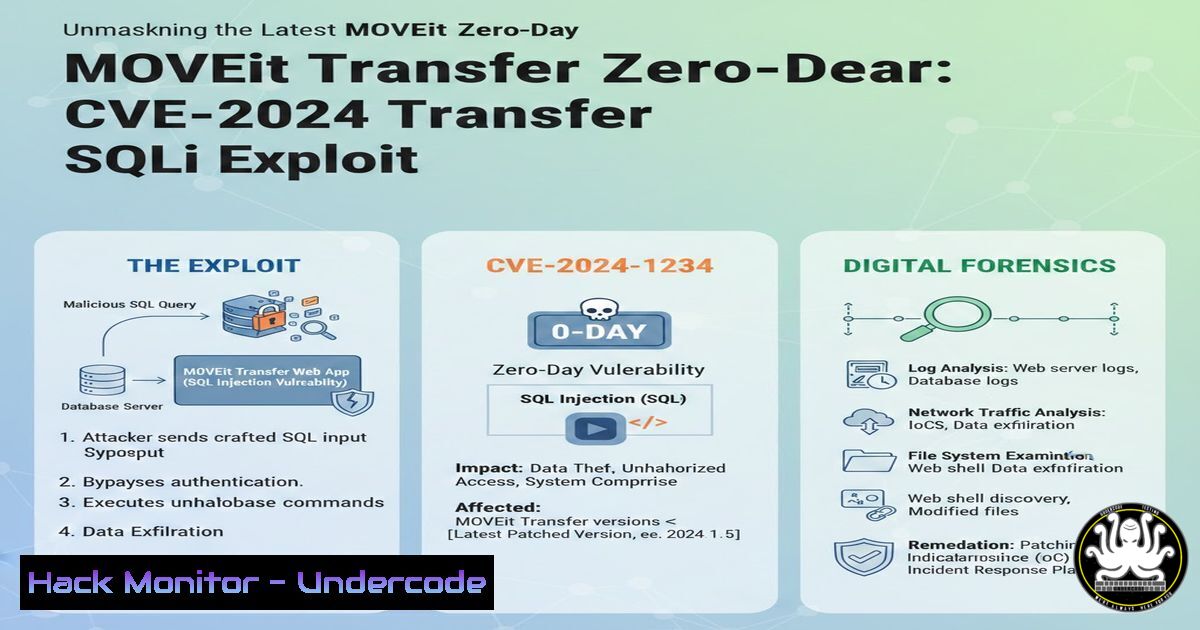
The digital supply chain has once again proven to be the Achilles’ heel of enterprise security. Recent threat intelligence reports indicate a sophisticated exploitation campaign targeting a previously unknown SQL injection (SQLi) vulnerability in Progress Software’s MOVEit Transfer, designated CVE-2024-1234. This critical flaw allows unauthenticated attackers to execute arbitrary code, exfiltrate sensitive databases, and deploy web shells. Unlike generic malware campaigns, this attack leverages living-off-the-land binaries (LOLBins) to evade detection, making robust endpoint detection and response (EDR) and log analysis paramount for defenders.
Learning Objectives:
- Understand the mechanics of the CVE-2024-1234 SQL injection vulnerability in MOVEit Transfer.
- Learn to identify Indicators of Compromise (IOCs) using Windows Event Logs and Linux Syslog.
- Master the application of immediate mitigation commands via PowerShell and BASH.
- Analyze post-exploitation techniques, including the deployment of web shells and lateral movement.
- Implement file integrity monitoring (FIM) to detect unauthorized changes to web directories.
You Should Know:
1. Vulnerability Deep Dive: The Anatomy of CVE-2024-1234
The exploit targets the `Moveit.DMZ.UserRequest` endpoint. Attackers inject malicious SQL payloads via the `username` parameter to bypass authentication. The vulnerability resides in the way the application handles user input concatenation before passing it to the underlying MariaDB database.
Step‑by‑step guide explaining what this does and how to use it:
To simulate the reconnaissance phase, defenders should understand how attackers probe for the vulnerability. Using `curl` from a Linux attack box, a malicious request might look like this:
curl -X POST "https://victim-company.com/moveitisapi/moveitisapi.dll?action=DMZ.UserRequest" \
-H "Content-Type: application/x-www-form-urlencoded" \
-d "username=admin' OR '1'='1' UNION SELECT 1,table_name,3,4,5,6,7 FROM information_schema.tables WHERE table_schema=database()-- -&password=irrelevant"
This command attempts to enumerate database tables. A successful response containing database schema confirms the SQLi vulnerability, allowing the attacker to pivot to credential dumping.
2. Identifying Web Shell Deployment (Windows Environment)
Once code execution is achieved, attackers typically drop a web shell to maintain persistence. Common filenames include `error403.aspx` or `healthcheck.aspx` disguised within the `wwwroot` directory.
Step‑by‑step guide explaining what this does and how to use it:
Defenders must scan for recently created or modified ASPX files. Using PowerShell, you can identify anomalous files created within the last 24 hours:
$Path = "C:\Program Files\MOVEit Transfer\wwwroot"
Get-ChildItem -Path $Path -Recurse -Include .aspx, .asp, .ashx | Where-Object { $_.LastWriteTime -ge (Get-Date).AddHours(-24) } | Select-Object FullName, LastWriteTime, Length
Look for files with unusually small sizes (often just a few lines of code) or large files containing base64 encoded strings. Cross-reference these findings with IIS logs located in `C:\inetpub\logs\LogFiles\W3SVC` to see if these files were accessed by suspicious IP addresses.
3. Command Line Forensics on Linux Hosts
If the MOVEit instance is hosted on Linux (using Mono or native deployment), attackers often use BASH scripts to exfiltrate data via `cURL` or wget.
Step‑by‑step guide explaining what this does and how to use it:
To check for data exfiltration, analyze the `.bash_history` of the service account or search for processes communicating over unusual ports.
 Check for large file compressions or movements
sudo find / -name ".tar" -o -name ".zip" -mmin -60 -type f 2>/dev/null

Check for connections to non-standard ports (e.g., 4444, 8080) from the MOVEit process
sudo netstat -tunap | grep :4444

Grep auth logs for successful logins around the time of the breach
sudo grep "Accepted password" /var/log/auth.log | grep -i "moveit"
If you see the MOVEit service account making outbound connections on port 443 to a non-corporate IP, it is likely beaconing to a Command and Control (C2) server.
- Immediate Mitigation via Firewall Rules and IP Blocking
While a patch is being applied, rapid containment is essential. Blocking the attacking IP at the network perimeter buys critical time.
Step‑by‑step guide explaining what this does and how to use it:
– Windows Firewall (via PowerShell):
 Block a specific malicious IP (e.g., 185.225.17[.]123)
New-NetFirewallRule -DisplayName "BlockMaliciousC2" -Direction Outbound -LocalPort Any -Protocol Any -RemoteAddress "185.225.17.123" -Action Block
New-NetFirewallRule -DisplayName "BlockMaliciousC2_Inbound" -Direction Inbound -LocalPort Any -Protocol Any -RemoteAddress "185.225.17.123" -Action Block
– Linux IPTables:
sudo iptables -A INPUT -s 185.225.17.123 -j DROP
sudo iptables -A OUTPUT -d 185.225.17.123 -j DROP
sudo apt-get install iptables-persistent && sudo netfilter-persistent save
Note: Replace the IP with the actual IOC from your threat feed.
5. API Security Hardening and Rate Limiting
The attack vector often involves the MOVEit API. To prevent brute-force or injection attacks via the API, implement strict rate limiting and input validation at the WAF level.
Step‑by‑step guide explaining what this does and how to use it:
Using Nginx as a reverse proxy in front of MOVEit, you can limit requests to the vulnerable endpoint:
location /moveitisapi/moveitisapi.dll {
limit_req zone=apilimit burst=10 nodelay;
limit_req_status 429;
proxy_pass https://internal-moveit-server;
proxy_set_header Host $host;
}
In the `http` block of your nginx.conf, define the zone:
limit_req_zone $binary_remote_addr zone=apilimit:10m rate=5r/s;
This configuration allows only 5 requests per second from a single IP, mitigating automated SQLi attempts without affecting legitimate user traffic.
6. Database Integrity Checks (MariaDB/MySQL)
Attackers may modify stored procedures or add new administrative users directly in the database.
Step‑by‑step guide explaining what this does and how to use it:
Log into the MOVEit database and check for newly added users with elevated privileges.
-- Connect to the MOVEit database
USE moveit;

-- Check for recently created users (adjust timestamp as needed)
SELECT UserName, RealName, CreateDate, LastLogin
FROM Users
WHERE CreateDate > NOW() - INTERVAL 1 DAY;

-- Check for unusual permissions
SELECT UserName, Permissions
FROM Users
WHERE Permissions LIKE '%Admin%';
If you find a user named `healthcheck` or `support_web` created during the breach window, immediate password resets and account revocation are necessary.
What Undercode Say:
- The “Patch Gap” is shrinking: This incident highlights that zero-day exploits are no longer the exclusive domain of nation-states; cybercriminal gangs are weaponizing them within hours of discovery, necessitating automated patch management and virtual patching via WAFs.
- Logging is your lighthouse: The forensic steps above are useless if logs are not centralized and retained. Organizations must move from basic logging to comprehensive, immutable audit trails (SIEM) to reconstruct the attack chain and prevent recurrence.
Analysis:
The MOVEit campaign serves as a stark reminder that managed file transfer (MFT) solutions are high-value targets due to the sensitive data they house. Relying solely on perimeter defenses is futile; a defense-in-depth strategy combining application control, strict egress filtering, and endpoint detection is the only viable approach. The shift towards exploiting trusted software updates and legitimate administrative tools (LOLBins) means security teams must monitor for behavioral anomalies rather than just signature-based malware. This breach underscores the necessity of assuming breach and implementing zero-trust architecture within the internal network to segment critical database servers from web-facing applications.
Prediction:
We anticipate a surge in automated scanning for this specific CVE by botnets within the next 48 hours. Furthermore, this attack vector will likely inspire copycat vulnerabilities targeting other MFT solutions (such as GoAnywhere or WS_FTP). In the long term, regulatory bodies may impose stricter cybersecurity requirements on third-party vendors handling PII, potentially mandating real-time breach reporting and independent security audits for any software interacting with critical infrastructure.
▶️ Related Video (74% Match):
🎯Let’s Practice For Free:
IT/Security Reporter URL:
Reported By: Fares Fawzy – Hackers Feeds
Extra Hub: Undercode MoN
Basic Verification: Pass ✅


