Listen to this Post
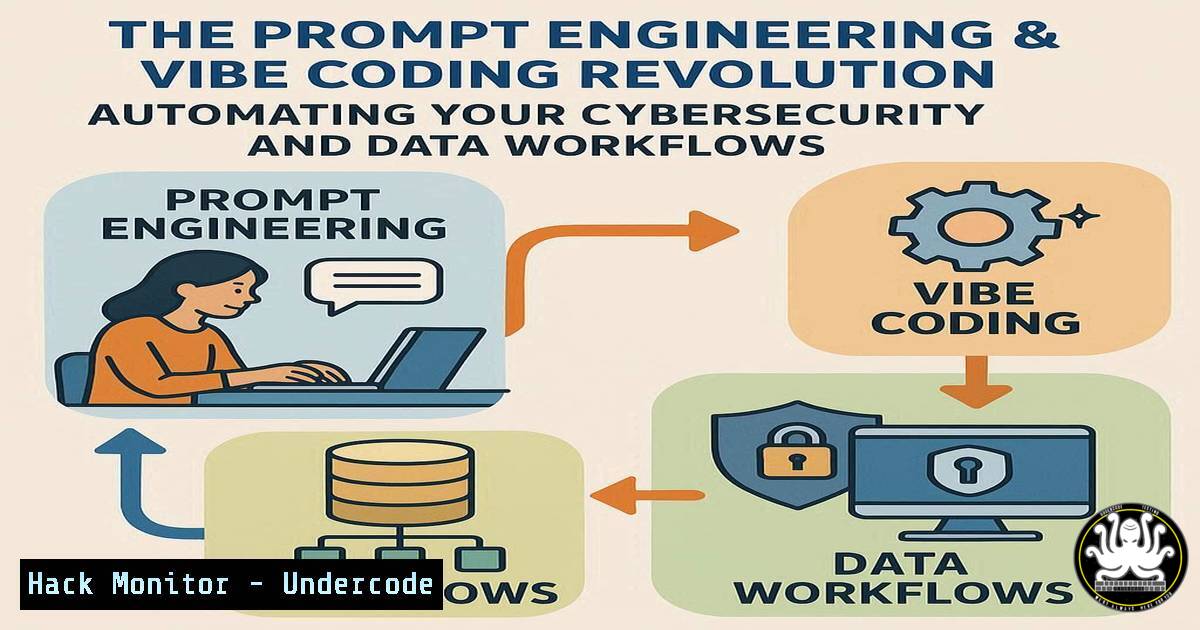
Introduction:
The emergence of Prompt Engineering and Vibe Coding is fundamentally reshaping the technical landscape, introducing powerful new paradigms for interacting with technology. For cybersecurity professionals and IT specialists, these disciplines are not just buzzwords but critical skill sets that enable the automation of complex tasks, from security analysis and data exploration to secure code generation, using natural language. This represents a pivotal shift towards augmented intelligence in the technology sector.
Learning Objectives:
- Understand the core principles of Prompt Engineering for cybersecurity and data analysis automation.
- Learn to apply Vibe Coding techniques to generate and refactor secure code in languages like Python and SQL.
- Develop the skills to leverage AI tools for threat intelligence summarization, data visualization, and building automated reporting systems.
You Should Know:
1. Automating Security Log Analysis with AI
A common task in cybersecurity is sifting through extensive log files. Using prompt engineering, you can instruct an AI to summarize and extract key security events.
Analyze the following Apache access log and provide a summary. Identify:
1. The top 5 IP addresses with the most requests.
2. Any requests that resulted in HTTP 4xx or 5xx status codes.
3. Potential suspicious activity (e.g., multiple 404 errors from a single IP).

[bash]
Step-by-step guide:
This prompt leverages the AI’s ability to parse structured data and identify patterns. The step-by-step instruction forces a structured output. To use this, you would first extract a relevant portion of your log file (e.g., using `tail -n 1000 /var/log/apache2/access.log` on Linux). Paste this data into your AI tool of choice (like ChatGPT or Claude) with the prompt. The AI will return a concise summary, highlighting potential threats and anomalies that would take a human analyst much longer to identify manually, allowing for faster incident response.
2. Vibe Coding for Secure Python Scripting
Vibe coding uses natural language to generate functional code. This is invaluable for quickly creating security tools or automation scripts.
Write a Python script that takes a domain name as input, performs a DNS lookup for its A record, and then checks if the resulting IP address is listed in the AbuseIPDB database using their API. Use the 'requests' library. Include basic error handling.
Step-by-step guide:
This prompt describes a complex multi-step process in plain English. The AI will generate the boilerplate code, including the API call structure and error handling. After receiving the code, your responsibility is to review it for security best practices, add your AbuseIPDB API key securely (using environment variables, not hard-coded), and test it. This dramatically accelerates development time for custom security checks.
3. AI-Powered Data Exploration for Threat Intelligence
Augmented Analytics, as mentioned in the source material, can be applied to security data for initial exploratory data analysis (EDA).
I have a CSV file named 'suspicious_connections.csv' with columns: timestamp, source_ip, destination_ip, port, protocol. Perform an initial Exploratory Data Analysis (EDA). Provide:
1. A count of unique source and destination IPs.
2. The most frequently targeted ports.
3. A time-series plot of connection attempts per hour.
Generate the Python code using pandas and matplotlib to do this.
Step-by-step guide:
This prompt instructs the AI to act as a data analyst. It will produce ready-to-run Python code that loads the CSV, performs the aggregations, and generates visualizations. For a security analyst, this automated EDA can reveal patterns like port scanning activity or DDoS attack waves much faster than manual querying, enabling a quicker understanding of the dataset’s characteristics.
4. Generating SQL Queries for Security Database Interrogation
Instead of writing complex SQL from scratch, you can use vibe coding to generate queries for your Security Information and Event Management (SIEM) database.
Write a SQL query to find users who have logged in from more than 3 different IP addresses within the last 24 hours. Assume a table 'auth_logs' with columns: username, source_ip, login_timestamp.
Step-by-step guide:
This is a classic indicator of potential account compromise. By describing the logic in natural language, the AI generates the precise SQL syntax, likely using a `COUNT(DISTINCT source_ip)` with a `GROUP BY` and `HAVING` clause. The security professional can then execute this query against their database to rapidly identify suspicious accounts for further investigation.
5. Refactoring Code for Security and Maintainability
“Refactor Prompting” is a key technique for improving existing code, including making it more secure.
Original Code Snippet (Python):
import os
def read_config():
with open('/hardcoded/path/config.txt', 'r') as f:
return f.read()
db_password = 'password123'
Refactor the following Python code to improve security and maintainability:
1. Remove hard-coded credentials and paths.
2. Use environment variables for sensitive data and configuration paths.
3. Add basic input validation if applicable.
Step-by-step guide:
The AI will analyze the provided code and generate a more secure version, replacing hard-coded strings with `os.getenv()` calls and suggesting a more flexible configuration system. This teaches and enforces secure coding practices by example, helping to eliminate common vulnerabilities like hard-coded secrets.
6. Automating Executive Security Reports
Transforming raw technical data into a narrative for management is a time-consuming task that can be automated with prompt engineering.
Based on the following dataset of security incidents from the last week, create a 3-paragraph executive summary for non-technical management. Highlight the overall trend, the most critical incident type, and the recommended action. Be concise and focus on business impact.

Incidents:
- [List of Incidents with Dates, Types, and Severity]
Step-by-step guide:
This prompt structures the AI’s output to fit a specific business need. You would feed it the structured data from your ticketing or SIEM system. The AI then synthesizes the technical details into a coherent narrative, saving analysts hours of work and ensuring consistent, clear communication to stakeholders about the security posture.
7. Leveraging RAG for Internal Knowledge Base Queries
Retrieval-Augmented Generation (RAG) allows an AI to answer questions based on your internal documentation, such as security policies or runbooks.
Prompt (within a RAG system):
According to our company's incident response policy, what are the first three steps an analyst must take upon identifying a potential data breach?
Step-by-step guide:
A RAG system first searches a vector database containing your internal documents (e.g., PDFs of security policies). It retrieves the most relevant excerpts and passes them to the AI model as context. The model then generates an answer grounded in your specific company policy. This provides immediate, accurate guidance to analysts, ensuring compliance with internal procedures.
What Undercode Say:
- Democratization of Technical Execution: Prompt Engineering and Vibe Coding are powerful force multipliers, but they do not replace deep technical knowledge. They lower the barrier to entry for generating code and analysis, but the critical thinking, architectural design, and security review must still be performed by a skilled human. The professional becomes a conductor, orchestrating the AI to produce a symphony of output, rather than playing every instrument themselves.
- The Criticality of Secure Prompting: The concept of “clean, maintainable, and secure code” generated by AI is entirely dependent on the specificity and security-awareness of the prompts. A poorly constructed prompt can generate functional but vulnerable code. Therefore, security training for prompt engineers is no longer optional; it is fundamental to preventing the AI from inadvertently introducing vulnerabilities into the software supply chain.
Prediction:
The integration of Prompt Engineering and Vibe Coding into mainstream IT and cybersecurity workflows will create a two-tiered professional landscape. Those who master these skills will achieve unprecedented levels of productivity, automating routine tasks and focusing on high-level strategy and complex problem-solving. Conversely, professionals who fail to adapt risk being sidelined, as their manual methods become economically non-competitive. Furthermore, we predict the rise of “AI-native” security threats, where attackers use these same techniques to generate sophisticated, polymorphic malware and automate social engineering attacks at scale, making AI-auganced defense not just an advantage, but a necessity.
🎯Let’s Practice For Free:
IT/Security Reporter URL:
Reported By: Dimitris Panaretos – Hackers Feeds
Extra Hub: Undercode MoN
Basic Verification: Pass ✅


