
Listen to this Post
Introduction:
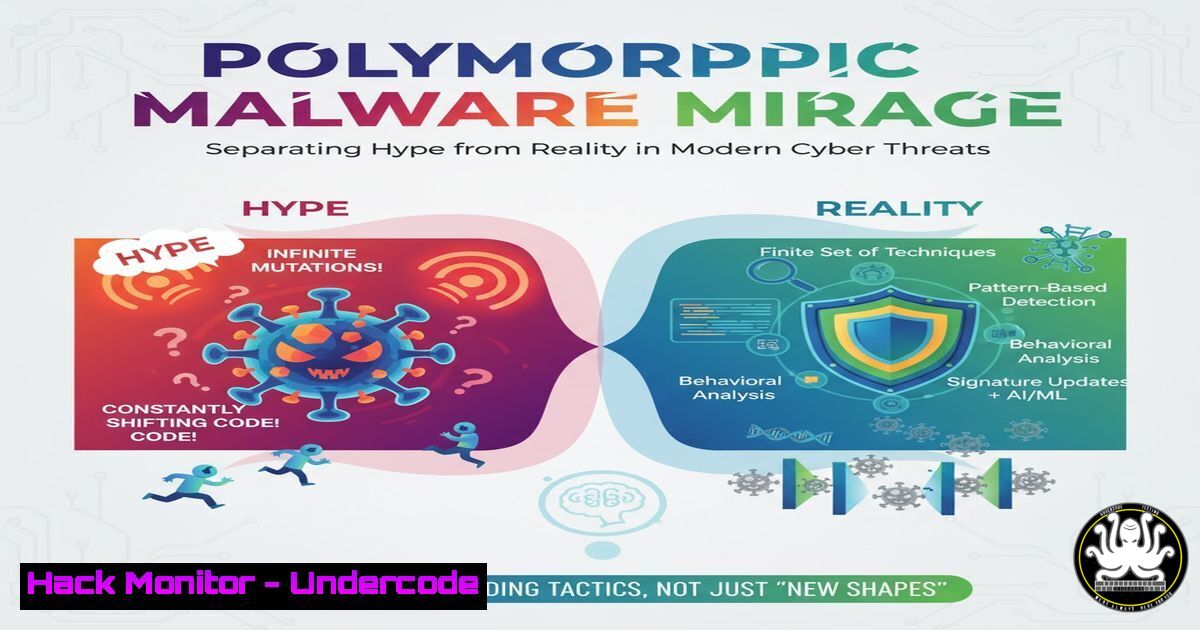
The term “polymorphic malware” has resurfaced in cybersecurity marketing, creating unnecessary fear about threats that can spontaneously rewrite their code to evade detection. In reality, true AI-generated polymorphic malware remains largely confined to proof-of-concept demonstrations, while practical threats employ more consistent, automated tactics that security professionals must understand.
Learning Objectives:
- Distinguish between true polymorphic malware and contemporary evasion techniques
- Implement detection strategies for actual threats like EDR bypasses and automated phishing
- Develop critical thinking for evaluating cybersecurity marketing claims
You Should Know:
1. Understanding True Polymorphic Code
// Traditional polymorphism example (encryption/decryption loop)
void polymorphic_decrypt() {
unsigned char key[] = {0xAA, 0xBB, 0xCC, 0xDD};
unsigned char code = get_encrypted_payload();
size_t length = get_payload_length();

for(size_t i = 0; i < length; i++) {
code[bash] ^= key[i % sizeof(key)]; // Simple XOR decryption
}
execute_decrypted(code);
}
Traditional polymorphic malware uses encryption with variable keys and decryptors that change with each infection. While this modifies the file hash, the underlying malicious payload remains consistent. Security teams should focus behavioral detection on the decryption and execution patterns rather than chasing hash variations.
2. Detecting EDR and AV Bypass Attempts
 Check for EDR/AV processes (Windows)
Get-CimInstance Win32_Process | Where-Object {$<em>.Name -like "edr" -or $</em>.Name -like "crowd" -or $<em>.Name -like "sentinel" -or $</em>.Name -like "defend"}

Monitor for process hollowing indicators
Sysmon - Event ID 10: ProcessAccess with specific access rights
Sysmon - Event ID 8: CreateRemoteThread detection

PowerShell detection for living-off-the-land techniques
Get-WinEvent -FilterHashtable @{LogName='Microsoft-Windows-Sysmon/Operational'; ID=1} |
Where-Object {$<em>.Message -like "powershell" -and $</em>.Message -like "Hidden"}
Modern attackers increasingly target EDR systems through process injection, token impersonation, and direct system call manipulation. Monitoring for these techniques provides more value than chasing theoretical polymorphic threats.
3. Analyzing Phishing Campaign Automation
 Python script to detect phishing infrastructure patterns
import re
import requests
from urllib.parse import urlparse

def analyze_phishing_url(url):
domain = urlparse(url).netloc
 Check for domain age using WHOIS
 Look for suspicious TLD patterns
suspicious_tlds = ['.tk', '.ml', '.ga', '.cf', '.xyz']
if any(domain.endswith(tld) for tld in suspicious_tlds):
return "High Risk TLD"

Analyze URL structure for evasion
if re.search(r'\d+.\d+.\d+.\d+', url):
return "IP Address in URL - Potential Phishing"

return "Further analysis required"
Contemporary phishing campaigns use automated decision trees that deploy different payloads based on victim environment detection. Understanding these automation patterns helps build better detection rules.
4. Memory Analysis for Evasion Detection
 Volatility framework commands for memory analysis
volatility -f memory.dump windows.malfind
volatility -f memory.dump windows.pslist
volatility -f memory.dump windows.dlllist

YARA rules for in-memory detection
rule EDR_Bypass_Detection {
strings:
$s1 = "NtCreateThreadEx" wide
$s2 = "ZwAllocateVirtualMemory" wide
$s3 = "CreateRemoteThread" wide
condition:
any of them and filesize < 500KB
}
Memory analysis remains crucial for detecting sophisticated evasion techniques that don’t rely on file system artifacts. Regular memory forensics exercises help teams recognize legitimate versus malicious memory patterns.
5. Network Traffic Analysis for C2 Communications
 Zeek/Bro scripts for C2 detection
event connection_established(c: connection) {
if (c$id$resp_h in known_c2_ips) {
NOTICE([$note=C2_Communication,
$conn=c,
$msg="Potential C2 communication detected"]);
}
}

Suricata rules for beacon detection
alert http any any -> any any (msg:"Potential C2 Beacon"; flow:established,to_server; content:"POST"; http_method; content:"api/"; http_uri; threshold:type track, count 5, seconds 60; sid:1000001;)
Command and control communications often follow predictable patterns that can be detected through network monitoring. Understanding these patterns helps identify compromised systems regardless of the initial infection vector.
6. Cloud Security Hardening Against Automated Attacks
 AWS CloudFormation template for security hardening
Resources:
SecurityGroup:
Type: AWS::EC2::SecurityGroup
Properties:
GroupDescription: Limit inbound traffic
SecurityGroupIngress:
- IpProtocol: tcp
FromPort: 443
ToPort: 443
CidrIp: 0.0.0.0/0
- IpProtocol: tcp
FromPort: 22
ToPort: 22
CidrIp: 192.168.1.0/24

GuardDutyDetector:
Type: AWS::GuardDuty::Detector
Properties:
Enable: true
As attackers automate cloud resource discovery and exploitation, proper cloud security configuration becomes essential. Implementing least privilege and continuous monitoring provides protection against automated attack tools.
7. Incident Response Playbook for Evasion Techniques
 IR script for comprehensive evidence collection
!/bin/bash
 Collect memory
echo "Collecting memory dump..."
avml -–compress memory.dump

Collect process information
ps aux > processes.txt
lsof -i -n > network_connections.txt

Collect persistence locations
systemctl list-unit-files | grep enabled > services.txt
crontab -l > cron_jobs.txt

Package evidence for analysis
tar -czf evidence_$(hostname)_$(date +%Y%m%d).tgz memory.dump .txt
Having a structured incident response process specifically designed for evasion techniques ensures consistent handling of sophisticated attacks. Regular tabletop exercises using these procedures improve team readiness.
What Undercode Say:
- Critical terminology precision separates effective security professionals from fear-mongers
- Current threats focus on practical evasion, not theoretical polymorphic capabilities
- Security investments should address demonstrated attack patterns, not marketing hype
The cybersecurity industry’s tendency to misuse technically precise terms like “polymorphic malware” creates unnecessary fear and misdirects security investments. While AI-generated polymorphic code remains theoretical for now, practical threats like EDR bypasses, automated phishing, and cloud exploitation demand immediate attention and resources. Security teams should maintain skepticism toward vendors using alarmist language without concrete evidence, focusing instead on building defenses against the evasion techniques actually employed by contemporary threat actors.
Prediction:
Within the next 18-24 months, we’ll see increased weaponization of AI for social engineering and target reconnaissance rather than true polymorphic code generation. Threat actors will leverage AI to analyze victim environments and customize social engineering lures, while defense teams will counter with AI-enhanced detection of behavioral patterns and communication anomalies. The cybersecurity landscape will shift toward AI-augmented human operators on both sides, with the human element remaining crucial for strategic decision-making.
🎯Let’s Practice For Free:
IT/Security Reporter URL:
Reported By: Strykernostriking Is – Hackers Feeds
Extra Hub: Undercode MoN
Basic Verification: Pass ✅


