Listen to this Post
Introduction:
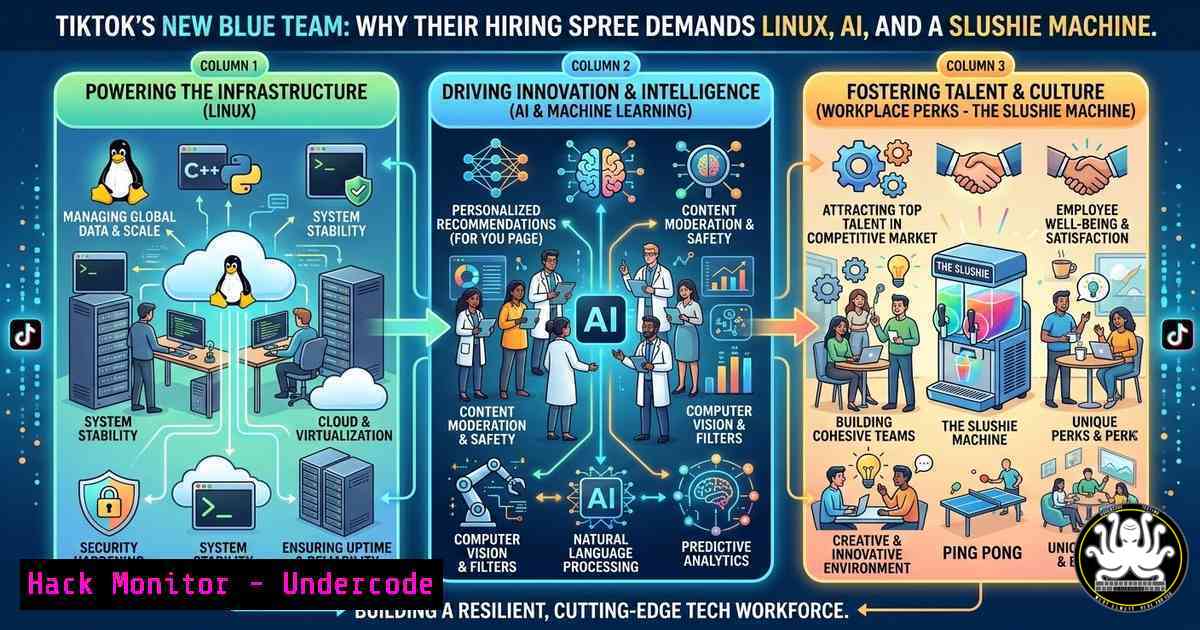
The traditional role of a Security Operations Center (SOC) analyst is undergoing a radical mutation. A recent hiring call from TikTok’s Head of Vulnerability Management reveals the industry’s shift away from siloed security roles toward hybrid engineers who can navigate the cloud, endpoint, and network layers while leveraging Artificial Intelligence (AI) to automate toil. The mandate is clear: modern defenders must possess the engineering rigor to build detection pipelines and the foresight to use AI as a force multiplier, all while maintaining a non-negotiable command of Linux.
Learning Objectives:
- Understand the convergence of Threat Detection and Response (TDR), Vulnerability Management (VM), and Cyber Intelligence.
- Master essential Linux command-line utilities for digital forensics and incident response (DFIR).
- Learn how to integrate AI workflows into security operations to augment analysis.
You Should Know:
1. The Non-Negotiable Baseline: Linux for DFIR
The job posting explicitly states that “Linux knowledge is a non-negotiable.” In modern cloud-native environments, the majority of workloads and containers run on Linux. An investigator cannot afford to be helpless when faced with a compromised server.
To perform initial triage on a potentially compromised Linux system, you must be comfortable with the following command-line toolkit:
Step 1: Capture Volatile Data (Order of Volatility)
Before pulling the plug, capture what is in memory and current process state.
 Display current running processes with full command lines and environment variables
ps auxef

List active network connections and listening ports (alternative to netstat)
ss -tulpn

Display recent login history and last logged-in users
last -F
lastlog

Check scheduled tasks (cron) for persistence
crontab -l
ls -la /etc/cron
Step 2: Log Analysis & Artifacts
The central repository for system logs is /var/log/. Knowing how to parse these quickly is vital.
 Tail the authentication log to see failed/successful logins
sudo tail -f /var/log/auth.log

Search for specific IP addresses or error codes in syslog
grep "192.168.1.100" /var/log/syslog

Check command history for specific users (persistence or recon)
cat /home/username/.bash_history
Step 3: File Integrity and Anomalies
Attackers often replace core binaries with rootkits.
 Verify package manager file integrity (Debian/Ubuntu)
dpkg --verify

Find files with the SUID bit set (potential privilege escalation)
find / -perm -4000 -type f 2>/dev/null
2. AI-Augmented Detection Engineering
The post emphasizes using AI to “work smarter, not harder.” In the context of a SOC, this means using Large Language Models (LLMs) to parse unstructured threat intelligence and convert it into detection logic.
Use Case: You receive a raw text report about a new malware campaign using a specific command-line obfuscation technique.
Instead of manually writing a Sigma rule from scratch, a Detection Engineer can use an AI prompt:
“Convert the following threat report text into a Sigma rule targeting Windows Process Creation (Event ID 4688) that looks for base64 encoded commands in the CommandLine field. Threat text: ‘The malware invokes powershell -enc SQBFAFgAIAA…’.”
The engineer then refines the AI-generated YAML, validates it in a test environment, and deploys it to the SIEM. This reduces the time from intel feed to detection from hours to minutes.
- Cloud Hardening and Container Security (TDR & VM Focus)
With the focus on “Cloud, Endpoint, Network,” a Security Engineer must ensure that cloud workloads are hardened against initial access vectors, specifically container escape or misconfiguration.
Configuration Audit (CIS Benchmark): Using `kube-bench` to check Kubernetes clusters.
 Run kube-bench on a master node to check for CIS compliance
kube-bench run --targets master
Vulnerability Scanning: Integrating scanners into the CI/CD pipeline. Using Trivy to scan a Docker image for known CVEs before it is pushed to production.
 Scan a local Docker image for high severity vulnerabilities
trivy image --severity HIGH,CRITICAL myapp:latest
- Building a Local DFIR Lab (The “Tufting” Playground)
To gain the experience required for roles like those at TikTok, you need a safe environment to simulate attacks and practice defense. This is where you can hunt for “potato chips” (bugs).
Step 1: Deploy the Target (Vulnerable VM)
Use a tool like Vagrant to spin up a deliberately vulnerable machine (e.g., Metasploitable 3).
vagrant init rapid7/metasploitable3-win2k8
vagrant up
Step 2: Deploy the Fleet Management (Osquery)
To practice “TDR” (Threat Detection and Response), deploy osquery to the endpoint to query it in real-time.
-- SQL query to find all processes listening on non-standard ports
SELECT pid, port, path FROM processes JOIN listening_ports USING (pid) WHERE port NOT IN (80,443,22,3389);
Step 3: Centralize Logs (The SIEM Lite)
Use the Elastic Stack (ELK) locally. Configure Filebeat on your victim machine to ship Windows Event Logs to your Elasticsearch instance. This mirrors the “SOC” workflow.
5. Windows Memory Forensics (Intel & TDR)
If an alert fires on an Endpoint, you may need to capture memory for deep-dive analysis. While Linux is the baseline, Windows endpoints are the primary target for attackers in corporate environments.
Tool: Volatility 3 (Works on Linux against Windows dumps)
 1. Capture memory using DumpIt.exe or WinPmem on the Windows host.
 2. Transfer the .raw file to your Linux analysis machine.
 3. Identify the profile and list processes.
python3 vol.py -f memory.dump windows.pslist

Check for network connections from the memory dump
python3 vol.py -f memory.dump windows.netscan

Dump a suspicious process for static analysis
python3 vol.py -f memory.dump windows.memmap.Memmap --pid 420 --dump
6. API Security in the Cloud (VM Focus)
Vulnerability Management isn’t just about patching servers; it’s about reviewing code and configuration. A common cloud misconfiguration is overly permissive Identity and Access Management (IAM) roles.
Scenario: An AWS S3 bucket policy allows “Authenticated Users” global write access.
Remediation Step (Infrastructure as Code): Review Terraform plans to ensure `aws_s3_bucket_policy` does not contain a Principal set to “” for untrusted actions.
 BAD PRACTICE
 principal = ""

GOOD PRACTICE (Least Privilege)
 principal = {
 type = "AWS"
 identifiers = ["arn:aws:iam::account-id:role/EC2-AppRole"]
 }
7. Integrating Threat Intelligence Feeds (Intel)
The “Intel” function mentioned in the rotation requires operationalizing threat data. Instead of manually checking IPs, automate the enrichment.
Linux Command Line Enrichment:
Using `jq` to parse JSON feeds from AlienVault OTX or MISP.
 Simulate pulling a malicious IP from a feed and checking if it appears in your firewall logs
curl -s https://otx.alienvault.com/api/v1/indicators/IPv4/185.130.5.133/general | jq '.pulse_info.count'
What Undercode Say:
- The Death of the Pure Analyst: The industry is moving away from analysts who only triage alerts. The future belongs to “SecOps Engineers” who can code, query databases, and understand operating systems at a kernel level.
- AI is a Co-Pilot, Not a Pilot: The requirement to use AI is not about replacing the engineer but augmenting them. The AI handles the syntax and the grunt work (log parsing, code generation), while the human handles the strategy, context, and validation.
- Culture Eats Strategy for Breakfast: The post highlights “cool people” and “free food.” This signals that retention in high-stress security roles relies heavily on team culture and psychological safety. The best tools are useless if the team burns out.
Prediction:
Within the next three years, the entry-level security certification (like Security+) will be supplemented by mandatory proficiency in AI prompt engineering and Infrastructure as Code (IaC). Job descriptions will no longer ask for “SOC Analyst” but for “AI-Augmented Detection Engineers.” The “potato chip” hunting will become automated, forcing human defenders to focus on novel attack chains and complex cloud-native intrusions, while AI handles the commodity malware and phishing campaigns.
▶️ Related Video (78% Match):
🎯Let’s Practice For Free:
IT/Security Reporter URL:
Reported By: Angelystor Dfir – Hackers Feeds
Extra Hub: Undercode MoN
Basic Verification: Pass ✅


