Listen to this Post
Introduction:
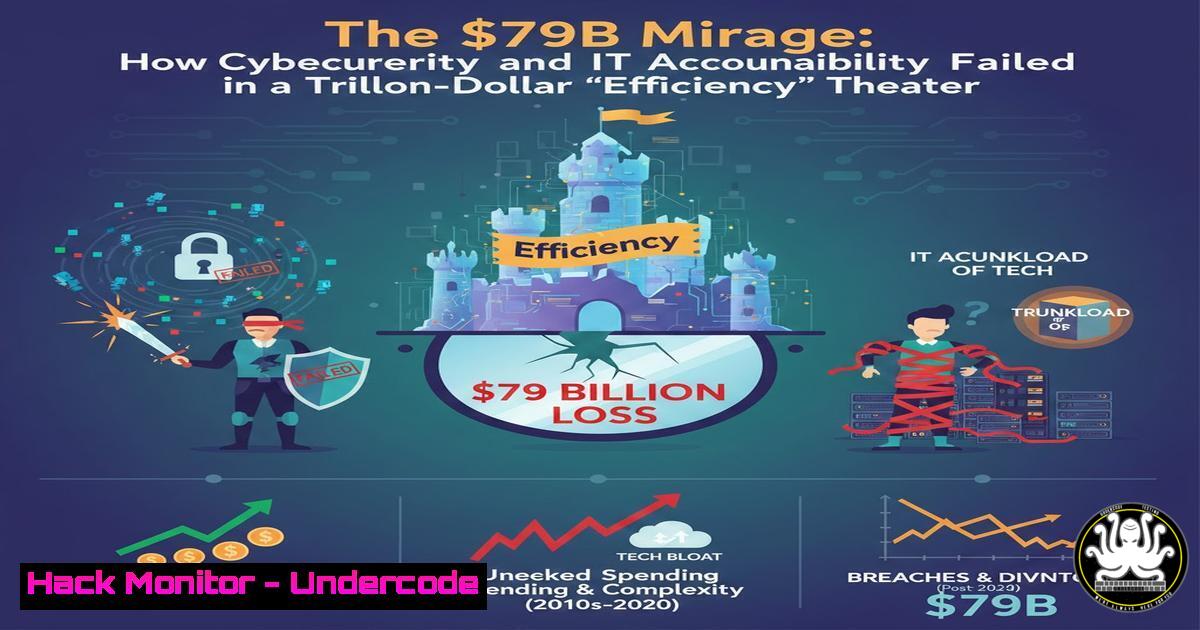
The spectacular failure of the Department of Government Efficiency (D🅾️GE) to deliver promised savings—while federal spending ballooned—isn’t just a fiscal scandal; it’s a profound case study in failed IT governance, cybersecurity oversight, and accountability theater. This analysis deconstructs the technical and procedural failures that allowed “fake/Monopoly money” savings claims to flourish, focusing on the cited $7.9B defense contract mirage, and provides a technical roadmap for verifying such claims and hardening systems against similar obfuscation.
Learning Objectives:
- Decode the technical mechanisms behind “accounting mirages” in large-scale government IT and defense contracts.
- Implement audit and verification protocols for IT spending and claimed efficiencies using open-source intelligence (OSINT) and log analysis.
- Understand the cybersecurity risks created by opaque budget processes and phantom organizational entities like “Tech Force.”
You Should Know:
- Dissecting the IT Contract “Savings” Mirage: Forensic Accounting Meets Log Analysis
The post highlights a claim of “$7.9B in fake/Monopoly money” savings from terminating two massive Defense Department contracts for IT and aircraft maintenance, while the contracts reportedly continued. This is a classic data integrity and transparency failure.
Step‑by‑step guide explaining what this does and how to use it:
This process involves correlating financial data with operational telemetry to validate contract status.
1. Identify Contract Entities: Use public procurement databases (e.g., USASpending.gov, SAM.gov) to find the specific contract numbers (e.g., FA8806-20-F-0001), award amounts, and performing entities.
Command (Linux): Use `curl` and `jq` to query APIs: `curl -s “https://api.usaspending.gov/api/v2/search/spending_by_award/” -H “Content-Type: application/json” –data ‘{“filters”:{“keywords”:[“IT maintenance”,”Defense”]}}’ | jq ‘.results[] | {award_id, recipient_name, total_obligation}’`
2. Correlate with Operational Logs: Claimed “termination” should result in a cessation of related activity logs (VPN access, service accounts, maintenance tickets, cloud resource provisioning). For a hypothetical cloud IT contract, query AWS CloudTrail or Azure Activity Logs for principal activity.
Command (AWS CLI): `aws cloudtrail lookup-events –lookup-attributes AttributeKey=ResourceName,AttributeValue=
3. Analyze Network Flow Data: Continued data flows between Defense networks and contractor IP ranges post-“termination” would disprove the claim. Use tools like `zeek` (formerly Bro) or firewall log analysis.
Command (Bash with Zeek logs): `cat conn.log | zeek-cut id.orig_h id.resp_h | grep
2. The Phantom “Tech Force”: A Cloud Security and Identity Management Nightmare
The post mentions a newly created “Tech Force” with “$200M in salaries alone without a penny more in costs—which is impossible.” This signals a severe lack of IT financial operations (FinOps) and identity governance.
Step‑by‑step guide explaining what this does and how to use it:
Unaccounted IT costs stem from uncontrolled cloud spend and privileged access.
1. Cloud Resource Discovery: Use CSP-native tools or open-source tools like `Scout Suite` or `Steampipe` to inventory all resources not linked to a formal cost center.
Command (Steampipe + AWS): `steampipe query “select arn, resource_type, region, account_id from aws_ec2_instance where tags->>’CostCenter’ is null union all select arn, resource_type, region, account_id from aws_s3_bucket where tags->>’CostCenter’ is null;”`
2. Privileged Access Audit: Verify if new, unbudgeted personnel have been provisioned access. Audit Active Directory (Windows) or IAM (Cloud).
Command (PowerShell – AD): `Get-ADUser -Filter {Created -ge ‘2025-01-01′} -Properties | Select-Object Name, Created, Department, Enabled`
Command (AWS CLI): `aws iam list-users –query “Users[?CreateDate>=’2025-01-01’].{UserName:UserName, CreateDate:CreateDate, Arn:Arn}” –output table`
3. Container & Serverless Oversight: Phantom costs often hide in ephemeral resources. Audit Kubernetes namespaces and AWS Lambda functions.
Command (kubectl): `kubectl get deployments –all-namespaces -o json | jq ‘.items[] | {namespace: .metadata.namespace, name: .metadata.name, replicas: .spec.replicas}’`
3. The D🅾️GE Legacy: Hardening Systems Against “Efficiency Theater” Attacks
The disassembly of D🅾️GE after causing “significant disruptions” illustrates an insider threat and change management failure.
Step‑by‑step guide explaining what this does and how to use it:
Implement technical controls to ensure organizational changes don’t compromise security or create financial opacity.
1. Enforce Infrastructure as Code (IaC) with Policy as Code: All resource provisioning must be via code (Terraform, CloudFormation) checked against security/cost policies using tools like Checkov, Terrascan, or AWS Config.
Tutorial: A `checkov` scan for cost-related tags: checkov -d /path/to/terraform --check CKV_AWS_XXX "Ensure all resources have cost allocation tags". This prevents untracked resource sprawl.
2. Implement Immutable Logging for Financial Decisions: Use a centralized SIEM (e.g., Elastic Stack, Splunk) to ingest logs from procurement software, IT service management (ITSM) tools, and cloud management consoles. Ensure logs are write-once-read-many (WORM).
Configuration (Elasticsearch Index Lifecycle Policy): Set `”read_only_allow_delete”: “true”` on indices containing financial audit data after a short period to prevent tampering.
3. API Security for Financial Systems: The “accounting mirage” likely involved data manipulation across systems. Secure APIs between ERP, contracting, and operational systems using strict authentication (OAuth 2.0, mTLS) and audit all transactions.
Command (to test API endpoint security with curl): `curl -H “Authorization: Bearer
- From OSINT to Action: Validating Public Spending Claims Technically
The post references New York Times and CRFB analyses. Security professionals can independently verify such claims.
Step‑by‑step guide explaining what this does and how to use it:
1. Data Scraping for Trend Analysis: Use Python (BeautifulSoup, requests) to scrape published budget documents from `.gov` sites and track changes over time.
Sample Python Code Snippet:
import requests
from bs4 import BeautifulSoup
url = "https://www.crfb.org/press-releases/treasury-confirms-spending-142-billion-2025"
response = requests.get(url)
soup = BeautifulSoup(response.text, 'html.parser')
 Extract key figures using specific selectors
figures = soup.select('.press-release p')
for fig in figures:
if 'billion' in fig.text:
print(fig.text.strip())
2. Blockchain for Public Audit Trails (Concept): While not yet standard, proposing a transparent, append-only ledger (e.g., a permissioned blockchain) for high-value contract milestones and payments would eliminate “mirage” possibilities. Each “savings” claim would require a verifiable, signed transaction matching operational data.
What Undercode Say:
- Key Takeaway 1: The inability to realize genuine IT savings and the creation of phantom savings claims is ultimately a cybersecurity failure—a failure of data integrity, system transparency, and audit controls. The attack surface here is the entire financial governance model.
- Key Takeaway 2: New, poorly defined entities like “Tech Force” represent massive shadow IT and insider threat risks. Without immediate identity, access, and cloud governance, they become privileged, unmonitored attack vectors within the most sensitive infrastructures.
The D🅾️GE episode is not merely bureaucratic failure; it is a systemic compromise. It reveals a environment where data can be manipulated to create a desired narrative, precisely like an attacker covering their tracks. The “savings mirage” is isomorphic to a sophisticated attacker creating false log entries to hide exfiltration. The technical response must be identical: immutable logging, stringent change control, and robust correlation of financial data with operational telemetry across the kill chain of budget execution.
Prediction:
This failure of technical accountability will catalyze two opposing forces. First, it will incentivize more sophisticated obfuscation techniques, potentially leveraging AI to generate convincing but fraudulent performance and savings metrics. Second, and crucially, it will drive demand for independent, automated “Proof of Spend” verification services. We will see the rise of regulatory-grade SaaS platforms that use AI not for generation, but for forensic correlation—continuously auditing cloud APIs, contract databases, network flows, and system logs to provide immutable, real-time verification of whether claimed efficiencies have a corresponding technical reality. The organizations that implement these verification layers internally will gain a decisive trust advantage, while those perpetuating “efficiency theater” will face escalating cyber risks as their opaque systems become magnets for both external exploitation and internal fraud.
▶️ Related Video (80% Match):
🎯Let’s Practice For Free:
IT/Security Reporter URL:
Reported By: Juliesaslowschroeder Taxes – Hackers Feeds
Extra Hub: Undercode MoN
Basic Verification: Pass ✅


