Listen to this Post
Introduction:
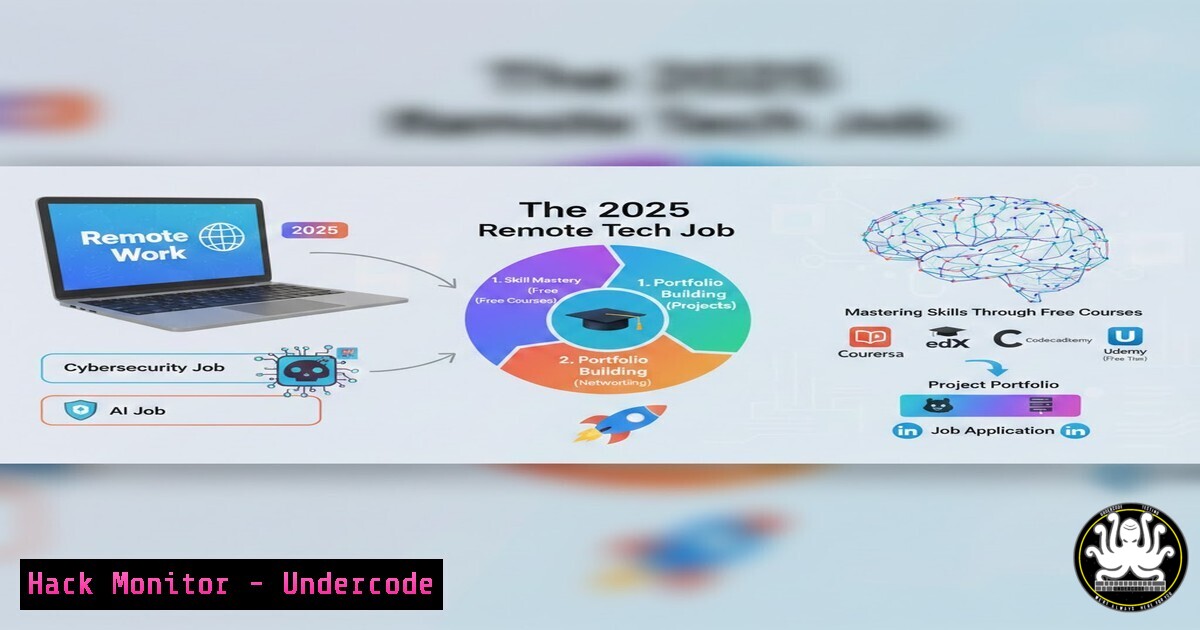
The landscape of employment is undergoing a seismic shift, with remote work becoming the standard, particularly in high-demand fields like cybersecurity, AI, and IT. This new paradigm requires a dual-pronged strategy: knowing where to find the most prestigious global opportunities and systematically acquiring the cutting-edge skills that make you a viable candidate. For professionals aiming to secure their future, mastering platforms and continuous learning is no longer optional—it’s a critical security protocol for your career.
Learning Objectives:
- Identify and leverage the top remote job platforms specializing in technical and cybersecurity roles.
- Access and navigate a curated list of free, high-value courses for 2025 to build in-demand skills.
- Develop a proactive job-hunting methodology using technical tools and automation to monitor opportunities.
You Should Know:
- Optimizing Your Remote Job Hunt with Technical Aggregation
The modern job search is a data-gathering operation. Platforms like Jooble and JustRemote act as aggregators, scraping thousands of sources. To gain an edge, you can mimic this proactively. Using command-line tools, you can monitor RSS feeds or API endpoints of these job boards for new postings containing keywords like “SOC Analyst,” “Cloud Security,” or “ML Engineer.”
Step-by-Step Guide:
Concept: Use `curl` and `grep` to create a simple job alert script that checks a site’s feed for keywords.
Example Command (Linux/macOS):
 Fetch job feed and filter for cybersecurity roles
curl -s "https://justremote.co/api/feed" | grep -i -E "security|cyber|SOC|penetration"
Automation: Place this script in a cron job to run daily and email you results. For Windows, you can achieve similar automation using PowerShell’s `Invoke-WebRequest` cmdlet and Task Scheduler.
Advanced Tactics: Use browser automation tools like Selenium or Playwright to log into and scrape job boards that require authentication, though always respect `robots.txt` and terms of service.
2. Building Foundational IT & Support Skills
Before targeting advanced remote roles, solidifying core IT knowledge is crucial. The free Google IT Support Professional Certificate is a prime starting point. This translates directly to practical remote troubleshooting skills, which often require managing systems via secure shells.
Step-by-Step Guide:
Concept: Learn essential command-line interface (CLI) skills for remote system administration, a cornerstone of IT support and cybersecurity.
Key Commands to Master:
Linux/macOS (Bash):
 Check system connectivity and network config
ping -c 4 google.com
ip addr show
 Manage processes and services
systemctl status ssh
top
 Analyze log files for errors (critical for security)
sudo tail -f /var/log/auth.log | grep "Failed"
Windows (PowerShell):
 Test network connectivity
Test-NetConnection google.com -Port 443
 Get network adapter configuration
Get-NetIPConfiguration
 Check and manage services
Get-Service | Where-Object {$_.Status -eq 'Stopped'}
Get-EventLog -LogName Security -Newest 20
- Mastering the Cloud & DevOps Pipeline for Remote Work
Remote tech jobs are increasingly cloud-native. The free Google Cloud and Cloud Computing courses provide the theoretical foundation. To apply this, you must practice provisioning and securing cloud infrastructure programmatically—the core of DevOps.
Step-by-Step Guide:
Concept: Use Infrastructure as Code (IaC) to deploy a secure, minimal virtual machine in the cloud.
Tutorial Outline (using Terraform & Google Cloud):
- Install Terraform and configure GCP CLI authentication (
gcloud auth application-default login). - Create a `main.tf` file to define a firewall rule and a compute instance.
- Critical Security Configuration: The firewall rule should explicitly deny all inbound traffic except SSH (port 22) from your IP and HTTP/HTTPS for web apps.
4. Apply the configuration:
terraform init
terraform plan  Review what will be created
terraform apply  Type 'yes' to confirm
5. This process demonstrates the reproducible, auditable infrastructure management that is gold standard in remote tech teams.
- Penetrating the AI & Machine Learning Job Market
The Generative AI and Machine Learning courses offer the knowledge base. To stand out, you must demonstrate practical application. Build a portfolio project, such as a threat detection model using a public dataset like the NSL-KDD.
Step-by-Step Guide:
Concept: Train a simple binary classifier to distinguish between normal and potentially malicious network traffic.
Sample Python Code Snippet (using scikit-learn):
import pandas as pd
from sklearn.model_selection import train_test_split
from sklearn.ensemble import RandomForestClassifier
from sklearn.metrics import classification_report

Load preprocessed network data
data = pd.read_csv('network_data.csv')
X = data.drop('label', axis=1)
y = data['label']  0 = normal, 1 = anomaly

X_train, X_test, y_train, y_test = train_test_split(X, y, test_size=0.3)
model = RandomForestClassifier(n_estimators=100)
model.fit(X_train, y_train)

predictions = model.predict(X_test)
print(classification_report(y_test, predictions))
Showcase: Deploy this model with a simple Flask API and host the code on GitHub. This tangible project becomes a key talking point in interviews for AI security roles.
- The Cybersecurity Practitioner’s Path: From Theory to Exploit/Mitigation
Free cybersecurity courses provide theory. Real skill is built in labs. Set up a home lab using VirtualBox to practice both offensive and defensive techniques.
Step-by-Step Guide:
Concept: Create a vulnerable virtual machine (like Metasploitable 2) and a attacker machine (Kali Linux) in an isolated virtual network.
Hands-On Exercise:
- Reconnaissance: Use `nmap` from Kali to scan the Metasploitable VM.
nmap -sV -O <Metasploitable_IP>
- Vulnerability Identification: Identify an open port running a service with a known exploit (e.g., vsftpd 2.3.4).
- Exploitation (Ethical Practice Only): Use the Metasploit Framework to launch a targeted exploit.
msfconsole
use exploit/unix/ftp/vsftpd_234_backdoor
set RHOSTS <target_ip>
exploit
- Mitigation: Research and document the patch for this vulnerability (e.g., upgrading vsftpd). This end-to-end exercise demonstrates practical threat intelligence and response skills.
-
Automating Your Application Process with API Security in Mind
Platforms like Wellfound and Dynamite Jobs often have public APIs. Automating your application tracking requires understanding API security—both using keys securely and recognizing insecure endpoints.
Step-by-Step Guide:
Concept: Write a Python script to query a job API, but do so securely by storing credentials in environment variables, not in the code.
Sample Secure Script:
import os
import requests
from dotenv import load_dotenv  pip install python-dotenv

load_dotenv()  Loads API_KEY from .env file
API_KEY = os.getenv('JOBS_API_KEY')
HEADERS = {'Authorization': f'Bearer {API_KEY}'}

response = requests.get('https://api.dynamitejobs.com/v1/jobs', headers=HEADERS)
jobs = response.json()
 Filter and process jobs...
Security Check: Always verify the API uses HTTPS (encryption in transit). Never commit your `.env` file to version control. Add it to your .gitignore.
What Undercode Say:
- The Job Market is a Securable System: Treating your job search as a target-rich environment allows you to apply cybersecurity principles—reconnaissance (research), automation (scripting), and continuous monitoring (alerts)—to gain a significant advantage over passive applicants.
- Skill Acquisition is Vulnerability Patching: Each knowledge gap in your resume is an exploitable vulnerability in your career defense. The listed free courses are not just learning; they are critical patches for CVEs (Common Career Vulnerabilities and Exposures) that hiring managers will inevitably scan for.
The convergence of remote work platforms and accessible, high-quality technical training has democratized entry into top-tier tech careers. However, this also raises the competition level. The professionals who will succeed are those who merge the strategic use of aggregation platforms with hands-on, practical skill demonstration. The future of remote tech work belongs to the hybrid tactician: part platform-savvy job hunter, part relentless hands-on learner, capable of automating their way to opportunity while proving their worth through demonstrable technical projects. The tools and knowledge are now publicly available; the differentiator is the proactive, security-minded methodology applied to one’s own career development.
Prediction:
The proliferation of remote work and free upskilling will lead to a more geographically dispersed but also more fiercely competitive talent pool by 2026. Companies will increasingly rely on automated, project-based assessments (like coding challenges or threat-hunting scenarios hosted in ephemeral cloud environments) to filter candidates. This will render traditional resume screening even less relevant. Consequently, job seekers must pivot from listing credentials to developing a “live portfolio” – a constantly updated GitHub, a technical blog with walkthroughs, or contributed CVEs/vulnerability disclosures. The ability to pass a rigorous, automated technical gauntlet will become the primary gatekeeper for high-paying remote roles in cybersecurity and AI.
▶️ Related Video (70% Match):
🎯Let’s Practice For Free:
IT/Security Reporter URL:
Reported By: Diwakar Panday – Hackers Feeds
Extra Hub: Undercode MoN
Basic Verification: Pass ✅


