Listen to this Post
Introduction:
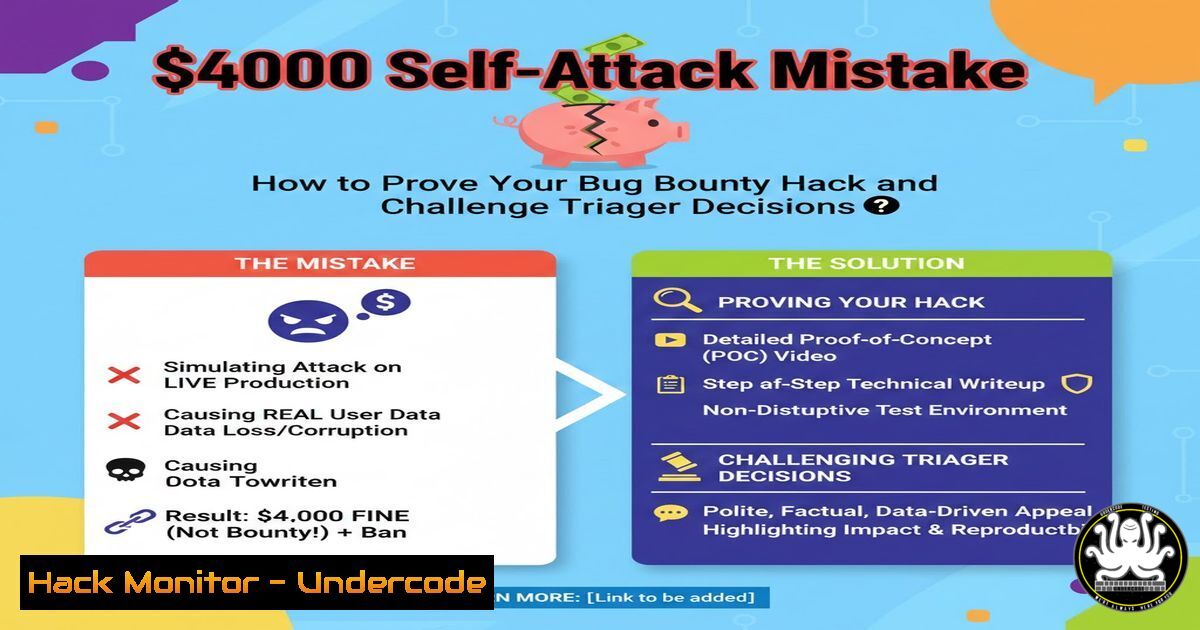
In the high-stakes arena of bug bounty hunting, the line between a critical vulnerability report and a dismissed “informative” finding can hinge on triager interpretation. A recent case saw a researcher nearly forfeit a $4,000 bounty after their valid logic flaw was incorrectly classified as a self-attack. This incident underscores a critical, often overlooked skill: the hunter’s ability to forensically prove their case and professionally navigate dispute resolution. Success requires more than finding a bug; it demands the meticulous documentation and communication skills to defend your discovery.
Learning Objectives:
- Learn how to systematically gather and present irrefutable technical evidence to distinguish a real attack from a self-attack.
- Understand the professional protocol for challenging a triager’s decision through mediation and escalation.
- Master key command-line and log analysis techniques to validate exploit chains and prove impact.
You Should Know:
- Gathering Forensic Evidence: Logs Are Your Best Witness
When a triager claims “self-attack,” they often refer to IP address matching—your test traffic originating from your own infrastructure. To counter this, you must prove the server’s application logic was flawed, not just that it received a request. This requires evidence beyond a simple HTTP request/response.
Step‑by‑step guide:
Step 1: Correlate Multi-Source Logs. Don’t rely on a single Burp Suite history. Capture synchronized logs from different layers.
Client-Side: Use browser developer tools (Network tab) to export HAR (HTTP Archive) files.
Proxy/Tool: Ensure Burp/ZAP is logging full requests/responses with timestamps.
Server-Side (If Possible): If your exploit triggers a visible side-effect (email, user creation, file write), immediately capture that output. For instance, if you created a new user attacker, query the application’s user listing to show its existence post-exploit.
Step 2: Prove State Change. The core of defeating a “self-attack” claim is demonstrating a persistent, unintended state change on the target system. After your exploit, use the application normally to show the impact.
Example: For an IDOR leading to data leak, after the request, navigate to the legitimate page where that data should now appear due to the flaw. Screenshot both.
Step 3: Use Timestamps. Note the exact time of your test (UTC). In your report, present a timeline: “At 14:30 UTC, sent exploit request (Request 1). At 14:31 UTC, accessed endpoint `/profile` as a different user to show their data now includes the leaked info from Request 1 (Request 2).”
2. Technical Documentation: Building Your Mathematical Proof
Your report must walk the triager through the logic flaw like a mathematical proof, leaving no room for ambiguity about the root cause.
Step‑by‑step guide:
Step 1: Diagram the Flow. Before writing, sketch the normal application flow vs. the exploit flow. Use simple ASCII diagrams or a quick draw.io image.
Step 2: Isolate the Flawed Parameter/Logic. Explicitly state the vulnerable component. Example: “The application uses the user-controlled parameter `document_id` to query the database but does not validate ownership by checking the session `user_id` against the `document_owner_id` in the resulting row.”
Step 3: Show the Broken Access Control (BAC) Equation. Frame it logically.
Normal Check: `IF session_user_id == database_record_owner_id THEN grant_access`
Actual Check: `IF document_id EXISTS THEN grant_access`
Your provided `document_id` belongs to another user, proving the check is missing.
3. Command-Line Verification for Complex Chains
For vulnerabilities involving server-side processing (SSRF, blind XXE, command injection), use external systems to prove the target server initiated the action, not your browser.
Step‑by‑step guide (Example: Blind SSRF):
Step 1: Set up a public listener to catch outbound connections from the target server.
Using `nc` (Netcat) on a VPS: `sudo nc -lnvp 80` or use a tool like interact.sh.
Step 2: Execute your payload (e.g., `http://your-vps-ip` in a vulnerable parameter).
Step 3: Capture the connection. The netcat output will show the source IP. If it’s the target application server’s IP, not your own, you have concrete proof it’s not a self-attack. Include this raw log in your report.
Windows alternative: Use a cloud-based logging endpoint or a service like Burp Collaborator, and include the unique interaction ID received.
4. Navigating Mediation and Professional Communication
When you receive a rejection you believe is incorrect, emotion must be set aside for structured, fact-based communication.
Step‑by‑step guide:
Step 1: Acknowledge, Don’t Accuse. Start your mediation request respectfully. “I appreciate the triage team’s review. I have examined the ‘self-attack’ conclusion and believe I can provide additional evidence that demonstrates a persistent logic flaw on the target system.”
Step 2: Present New Evidence Clearly. Consolidate your forensic proof from Sections 1 & 2 into a simple, addendum-style format. “To clarify, the issue is not that the server received my request, but that its business logic failed. Here is a timeline with evidence of state change…”
Step 3: Request Specific Action. Be clear. “I respectfully request the report be re-evaluated by a senior triager or the program owner, with the provided evidence in mind.”
5. Advanced Evidence: Leveraging the Application’s Own APIs
Modern applications use internal APIs. You can use these to demonstrate the flaw programmatically.
Step‑by‑step guide (Example with `curl`):
Step 1: Find the API endpoint and normal request via proxy tools.
Step 2: Craft two distinct `curl` commands showing the flaw.
Command A (Malicious Request): curl -H "Authorization: Bearer <your_valid_token>" https://target.com/api/v1/documents/12345` where `12345` belongs to another user. if proper authorization was in place. The successful, identical response from Command B proves the missing check.
Command B (Proof of Ownership): `curl -H "Authorization: Bearer
Step 3: Explain that Command A should have returned a `403 Forbidden
What Undercode Say:
- Triagers Are a Filter, Not a Final Judge. They manage immense volume and fatigue. A hunter’s role is to make the valid signal so clear and undeniable that it passes effortlessly through that filter. Your technical proof must do the heavy lifting.
- Persistence is a Technical Skill. Professional persistence isn’t arguing; it’s the methodical escalation of evidence. It involves transforming a narrative report into a forensic dossier that logically compels a different conclusion.
Prediction:
The future of bug bounty triage will increasingly integrate automated initial analysis and AI-assisted filtering to handle scale. However, this will make the human skills highlighted in this case more valuable, not less. Hunters who can curate machine-readable proof, interact with automated systems via structured data, and escalate complex logic flaws that evade automated checks will dominate the highest reward tiers. We will see a growing niche for “bug bounty forensic specialists” who combine deep technical exploitation skills with the legal-esque rigor of evidence presentation and case building, turning mediation from a last resort into a standard, high-success-rate phase of the responsible disclosure process.
▶️ Related Video (78% Match):
🎯Let’s Practice For Free:
IT/Security Reporter URL:
Reported By: Shay Hagai – Hackers Feeds
Extra Hub: Undercode MoN
Basic Verification: Pass ✅


