Listen to this Post
Introduction:
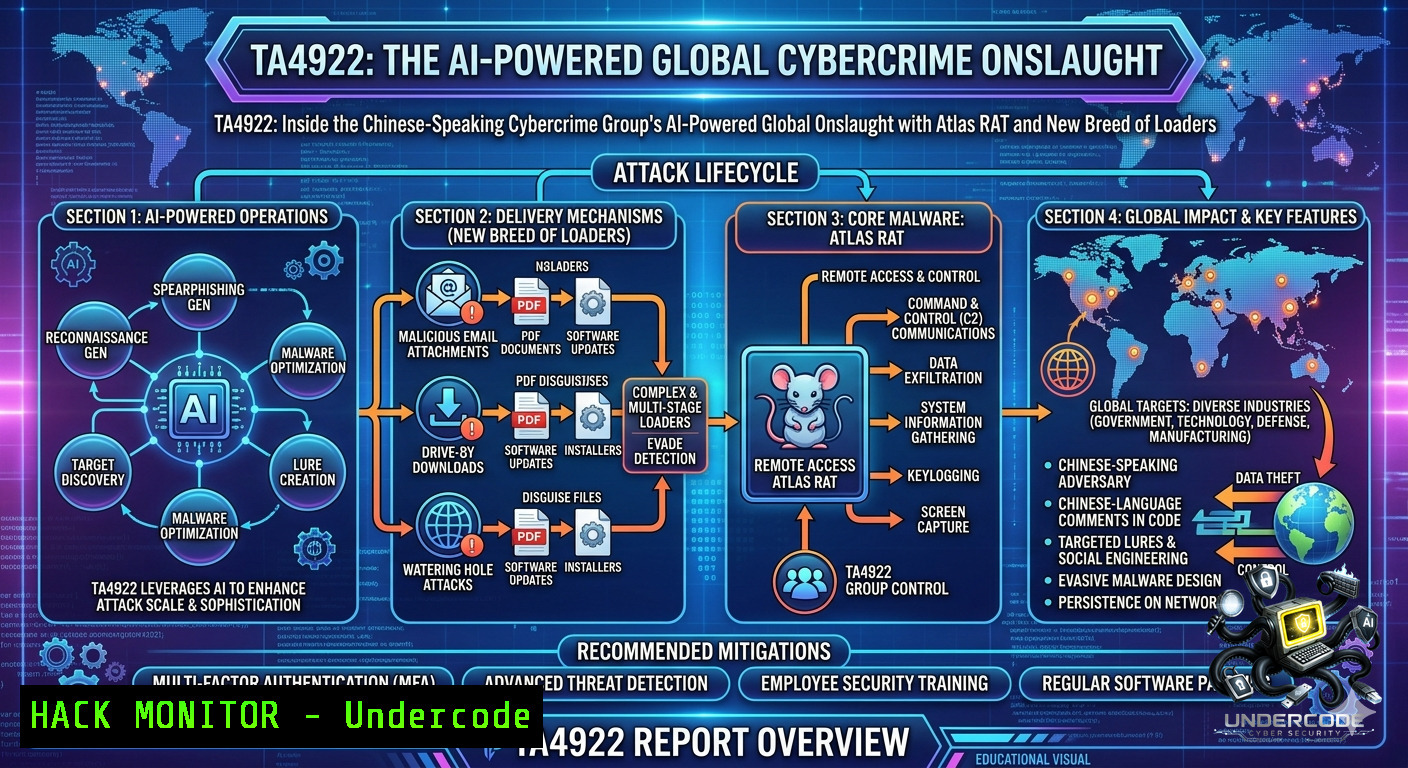
The Chinese-speaking cybercrime ecosystem is undergoing a rapid, aggressive expansion. At the forefront is a newly designated threat actor, TA4922, which has drastically escalated its global operations by deploying a sophisticated arsenal that includes the newly identified Atlas RAT, along with RomulusLoader and SilentRunLoader. This financially motivated group is shifting away from simple credential phishing and now employs advanced social engineering, often accelerated by AI-assisted development, to target organizations in East Asia, Europe, and beyond.
Learning Objectives:
– Understand the operational tactics and expanding global footprint of the TA4922 threat actor.
– Analyze the technical capabilities and infection chains of Atlas RAT, RomulusLoader, and SilentRunLoader.
– Learn proactive detection, analysis, and mitigation strategies using both proprietary tools and open-source utilities.
You Should Know:
1. Decoding TA4922’s Global Phishing Playbook
The core of TA4922’s success lies in its highly tailored social engineering campaigns. The group uses localized lures, often themed around HR, payroll, tax, and invoices, to deliver its payloads. Their operational tempo is unprecedented; Proofpoint notes that TA4922 currently conducts more unique campaigns than any other tracked cybercrime actor. Their methods are evolving rapidly: they now attempt to move conversations to out-of-band channels like WhatsApp and Microsoft Teams to bypass enterprise security controls.
Step-by-step guide: Analyzing a Phishing Email and Malicious Attachment
When you receive a suspected TA4922 phishing email, follow this analytical workflow:
Linux (Using `eml2txt` and `vTactics`):
1. Convert the EML file to readable text:
eml2txt suspicious_email.eml > email_analysis.txt
cat email_analysis.txt | grep -E "From:|To:|Subject:|Date:|X-Originating-IP"
2. Extract and analyze all URLs and attachments:
 Extract URLs
grep -oP 'https?://[^\s<>"\']+' suspicious_email.eml > extracted_urls.txt

 Extract base64 encoded attachments
grep -oP 'Content-Transfer-Encoding: base64.?\n\n\K[^-]+' suspicious_email.eml > base64_attachment.txt

 Decode the attachment
cat base64_attachment.txt | base64 -d > extracted_payload.zip
3. Check file hashes against VirusTotal:
sha256sum extracted_payload.zip
curl --request GET --url "https://www.virustotal.com/api/v3/files/[bash]" --header "x-apikey: YOUR_API_KEY"
Windows (Using PowerShell and Sysinternals Sigcheck):
1. Examine the email header in Outlook or via PowerShell:
Get-Content "C:\path\to\suspicious_email.msg" | Select-String -Pattern "Received:", "From:", "Return-Path:"
2. Extract and scan URLs:
Select-String -Path "C:\path\to\suspicious_email.eml" -Pattern 'https?://[^\s<>"\']+' -AllMatches | ForEach-Object { $_.Matches.Value } | Out-File -FilePath .\urls.txt
3. Analyze a downloaded attachment with Sigcheck:
.\sigcheck64.exe -h -a extracted_payload.exe
2. Atlas RAT: A Fully Featured Modular Backdoor
Atlas RAT is the crown jewel of TA4922’s malware arsenal. It is a fully featured, modular backdoor delivered via DLL sideloading within seemingly innocuous ZIP attachments. Once executed, it performs extensive anti-sandbox checks and communicates with its C2 server using ChaCha20 encryption. Its capabilities include keylogging, screen capture, webcam recording, file management, and remote command execution.
Step-by-step guide: Sandbox Analysis and YARA Rule Creation for Atlas RAT
To detect Atlas RAT in your environment, you can emulate its behavior in a sandbox and then create a YARA rule.
Linux (Using Cuckoo Sandbox and YARA):
1. Submit the sample to a Cuckoo Sandbox instance:
cuckoo submit --machine win7_analysis --timeout 300 --package exe extracted_payload.exe
2. Observe the behavior in the generated JSON report. Look for indicators of Atlas RAT such as:
Created mutexes.
Network connections to unusual ports (e.g., port 886).
Processes like `cmd.exe` being spawned for reconnaissance.
3. Create a YARA rule to detect Atlas RAT artifacts:
rule AtlasRAT_ChaCha_Indicator {
meta:
description = "Detects Atlas RAT based on ChaCha encryption constants and strings"
author = "Security Analyst"
date = "2026-06-05"
strings:
$chacha_const = { 62 61 64 61 65 68 67 66 } // 'badaehgf' expansion
$c2_config = "206.238.115.58" wide ascii
$c2_port = "886" wide ascii
$antidebug = "CExecSvc" wide ascii
condition:
any of them
}
4. Scan a file or directory with the rule:
yara64.exe -r atlas_rat_detector.yar -s C:\Suspicious_Files\
Windows (Using ANY.RUN or CAPE sandbox):
1. Upload the sample to ANY.RUN or a local CAPE sandbox instance.
2. Monitor the process tree. Look for DLL sideloading behavior, where a legitimate executable loads a malicious DLL.
3. Capture network traffic using Wireshark to identify the encrypted C2 communication.
4. Use Regshot to compare the registry before and after execution to identify persistence mechanisms.
3. RomulusLoader and SilentRunLoader: Stealthy Initial Access and Evasion
RomulusLoader is a C-based loader that uses process hollowing and shellcode injection to deploy legitimate remote management tools like AnyDesk and SyncFuture, allowing attackers to blend in. SilentRunLoader is a Python-based stealer (vibe-coded with artifacts like `”your_secret_key_here”`) that exfiltrates credentials and cookies from Chrome.
Step-by-step guide: Memory Forensics for Loader Injection
These loaders are best detected through memory analysis.
Linux (Using Volatility 3 for Windows memory dumps):
1. Acquire a memory dump from a suspected Windows host using DumpIt or FTK Imager.
2. List running processes to find anomalies:
vol -f memory.dmp windows.psscan > processes.txt
3. Scan for potential process hollowing by checking for mismatched process paths:
vol -f memory.dmp windows.cmdline.CmdLine
Look for a legitimate process like `explorer.exe` or `svchost.exe` originating from an unusual path or with no command-line arguments.
4. Dump a suspicious process for offline analysis:
vol -f memory.dmp windows.dumpfiles --pid [bash]
5. Examine network connections from the memory dump to find C2 beacons:
vol -f memory.dmp windows.netscan.NetScan
4. Hardening Against DLL Sideloading Attacks
TA4922 heavily relies on DLL sideloading to execute its malware. Hardening your systems against this technique is crucial for defense.
Windows (Using WDAC and ASR Rules):
1. Implement Windows Defender Application Control (WDAC) to allow only trusted executables and DLLs to run.
 Create a base policy from a clean reference system
New-CIPolicy -FilePath C:\WDAC_Policies\BasePolicy.xml -UserPEs -Level Publisher -Fallback FilePath

 Convert XML to binary format for deployment
ConvertFrom-CIPolicy -XmlFilePath C:\WDAC_Policies\BasePolicy.xml -BinaryFilePath C:\WDAC_Policies\BasePolicy.bin
2. Enable Attack Surface Reduction (ASR) rules to block Office applications from creating child processes.
 Rule: Block Office applications from creating child processes (Rule ID D4F940AB-401B-4EFC-AADC-AD5F3C50688A)
Add-MpPreference -AttackSurfaceReductionRules_Ids D4F940AB-401B-4EFC-AADC-AD5F3C50688A -AttackSurfaceReductionRules_Actions Enabled
3. Monitor for sideloading events via Sysmon (Event ID 7). Configure Sysmon to log loaded DLLs.
Sysmon64.exe -accepteula -i
5. Network Defense and C2 Threat Hunting
Detecting the C2 traffic of Atlas RAT and its companion loaders is a key pillar of a proactive defense strategy. Their use of cloud hosting and encryption makes this more challenging, but not impossible.
Linux (Using Zeek and Suricata):
1. Deploy Zeek (formerly Bro) to monitor network metadata. Create a Zeek script to log all connections to known TA4922 infrastructure, such as the C2 server at `206.238.115.58`. Use Suricata to inspect encrypted traffic for JA3 fingerprints.
2. Create a Suricata rule for Atlas RAT traffic patterns:
alert tcp $HOME_NET any -> $EXTERNAL_NET 886 (msg:"TA4922 Atlas RAT C2 Beacon"; flow:to_server,established; dsize:32..1000; threshold: type both, track by_src, count 5, seconds 60; sid:1000001; rev:1;)
Windows (Using PowerShell and Sysmon for Netconn):
1. Use Sysmon to log all network connections (Event ID 3) for specific processes.
2. Query Windows Event Logs for suspicious outbound connections:
Get-WinEvent -FilterHashtable @{LogName='Microsoft-Windows-Sysmon/Operational'; ID=3} | Where-Object {$_.Message -like "chrome.exe" -and $_.Message -like "886"}
3. Monitor for DNS requests to newly registered domains using tools like `dnstrace` to track TA4922’s infrastructure.
What Undercode Say:
– The AI-Coding Paradox: The use of LLMs to rapidly generate malware is a double-edged sword. While it accelerates development for attackers, the resulting code artifacts (like placeholder keys or predictable structures) also create unique, persistent signatures that defenders can build detections around.
– The Blending-In Technique: TA4922’s use of legitimate RMM tools like AnyDesk represents a mature, “living-off-the-land” (LotL) approach. This bypasses traditional application allowlisting and makes it extremely difficult for incident responders to differentiate between malicious and administrative activity without deep behavioral analytics.
Prediction:
– -1 Globalization of Chinese-Speaking Crime Groups: The rapid expansion of TA4922 from East Asia to Europe and Africa signals a major shift. This will likely spur the proliferation of similar financially motivated groups, leading to a spike in credential theft, ransomware, and espionage-for-hire across the globe.
– -1 Normalization of AI-Driven Malware Development: The use of AI for ‘vibe-coding’ malware will become standard practice for criminal groups. This will lead to a new class of “fast-flavor” malware variants that are harder for traditional signature-based antivirus solutions to keep pace with, necessitating a move toward behavior-based detection.
– +1 Community-Driven Counter-Intelligence: The unusual artifacts and patterns in AI-generated malware will lead to the rapid creation of robust community YARA rules and detection heuristics, enabling smaller security teams to defend against these threats more effectively than ever before.
▶️ Related Video (74% Match):
🎯Let’s Practice For Free:
🎓 Live Courses & Certifications:
[Join Undercode Academy for Verified Certifications](https://undercode.co.uk/certifications/)
🚀 Request a Custom Project:
Secure, high-velocity infrastructure and disruptive technological engineering. Contact our engineering team for high-tier development and proprietary systems:
[[email protected]](mailto:[email protected])
💎 Smart Architecture | 🛡️ Secure by Design | ⭐ Trusted by Thousands
IT/Security Reporter URL:
Reported By: [Varshu25 Proofpoint](https://www.linkedin.com/posts/varshu25_proofpoint-warns-ta4922-deploys-atlas-rat-share-7468620372578459648-6a21/) – Hackers Feeds
Extra Hub: Undercode MoN
Basic Verification: Pass ✅
🔐JOIN OUR CYBER WORLD [ CVE News • HackMonitor • UndercodeNews ]
[💬 Whatsapp](https://undercode.help/whatsapp) | [💬 Telegram](https://t.me/UndercodeCommunity)
📢 Follow UndercodeTesting & Stay Tuned:
[𝕏 formerly Twitter 🐦](https://x.com/undercodeupdate) | [@ Threads](https://www.threads.net/@undercodetesting) | [🔗 Linkedin](https://www.linkedin.com/company/undercodetesting/) | [🦋BlueSky](https://bsky.app/profile/undercode.bsky.social)


