
Listen to this Post
Introduction:
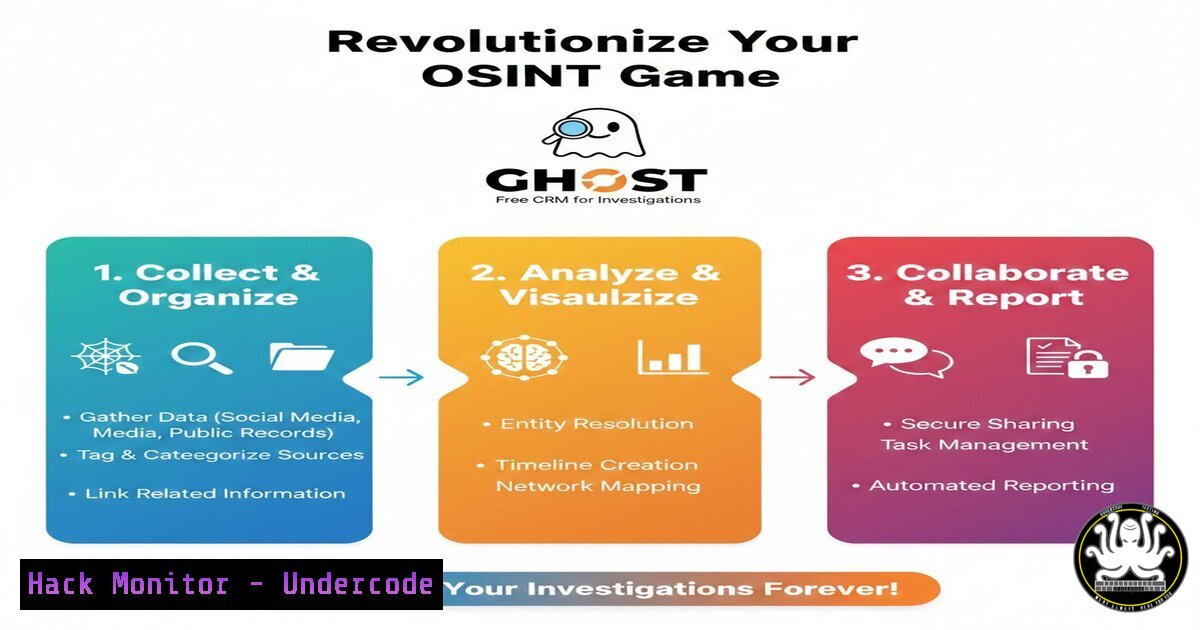
Open-Source Intelligence (OSINT) is a powerful discipline, but its greatest weakness is often the analyst themselves. Collecting emails, usernames, and social media profiles in scattered notes or spreadsheets leads to data silos, missed connections, and cognitive overload. To conduct professional-grade investigations, you need more than just search tools—you need a centralized platform to manage the data. Enter GHOST, a free and open-source OSINT CRM designed to transform chaotic data streams into structured, actionable intelligence.
Learning Objectives:
- Understand the limitations of traditional data collection methods in OSINT.
- Learn how to deploy and configure the GHOST OSINT CRM.
- Master the process of creating entities, storing artifacts, and visualizing relationships within an investigation.
- Discover how to map digital footprints to uncover hidden connections between targets.
You Should Know:
- Why a CRM is the Missing Piece in Your OSINT Arsenal
Most aspiring investigators focus solely on collection—finding the email, the phone number, the social account. However, professional intelligence analysis relies on collation and connection. When you are investigating a single person, a handful of sticky notes might suffice. But when that person has multiple aliases, associated domains, and linked phone numbers, the human brain struggles to maintain the “big picture.”
GHOST acts as a centralized database. Instead of switching between 15 browser tabs, you create a “Target” profile within GHOST. Under that target, you attach “Identities” (different names/aliases), “Locations,” and “Artifacts” (emails, phones, usernames). This methodology ensures that no clue is lost and that every piece of data is contextualized.
- Setting Up GHOST on Your Local Machine (Linux)
To get started with this OSINT CRM, you need to deploy it. The tool is hosted on GitHub and is typically run in a local environment for security and privacy reasons. Here’s how to get it running on a Debian-based Linux distribution.
Step 1: Prerequisites and Cloning the Repository
First, ensure you have Git and Docker installed, as GHOST often relies on containerization for easy setup.
sudo apt update && sudo apt install git docker.io docker-compose -y
sudo systemctl start docker
sudo systemctl enable docker
Now, clone the repository provided in the original post.
git clone https://github.com/EntySec/GHOST.git
cd GHOST
Step 2: Installation and Launch
Navigate the directory and run the installation script (if provided) or use Docker Compose to build the environment.
 Check the repository for specific instructions, but generally:
chmod +x install.sh
./install.sh
 Or if using Docker:
docker-compose up -d
Once the server is running, access the web interface via `http://localhost:8080` (or the port specified in the docs). The default login credentials are usually found in the repository’s README file; change these immediately upon first login to secure your investigation data.
3. Core Workflow: Adding Entities and Evidence
Once logged in, the power of the OSINT CRM becomes apparent. You are no longer just collecting; you are building a dossier.
Step 1: Creating an Investigation
Start by creating a new “Case” or “Investigation.” Give it a name related to your target (e.g., “Suspicious_Profile_Investigation_2024”).
Step 2: Adding the Primary Target
Inside the case, create the main entity. This is your primary person or organization.
– Navigate to the Entities tab.
– Click Add Entity.
– Fill in the known details: Name, Aliases, and a brief description.
Step 3: Attaching Artifacts
Now, attach the raw data you have collected via other OSINT tools (like theHarvester, Sherlock, or Maltego).
– Find the “Observables” or “Artifacts” section within the entity’s profile.
– Add a new Email Address.
– Add a new Phone Number.
– Add a new Username.
– Add a new Domain.
The system stores these as discrete objects linked to the target. This allows you to run queries later, such as “show me all targets who used this phone number.”
4. Visualizing Relationships and Pattern Detection
The true advantage of a CRM over a text file is the ability to visualize connections. GHOST typically includes a graph view or relationship mapper.
Step 1: Creating Links
If your investigation reveals that `[email protected]` is linked to a secondary domain malicious-site.com, do not just note it in a text field. Create the domain as a separate entity (or observable) and explicitly link it to the email.
– Select the email observable.
– Click Link to Existing or Create New Link.
– Select the target (the domain) and define the relationship type (e.g., “Registers Domain” or “Associated With”).
Step 2: Analyzing the Graph
Navigate to the Analysis or Graph view. Here, you will see nodes (entities) and edges (relationships). A well-populated CRM will visually reveal clusters. For example, you might see that `Alias_1` and `Alias_3` are not directly linked by name, but they both connect to the same phone number +XX-XXXX-XXXX. This visual pattern is easy to spot on a graph but easy to miss in a spreadsheet.
5. Real-World Application: Deconstructing a Fake Profile
Let’s apply the example from the original post. You are investigating a suspicious profile.
- Initial Intake: You have a username, a profile picture (hash), and an email address.
- Data Entry: Log into GHOST. Create the main entity “Suspicious User.” Attach the username as an observable.
- Deep Dive: You run the email through a data breach database and discover it is associated with a forum account.
- CRM Update: Create a new entity called “Forum Account.” Link the email to the forum account. From the forum account, you extract an IP address from an old post.
- Correlation: Create an “IP Address” observable and link it to the forum account.
- Discovery: Later, you find another suspicious profile on a different platform. You search GHOST by IP address. The search returns the original “Suspicious User” entity because the IP is linked through the forum. You have now connected two seemingly unrelated profiles.
What Undercode Say:
- Structure Becomes Strategy: GHOST transforms OSINT from a reactive gathering process into a proactive analytical one. By forcing data into a structured format, it compels the investigator to think in terms of connections, not just collections.
- Free Does Not Mean Limited: This tool proves that enterprise-grade intelligence analysis frameworks are accessible to independent researchers and hobbyists. The barrier to entry for professional OSINT is no longer cost, but the willingness to learn structured methodologies.
Prediction:
The future of OSINT lies in automation and integration. We will likely see a convergence where tools like GHOST begin to integrate APIs directly. Imagine a future where running a username search via Sherlock automatically populates the GHOST CRM with the results. As data volume increases, the analyst’s role will shift from “finder” to “analyzer,” making tools that prioritize data correlation and visualization the absolute standard for any serious investigation.
▶️ Related Video (74% Match):
🎯Let’s Practice For Free:
IT/Security Reporter URL:
Reported By: Saadsarraj Osint – Hackers Feeds
Extra Hub: Undercode MoN
Basic Verification: Pass ✅


