Listen to this Post
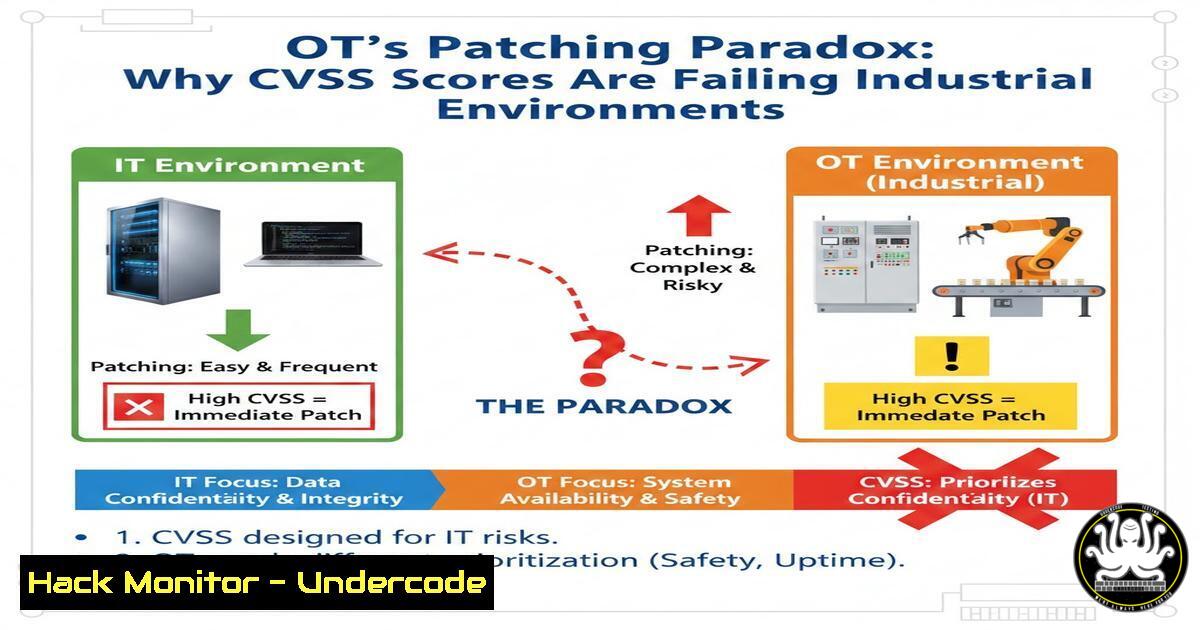
Introduction:
In the high-stakes world of Operational Technology (OT) and Industrial Control Systems (ICS), the traditional IT approach to vulnerability management is causing a critical blind spot. While IT departments race to patch the highest CVSS (Common Vulnerability Scoring System) scores, OT engineers are forced to make decisions based on asset criticality and operational downtime. This conflict between “severity-driven” and “context-driven” prioritization exposes a fundamental flaw in industrial cybersecurity: a vulnerability in a non-critical sensor is less urgent than a medium-severity flaw in a live production controller, yet standard workflows fail to differentiate between the two.
Learning Objectives:
- Understand the limitations of CVSS-only prioritization in OT/ICS environments.
- Learn how to map vulnerabilities to actual asset inventory and network exposure.
- Explore practical commands and methodologies for asset discovery and contextual risk scoring.
- Implement a hybrid prioritization model that balances severity with operational impact.
You Should Know:
1. The Asset Discovery Prerequisite: Building Your Baseline
Before any debate on prioritization can occur, you must have verified asset data. You cannot protect what you cannot see. In OT, this means moving beyond simple ping sweeps to passive and active interrogation that does not disrupt operations.
Step‑by‑Step Guide for OT Asset Discovery:
- Passive Network Monitoring: Use tools like `Wireshark` or `Zeek` to listen to mirror ports on OT switches. Capture traffic for 24–48 hours to identify all communicating IPs, MAC addresses, and protocols (e.g., Modbus, DNP3, S7).
– Linux Command: `sudo tcpdump -i eth0 -w ot_capture.pcap`
– Analysis: Use `capinfos ot_capture.pcap` to get a summary and `tshark -r ot_capture.pcap -T fields -e ip.src -e ip.dst | sort | uniq` to list unique IP conversations.
- Active (but Safe) Probing: For devices that do not generate traffic, consider safe active scans using `nmap` with reduced timing templates to avoid flooding sensitive controllers.
– Command: `nmap -sn -T0 –host-timeout 300s 192.168.1.0/24` (Ping scan, paranoid timing, long timeout).
– Identification: `nmap -O -sV -T1 -p 102,502,44818 192.168.1.100` (Slow OS and version detection on common ICS ports like Siemens S7, Modbus, Ethernet/IP).
- Leveraging Existing Tools: If you have Langner’s OTbase or similar, export the asset inventory to a CSV for analysis.
– Conceptual Command: `otbase-cli export assets –format csv –output inventory.csv`
2. Enriching Assets with Contextual Data
Once you have a list of devices, you must enrich them with operational context. A PLC controlling a blast furnace has a higher “asset criticality” score than a building management system controller.
Step‑by‑Step Guide for Contextual Tagging:
- Create a Criticality Matrix: Define tiers (Critical, High, Medium, Low) based on function.
- Map IPs to Physical Zones: Document if a device is in the DMZ, Control Zone, or Safety Zone.
- Command Line Tagging (Example using a simple CSV and
awk):
– Inventory.csv structure: IP,Hostname,Protocol,Function,Zone
– Command: `awk -F, ‘$5==”ControlZone” && $4==”PLC” {print $0}’ inventory.csv` (This lists all PLCs in the control zone for further inspection).
3. Correlating CVEs with Asset Inventory
A vulnerability scanner might report hundreds of CVEs. The goal is to filter this list to only those that apply to your actual, context-rich inventory.
Step‑by‑Step Guide for CVE-Context Correlation:
- Extract Product Versions: From your scans, create a unique list of software/firmware versions. `nmap` output can be parsed.
– Command: `grep “Siemens” nmap_results.txt | awk ‘{print $5, $6}’ | sort -u > siemens_versions.txt`
2. Query Public Databases: Use `searchsploit` (offline Exploit-DB) to see if any exploits are available for your specific versions.
– Command: `searchsploit siemens s7-1200 4.2` (Checks for exploits against that specific firmware).
3. Manual Correlation: Cross-reference your `siemens_versions.txt` against Siemens ProductCERT advisories using `wget` and grep.
– Command: `wget -qO- https://new.siemens.com/global/en/products/services/cert.html | grep -i “S7-1200″`
4. Simulating Network Exposure Analysis
A vulnerability is only truly critical if the asset is reachable by a potential attacker. You must analyze network segmentation.
Step‑by‑Step Guide for Exposure Testing:
- Identify Gateway Rules: Check firewall rules between the IT and OT zones.
– Windows Command (if on a management host): `tracert 192.168.1.100` to see the path.
– Linux Command: `mtr –report 192.168.1.100` to analyze the route and packet loss.
2. Test Port Accessibility: From a compromised IT machine, test if critical OT ports are accessible.
– Linux Command: `nc -zv 192.168.1.100 102` (Tests if Siemens S7 port 102 is open from the IT perspective).
– Windows PowerShell: `Test-NetConnection 192.168.1.100 -Port 102`
5. The Hybrid Prioritization Matrix
Merge the CVSS score with your asset context to create a dynamic queue. For example:
– Priority 1: CVSS 9+ AND Critical Asset AND Exposed.
– Priority 2: CVSS 7-8.9 AND Critical Asset AND Exposed.
– Priority 3: CVSS 9+ BUT Isolated in a Safety Zone (Virtual Patching is acceptable).
– Priority 4: CVSS 7-8.9 BUT Non-Critical Asset.
Conceptual Script (Python/Pseudo):
vulnerabilities = [
{'cve': 'CVE-2023-1234', 'cvss': 9.8, 'asset': 'PLC_01', 'criticality': 'Critical', 'exposed': True},
{'cve': 'CVE-2024-5678', 'cvss': 5.5, 'asset': 'HMI_02', 'criticality': 'Critical', 'exposed': True},
]

for vuln in vulnerabilities:
if vuln['cvss'] >= 7.0 and vuln['criticality'] == 'Critical' and vuln['exposed']:
print(f"ACTION REQUIRED: Patch {vuln['cve']} on {vuln['asset']}")
elif vuln['cvss'] >= 9.0 and not vuln['exposed']:
print(f"MONITOR: Apply virtual patch/IDS rule for {vuln['cve']}")
What Undercode Say:
- Context is King: In OT, a medium-severity vulnerability on a live production line is a higher priority than a critical-severity flaw on a decommissioned test bench. Asset context must override raw CVSS scores.
- Visibility Enables Strategy: The entire debate between CVSS and context is moot without an accurate, living asset inventory. As Langner’s handbook implies, you must invest in discovery before you can prioritize.
- Hybridization is Inevitable: The future of OT security is not choosing one method over the other, but merging them. A mature program uses CVSS as a filter and asset context as the decision-making engine.
Analysis:
The LinkedIn debate highlights a growing maturity in the ICS community. We are moving away from the “scorched earth” patching mentality of IT, which often causes more downtime than attacks themselves. By prioritizing asset context, engineers regain operational stability while still addressing risk. This approach requires a cultural shift where security teams respect engineering constraints, and engineering teams provide the necessary data for accurate risk calculation. The tools are available—from simple `nmap` scripts to enterprise-grade OTbase solutions—but the process must be collaborative.
Prediction:
Within the next two years, regulatory frameworks (like NIS2 in the EU) will mandate “context-aware” vulnerability management for critical infrastructure. We will see the rise of AI-driven tools that automatically ingest asset inventory, network topology, and threat intelligence to recommend not just what to patch, but when and how to apply compensating controls without stopping the line. The role of the “OT Security Architect” will solidify, bridging the gap between the IT security operations center and the plant floor engineer.
▶️ Related Video (88% Match):
🎯Let’s Practice For Free:
IT/Security Reporter URL:
Reported By: Ot Vulnerability – Hackers Feeds
Extra Hub: Undercode MoN
Basic Verification: Pass ✅


