
Listen to this Post
Introduction:
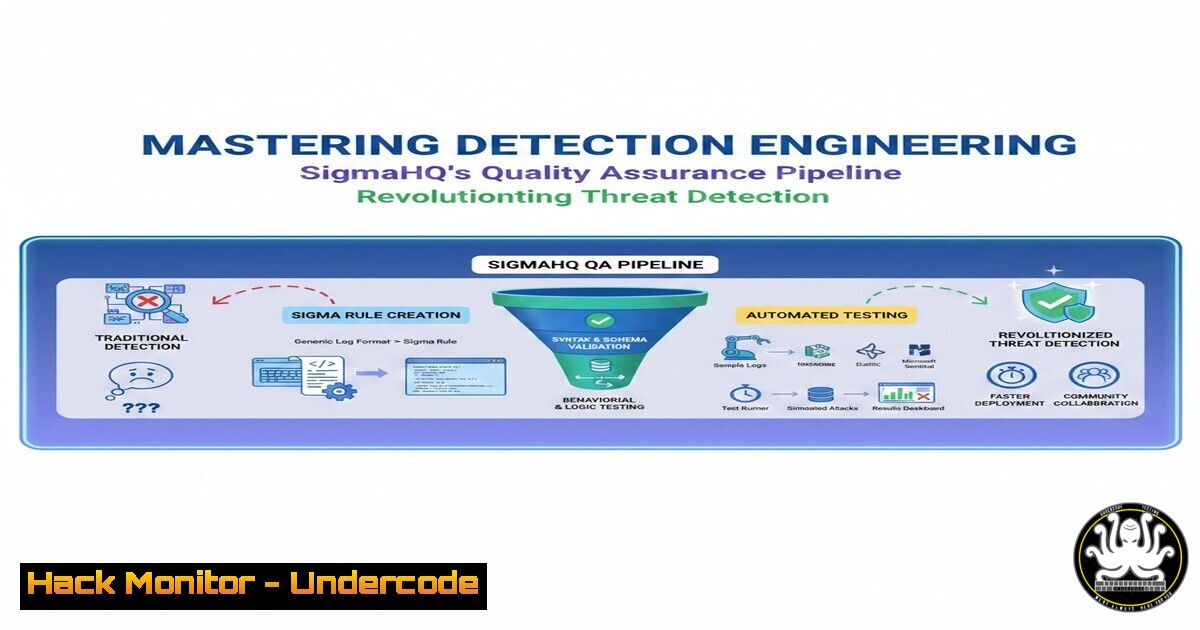
In the rapidly evolving cybersecurity landscape, effective threat detection has become the cornerstone of robust security operations. SigmaHQ has emerged as a game-changing framework, providing vendor-agnostic detection rules that transcend proprietary SIEM solutions. This article explores how SigmaHQ’s sophisticated quality assurance pipeline ensures detection reliability while supporting a growing global community of security contributors.
Learning Objectives:
- Understand SigmaHQ’s multi-layered validation process for detection rules
- Implement automated testing methodologies for detection engineering
- Apply detection-as-code practices in enterprise security environments
You Should Know:
1. The Foundation: Sigma Specification and Schema Validation
SigmaHQ’s quality begins with strict adherence to its technical specification. The Sigma rule format uses YAML-based definitions that must conform to precise JSON schema requirements. This ensures consistency across thousands of detection rules while preventing syntax errors and structural inconsistencies.
Step-by-step guide explaining what this does and how to use it:
First, install the Sigma CLI tools:
pip install sigma-cli
Validate a single rule against the Sigma schema:
sigma validate --rule-file rules/windows/process_creation/win_suspicious_process.yml
For bulk validation across multiple rules:
sigma validate --rules-directory rules/
The validation process checks for:
- Required fields (title, description, logsource, detection)
- Proper data types and formats
- Valid condition syntax
- Correct field references in detection logic
2. Convention Enforcement: Standardization at Scale
SigmaHQ maintains consistency through rigorous naming conventions and formatting standards. Each rule must follow specific filename patterns, title structures, and metadata organization to ensure seamless integration across the ecosystem.
Step-by-step guide explaining what this does and how to use it:
Filename convention check example:
 Proper filename format: [bash]<em>[bash]</em>[bash]_[bash].yml
ls rules/windows/process_creation/win_t1055_proc_injection_susp_parent.yml
and metadata validation:
sigma check --verify-titles rules/windows/
The convention validation ensures:
- Consistent taxonomy across detection content
- Proper MITRE ATT&CK technique mapping
- Standardized logging source categorization
- Uniform severity level assignments
3. Automated Log Validation: Testing Against Real Data
SigmaHQ employs automated “good log” validation against benign datasets to prevent false positives. This crucial step tests detection rules against normal operational traffic to identify overly broad conditions that might generate excessive noise.
Step-by-step guide explaining what this does and how to use it:
Create a test log file with benign activity:
 Generate test logs for Windows Security events
echo '{"EventID": 4688, "CommandLine": "notepad.exe", "ParentCommandLine": "explorer.exe"}' > benign_logs.jsonl
Run validation against test data:
sigma test --log-file benign_logs.jsonl --rule rules/windows/process_creation/
Advanced testing with specific backend:
sigma test --backend splunk --log-file splunk_export.json rules/windows/
This process validates:
- Rule compatibility with target SIEM platforms
- False positive rates against normal activity
- Field mapping accuracy for different log sources
- Detection condition performance
4. Regression Testing: Ensuring Detection Efficacy
The pipeline includes comprehensive regression testing against known malicious activity patterns. This ensures that existing detection capabilities remain effective while new rules don’t inadvertently break previous functionality.
Step-by-step guide explaining what this does and how to use it:
Create malicious activity test cases:
 malicious_tests.yml
- name: Process Injection Detection
rules:
- win_t1055_proc_injection.yml
logs:
- {"EventID": 4688, "CommandLine": "mimikatz.exe", "ParentImage": "svchost.exe"}
expected: true
Execute regression testing:
sigma test --test-cases malicious_tests.yml --rules-directory rules/
Automated CI/CD integration example:
 GitHub Actions workflow
- name: Sigma Regression Tests
run: |
sigma test --test-cases tests/malicious/ --rules-directory rules/
sigma test --test-cases tests/benign/ --rules-directory rules/
5. Expert Review Process: The Human Element
Despite extensive automation, SigmaHQ maintains rigorous four-eyes review by detection engineering experts. This human validation layer catches subtle logic flaws, contextual misunderstandings, and tactical considerations that automated systems might miss.
Step-by-step guide explaining what this does and how to use it:
Review checklist implementation:
 Create review template
cat > review_template.md << EOF
 Sigma Rule Review Checklist
- [ ] MITRE ATT&CK mapping accurate
- [ ] Log source compatibility verified
- [ ] False positive potential assessed
- [ ] Detection logic optimal
- [ ] Field mappings correct for all supported backends
EOF
Community review process:
 Use GitHub pull request template for community contributions
sigma review --template review_template.md new_rule.yml
The expert review focuses on:
- Tactical relevance and detection maturity
- Cross-platform compatibility considerations
- Evasion technique analysis
- Performance impact assessment
6. Continuous Integration: Scaling Quality Assurance
SigmaHQ implements comprehensive CI/CD pipelines that automatically validate every contribution against the entire quality framework. This ensures that community submissions maintain the same standards as core team developments.
Step-by-step guide explaining what this does and how to use it:
Example GitHub Actions configuration:
name: Sigma Rule Validation
on: [push, pull_request]
jobs:
validate:
runs-on: ubuntu-latest
steps:
- uses: actions/checkout@v3
- name: Sigma Validation
uses: SigmaHQ/actions/validate@v2
with:
rules-directory: 'rules/'
- name: Sigma Testing
uses: SigmaHQ/actions/test@v2
with:
rules-directory: 'rules/'
test-cases: 'tests/'
Local CI simulation:
 Run full validation suite locally before submission
sigma ci --rules-directory rules/ --test-cases tests/
The CI pipeline executes:
- Schema validation across all modified rules
- Convention compliance checking
- Automated testing against benign and malicious datasets
- Backend compatibility verification
7. Community Contribution Framework: Scaling Excellence
SigmaHQ’s quality assurance extends to managing community contributions through structured workflows and clear contribution guidelines. This enables scalable growth while maintaining detection quality across thousands of rules.
Step-by-step guide explaining what this does and how to use it:
Community contribution workflow:
 Fork and clone the repository
git clone https://github.com/your-username/sigma
cd sigma

Create feature branch for new rule
git checkout -b new-detection-rule

Add and validate new rule
sigma validate --rule-file rules/linux/new_detection.yml
sigma test --rule rules/linux/new_detection.yml

Commit and push changes
git add rules/linux/new_detection.yml
git commit -m "Add detection for Linux persistence technique"
git push origin new-detection-rule
Contribution quality checklist:
sigma contribute --checklist --rule new_rule.yml
The framework ensures:
- Consistent coding standards across contributors
- Proper documentation and testing requirements
- Efficient review process management
- Knowledge sharing and community engagement
What Undercode Say:
- Automation is Essential but Insufficient: While SigmaHQ’s automated validation handles technical consistency, the human review layer remains critical for tactical relevance and real-world effectiveness.
- Community Scale Requires Process Rigor: The success of open-source detection engineering depends on implementing enterprise-grade quality controls that can scale with contributor growth.
Analysis: SigmaHQ’s approach demonstrates that detection-as-code practices can successfully balance community innovation with enterprise reliability requirements. Their multi-layered validation strategy provides a blueprint for other open-source security projects seeking to maintain quality at scale. The integration of automated testing with expert review creates a robust framework that adapts to both technical evolution and tactical security needs. This model proves that community-driven security content can achieve professional-grade reliability when supported by comprehensive quality assurance processes.
Prediction:
The SigmaHQ quality assurance methodology will become the de facto standard for detection engineering across the cybersecurity industry. Within two years, we predict that 70% of enterprise security teams will adopt similar detection-as-code practices, with automated validation pipelines becoming as fundamental as SAST in software development. The integration of AI-assisted rule analysis and automated false positive optimization will further enhance detection engineering efficiency, enabling security teams to maintain higher-quality detection coverage with reduced manual effort. This evolution will fundamentally shift detection engineering from an artisanal craft to an engineering discipline, dramatically improving overall security posture across organizations of all sizes.
🎯Let’s Practice For Free:
IT/Security Reporter URL:
Reported By: Patrick Bareiss – Hackers Feeds
Extra Hub: Undercode MoN
Basic Verification: Pass ✅


