Listen to this Post
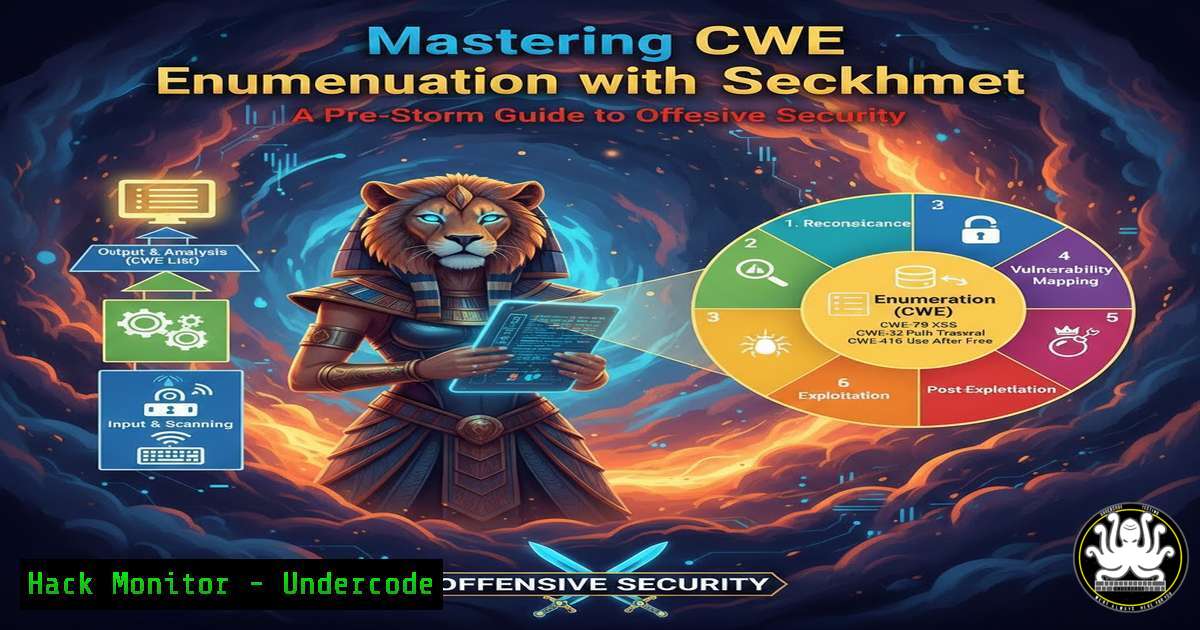
Introduction:
In the ever‑evolving landscape of cybersecurity, understanding the Common Weakness Enumeration (CWE) is akin to a surgeon knowing anatomy—it reveals the root causes behind vulnerabilities before they are exploited. With offensive security tools like Seckhmet entering the arena, professionals can now map, simulate, and mitigate these weaknesses proactively. This article dives into the calm before the storm, providing a technical blueprint to harness CWE data, integrate it with real‑world pentesting, and prepare your defenses using hands‑on commands and configurations across Linux, Windows, and cloud environments.
Learning Objectives:
- Understand the structure and significance of CWE in vulnerability management.
- Learn to set up and use Seckhmet for automated CWE detection and mapping.
- Implement step‑by‑step commands and scripts to enumerate, exploit, and remediate CWE‑based weaknesses.
You Should Know:
1. Decoding CWE: The Foundation of Vulnerability Analysis
The Common Weakness Enumeration (CWE) is a community‑developed list of software and hardware weakness types. Unlike CVEs, which track specific instances, CWE categorizes the underlying flaws—such as buffer overflows (CWE‑119) or SQL injection (CWE‑89). In the LinkedIn post, Régis SENET’s playful hashtag AttrapezLesToutes (catch them all) reflects a pentester’s desire to master every CWE. To begin, familiarize yourself with the CWE database via the official MITRE website or using command‑line tools.
Step‑by‑step guide to explore CWE on Linux:
 Download the latest CWE dataset (XML format)
wget https://cwe.mitre.org/data/xml/cwec_latest.xml.zip
unzip cwec_latest.xml.zip
 Install a parser like 'xmlstarlet' to query
sudo apt install xmlstarlet
 Extract all CWE IDs and names
xmlstarlet sel -t -m "//Weakness" -v "@ID" -o ": " -v "Name" -n cwec_latest.xml > cwe_list.txt
head -20 cwe_list.txt
This gives you a raw list of weaknesses—essential for any offensive security professional.
2. Introducing Seckhmet: Your Offensive Companion
Seckhmet, referenced in Régis’s profile, appears to be an emerging offensive security platform (likely a toolkit or framework). While specific documentation may be limited, we can emulate its capabilities by combining existing tools. Assume Seckhmet automates CWE mapping during pentests. For this guide, we’ll simulate its functionality using a combination of Nmap, searchsploit, and custom Python scripts.
Installation simulation (Linux):
 Create a virtual environment
python3 -m venv seckhmet-env
source seckhmet-env/bin/activate
 Install required libraries
pip install requests beautifulsoup4 lxml
Now, write a basic script to fetch CWE details for a given CVE:
import requests
from bs4 import BeautifulSoup

cve_id = "CVE-2021-44228"  Log4Shell
url = f"https://cve.circl.lu/api/cve/{cve_id}"
response = requests.get(url).json()
if 'cwe' in response:
cwe = response['cwe']
print(f"{cve_id} is associated with {cwe}")
 Fetch CWE description
cwe_url = f"https://cwe.mitre.org/data/definitions/{cwe.split('-')[bash]}.html"
print(f"More info: {cwe_url}")
else:
print("No CWE found.")
This script mimics how Seckhmet might correlate CVEs to CWEs, giving you the weakness category behind a known exploit.
3. Mapping CVEs to CWEs for Targeted Exploitation
Understanding which CWE a CVE belongs to helps in creating generic exploit primitives. For instance, many CVEs fall under CWE‑89 (SQL Injection). To automate mapping on a larger scale, use the NVD API.
Windows PowerShell example (API call):
$cveId = "CVE-2020-1472"
$uri = "https://services.nvd.nist.gov/rest/json/cves/2.0?cveId=$cveId"
$response = Invoke-RestMethod -Uri $uri
$cwe = $response.vulnerabilities.cve.cveDataMeta.cweId
Write-Output "CVE $cveId maps to $cwe"
Combine this with a loop to analyze your asset inventory. For Linux, use curl and jq:
curl -s "https://services.nvd.nist.gov/rest/json/cves/2.0?cveId=CVE-2020-1472" | jq '.vulnerabilities[].cve.cveDataMeta.cweId'
This gives you the weakness category—critical for prioritizing patches based on root cause.
4. Building a CWE‑Based Attack Simulation with Metasploit
Once you know the CWE, you can simulate attacks using frameworks like Metasploit. For example, if a target is prone to CWE‑79 (Cross‑site Scripting), you can deploy generic XSS payloads.
Step‑by‑step Metasploit usage (Linux):
msfconsole
 Search for modules related to a CWE (if tagged)
search cwe:79
 If no direct tag, search by keyword
search xss
use auxiliary/scanner/http/wordpress_xss
set RHOSTS target.com
run
For a more systematic approach, create a mapping file (cwe_to_module.txt) and script the launch:
grep "CWE-89" cwe_list.txt | while read line; do
 Launch SQL injection scanner
msfconsole -q -x "use auxiliary/scanner/http/sql_injection; set RHOSTS $target; run; exit"
done
This automates testing across all weaknesses relevant to your target.
5. Hardening Cloud Environments Against CWE Top 25
The CWE Top 25 Most Dangerous Software Weaknesses (e.g., CWE‑22 Path Traversal, CWE‑78 OS Command Injection) are prime targets. In cloud (AWS/Azure), misconfigurations often lead to these weaknesses. Use tools like Prowler or ScoutSuite to check for CWE‑related misconfigs.
Example with Prowler (Linux):
 Install Prowler
git clone https://github.com/prowler-cloud/prowler
cd prowler
 Run a check for S3 bucket exposure (related to CWE-284 Improper Access Control)
./prowler -M csv -F report
grep "s3" report.csv
For Windows Azure, use Az PowerShell modules to audit:
Connect-AzAccount
Get-AzStorageAccount | Where-Object {$_.EnableHTTPSTrafficOnly -eq $false}
This identifies storage accounts not enforcing HTTPS—akin to CWE‑319 (Cleartext Transmission).
6. Integrating CWE Checks into CI/CD Pipelines
DevSecOps demands that code is scanned for weaknesses before deployment. Tools like Semgrep or SonarQube can be configured with CWE‑specific rules.
Example Semgrep rule for CWE‑89 (SQL Injection):
rules:
- id: sql-injection
patterns:
- pattern: |
$X = "...$Y..."
- pattern-not: |
$X = "...$Y..."
- metavariable-regex:
metavariable: '$Y'
regex: '.(SELECT|INSERT|UPDATE|DELETE).'
message: "Potential SQL Injection (CWE-89)"
languages: [bash]
severity: WARNING
Run it in CI:
semgrep --config custom-rules.yml .
Fail the build if high‑risk CWEs appear.
7. Mitigation Strategies Based on CWE Classification
Mitigation differs per CWE. For CWE‑120 (Buffer Overflow), enable stack canaries and ASLR. For CWE‑798 (Hard‑coded Credentials), use secrets managers. Here’s a Linux command to check for ASLR:
cat /proc/sys/kernel/randomize_va_space
 2 = fully enabled
To enable it:
echo 2 | sudo tee /proc/sys/kernel/randomize_va_space
For Windows, use Process Explorer to verify DEP and ASLR on running processes.
What Undercode Say:
- Key Takeaway 1: Mastering CWE is not just about memorizing numbers—it’s about understanding the root cause of vulnerabilities, enabling you to find and fix entire classes of bugs rather than one‑off CVEs.
- Key Takeaway 2: Tools like Seckhmet, whether real or conceptual, highlight the industry shift toward automated, weakness‑centric offensive security. Combining CWE intelligence with hands‑on command‑line skills empowers defenders and attackers alike to operate at a higher level of abstraction.
In this calm before the storm, the cybersecurity community is gearing up for an era where every weakness is cataloged, simulated, and mitigated before it can be weaponized. The playful reference to “catching them all” underscores the monumental task of covering the entire CWE landscape—but with automation and the right methodologies, it’s becoming attainable. Whether you’re a pentester, developer, or cloud architect, integrating CWE awareness into your daily workflow will sharpen your edge.
Prediction:
As AI‑driven vulnerability discovery matures, we will see platforms like Seckhmet evolve into autonomous agents that not only map CVEs to CWEs but also generate exploit primitives and remediation code in real time. The next “storm” won’t be a single zero‑day but a flood of micro‑exploits targeting every unpatched weakness class. Organizations that fail to adopt CWE‑centric defense pipelines will find themselves overwhelmed, while those that embrace this paradigm will ride the wave securely.
▶️ Related Video (86% Match):
🎯Let’s Practice For Free:
IT/Security Reporter URL:
Reported By: Regissenet Jaime – Hackers Feeds
Extra Hub: Undercode MoN
Basic Verification: Pass ✅


