Listen to this Post
Introduction:
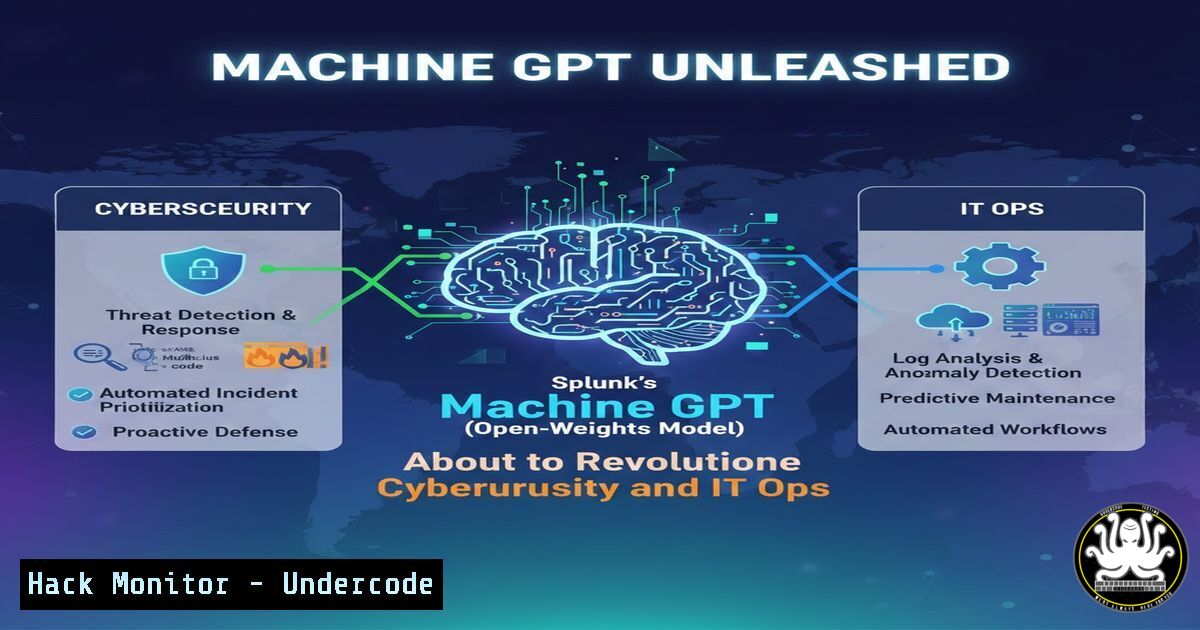
The era of generative AI has been dominated by models trained on human language, leaving a critical gap in understanding the complex, high‑volume, and structured world of machine data. Splunk’s introduction of “Machine GPT,” an open‑weights large language model specifically designed for machine data, promises to transform IT operations and cybersecurity by enabling proactive outage prediction and pre‑emptive threat hunting. This article deconstructs how this technology works and provides a technical blueprint for leveraging it to secure your environment.
Learning Objectives:
- Understand the fundamental limitations of standard LLMs (like ChatGPT) when processing machine logs, telemetry, and network data.
- Learn how to access and implement Splunk’s Machine GPT model in a lab environment for security and operational analysis.
- Develop actionable skills to create automated workflows that predict failures and identify threats using machine data.
You Should Know:
- Why Standard LLMs Fail on Machine Data: The Tokenization Problem
Machine data—system logs, network flows, metric streams—is numerically dense, highly structured, and context‑dependent in ways human language is not. Standard LLMs tokenize text based on linguistic patterns, which shatters the semantic meaning of a log line or an IP address sequence. For instance, the log entry `”Failed password for root from 192.168.1.105 port 22 ssh2″` might be tokenized into meaningless fragments like"Failed"," password"," 192",.,"168", destroying the crucial relationship between the IP address and the attack event.
Step‑by‑step guide:
To illustrate, let’s compare tokenization. Using a typical LLM’s tokenizer via Python:
from transformers import AutoTokenizer
tokenizer = AutoTokenizer.from_pretrained("gpt-3.5-turbo")
sample_log = "CRITICAL 2024-05-27T14:32:01Z CPU_LOAD 95.7% host:server-prod-01"
tokens = tokenizer.tokenize(sample_log)
print(tokens)
 Output might be: ['CRITICAL', '2024', '-', '05', '-', '27', 'T', '14', ':', '32', ':', '01', 'Z', 'CPU', '_', 'LOAD', '95', '.', '7', '%', 'host', ':', 'server', '-', 'prod', '-', '01']  The metric `95.7%` and hostname are broken apart.
Machine GPT uses a tokenization strategy that preserves numerical sequences and key‑value pairs as single semantic units, allowing the model to understand that `95.7%` is a metric value and `server-prod-01` is a single entity.
- Setting Up Your Lab Environment with Splunk and Machine GPT
To experiment, you need a Splunk instance (a free developer license works) and access to the Machine GPT model weights, which Splunk has released openly. The integration happens through Splunk’s AI Toolkit.
Step‑by‑step guide:
- Deploy a Splunk Instance: On a Linux lab server, install Splunk Enterprise.
Download Splunk Enterprise (replace with latest version URL)
wget -O splunk.tgz 'https://download.splunk.com/products/splunk/releases/9.x.x/linux/splunk-9.x.x-xxx-Linux-x86_64.tgz'
tar -xzvf splunk.tgz -C /opt
cd /opt/splunk/bin
./splunk start --accept-license --answer-yes --no-prompt --seed-passwd 'YourSecurePassword'
- Install the Splunk AI Toolkit: From Splunk Web, navigate to “Apps” > “Find More Apps” and search for “AI Toolkit”. Install it.
- Load the Machine GPT Model: Within the AI Toolkit, use the “Manage LLMs” interface to import the open‑weights Machine GPT model. You will need the Hugging Face model repository URL provided by Splunk. This process downloads the model to your Splunk environment for private, secure inference.
3. Generating Predictive Alerts for System Outages
The core power of Machine GPT is identifying subtle, correlated patterns in time‑series data that precede a major incident, like a database crash or service degradation.
Step‑by‑step guide:
- Ingest Historical Performance Data: Forward CPU, memory, disk I/O, and application logs from your servers to Splunk.
- Craft a Predictive Query: Use Splunk’s Search Processing Language (SPL) with the `llm` command to pipe context to the model.
index=os_metrics earliest=-7d latest=now
| stats avg(cpu_pct), avg(mem_used), max(disk_queue) by host, _time span=1h
| sort + _time
| llm model="machine_gpt_local" prompt="Analyze these sequential metric readings for host $host$. Identify any pattern that historically indicates an impending system failure in the next 12 hours. Output 'HIGH_RISK', 'MEDIUM_RISK', or 'LOW_RISK' with a one-line reason."
| search llm_result="HIGH_RISK"
- Create a Proactive Alert: In Splunk, save this search as an alert that triggers a webhook to your IT Ops platform (e.g., PagerDuty, ServiceNow) when the model returns
HIGH_RISK.
4. Automating Threat Hunting with Natural Language Queries
Security analysts can query machine data in plain English, and Machine GPT will translate it into correct, complex SPL queries, reducing mean time to detection (MTTD).
Step‑by‑step guide:
- Enable the Natural Language Interface: In the AI Toolkit, configure the “NLQ to SPL” feature, selecting Machine GPT as the underlying model.
- Ask a Security Question: Instead of writing complex SPL, an analyst can type: “Show me all internal hosts that communicated with the known malicious IP 185.xxx.xxx.xxx in the last 24 hours, then list any unusual processes that ran on those hosts immediately after the communication.”
- Deploy the Generated SPL: Machine GPT will generate and run a query like:
index=firewall dest_ip="185.xxx.xxx.xxx" earliest=-24h
| stats count by src_ip
| join type=left src_ip [ search index=endpoint earliest=-24h
| transaction src_ip maxspan=5m
| search process_name=""
| stats values(process_name) as processes by src_ip ]
| table src_ip, processes
- Automate this Hunt: Schedule this converted search to run hourly, feeding results into a SIEM dashboard or a SOAR playbook for automated ticket creation.
5. Hardening Your API Security with Anomaly Detection
Machine GPT can learn the normal baselines of API traffic—endpoints, payload sizes, response codes—and flag behavioral anomalies indicative of scanning or attack.
Step‑by‑step guide:
- Feed API Gateway Logs to Splunk: Ensure logs capture endpoint, method, response code, user_agent, and response_time.
- Train a Baseline: Over a week of normal traffic, use Machine GPT’s embedding capability to create a profile of “normal” API behavior.
3. Create a Real‑Time Detection Search:
index=api_gw earliest=-5m
| llm model="machine_gpt_local" prompt="Compare this API transaction: Endpoint=$endpoint$, Method=$method$, Response_Code=$response_code$, Client_IP=$client_ip$ to the established normal baseline. Does this fit a pattern of reconnaissance, data exfiltration, or credential stuffing? Answer only YES or NO."
| where llm_result="YES"
| table _time, client_ip, endpoint, user_agent
4. Integrate with a WAF: Use Splunk’s HTTP Event Collector (HEC) to send high‑confidence anomalies to a web application firewall (like F5 Advanced WAF or AWS WAF) to dynamically block offending IPs.
What Undercode Say:
- Key Takeaway 1: The specialized tokenization and training of Machine GPT on machine data represent a paradigm shift from repurposing general‑purpose LLMs. It turns raw telemetry into a queryable, predictive knowledge base, fundamentally changing the roles of SOC and NOC analysts.
- Key Takeaway 2: By releasing the model as “open weights,” Splunk is betting on community‑driven enhancement and transparent, auditable AI—a critical factor for adoption in regulated industries where “black box” AI is a non‑starter.
Analysis:
Splunk’s move strategically counters the generic AI offerings from cloud hyperscalers. It leverages their entrenched position in the SOC and IT operations market. The real value won’t be in the model itself, but in the proprietary, high‑quality machine data organizations use to fine‑tune it. This creates a significant moat: the best predictions will come from models finely‑tuned on an organization’s own unique data streams. The immediate technical hurdle for adopters will be data pipeline hygiene—Machine GPT, like any AI, is garbage‑in, garbage‑out. Organizations must prioritize log normalization and context enrichment before deployment to realize its full potential. This technology will gradually shift security from reactive investigation to proactive risk mitigation, but success hinges on integrating these insights into automated orchestration tools.
Prediction:
Within two years, Machine GPT and its successors will become the core reasoning engines inside Autonomous Security Operations Centers (ASOCs). We will see the emergence of “self‑healing” networks and applications, where predictive alerts from these models automatically trigger remediation scripts—such as scaling infrastructure, isolating compromised containers, or rotating credentials—before a human analyst is even notified. This will commoditize routine threat hunting and system monitoring, elevating the cybersecurity and IT professional’s role to that of a strategist and automation overseer, focusing on adversarial AI and designing ever‑more sophisticated data‑driven policies.
🎯Let’s Practice For Free:
IT/Security Reporter URL:
Reported By: Davidbombal Cisco – Hackers Feeds
Extra Hub: Undercode MoN
Basic Verification: Pass ✅


