Listen to this Post
Introduction:
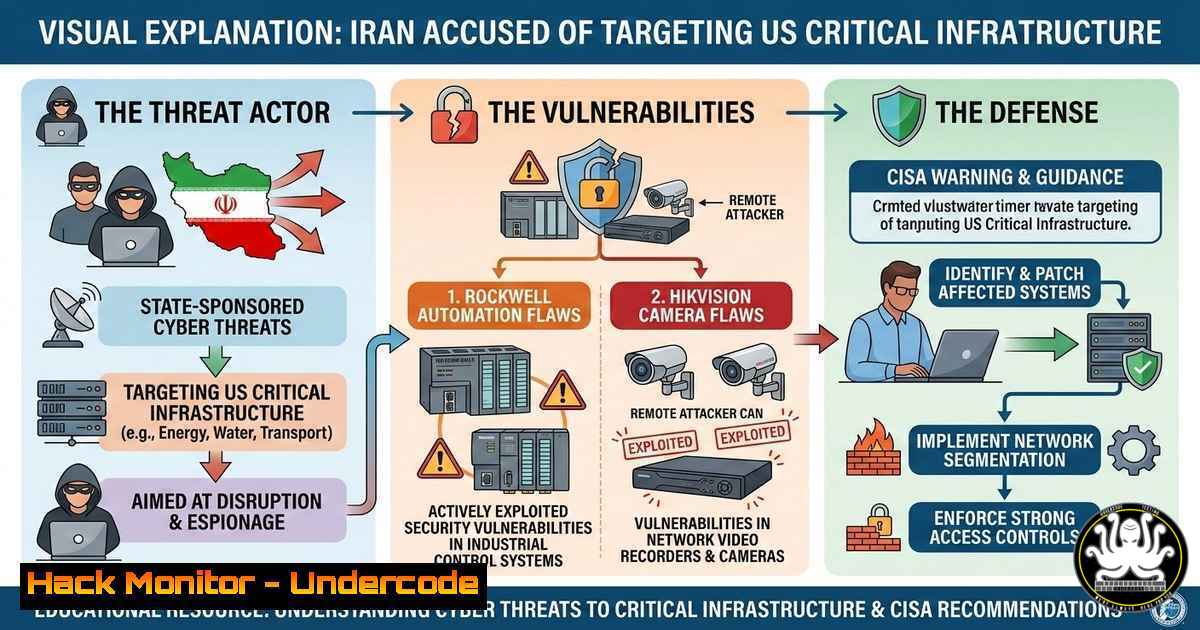
The U.S. Cybersecurity and Infrastructure Security Agency (CISA) has recently added two older, yet critical, vulnerabilities to its Known Exploited Vulnerabilities (KEV) catalog, signaling a potential escalation in cyber activities targeting American industrial assets . The flaws in question—CVE-2021-22681 affecting Rockwell Automation PLCs and CVE-2017-7921 impacting Hikvision cameras—are now confirmed to be under active exploitation, with experts pointing toward Iranian threat actors as the likely culprits . This development underscores a dangerous trend where nation-state adversaries are moving beyond espionage to actively probe and potentially disrupt Operational Technology (OT) environments .
Learning Objectives:
- Analyze the technical mechanics of CVE-2021-22681 and understand why it enables unauthorized access to Rockwell Logix controllers.
- Assess the geopolitical context linking these CVEs to Iranian state-sponsored activity and broader pressure campaigns against US infrastructure.
- Execute practical network auditing commands to identify exposed industrial control systems (ICS) and apply critical mitigations like network segmentation and mode switching.
You Should Know:
- CISA KEV Addition Signals Active Iranian Targeting of US Industrial Control Systems
The inclusion of CVE-2021-22681 in CISA’s KEV catalog is not merely a routine update; it is a direct warning that adversaries are actively leveraging this flaw in the wild. As Ruben Santamarta pointed out, this is likely a signal that someone is “successfully probing PLCs at a certain scale” . Given the geopolitical climate, the primary suspect is Iran. The Homeland Security Today report confirms that in periods of heightened tension, Iranian actors pivot from pure espionage to “pressure campaigns intended to create localized disruption, safety concerns, or economic friction” specifically targeting “internet-facing industrial control components” .
The vulnerability itself, CVE-2021-22681, is a severe authentication bypass issue residing in Rockwell Automation’s Studio 5000 Logix Designer and RSLogix 5000 software. According to Rockwell’s advisory, the software uses a hardcoded or extractable key to verify that Logix controllers are communicating with trusted Rockwell software . Successful exploitation allows a remote, unauthenticated attacker to bypass this verification mechanism, effectively impersonating an engineering workstation. This grants the attacker the ability to read, modify, or completely wipe the logic on affected controllers, which include a vast range of CompactLogix, ControlLogix, and GuardLogix families .
- Step-by-Step Guide: Identifying and Auditing Exposed Rockwell PLCs
Before an attacker can exploit CVE-2021-22681, they must first find a vulnerable device. As researcher Jos Wetzels noted, the exploit is most valuable for scaling attacks, but finding the devices is the first step . Security professionals must proactively audit their own external footprint. The primary tool for this is Shodan, a search engine for internet-connected devices. Here is how to perform a basic audit using Linux command-line tools and Shodan:
Step 1: Install Shodan Command-Line Interface (CLI)
On a Linux machine (Debian/Ubuntu), open a terminal and install the Shodan Python package.
 Install Shodan via pip
pip3 install shodan

Initialize and input your Shodan API key (available from your Shodan account)
shodan init YOUR_API_KEY
Step 2: Search for Rockwell PLCs
Attackers look for specific banners and open ports. Rockwell PLCs typically use port 44818/TCP for EtherNet/IP communications. Use the Shodan CLI to search for these devices globally or filter by country.
 Search for Rockwell PLCs in the United States
shodan search --limit 10 --fields ip_str,port,org,hostnames "port:44818 Rockwell Automation country:US"

Search specifically for potentially vulnerable Logix controllers
shodan search "port:44818 ControlLogix country:US"
What this does: This command queries Shodan’s database for devices with port 44818 open that contain the string “Rockwell Automation” and are located in the US. The output will show IP addresses that are publicly exposed—a primary indicator of risk .
Step 3: Validate with Nmap
Once you identify a potential asset within your own range, use Nmap to verify the service and grab the banner to confirm it is a Logix controller.
 Scan a specific IP for the EtherNet/IP port and attempt to grab the banner
nmap -sV -p 44818 --script=banner <target_ip>

For a more aggressive identification, use the modicon-disclosure script (generic PLC info)
nmap -sV -p 44818 --script enip-info <target_ip>
What this does: The `-sV` flag enables version detection. The `enip-info` script specifically queries the EtherNet/IP protocol to retrieve device information, confirming the make and model of the PLC . If your organization has assets appearing in these searches, they are at immediate risk and violate Rockwell’s and CISA’s guidance to “minimize network exposure.”
3. Mitigation Strategies and Immediate Hardening Actions
Rockwell Automation has stated that this vulnerability cannot be fixed with a software patch . Therefore, mitigation relies entirely on compensating controls and configuration changes. Based on the official advisory and CISA guidelines, here are the immediate steps to secure vulnerable Logix controllers.
Primary Mitigation: Physical Mode Switch
The most effective mitigation is to place the controller’s hardware keyswitch into the RUN position. When in RUN mode, most malicious engineering actions (such as downloading new code) are blocked, even if the authentication bypass is successful .
– Action: Physically inspect the controller or verify its status via the software. If it must be in PROG or REM mode for operational reasons, implement strict access controls.
Secondary Mitigation: Network Segmentation and Filtering
The attack vector requires network access. Therefore, blocking access at the network level is critical.
– Action: Deploy firewall rules to restrict access to TCP port 44818.
– Linux iptables example (on a gateway/firewall):
 Block all incoming traffic to port 44818 from untrusted zones
iptables -A INPUT -p tcp --dport 44818 -j DROP

Or, more specifically, allow only trusted engineering workstations
iptables -A INPUT -p tcp --dport 44818 -s 192.168.1.100 (trusted_IP) -j ACCEPT
iptables -A INPUT -p tcp --dport 44818 -j DROP
– Windows Firewall (PowerShell as Administrator):
 Block port 44818 on the Windows firewall to prevent connections from reaching the PLC through a Windows host
New-NetFirewallRule -DisplayName "Block_Rockwell_44818" -Direction Inbound -LocalPort 44818 -Protocol TCP -Action Block
Advanced Mitigation: Deploy CIP Security
For newer controllers (e.g., ControlLogix 5580), implement CIP Security. This provides TLS/DTLS-based authentication for communications, preventing unauthorized connections even if the old key is compromised. For older devices that do not support CIP Security natively, Rockwell recommends the 1783-CSP CIP Security Proxy, a hardware appliance that sits between the workstation and the controller to enforce secure communications .
What Undercode Say:
- KEV Inclusion is an Action Order, Not a Suggestion: CISA adding CVE-2021-22681 and CVE-2017-7921 to the catalog means federal agencies must patch by March 26, 2026, and private sector organizations are strongly urged to treat this as a directive . The confirmation of exploitation transforms these theoretical risks into active threats.
- Internet-Exposed OT is the Achilles’ Heel: The core issue is not just the vulnerability, but the fact that hundreds of thousands of industrial devices remain directly accessible via the internet . As Gregory Martz noted, the number of exposed PLCs on Shodan is “staggering” and an easy fix that the industry continues to ignore. The primary takeaway from the Rockwell advisory is to disconnect OT from the public internet entirely .
- Geopolitics Drive ICS Cyber-Attacks: This event is a clear example of how geopolitical tensions manifest in the cyber domain. The targeting of US-exposed Rockwell PLCs aligns perfectly with the predicted shift by Iranian actors toward “disruptive and symbolic cyber operations” against critical infrastructure . Defenders must now view their OT environments not just as technical assets, but as geopolitical targets.
Prediction:
In the coming weeks, we will likely see a measurable decrease in the number of US-based Rockwell PLCs visible on Shodan as organizations scramble to comply with the spirit of CISA’s warning . Furthermore, this will accelerate the adoption of “defense-in-depth” strategies in the OT space, specifically the deployment of hardware-based security proxies like the 1783-CSP and a shift toward “RUN” mode operations where possible. However, as the Unitronics attack demonstrated, unsophisticated actors are already capable of causing significant damage through simple password reuse and poor hygiene . The inclusion of CVE-2021-22681 suggests the next wave of attacks may be more automated and widespread, moving beyond manual defacement to large-scale, coordinated disruption of industrial processes.
▶️ Related Video (76% Match):
🎯Let’s Practice For Free:
IT/Security Reporter URL:
Reported By: Rubensantamarta Are – Hackers Feeds
Extra Hub: Undercode MoN
Basic Verification: Pass ✅


