
Listen to this Post
Introduction:
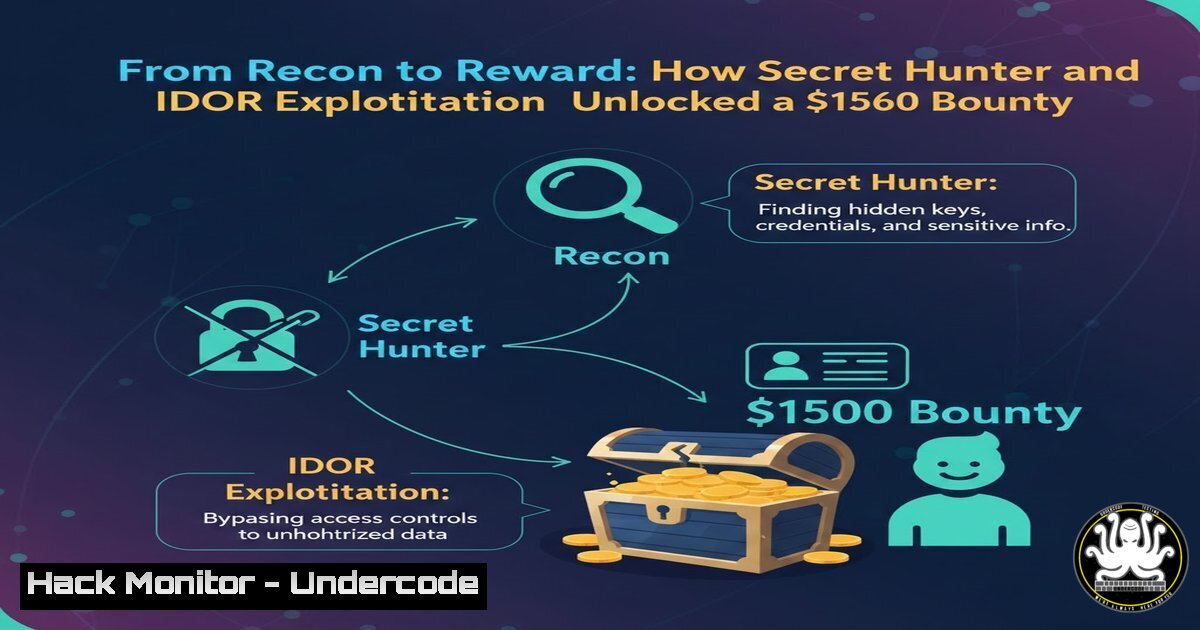
In the relentless pursuit of web application vulnerabilities, seasoned ethical hackers know that the combination of automated reconnaissance and deep manual analysis is unbeatable. A recent high-severity finding of an Insecure Direct Object Reference (IDOR) vulnerability, which netted a $1500 bounty, underscores this principle. This case study dissects the workflow from using a tool like Secret Hunter to identify a critical endpoint to exploiting the classic “Old but Gold” IDOR flaw, demonstrating a potent model for modern bug bounty success.
Learning Objectives:
- Understand the role and operation of reconnaissance tools like Secret Hunter in modern vulnerability discovery.
- Master the methodology for identifying and exploiting Insecure Direct Object Reference (IDOR) vulnerabilities in APIs and web endpoints.
- Learn the essential commands for endpoint discovery, parameter testing, and crafting proof-of-concept exploits for IDOR.
You Should Know:
1. The Reconnaissance Powerhouse: Automating Secret Discovery
The first step in this successful hunt was leveraging Secret Hunter, a tool designed to crawl files and scan webpages for hardcoded secrets, API keys, tokens, and, crucially, exposed endpoints. This automates the tedious process of mapping an application’s attack surface, allowing researchers to focus on analysis and exploitation.
Step-by-Step Guide:
What it does: Secret Hunter parses JavaScript files, HTML comments, and other client-side resources for patterns that indicate sensitive data or API routes. It’s often used to find endpoints that are not linked in the main sitemap but are accessible if discovered.
How to use it (Basic Linux CLI):
- Installation: It’s typically a Python tool. Clone the repository and install dependencies.
git clone https://github.com/your-repo/secret-hunter.git  Note: Actual repo link from the post's Telegram channel
cd secret-hunter
pip install -r requirements.txt
- Basic Scan: Run it against a target URL to crawl and scan.
python secret_hunter.py -u https://target.com -o scan_results.txt
- Analyze Output: Review the `scan_results.txt` file. Look for lines indicating “Endpoint” or “API Route,” often with parameters like `/api/v1/user/
` or <code>/admin/export?userId=</code>. This is how our hunter found the critical endpoint.</li>
</ol>

<h2 style="color: yellow;">2. Understanding the "Old but Gold" Vulnerability: IDOR</h2>

Insecure Direct Object Reference occurs when an application uses user-supplied input (like an ID in a URL or POST body) to directly access an object without proper authorization checks. If you change the `id` parameter from `?user_id=123` to <code>?user_id=124</code>, and you access another user's data, you've found an IDOR.

<h2 style="color: yellow;">Step-by-Step Guide:</h2>

What it does: This flaw allows attackers to bypass authorization and access, modify, or delete data they shouldn't have access to. It's a core Broken Access Control issue (OWASP Top 10).

<h2 style="color: yellow;"> How to test for it:</h2>

<ol>
<li>Identify a Direct Reference: From your recon data, find an endpoint like <code>GET /api/v1/orders/12345</code>.</li>
<li>Manipulate the Parameter: Use a proxy like Burp Suite or a simple cURL command to change the object reference.
[bash]
Test with sequential IDs
curl -H "Authorization: Bearer <your_valid_token>" https://target.com/api/v1/orders/12346
curl -H "Authorization: Bearer <your_valid_token>" https://target.com/api/v1/orders/12347
- Observe the Response: If you receive data for different orders/users without being blocked, you have confirmed an IDOR. The impact escalates if you can perform
POST,PUT, or `DELETE` requests.
3. Crafting the High-Impact Proof of Concept (PoC)
Finding a bug is one thing; proving its impact is what justifies a high-severity rating and bounty. The goal is to demonstrate unauthorized access to sensitive information or functionality.
Step-by-Step Guide:
What it does: A well-documented PoC shows the exact steps to reproduce the vulnerability, from an unprivileged user’s perspective, leading to a clear security impact.
How to document it:
- Start State: “Logged in as low-privilege user
attacker_id=1001.”
2. Malicious Request: Show the manipulated HTTP request.
GET /api/v1/admin/userProfile?userId=1005 HTTP/1.1
Host: vulnerable-app.com
Authorization: Bearer <attacker's_token>
3. Response: Show the server’s response containing sensitive data (anonymized) for user 1005 (e.g., email, personal details, payment info).
4. Impact Statement: Clearly articulate: “This allows any authenticated user to retrieve the full profile of any other user by enumerating the `userId` parameter, leading to a massive data breach.”
4. Essential Companion Tools for Manual Validation
While Secret Hunter finds the clues, other CLI tools are vital for manual testing and exploitation.
Step-by-Step Guide:
What they do: Tools like `ffuf` (for fuzzing), `jq` (for parsing JSON), and `sqlmap` (for testing SQLi as a secondary vector) allow for rapid validation and impact escalation.
How to use them:
Fuzzing for Hidden Parameters (Linux):
ffuf -w /usr/share/wordlists/parameters.txt -u 'https://target.com/api/v1/user/FUZZ' -H 'Authorization: Bearer <token>' -fs 0
Parsing JSON Responses Cleanly:
curl -s -H "Authorization: Bearer <token>" https://target.com/api/v1/data/123 | jq '.user.email, .user.ssn'
5. Mitigation and Secure Coding Practices
For developers and defenders, understanding how to fix these issues is as critical as finding them.
Step-by-Step Guide:
What it does: Implementing proper access controls ensures that each request is authorized for the specific user making it.
How to implement it:
- Use Indirect References: Map a user’s session to an internal, non-guessable object ID on the server.
- Implement Access Control Checks: Always verify the authenticated user has permission for the requested object on every request.
Pseudocode for a secure endpoint def get_order(order_id): order = Order.get(order_id) if current_user.id != order.user_id: AUTHORIZATION CHECK raise PermissionDenied("Access Forbidden") return order - Use UUIDs/GUIDs: While not a security control, using non-sequential IDs makes mass enumeration harder.
What Undercode Say:
- Automation is the Force Multiplier, Not the Replacement: Tools like Secret Hunter are indispensable for scaling reconnaissance, but they only highlight potential leads. The critical thinking, exploitation logic, and impact analysis of a skilled human researcher turn that lead into a validated, high-severity finding. The $1500 bounty was paid for the exploitation and proven risk, not just for running a tool.
- The Vulnerability Landscape is Built on Fundamentals: Despite advances in AI and complex attack chains, foundational vulnerabilities like IDOR remain rampant and highly impactful. A mastery of OWASP Top 10 principles, particularly Broken Access Control, provides a consistently high return on investment for both attackers and defenders. This finding is a perfect testament to the enduring power of methodical, fundamental security testing.
Prediction:
The integration of AI into reconnaissance tools will become even more sophisticated, moving beyond simple pattern matching to contextual understanding of application architecture, likely predicting vulnerable parameter patterns. However, this will create a dual-edged sword: while it will empower defenders and ethical hackers to secure systems faster, it will also lower the barrier to entry for malicious actors. The future battleground will shift even more towards the logic layer—the business rules and complex authorization schemes that AI struggles to interpret. Researchers and developers who deepen their understanding of application logic and context-aware access control will be the ones ahead of the curve, finding and fixing the next generation of “Old but Gold” vulnerabilities.
▶️ Related Video (80% Match):
🎯Let’s Practice For Free:
IT/Security Reporter URL:
Reported By: All Inbox – Hackers Feeds
Extra Hub: Undercode MoN
Basic Verification: Pass ✅


