Listen to this Post
Introduction:
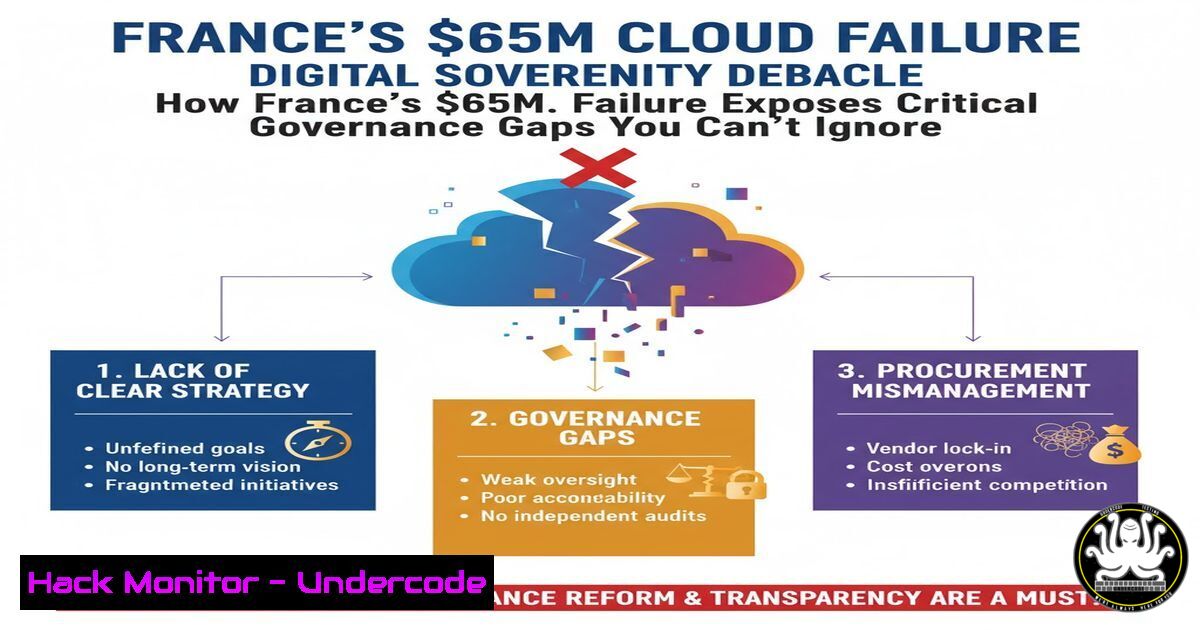
The French Court of Accounts’ damning report on the state’s digital sovereignty reveals a catastrophic governance failure that transformed technical strategy into a $65 million graveyard of unused cloud infrastructure. This case study transcends French borders, serving as a universal warning that even the most advanced technical safeguards collapse without coherent risk appetite and cross-organizational oversight. The resulting vulnerability exposes sensitive citizen data to foreign jurisdictions and highlights critical cybersecurity control failures.
Learning Objectives:
- Identify the core governance failures that sabotage digital sovereignty initiatives
- Implement technical controls to enforce data residency and cloud security policies
- Apply risk appetite frameworks to strategic technology investments
You Should Know:
1. Cloud Security Posture Management (CSPM) Misconfiguration Auditing
 Prowler AWS Security Assessment
prowler -c check31,check72,extra79

ScoutSuite Multi-Cloud Security Audit
scout aws --report-dir ./aws_audit
scout azure --report-dir ./azure_audit
Step-by-step guide:
1. Install Prowler: `pip install prowler`
2. Configure AWS credentials: `aws configure`
- Run compliance checks: The `check31` audits IAM password policy, `check72` monitors for CloudTrail log validation, and `extra79` checks for security group restrictions
- Generate reports: Use `-M html` for HTML format reports
- Review findings: Focus on misconfigurations that violate data sovereignty policies
2. Data Residency Enforcement via S3 Bucket Policies
{
"Version": "2012-10-17",
"Statement": [
{
"Effect": "Deny",
"Principal": "",
"Action": "s3:",
"Resource": "arn:aws:s3:::your-sensitive-bucket/",
"Condition": {
"StringNotEquals": {
"aws:RequestedRegion": "eu-west-3"
}
}
}
]
}
Step-by-step guide:
- Access AWS S3 Console and select target bucket
2. Navigate to Permissions > Bucket Policy
- Implement geo-restriction policy: This JSON policy denies all S3 actions unless the request originates from the Paris region (eu-west-3)
- Test enforcement: Attempt cross-region replication to verify blocking
- Monitor violations: Use CloudWatch alarms for policy denial events
3. Container Security Hardening for Sovereign Deployments
FROM alpine:latest
RUN apk add --no-cache libressl
RUN addgroup -S appgroup && adduser -S appuser -G appgroup
USER appuser
COPY --chown=appuser:appgroup app /app
HEALTHCHECK --interval=30s --timeout=30s --start-period=5s --retries=3 \
CMD curl -f http://localhost:8080/health || exit 1
Step-by-step guide:
- Create minimal base image: Start with Alpine Linux to reduce attack surface
- Implement least privilege: Create dedicated non-root user and group
- Secure file permissions: Use COPY with chown to maintain proper ownership
- Configure health checks: Monitor container integrity without privileged access
- Scan for vulnerabilities: Run `docker scan
` before deployment
4. Windows Server Security Configuration for Sovereign Data
 Sovereign Data Access Control Script
Set-LocalGroupMember -Group "Administrators" -Member "Domain Admins"
Remove-LocalGroupMember -Group "Administrators" -Member "Guest"
auditpol /set /category:"Detailed Tracking" /success:enable /failure:enable
Set-NetFirewallProfile -Profile Domain,Public,Private -Enabled True
Step-by-step guide:
1. Launch PowerShell as Administrator
- Restrict administrative access: Ensure only domain admins have server administration rights
- Remove default accounts: Eliminate Guest and other non-essential accounts from privileged groups
- Enable comprehensive auditing: Track process creation and command-line auditing
- Harden firewall configuration: Enable all firewall profiles with strict inbound rules
5. API Security Monitoring for Cross-Border Data Transfer
from flask import Flask, request, jsonify
import requests

app = Flask(<strong>name</strong>)

@app.before_request
def check_data_sovereignty():
client_region = request.headers.get('X-Client-Region')
sensitive_endpoints = ['/api/v1/healthdata', '/api/v1/education']

if any(endpoint in request.path for endpoint in sensitive_endpoints):
if client_region not in ['FR', 'DE', 'EU']:
return jsonify({"error": "Data sovereignty violation"}), 403
Step-by-step guide:
1. Implement Flask application with pre-request checks
2. Identify sensitive API endpoints containing regulated data
- Extract client region from headers or IP geolocation
4. Implement blocking logic for non-compliant regions
5. Log all sovereignty violations for audit compliance
6. Linux Filesystem Encryption for Sensitive Data
 LUKS Encryption Setup
cryptsetup luksFormat /dev/sdb1
cryptsetup luksOpen /dev/sdb1 sovereign_data
mkfs.ext4 /dev/mapper/sovereign_data
mkdir -p /mnt/secure_data
mount /dev/mapper/sovereign_data /mnt/secure_data
Step-by-step guide:
- Identify target block device: Use `lsblk` to locate storage device
- Initialize LUKS encryption: This will erase all existing data
- Create filesystem on encrypted volume: Format with ext4 for compatibility
- Mount encrypted volume: Access data through decrypted mapper device
- Configure automatic mounting: Add entry to `/etc/crypttab` and `/etc/fstab`
7. Infrastructure as Code Security Scanning
 Terraform Security Hardening
resource "aws_s3_bucket" "sovereign_data" {
bucket = "company-sovereign-data"

server_side_encryption_configuration {
rule {
apply_server_side_encryption_by_default {
sse_algorithm = "AES256"
}
}
}

versioning {
enabled = true
}
}

Run: terraform plan -out=tfplan
 Then: terraform show -json tfplan | checkov -
Step-by-step guide:
1. Write Terraform configuration with security settings
2. Initialize Terraform: `terraform init`
3. Generate execution plan: `terraform plan -out=tfplan`
- Security scan: Pipe plan to Checkov for policy validation
- Remediate violations: Address all high-severity findings before apply
What Undercode Say:
- Technical controls cannot compensate for governance failure at the strategic level
- Data sovereignty requires continuous compliance monitoring, not one-time configuration
- The cost of retroactive security implementation exponentially exceeds proactive governance
The French digital sovereignty catastrophe demonstrates that technical excellence cannot overcome organizational dysfunction. While the commands and controls outlined provide essential cybersecurity foundations, they remain useless without clear risk appetite definitions from leadership. Organizations must establish cross-functional governance committees with authority to enforce data residency decisions, regardless of individual departmental budget constraints. The $65 million wasted on unused cloud infrastructure represents merely the visible cost—the true expense includes ongoing compliance violations, data leakage risks, and strategic vulnerability to extraterritorial legislation. Technical teams can implement perfect encryption and access controls, but without governance aligning these measures with business objectives, organizations remain fundamentally exposed.
Prediction:
Within 24 months, we will witness a major sovereign data breach directly attributable to governance failures similar to the French case, triggering aggressive regulatory action and potentially billions in fines under emerging digital sovereignty legislation. Organizations that fail to bridge the governance-technical implementation gap will face existential compliance challenges, while those establishing clear risk frameworks will gain significant competitive advantage in regulated markets. The convergence of AI data processing requirements with sovereignty concerns will accelerate this crisis, forcing fundamental restructuring of how enterprises approach strategic technology governance.
🎯Let’s Practice For Free:
IT/Security Reporter URL:
Reported By: Elodie Le – Hackers Feeds
Extra Hub: Undercode MoN
Basic Verification: Pass ✅


